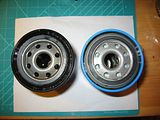
Oil- Hydraulic Filter Difference

   / Oil- Hydraulic Filter Difference #1  

TTTTTT

Gold Member
Joined
Mar 16, 2008
Messages
304
Location
Bancroft , Ontario
Tractor
Dong Feng 354 (Oct 2008)
I know filter X referenceing is all but exhausted and I have done my own as well although have not actually used Baldwin or NAPA ones yet. I also realize that the OEM filters are often totally relabeled wrong. I still have a few originals. After doing my recent fluid changes I did notice my oil and hydraulic looked and measured stangely identical although labelled different. Is there a fundamental difference or are they in fact the same. I do realize the hydraulic filter should be in the 150 micron range. Is this generally the same micron size for a typical oil filter? At this point I have had no issues with my hydraulics and everything works as normal. Just to note the DF's have the large 25l. combined tranny/hydraulics reservoir that operates everything.

Thanks Dave


   / Oil- Hydraulic Filter Difference #2  
With you having a common sump system everything I know goes out the door. As far as a common oil filter I believe they are in the 20 micron range. I just looked up the Fram PH3950 I use on my Jinma and its listed at 21 micron.

Chris
 
   / Oil- Hydraulic Filter Difference
  • Thread Starter
#3  
With you having a common sump system everything I know goes out the door. As far as a common oil filter I believe they are in the 20 micron range. I just looked up the Fram PH3950 I use on my Jinma and its listed at 21 micron.

Chris

Thanks Chris,

I kind of thought that. Another good ?, are there any specs out there on the Chineese OEM filters for oil, hydraulics and fuel. Any of the dealers have any inside info on them? On the Jinmas with the separate sumps is there a tranny filter? I don't think so but... Again just thinking I am using a universal tranny hydraulic oil. If the rating is less on it I guess perhaps a 20 micron filter would work without issues compared with a typical AW32 hydraulic oil. I know when it is cold and very cold my hydraulics work almost immediately which indicates a lower viscosity for the universal fluid leading to maybe the filter micron size would be less. Make sense?

Dave
 
   / Oil- Hydraulic Filter Difference #4  
Chris is correct.
Tractor engine oil filters are in the 20µ - 30µ range.
Dedicated tractor hydraulic circuits generally use 10µ filters in the return line to the sump, 25µ for pump suction side filtering, and 15µ for pump discharge (pressure) side filters.
If your tractor has a combined sump system, I would use the filter recommended by the manufacturer or defer to rheology. Panta rei.

Oil viscosity comparison at different temperatures: http://www.ctoa.net/modules/xoopstube/singlevideo.php?cid=5&lid=30
 
   / Oil- Hydraulic Filter Difference #5  
My tractor does not have any filter on the tranny. As for the hydro side it came with a screen on the suction side of the pump. I did not like this so I removed the suction side filter and put in a return side filter. Basically the same thing that is on a common log splitter. I run 10 micron filter on the return side filter.

Chris
 
   / Oil- Hydraulic Filter Difference
  • Thread Starter
#6  
Chris is correct.
Tractor engine oil filters are in the 20オ - 30オ range.
Dedicated tractor hydraulic circuits generally use 10オ filters in the return line to the sump, 25オ for pump suction side filtering, and 15オ for pump discharge (pressure) side filters.
If your tractor has a combined sump system, I would use the filter recommended by the manufacturer or defer to rheology. Panta rei.

Oil viscosity comparison at different temperatures: Chinese Tractor Owners Association - Oil viscosity comparisons

Hi Bob,

Excellent test you did. Very descriptive. I guess that just about says it all. At a higher temp UTF is very close to AW32 (which most in colder climates use) , but at the low temp the UTF is way more efficient . That would explain why I have very little lag time in the winter before I can use my hydraulics. Would this make sense then that if using UTF as I do, a filter for my hydraulics/tranny would not need or is designed for a filter with a high micron size such as a 150 which most people use when using AW32. Its possible a lower rating such as a 20-30 would work just fine on my system. That could explain that there is little or no difference between my oil filter as labelled and my hydraulic as labelled.

Thanks and great video

Dave
 
   / Oil- Hydraulic Filter Difference #7  
Dave,
I know of no one that uses a 150µ filter in a hydraulic system (if the ambient temp is cold, then it is pre-heated). You must have stuttered and meant 50µ, which in some cases is used on the suction side.
Do you have a filter on your combined sump system? If so, where? Or do you not have one and want to install one (recommended)?

As far as your Chinese filters go, I don't think I would swap the engine oil filter for the hydraulic oil filter - one may have a built in by-pass, and the other not. To my knowledge there are subtle differences between hydraulic oil filters and engine oil filters aside from just the pleated filter media, and I wouldn't recommend swapping just to save a buck either.
:D
 
   / Oil- Hydraulic Filter Difference #8  
Dave - the black and blue cannisters in your photo may actually both be oil filters. Cuz I think the DF fluid is filtered underneath the tractor. Look under the floorboards, I think maybe the right one. I'd expect to see a narrow cylinder - you might call it a tube - inline lengthways with one of the hydraulic lines. If it's designed like mine, you'll likely find 80 micron brass mesh inside. The mesh will likely be wrapped around cylinder shaped form, which may be magnetic. When I change fluid, I remove the mesh > wipe the filings off the magnetic surface > install new mesh if necessary. It's aftermarket stuff. You buy it by the foot, then cut to fit.

//greg//
 
   / Oil- Hydraulic Filter Difference
  • Thread Starter
#9  
Dave - the black and blue cannisters in your photo may actually both be oil filters. Cuz I think the DF fluid is filtered underneath the tractor. Look under the floorboards, I think maybe the right one. I'd expect to see a narrow cylinder - you might call it a tube - inline lengthways with one of the hydraulic lines. If it's designed like mine, you'll likely find 80 micron brass mesh inside. The mesh will likely be wrapped around cylinder shaped form, which may be magnetic. When I change fluid, I remove the mesh > wipe the filings off the magnetic surface > install new mesh if necessary. It's aftermarket stuff. You buy it by the foot, then cut to fit.

//greg//

Thanks Greg,

The newer DF's has just the spin on on the suction side


Dave,
I know of no one that uses a 150オ filter in a hydraulic system (if the ambient temp is cold, then it is pre-heated). You must have stuttered and meant 50オ, which in some cases is used on the suction side.
Do you have a filter on your combined sump system? If so, where? Or do you not have one and want to install one (recommended)?

As far as your Chinese filters go, I don't think I would swap the engine oil filter for the hydraulic oil filter - one may have a built in by-pass, and the other not. To my knowledge there are subtle differences between hydraulic oil filters and engine oil filters aside from just the pleated filter media, and I wouldn't recommend swapping just to save a buck either.

Hi Bob,

As above , I have a spin on on the suction side. I definitely read somewhere about people using a 140-150 for the hydraulics when complaining of slow hydraulics. i know the labeling of filters can be way off.

May have to give Chip a PM and see what he thinks as he sells the DF's unless he sees this.

Dave
 
   / Oil- Hydraulic Filter Difference #10  
If your hydraulics are slow due to cold ambient temps without the benefit of pre-heated oil, I would opt for a 100 mesh strainer element on the suction side instead of the pleated media type.

Zinga Industries, Inc.
 
   / Oil- Hydraulic Filter Difference
  • Thread Starter
#11  
Post #3 from me
I know when it is cold and very cold my hydraulics work almost immediately which indicates a lower viscosity for the universal fluid leading to maybe the filter micron size would be less. Make sense?

Hi Bob, i have no issues with my cold hydraulics, mine are very responsive quickly, but I know some have had issues and moving to a larger micron filter seemed to help. (less restricted flow)

Dave
 
   / Oil- Hydraulic Filter Difference #12  
I think the confusing term being used here is the word filter. In the case of the factory spin-on cartriges used on the hydraulic system suction line before the pump inlet, the term strainer should be used. IE filters have fluid pumped thru them and strainers have fluid sucked thru them. With that terminology applied, I also don't know of anyone using a hydraulic FILTER larger than 40 or 50 micron. In my experience they are typically 10-20 micron. Hydraulic pumps are great at pumping fluid to high pressure. They are not so great at sucking fluid in. On the suction side, 150 micron would be appropriate for a STRAINER. Anything less and you run the risk of starving the pump for oil and causing damage to it.

The in-tank screen mesh strainer that came on my tractor was I believe #100 mesh, that equates to approximately 150 Micron hole size.

Got an old hydraulic spin-on? Cut it in two. I would be surprised if it contains a paper/cellulose element and not a piece of #100 mesh screen...
 
   / Oil- Hydraulic Filter Difference #13  
It depends on the capacity of the suction filter/strainer Ron.
I run a Zinga AE25 (25µ) filter (pleated cellulose fiber) on the suction side of my Prince 7 gpm pump for the backhoe. No problems at all and the pump is quite happy.

Most all hydraulic filters have a built in free-flow by-pass valve that will open at ~15 psig or 20"hg, depending on if you are sucking or pushing. This prevents cavitation, or the filter exploding.
 
   / Oil- Hydraulic Filter Difference
  • Thread Starter
#14  
I think the confusing term being used here is the word filter. In the case of the factory spin-on cartriges used on the hydraulic system suction line before the pump inlet, the term strainer should be used. IE filters have fluid pumped thru them and strainers have fluid sucked thru them. With that terminology applied, I also don't know of anyone using a hydraulic FILTER larger than 40 or 50 micron. In my experience they are typically 10-20 micron. Hydraulic pumps are great at pumping fluid to high pressure. They are not so great at sucking fluid in. On the suction side, 150 micron would be appropriate for a STRAINER. Anything less and you run the risk of starving the pump for oil and causing damage to it.

The in-tank screen mesh strainer that came on my tractor was I believe #100 mesh, that equates to approximately 150 Micron hole size.

Got an old hydraulic spin-on? Cut it in two. I would be surprised if it contains a paper/cellulose element and not a piece of #100 mesh screen...


You guys have a lot of experience compared with me, but this is the one that would X reference to mine (140 Micron) unless it is a typo. It is a great conversation. The more info and dialogue the better.

Hydraulic Filter, 5.745"

Dave
 
   / Oil- Hydraulic Filter Difference #15  
Bummer Dave, "catalogue session has expired". Dead link. Sorry.:(
 
   / Oil- Hydraulic Filter Difference #16  
Just go to the NAPA website and look up FIL 1614 Bob.

//greg//
 
Last edited:
   / Oil- Hydraulic Filter Difference
  • Thread Starter
#17  
Hi Guys
I guess the links dies, heres the details on it

Dave


Part: FIL 1614
Product Line: NAPA Filters

Price Unit 31.99
Features & Benefits

NAPA Gold Oil Filters Hold 45% More Dirt + Last 30% Longer Than Other
Leading Competitive Brands.; 141 Micron

Attributes
Height (Inches) : 5.745"
Gasket I.D. (Inches) : 2.5"
Gasket I.D. (mm) : 63.5 mm
Gasket O.D. (Inches) : 2.865"
Gasket O.D.(mm) : 72.77 mm
Gasket Thickness (Inches) : .125"
Gasket Thickness (mm) : 3.18 mm
Height (mm) : 145.92 mm
Hydraulic Filter Style : Spin-On Hydraulic Filter
O.D. (Inches) : 3.73"
O.D. (mm) : 94.74 mm
Thread Size (Inches) : 1-12
 
   / Oil- Hydraulic Filter Difference #18  
Costly little bugger. I would try to find a more economical replacement.

Chris
 
   / Oil- Hydraulic Filter Difference #19  
Dave,
Do you intend to use this filter for your engine oil or is it for your hydraulic system?
The Zinga 100 mesh hydraulic "strainer" is much cheaper.
See it here: http://www.zinga.com/index.aspx?page=products&seriesid=135

This is the assembly I use on my backhoe's hydraulic system:
https://www.surpluscenter.com/item.asp?UID=2009111223250909&item=9-4544&catname=. It is rated at 25 gpm and I'm only running 7 gpm through it. It doesn't even go into bypass when the oil is cold.
It's not uncommon to find all three methods of filtering in industrial hydraulic systems:
1) Suction - protects the pump, 2) Pressure - protects the valves and actuators (cylinders), and 3) Return line - keeps the reservoir contaminant free.
 
Last edited:
   / Oil- Hydraulic Filter Difference
  • Thread Starter
#20  
Dave,
Do you intend to use this filter for your engine oil or is it for your hydraulic system?
The Zinga 100 mesh hydraulic "strainer" is much cheaper.
See it here: Zinga Industries, Inc.

This is the assembly I use on my backhoe's hydraulic system:
https://www.surpluscenter.com/item.asp?UID=2009111223250909&item=9-4544&catname=. It is rated at 25 gpm and I'm only running 7 gpm through it. It doesn't even go into bypass when the oil is cold.
It's not uncommon to find all three methods of filtering in industrial hydraulic systems:
1) Suction - protects the pump, 2) Pressure - protects the valves and actuators (cylinders), and 3) Return line - keeps the reservoir contaminant free.

Sorry for the delay, gone for a few days.. It is for my hydraulic replacement. Thanks for the info all. I see the the one is a 141 micron size. I'll have to do a little more research and see.
I don't have a big problem with the price as it is not a yearly replacement with the hours I put on. I also still have one more OEM filter.

Dave
 

Tractor & Equipment Auctions

CATERPILLAR 255 SKID STEER (A52709)
CATERPILLAR 255...
2008 Toyota Camry Sedan (A59231)
2008 Toyota Camry...
Case-IH 160 Puma (A57148)
Case-IH 160 Puma...
Blue Diamond 103709 (A53317)
Blue Diamond...
2012 Mini Cooper Coupe (A59231)
2012 Mini Cooper...
2013 VOLVO VNL (A55745)
2013 VOLVO VNL...
 
Top