new tractor idea possibly....

   / new tractor idea possibly....
  • Thread Starter
#281  
RECAP RECAP RECAP

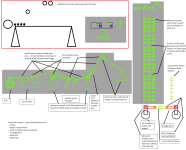
see post 280 (post directly before this one) for a large listing of all diagrams / chicken scratches up to this point.

GOALS / PRO's / CON's....

==overall. grown tired, of extremely large size tractors going down the road, and then implements behind them. that more or less take up almost 2 lanes of road. or rather almost 16 foot width. (a single lane is approx 8 feet wide
==ya tractor power and implements can keep going up in power and size. but at what point before roads are no longer big enough, to allow for tractors to go down the roads without fully locking down the entire road for a few miles just to get tractor and implements from farm to field and from field to field.
==logistics. it takes a small organized crew to trailer and drive various tractors and implements here to there, and then hook everything up. before one can start operating in the field.
==all these wheels these implements tend to get, are just wheels on bearings. by the time ya add things up ya get up to 20 to 30 plus wheels. and maybe at most 12 of them are powered.
==on the rainy yuky muddy years, there is only a handful of days you can get out in the field, without tearing it up, this is part to just mud, but also weight of everything, and traction.
==reducing compaction, both simply rolling / driving over the field, but also how the plows, chisels, fertilizer, seeders, drills, discs, etc... physically work the soil.

==get a working tractor implement combo. that can fit within a 8 feet width (width of a road), 60 feet long (approx max length across the world), 14 feet tall (approx max height across the world) these road limit dimensions, are an attempt to be able to get the tractor / implement combo down the road, during all times of day, AND NIGHT!, vs being limited between 1 hour after sunrise, and 1 hour before sun set.
==road dimensions are more an attempt to make things more road safer.
==reduce logistics, of moving tractor/implements. reducing over all crew needed.

==go for multi use tractor implement unit, as in....tilling (working / preping soil for seeding/planting.), seeding / planting, and then harvesting the crop. as a complete single unit. that can do it all. and just change out implements.
==ability to handle multi different crops, from corn / beans row like crops, to potatoes, to celery, carrots that are more of a root based crop.
==ability to get through deep wet mud, regardless of tilling, seeding, harvesting.

==deal with fertilizers and chemicals while tilling / planting / harvesting. the on thing i am not looking at is once the crop begins to grow. and trying to go through fields, to spray a fertilizer or chemical. i am not completely knocking the idea out, but once the plant/crop size gets so large, you would be running over more plants and destroying them, vs a more dedicated spray/chemical unit most likely.

==adjust the fields, as in, move the soil around, like a motor grader, or box blade, or rear blade, or roll over scrapper, or dozer. both to fix fields up, but also maintain fields over the years. for good drainage, reduction of high and low spots.
==abilty for unit, to handle various degrees of slopes within the field. (unit needs flexible joints) so entire machine follows the ground contour.

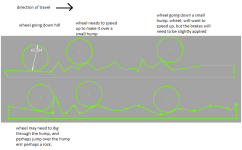
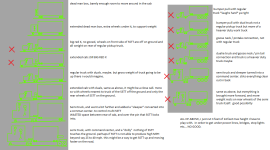
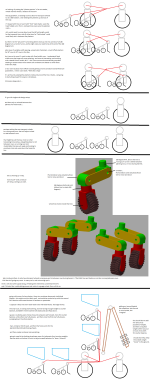
==finite wheel control. as in down to .00001 or more .0000000001 in adjustments of RPM and torque. other words how many trucks/cars have some sort of traction control. this is more traction control for in the field. vs keeping car/truck on the road and not skidding out, or trying to stop as fast as possible. finite adjustments are for compaction, and easier ride, kinda of part of the suspension. with so many wheels / tracks on the ground. and most likely less weight. the need to adjust for wheel slippage, and tiny humps and dips. more finite control the more happier i will be. see attached images.
boggen elec sstt6.png .......... boggen elec sstt5.png

=======================

to meet above....

cab
==through out this entire thread, i have not really figured out a way to include a "cab" for a person to actual stand or seat to drive the unit. by the time you fold up all the implements, and placement for main engine, batteries, gas tanks, etc... you end up taking up a huge section. that would require extra linkages and things to move. in order to work around a cab.
==with above, i am more looking for a cab ((i am now calling it the ""command center"")), kinda like a tower command center at a big airport, or nasa space ship launch command center. but geared for 1 or 2 people. and have abilty to control multi tractor/implement combo units. other words a kids video game placed in a vehicle. and wireless internet connection to 1 to multi tractor/implement units.
==to add to above, it would be like playing with a RC (remote control) kids toy car. but being able to control multi RC cars from a single place.
==problem is internet more so wireless internet, make it satellite, to cell phone, to wisp, to other wireless internet, does not cover a good amount of areas, (dead zones) and the bandwidth, to handle multi video feeds/singles and sensor readings.
==with above, this is going to put the unit up into a upper tier, that will most likely require paying FCC a yearly fee, to use a certain frequency, that can handle say 5 miles radius from the "command center".
==i have not completely ruled out the idea, of tossing a "box" on end of a SSTT. to hold a person, for "safety". or having a chase or lead vehicle make it a truck, car, or 4 wheeler. that has either a pull cord safety rope when following, or some sort of rod that extends to 4 wheeler, for stopping unit completely.
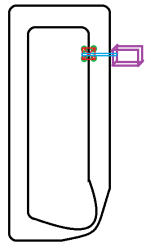
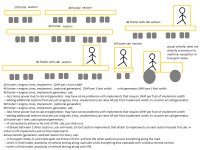
==very old chicken scratch diagram...
299306d1359027076-new-tractor-idea-possibly-boggen-new-tractor-idea86.png
and now... more recent diagram...
boggen elec sstt7.png
not covered in above, is low boy trailer. and not real keen on a low boy trailer. way to many hills and ditches, and simply not enough clearance.
other thing not covered, is treating SSTT as a wagon, much like a grain wagon. this still might be a good possibility.
Ryan I was thinking you were planning on equipment large enough to pay the not using a tractor. But hauling on pick up ?
see above diagram.

================

wheel motors
==hydraulic motors for say in the rims of wheels (wheel hub motors), while yes they could work, i am having a hard time for the finite control. more so when needing to go between hydraulic control to electrical control, and then back to hydraulic control. and then dealing with hydraulic oil, that might have just the slightest amount of air entertained in the hyd oil. would cause reduction of finite control.
==electrical motors... on other hand there is no conversion between to power medium and feed back sensors. other words much faster response time. and more likely better finite control. but i am still not sold on current age typical regular electrical motors found out there in everyday life in factories, to vehicles, to other. while debate is still on, on type of electrical motor. to use in the rim of the wheels. i am more confident in saying electrical motors it will be.
==
Elec. motors with dc voltage that is pulsed will rotate at full current and rpm is by frequency of pulse.
i understand that, and would like to say i comprehend the statement as past that, and trying to apply fluid dynamics to the magnetic fields themselves being manipulated as the motor turns. i think there can be more finite control that can be had, beyond just sending electricity to just the stator or just to the rotor of an electrical motor. but by sending electricity to both rotor and stator at the same time and controlling frequency and pulse to both of them. in all sense i should be able to keep the frequency and pulse at a lower settings, vs cranking them up higher, if just sending elec to just stator or rotor, both for higher RPM's and torque.
==i would imagine sending power to both stator and rotor is going to require some extra electricity vs a regular motor that is just sending elec to just the rotor or just the stator. but i might be able to reduce amount of heat that is produced, by not having to ramp up the amps/volts in all the coils. well at least until full max torque is required, or full RPMs are required, and that is when other heat sources will more likely be more dominant in creation of heat.
==ya trade off is complexity for sending elec to both rotor and stator of motor. and in that more complex more prone to failures. but trade off of finite control for less wheel slippage in field, less compaction, less heat being created. it might work out for the better.

==if i read the rules/regs/laws correctly, electric motors will need to be made "explosion proof" other words in sure there is no chance for a spark to ignite a fume or dust. meaning electric motors can not have vents and air blown / pulled through them.
==since the electric motors will be submerged in mud / water. i can not rely on heat sink fins or external fan blowing air across the motor.
==i am left with coolant with a fluid. other words, just like your car / truck engine is cooled, the electrical wheel hub motors, will need some sort of water/antifreeze mix, flowing through it. to keep temperatures down.
==if i can keep a lower running temperature, of an electrical motor. that includes the full internals and externals. different magnets might be able to get used. to make stronger electric magnet. that spins the motor. stronger the magnetc, the more RPM's and torque, that might be possible from the motor. that is if i reading specs i have seen on the internet, for various types of permanent magnets, and there point of max heat before they start loosing there magnetic force.

================

brakes
magnetic clutch no voltage full brakes.
read this and like *duh* thanks ken!

with a switch from hydraulic motors to electric motors. electric magnetic clutch type of setup makes sense. and reducing need to run a higher PSI air hose down to the brakes.

=================

wheel types and how they are setup.

==this is now up in the air, more so looking at how the nasa spider looking rovor uses electric motors to move the linkages.
==at moment caster wheel design style has favor.
==old diagram
299012d1358870385t-new-tractor-idea-possibly-boggen-elec-sstt1.png

==the ability to sink the wheel past its center point / axle. and keep going. on a smaller diameter wheel. vs relying on 4 feet plus diameter wheels. is what has it.
==other wheel designs, seem to cause to much "junk" to stick out from the sides of a single wheel or 2 wheels mounted. and cause more stuff to drag and get hung up in the mud.

==i am leaning more towards "tracks" vs regular wheels. more so, if the nasa spider looking rover, electrical motors get used. the abilty to make a track to act like a "foot" and angle the track. so it does not run horizontal to the ground, but perhaps at a slight slope. so the track basically continually tries to climb up and out of the mud rut.
==track might be able to give a lower profile. instead of a 24" diameter wheel taking up 24 inches. a track i might be able to shave off a couple more inches to say 20 inches tall.

=======================

i am considering single direction of travel for the SSTT. (it has a rear and a front) for going through the field, vs UN-directional. if given implements connected allowed for it.

==i state above, due to wanting to move the center main frame of the SSTT to one side vs being straight down the middle.
==yet above is still not all there, i am tempted to almost completely remove a "main frame" that for most part stays in the same spot except for angling forward or backward for weight transferring. and in that, i am thinking of turning the so called main frame, more into multi linkages. were the implement and tires are linked directly together. and there would be multi tires and multi implements. and then just using main frame, more of as a bundle of wires, and hoses. and more act like a spinal cord going from ya brain, down to your butt.

==as much as i would like to place blamn on not wanting to deal with transport wheels, and removing them from the entire picture. and reduce things to less complexity of wheels and there linkages, and implements and there linkages. i am wanting something a tad more flexible.

======================
implements....

discs
==honestly considering putting a motor on them.

plows
==considering implementing something like no till drillers and air seeders, and other planters. and physically being able to control depth and cut angle.

chiseals and like
==considering full depth control like plows.

considering ughs" forget the name.. "plug aerators" like when aerating a lawn, and it takes small plugs up out of the ground.
==just wish there was a way, to make a small hole at the surface, and then go down a couple inches, and then "funnel" out to were roots for give crop would most likely go. suck that dirt up, and then put it back down into the upside down funnel hole. place seed and fertlizer in as the dirt all goes back in.

==================
actual engine, i am considering more of a stunt air plane type of engine. to better handle various angles the engine might be placed in.

running a hydrostatic transmission in a sense between engine and generator head. i am more thinking of "dynamic" output of the generator. if wheels are needing a specific frequency / pulse. instead of off setting all the changes at computer chip, help the computer chip out some. by turning generator a tad faster. or a tad slower.

though i am considering D/C for computer chips and sensors, but still producing A/C so i can send the A/C single directly to the motors. letting the computer chips change the A/C single as needed. the A/C sine wave, just seems to be more "good" i guess, in how an electric magnet would change from north pole to south pole. without sudden "stepping". a smoother directiontical change from north to south pole. vs trying to "smash" to steps together. i am not wanting surge of power struggle but a finite control of nice smooth changes in RPM's and torque for wheel motors.

though i am not completely sold, if i could produce a nice strong solid D/C single with little to no wave pattern from generator. i might be able to achieve higher finite micro stepping of volts/amps going into and out of the wheel hub motors. i am not sure if i want to place that much faith on banks of multi capacitors in a chip or on a PCB (programmable circuit board). to create a rapid frequency / pulse changes.
 
Last edited:
   / new tractor idea possibly....
  • Thread Starter
#282  
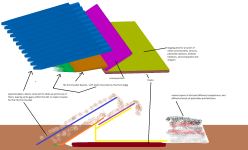
side tracked, yet again, on some how redoing how tillage / preping for seeding is done.

dirt harvester.png

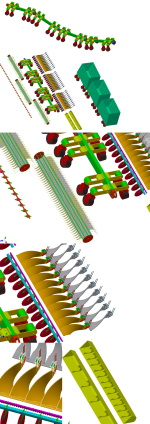
"dirt harvester". a new spin on strip mine farming. it will strip the layers of dirt off the ground each time going deeper down into the ground. and send the dirt through convery belts of different mesh sizes. to remove rocks and large compacted clumps. and continue to sequeeze the daylights out of some large clumps till they bust. if they do not bust. they get sent out to a row. on top of the soil. to be removed later on.

as the dirt falls back down, strips or rather layers of dirt are controlled. for compaction. in each layer, rows are formed, for injection of pesticides, and fertilizers. compaction can be done per layer and per row, to "funnel" water and root growth. if ya expect a dry year, rows and layers can be compacted in a way to more force the roots down wards. vs spreading out. perhaps purposely creating U shape compaction channels that seeds are placed in. to more focous any rain water towards the plant roots or away from the roots.

the conveyer belts. are not like a regular tiller, were there are blades cutting everything single 1/64 of an inch of dirt into fine dust. but rather, shakes the dirt, and rolls the dirt. to aerate it, and to crumble the dirt up.

if weight is king, the heavier the dirt ends up being, the more traction this unit obtains, due to all dirt goes over top of the unit. almost like a mole going through the ground.

the last crop stalks and roots, that do not break up and fall through the conveyer belts. can be sliced and diced and fed back into a specific depth layer of dirt, or sent all to the surface to help with errrosion in wet rainy years. or perhaps sent to the surface during dry years, to act as a cover to help hold in moisture.

worm and insect friendly, (the wanted types) or less they make it to the slicer dicer of last crop roots/stalks, or stuck in a hard compacted piece of dirt, that ends up getting pressed through convery belts to break the piece up.

=============
in diagram above, the "staging area" were all the convery belts, sensors and like would be, been thinking of a printing press factory. and all them rolls and belts and drums. and then thinking about other harvesters for root based crops.
 
   / new tractor idea possibly.... #283  
side tracked, yet again, on some how redoing how tillage / preping for seeding is done.

View attachment 299435

"dirt harvester". a new spin on strip mine farming. it will strip the layers of dirt off the ground each time going deeper down into the ground. and send the dirt through convery belts of different mesh sizes. to remove rocks and large compacted clumps. and continue to sequeeze the daylights out of some large clumps till they bust. if they do not bust. they get sent out to a row. on top of the soil. to be removed later on.

as the dirt falls back down, strips or rather layers of dirt are controlled. for compaction. in each layer, rows are formed, for injection of pesticides, and fertilizers. compaction can be done per layer and per row, to "funnel" water and root growth. if ya expect a dry year, rows and layers can be compacted in a way to more force the roots down wards. vs spreading out. perhaps purposely creating U shape compaction channels that seeds are placed in. to more focous any rain water towards the plant roots or away from the roots.

the conveyer belts. are not like a regular tiller, were there are blades cutting everything single 1/64 of an inch of dirt into fine dust. but rather, shakes the dirt, and rolls the dirt. to aerate it, and to crumble the dirt up.

if weight is king, the heavier the dirt ends up being, the more traction this unit obtains, due to all dirt goes over top of the unit. almost like a mole going through the ground.

the last crop stalks and roots, that do not break up and fall through the conveyer belts. can be sliced and diced and fed back into a specific depth layer of dirt, or sent all to the surface to help with errrosion in wet rainy years. or perhaps sent to the surface during dry years, to act as a cover to help hold in moisture.

worm and insect friendly, (the wanted types) or less they make it to the slicer dicer of last crop roots/stalks, or stuck in a hard compacted piece of dirt, that ends up getting pressed through convery belts to break the piece up.

=============
in diagram above, the "staging area" were all the convery belts, sensors and like would be, been thinking of a printing press factory. and all them rolls and belts and drums. and then thinking about other harvesters for root based crops.

Something like this ?

STANDEN-PEARSON UNISTAR High Output Stars over Web Soil Separator & De-stoner - YouTube
 
   / new tractor idea possibly....
  • Thread Starter
#284  
in general, ya pretty much. but thinking more along the lines of a double or triple decker. approach.

"cons" large tractor out in front (had to)

"cons" all the dirt is being subjected to the sun itself. (i do not like that a single bit) oh ya it gives operator good eye sight, but my question is, all the micro organisms and single cell bacteria, etc... that live within the soil, how many are hurt by direct sun light.

not sure about the stars, almost like tines of a tiller. i thought hole goal of good soil, is to have good set of worms and insects, along with a good set of bacteria and other things, that will not destroy the crop, but rather aerate, and work the soil and breaking things down. the part of beating the dirt up, has me. its kinda like taking a sledge hammer onto a flower pot, an expecting, the best soil to come of beating the soil to death. genital hands is what me looking for.
 
   / new tractor idea possibly....
  • Thread Starter
#285  
well hhhhmmmssss.....

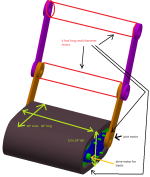
how do i make a 4 foot long motor, and smallest diameter possible. and have initial start load, at absolutely max torque being able to produce. and not done yet... have that "finite" control of adjustments. of .0001 degree or more of rotation.
combine the motor with a set of disc brakes, that also needs to fit in the 4 foot length.
--willing to compromise using a coil of tubing basically wrapped around the outside, as a way to create a cooling jacket. but not really sure about internal coolant, say through the axle itself.

4 foot long shaft is fairly long, and i am worried about vibration, and things banging into this motor, and simple twisting of things. that could cause motor to short out some place in the center of the 4 foot length. meaning most likely going to need to split the 4 foot length up in half, and have 2 motors. one on each side, but not real thrilled about running extra wires for 2 motors.

i thought about multi pancake motors, stacked one next to each other. but worried, about reducing the center shaft, and resulting more chance of something bending, and taking the motor out of commission.

i really do not like idea, of a "squirrel cage" style motor. i do not think i could ever get the "finite" control i would want.

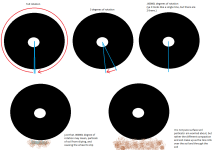
i am thinking of a modified squirrel cage motor. and the coils of wire, instead of being parrallel to the shaft. wrapping the coils at 22.5 or 45 degrees. both in rotor and stator. part of thinking is, i will be able to wind the wires tightly without need of some sort of wedge or something to hold the wires / coils in place. and at same time allow for finite control. problem i do not know were finite control. vs needed/wanted initial starting torque is, and being able to hold that torque without much spin.

i am not to keen on wrapping the coils all in the exact same direction, i am more thinking of wrapping one half of motor in one direction, then doing a 90 degree in center, and wrapping coils in other direction. to help balance out the force, of instead of pushing rotor/stator apart at the axis. but rather almost keep them aligned with each other. reducing pressure on any side force bearings.

thinking about it, i might run a slightly bigger axle, to cool the internals. the 360 / rotoational joint, would not be spinning like a wheel hub motor.

ok for water jacket, perhaps extremely large thread shaped hit sink fine, and then a long nut that went over the fines for a better tight fit. that might work, out nicely, good solid heat sink material, and water/antifreeze running through the fines. i would imagine it would not be that bad for friction loss either... errrr strike that. that tightly wound of coil. would only be good for internal pressure pushing on a pipe. i am more worried at moment, in beending over 4 feet length. sounds more likely i am going to have to rely on U shape passage ways at the ends. so i can run the heat sink fins parallel to the shaft length. though thinking i might put a slight twist / rotation on the fines.

as ken poinited out going with a magnetic clutch / brake. but how do i time it, how do i sense things. so that current torque being placed on this joint and being held by the brakes, to the point that the motor is able to build up enough torque, and more the point, a torque that comes as close as possible to current torque being held by the brakes. before the brakes are released and the joint moves.

also can create a "spring" or rather shocks, and leaf spring style effect. out of these joint motors.

thinking about it, these tracks, are going to range widly on this SSTT. from say 8 inches wide, to perhaps up to 4" inches wide. and may be any were from 2 feet long, to 8 feet long.

man, that totally changes dynamics of things.

================

before i got to hang man games for track widths and lengths, and linkages lengths....

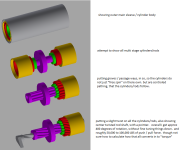
for the multi pancake motor idea, for the 4 foot long motor idea.... was think of setting them up like wet disc brakes. see below video. and instead of friction disc, discs would be stacked in a tube, and over a geared shape shaft. and then runnng wires down in the groves of the teeth. and then a spring /brush type of connection. for each disc. and using the teeth. to slightly off set all the discs. to obtain a better finite control.


=====
for current thought for wrapping coils in and around rotor and stator.... would be something like a combine header auger...
below picture is from...
AH223184 - Platform Auger for John Deere Combines
popup_image.php

while the combine header is made to bring crop towards the center of the header and then up into the combine. i am more looking at the fines and how the wrap around. as a way to equalize forces along the length of a 4 foot smaller diameter motor. vs trying to rely on bearings, to try and keep the rotor and stator of the motor aligned.

=========
placement for this type of motor would be....
boggen elec sstt8.png

=========
alright off to play the old hangman game in autodesk inventor. to see what works / does not work.
 
   / new tractor idea possibly....
  • Thread Starter
#286  
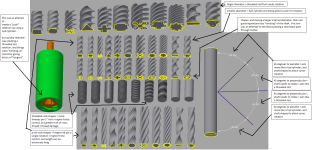
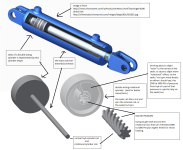
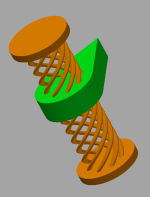
i wanted to see if i could use a simple hydraulic cylinder, that allowed "rotation" of say 350 to 300 degrees, for the track / wheel linkages. the idea seemed simple enough, and then frustation sat in, trying to figure out how to "place seals" that could handle 2000 to 3000 PSI of hydraulic oil pressure. and then getting rotation.

decided to step back, and look at coil/spiral shapes. to get a better idea of what might work. ending in below diagrams, and understandings.

boggen elec sstt9.png

to sum up above. if i am going to make idea of "push rotation" reality.
==rod that has twists / teeth will need to be small diameter (smaller the better), and long (longer the better)
==PROBLEMS, is getting seals in place, trying to hold back 2000 to 3000 PSI, and then shock load pressures that would be even higher, around a shaft that is twisted / has teeth and is small. a perfect circle is one thing, just like a regular hydraulic cylinder rod shape. but to twist the rod and put a grooved path / teeth on it.... is another thing entirely.

EDIT: additional diagrams to help get things across better perhaps
boggen elec sstt10.png

EDIT: complex'ing the problem....
boggen elec sstt11.png
 
Last edited:
   / new tractor idea possibly....
  • Thread Starter
#287  
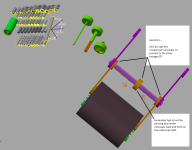
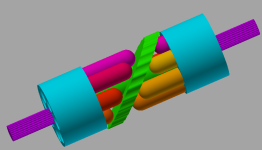
just been trying to draw things up, to visualize if they may or may not work.

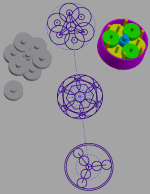
2 hydraulic motors, end for end. just trying to make the most of space. with the swash plate (green) center piece, tilted at 45 degrees.
this has some promise, granted this is rough draft, and need to change what connects to what for rotation.
boggen elec sstt12.png

Above diagram, vs below diagram....
above diagram, has smaller sized overall cylinder/rod capacity (bore size/rod size), vs below diagram. though, with above if i could find a gear ratio set. above might prove more promising.

below diagrams been tad of a challenge, couple dozen 2D sketch redraws over a 2 to 3 days, in attempt to find something that might work. this one i am actually wanting to run through a stress test. just to see if it could be possible.
run into problems with autodesk, with drag and move, and "drive constraint" option. i either got "insert, or tangent" constraint errors. after so many multi stage cylinders had to move. tempted to create a short animated video but no go.
the multi stage cylinders are an attempt to fit more into a small space.
the spiraled paths/teeth, are required in order to transfer torque from the center, what do i call it,,, (large push/pull) disc. that rides on the main centered twisted rod.
boggen elec sstt13.png

this idea never will pan out, without some sort of multi stage like setup, connected to the main center disc that slides back and forth and rotates. the entire trying to place seals, to deal with the 2000 to 3000 PSI hyd oil pressure, and then higher pressure loads from shock forces. and then work out some sort of connect rod or grooved paths or something. to get things to rotate the 300 to 330 degrees.
boggen elec sstt14.png

an attempt to figure out what gear ratios might be achievable. within 7.5" diameter by 20 inches long. (motor, and brakes/clutch also need to fit in the area)
boggen elec sstt15.png

i did come across some regular bicycles (the ones you actually peddle). the rear wheel gear hub. that had multi planetary gear sets. that might be something. with shifting all put into it all. granted i really do not need shifting, just a way to reduce gear ratio of a electric or hyd motor. and obtain a nice super finite control that is extremely smooth in rotation.
i also came across some helicopter transmissions that gave some thought of how to "gear" things. to obtain a higher ratio.
i thought about "worm gear" type of drive train, but gave up on the idea, not sure how i could achieve compactness and keep stresses from tearing things apart.
hhmmsss ovalish?

================
i figure i am going to need enough power. in the following scenario....

going down a very steep hill in transport mode. and need to raise the lower front up, perhaps to get over a creek or wash out. a single wheel/track is for most part going to need to support entire weight of the SSTT, and forces going at unknown amount of MPH. this cylinder shaped rotation device for linkages needs to be able handle

===============
alright time to go searching for "solenoids" and look more into gears and seeing what ratio might be obtainable.

hopefully i will come across the elusive youtube video. that had like 40 to 1 ratio. in a smaller foot print than multi planetary gears. had pegs and a gear or something that ran between pegs and a ring gear maybe, i don't know, it was an autodesk or solidwork type of animated diagram.

this is not the video i was looking for but... hmmsss... so few teeth in contact, and so much torque. *cringes* but hhmmsss...
http://www.youtube.com/watch?v=P-Obt-9tZVo
 
Last edited:
   / new tractor idea possibly....
  • Thread Starter
#288  
*well duh*

--no need for a full 360 degree rotation. but say 300 to 330 degree rotation.
--works like a vane pump / motor.
--easily size-able to different diameters and lengths. to produce different torque values.
--only a few parts needed. KISS (keep it simply stupid)
--electrical over hydraulic valving. perhaps double up the valves. one larger valve, for quicker change in degrees, and another valve for finite control. second valve more of a needle valve with a variable direction solenoid could control. without use of electrical, over hydraulic, over hydraulic. to control the needle valve.
--cylinder shape force bearings on ends of the center shaft
--some regular hydraulic cylinder seals perhaps between central shaft and outer body.
--toss on some brakes at one end of it, for fail safe to and to lock the linkages in place.
--other end toss on a disc shape, that has multipule sensors (back up and better finite control of readings).
--down the long length of the cylinder and across breaks and digital sensor disc. run valves for the rotary actuator, and hyd hoses. it would not be a perfect circle i was looking for. but more egg shape, but that might be a pretty good compromise i could live with. just would take some extra planning to double check clearances.

weeks worth of fussing... and only to find above...

==============
do i need to go with more vanes and inlet/outlet ports. to how do i say it, multiple the torque. and to even out forces being applied to the center shaft and outer casing/body. other words do i go for more of a vane motor/pump type setup. but without the off set in rotation that a vane pump/motor has.
--if i start going with more vanes. and rigid shoes (per video notation) that act like stop blocks. i would have to go with a planetary gear setup or like on ends. to obtain my 300 to 330 degrees of rotation.
--if i remove the shoes / stop blocks completely....there would be no way to accurately predict direction of rotation. so that is no good. i suppose i could do "one way clutch" one direction free spins, other direction locks. and use 2 of them. and engage one or the other. to determined rotational direction wanted.
--getting to complex for way to many linkages. would rather enlarge things, and place more focus on sensors and valves and complexion the computer logic up.

===============
seals...the "shoe" / stop block in video.
--i do not want to physically cut the outer body/casing into a C. but perhaps a "grove" on the inside, that the "shoe" / stop block goes into, into the outer casing/body. then every so many inches. drill holes through outer casing. that align with the shoe piece.
--the strip of metal of the shoe, grove it out for seal that touches the shaft, and then, hundreds of springs, all with same tension. pressing down onto seal. and onto the shaft for a even seal face?
--hhhmmsss perhaps a simple "check valve", well no better yet. hooking the "pressure line" 2000 to 3000 PSI hyd line. to the shoe from the outside of the outer case/body. and using that force, to push the seal down tight against the shaft. along with into the internal sides of the grove the seal sets in.
--gggaahh... i need more of a "wear seal" and a tight tolerance.

================
what about the tip of the vane. and sides of the vane.

actually the side of the vane, more likely be problematic.
--well no maybe not. just toss a cylinder shape disc on end. ok but how the heck does that help me.

ok instead of a nice perfect 90 degree corners, what about more of a rounded out ends.
--that would let me curve the vane seal right around from the long face, and down the sides of the vane.

================

what about the actual shaft, and dealing with leakage, a bearing would most likely have to set outside. and a seal setting closer inside.
--hhmmss suction cup but turned into a seal, and center drilled out.

multi groves that are circle in shape. to act like a labyrinth, that hyd oil would have to flow through.
--i can visualize the groves, being done on a lath. but actual rubber like seal

to much to think about time to get drawing, to get better look at things...
 
   / new tractor idea possibly....
  • Thread Starter
#289  
3rd post of today.

YA!!!!!
http://www.clevelandvalve.com/files/RV-series.pdf
awesome!!


but 1,2, or 3 vanes.

1 vane would give me right at wanted rotation from 0 degrees, to max of 300 to 330 degrees.

if i go up to more vanes, i would need some sort of gearing. to change the 90 degrees (2 vanes) or 60 degrees (3 vanes) to get my wanted 300 to 330 degrees.

drawing things up in autodesk inventor. the "shoe" / stop block, were it seals up against that shaft. and thickness of the vane. dramatically effects. diameter of the central shaft.
with above...

8" outside diameter, 1/2" thick outer casing. with 0.5" thick vane, and 0.5" thick sealing face between shoe and face. gives me approx 4" diameter shaft. leaving basically 3.5" space going through the center. plenty of room to shove a pipe through the center. a simple say 3 to 1 to 5 to 1 gear ratio change. could be had from a single planetary gear set.

yikes! going to 3 vanes, to up the torque, and then i go back and using a gear set to reduce that torque right back out.
but would it allow me to reduce overall size both in length and in diameter.

==================
i am more for 3 vanes, do to less likely any sort of shaft vibration, that would cause more internal leakage of hyd oil.
on other hand more seals to go bad.
if a seal did go bad, it would effect all 3 vanes. or rather the entire units performance would suffer.

well 3 vanes vs 1 vane, thinking about it, the flexing, would not cause the seal on edge of vane to outer casing body to not be harmed.
on other hand there would be some flexing between seal on shoe and central shaft. but i would imagine the flexing would be kept to a min, and correct itself. as long as the "rotatory vane actuator", was worked more from min to max full degrees.

i think i will stay with a single vane. adding a little more thickness to outer body/casing, and/or to the central shaft should be easier within reason, to deal with any sort of flexing / bending.

==================
been trying to think of a way to circulate hyd oil through the "rotatory vane actuator. besides fully going to 0 degree, and then to max degree. along with hydraulic accumulators, finite control, routing of hoses. dealing with air accumulation, and water within the unit. the "shoe" looks like prime real-estate to install valves into possibly, vs having things wrapped around the outside of the unit, or mounted to the linkage arms.

i think disc brakes will be easy enough to cut some groves into outer casing, and put a bushing that is keyed to shaft. with some groves in pushing. for the other set of brake discs to slide in on. but unsure if i want to cool brakes with a anti freeze / water mixture, or send hyd oil through the brake discs. or just use a generic gear oil errr brake oil. and state it needs to be changed some many X hours. i think i rather have cooling happen on the brakes, i can not rely on air and in that fan. hhhmmsss perhaps plumb the low pressure side of the hyd lines coming from the unit and go into the brake discs. so any particles and crud from brakes wearing down ends up going to return lines and through filters before going into any other system were damage could occurs or cause more wear and tear.

the hydraulic valving for this unit "rotatory vane actuator" i think i am going to set it up. so valves for inlet/outlet can be controled independent. and in that be able to lock the brakes, and circulate hyd oil through the unit. hhhmmsss.....

4 valves total 2 main valves for rapid degrees of rotation, and then 2 metering valves for finite control.
2 main valves = electrical, over hydraulic, over hydraulic. the first hyd is to ensure actuator can open/close valve.
2 metering valves, smaller sized needle valves and a small hole (orifice feeding). if i work the numbers out might allow just what i want. and just have electrical over hydraulic. with out interment step of needing hyd pressure to open/close the valve.

2 main valves, perhaps variable open/close.
2 metering solenoid valves for rapid on/off granted it will cause clicking sounds but hhhmmsss...

sensors....
tempted to place a temperature sensor. in the valves, or at the brakes or on the outlet of the brakes. if unit is rapidly changing position, perhaps acting like shocks, perhaps dealing with uneven ground or what not. those valves and brakes are going to be seeing some heat, from friction loss of hyd oil rapidly moving through small pipes.
--not sure if placing in valves would work, while most likely were heat would be developing in the valves and hoses/passage ways immediately before and after the valves. i am wondering if good idea or not to waste extra cash / complexity putting sensor in the valve area were it would read most accurately. or placing everything down stream on output of the brakes. there would be a "delay" before tempature readings were obtained. but would cover valves, and brakes all in one shot.
--having on outlet of brakes, would catch if brakes or not fully releasing and partially locked up causing extra heat to be produced.

position sensors.
--double sensor, one for zero degree and one for max degrees of rotation. well hhhmmsss... as much as i am for full computer control. i suppose a nice dry oil free, grease free, coolant free, dust free, its own little 1/"2 self contained space. and dropping i guess optical sensors, (much like optical sensors in a mouse for your computer). and small circuit board for connections to the valves and brakes.
 
   / new tractor idea possibly....
  • Thread Starter
#290  
guessing, i will need to produce approx 100,000lbs of torque within a RVA (rotatory vane actuator), if not more.

say 50,000lbs of total weight of the SSTT, and heaviest implement all folded up on it.
total of 8 wheels per end for transport mode. for a total of 16 wheels.
SSTT is 60 feet long.
wheels are placed directly on the very end.
each end of SSTT in transport mode. will need to lift the given end of the SSTT up.

say 50,000lbs is evenly distributed across the entire 60 feet of the SSTT
say the fulcrum point is at 0 and 60 feet. ((at the very ends)) to keep math simple.

i guess split the length up into 1 foot section. and do the math for weight at each length, for a second class lever. to figure out how much force will be needed to lift each end of the SSTT.
excel time!
excel doings = roughly 25,000 to 26,000 lbs, using class 2 lever type. and moving fulcrum exactly on end or moving them in towards center.

=================
26,000 / 8 wheels = 3250lbs each wheel, would need to handle.

SSTT is 8 feet wide.
say 2 linkage arms. errr 2 pivot points using RVA (rotatory vane actuator)
mainframe to linkage arm (A)
linkage arm (A) to linkage arm (B)
wheels are attached to linkage arm (B)


say wheels will extend out from center 6 feet. or rather i should say, center point of axle of wheels. to center point of RVA that is between (main frame and linkage arm (A)).
effort/force applied in RVA say 3" off center point...

6*12 = 72 inches
class 3 lever....
72 * 3250 / 3 = 78,000 ft lbs of torque required from RVA that connects between main frame and first linkage. per wheel

==================
Surplus Center - Tech Help
then click on "tech help" top left hand corner. and using calculators...

if using a pure regular ordinary hydraulic cylinder, looking at 5.8" diameter bore (internal diameter of the cylinder)

if using hyd speed / motor torque calc
using 3000 PSI would need approx 160 cubic inch hyd motor.
using 2000 PSI would need approx 242 cubic inch hyd motor.

copy paste of info from... Surplus Center - 57.4 cu in CHARLYNN 10000 SERIES MOTOR 119-1031
57.4 cu in CHARLYNN 10000 SERIES MOTOR 119-1031
Brand new CHAR-LYNN 10,000 Series motor. Most powerful series of Disc Valve motors made by Eaton.
Our Price $2,805.95
SPECIFICATIONS

Model 119-1031
57.4 cu in displ
PSI 2750 cont
PSI 3500 int
PSI 3750 peak
Torque 23,910 in lbs cont
Torque 30,460 in lbs int
179 RPM at 45 GPM
279 RPM at 70 GPM


Rotation reversible
Mount SAE C 4 bolt
Shaft 2-1/4" dia x 4.49" w/1/2" keyway
Ports SAE 16
Case drain SAE 6
Size 16-1/4" x 6" x 6"
Shpg 110 lbs.

78000 / 23910 = approx 3.26 ratio that would have to come from gears, or different way to connect linkages
at price of 2805.95 * 16 = $$44895.2 might as well double that, for the second pivot point, for $89790.4 just for linkages between mainframe and wheels, and that is just to get the linkages to rotate / move. does not count in brakes / clutch, and gearing or anything else.....


=======================

http://www.parker.com/docs/Literature/Pneumatics Division/1800Tork.pdf

liking this pdf file even better....
http://www2.emersonprocess.com/siteadmincenter/PM Valve Automation Documents/Shafer/RV_specs_us.pdf

===================

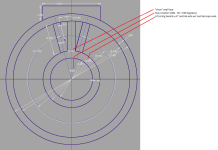
below is my own attempt over last few days of an RVA.

the seal between shoe/stop and the axle, this seal and degrees wanted 330 degrees of rotation, is predicting outer diameter of the central axle.
boggen elec sstt17.png

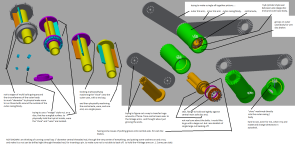
my own pathetic attempts in trying to figure out how to machine everything, bolt it all together, and to include brakes/clutch, along with attaching linkage arms to both sides of the RVA. granted it is all "rough draft" chicken scratches at this point, but i am getting a tad frustrated.
boggen elec sstt18.png

the whole trying to reduce need to make multi sections of the outer casing/body and bolt everything up, along with the central shaft and vane and also making into one piece is what is getting me. along with trying to keep linkage arms as thin as possible in attachment points to the RVA. getting hung up at the shoe/stop seal, the vane seal, and then seal/s for ends of them, to keep the hyd oil pressure were it needs to stay. and then making sure i can place groves in outer casing and central axle, so i can slide on some wet disc brakes.

may call Emerson Process Management to see about 3D file/s and then tweak there design, for connections for linkage arms and brakes.
=================
re-looking back at my own math for torque. for RVA (rotary vane actuators) my math has to be off...

need to rebuild SSTT based on RVA's, along with rebuild the SSTT how i had it at one time with hyd cylinders. to actually have something i can pull numbers off of.
 
   / new tractor idea possibly....
  • Thread Starter
#291  
not sure i came across RVA (rotatory vane actuator) clear back during initial first few posts of this thread. and only looked at regular hydraulic cylinders as a form of movement.

going back to a old diagram i posted clear back on this thread. of using multi small tractors, and combining them into a single larger tractor.
299343d1359027162-new-tractor-idea-possibly-boggen-new-tractor-idea48.png


brain storming lead to....
boggen elec sstt19.png
301273d1359946193-new-tractor-idea-possibly-boggen-elec-sstt19.png


game plan change WSSTT (wheeled spider snake train tractor)

the more i re-look at old diagrams, i maybe going back to the original first handful of diagrams on this thread! just taken me 5 months to get that far *doh*
 
   / new tractor idea possibly....
  • Thread Starter
#292  
side tracking once again, need to look into conveyer belts with small sized buckets bolted to the rubber. to dig into the soil, and raise it up. without trying to get the dirt to go through an auger, or through a simple belt with tread perpendicular to the belt/track. hhmmmsss that might just work, but how to get a full scoop, that does not involve pealing the dirt off, and having it forced into the bucket. vs some how driving a blade in horizontally and then lifting 12" of dirt at a time or more, straight up vertically.

Wallace Truck & Equipment
google search for "wallace rooster picker" i can only find one that is for sale and not mfg.

EDIT:
thinking along the lines of a roller cooster, or rather i should say, a "track" that causes a motion of a bucket to act either like a backhoe bucket, or a FEL bucket. were, the bucket moves in and out.

the bucket punches horizontally into the dirt, and then rotates up and out of the way, taking a bucket full of dirt, without "smashing" the dirt into the bucket causing the dirt to fold and roll inside the bucket as the bucket goes into the dirt. instead, it is a nice smooth, punch into the dirt, and lift out, and very min of cutting/shaving the dirt wall.

instead of operator moving the boom, dipstick, bucket cylinders of a backhoe, the motion would be controlled by the tracks

dirt harvester2 tracked bucket puncher.png

====================

getting back on track using RVA (rotatory vane actuators) for movement of linkages on the SSTT.

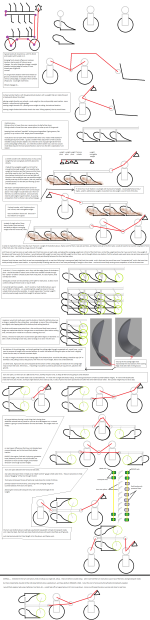
bottom plows.... ((single long picture / diagram))
boggen elec sstt20.png
 
Last edited:
   / new tractor idea possibly....
  • Thread Starter
#293  
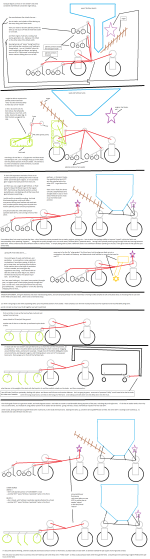
air seeder along with disc/chisel/fertilizer injection setup.

single long picture
boggen elec sstt21.png

back at it, to look, to see how other implements might be setup. so hopefully i can come up with a common "frame" and connection points that are universal for all attachments / setups. without making to huge of compromises.
 
   / new tractor idea possibly....
  • Thread Starter
#294  
air seeder doings continued / box planter

boggen elec sstt22.png
 
   / new tractor idea possibly....
  • Thread Starter
#295  
getting things figured out slowly.

i have scribbled out rough frame for the SSTT and linkages to wheels connected to the frame. i got a little frustrated with linkage between each 10 or 15 or 20 foot section, that makes up total 60 foot width. i am needing something that allows degrees of freedom in 2 axes (cone shape) and then the 3rd axis linear motion (hyd cylinder type of action)
trying to put power to all degrees of freedom. so they can be controlled and locked. just never came up with anything yet.

i scribbled out a trailer just to set it beside the 3D scribbles of the SSTT, and it looks promising. autodesk just does not like me, and kept crashing or giving me constraint errors. when i tried to drag things around to see how everything would drive through a field.

it took me a couple days to figure out how to setup "discs" to adjust angle of the discs, but almost compact them, in such a way that it would better work for the SSTT length. i think i got general idea down, and should work pretty nicely, in the simple basic form, and could be improved upon to point of controlling angle of every single disc separately from one another. and possibly adjust depth each disc goes down as well.

last couple days been working on trying out how to deal with bottom plows. this one has been a challenge. but i think i got something finally that allows for "turn over plow" like doings, and fits within the SSTT, i just have not decided on which path i may take of 2 different ideas. though i do believe i have already chosen the path i am going to shoot for. so i can have "controlled maintenance of re-shaping a field over course of so many years, or so many passes over a field. i have not gotten to the point of putting in trip points with springs. or adding a coulter/disc to edges of cut. but so far looks promising.

=======================
with above said,

SSTT will have a 3pt hitch side (60 foot width), that will accept a combine harvester head, or will connect to a disc, plow, etc...

the other side of the SSTT (60 foot width), will be engine side, (contains fuel tank, batteries, hyd pump, generator, hyd oil coolers, radiators, etc...) this side will have a "trailer" connection. kinda like the 3pt hitch implements, that has a ball hitch, and then a pin-tail hitch combo. but would be all combined into a better universal connection setup, this universal connection, will also be on both the 8 foot ends of the SSTT. most likely this will have more of an automatic connection setup, that also always hyd oil, air, electrical, to all be connected while moving in the field.

=========================
side tracking.....

i am so tempted to look more into the post 282 idea. but going to hold off, till the current age implements are covered. or at least roughed out 3D.

==========================
side tracking.....

i am been looking at "translating" growing a seed up to a small plant at some nursery or hydroponics setup. and then physically planting the plant vs seed. to get crops in earlier, and perhaps longer growing season.

at moment i think it could be very well possible with current path i am going with SSTT. and being able to bring in trailers that have shelves upon shelves of baby plants, and be able to hook up on the fly, and put the plants right into the ground. and have it all computer driven and mechanically done. current age transplanting, of having someone physically grab a plant and drop it in a hole, is just not there, when i am looking at billions to trillions of plants going into fields.

not a whole lot of thought, but looking at a "nail gun" approach, for taking baby plants off of rows / shelves and putting them into the ground in the field. the nursery / hydroponics factory would either grow or place individual plants into some sort of trays or something, that would allow the SSTT planter portion of machine, to grab ahold of a row or tray, and punch out, grab, or other. invidiual plants. and drop them into the hole. but the entire idea, falls clear back at growing billions to trillions of seeds, in a way that would allow machinable transplanting to happen.

and i am seriously looking at taking the stalks / leaves / even the roots of a non wanted crop during harvesting of the crop. and putting the left over portions of a plant, into a wagon. so wagon can be hauled to some nursery, so left over parts can be used to help provide nutrients, for next set of seeds to be grown into baby plants for the next planting season.

==========================
getting back on track....

the main frame and wheel setup and linkages for wheels. i think will work out nicely, possibly able to get 36" diameter wheels maybe slight larger diameter wheels on it. though i have not worked all the math out yet, but i think it could work out decently, and for farmers needing the larger diameter tires, it would be extra cost for linkages but should be happy with it.

but with current looking at how "bulk material" are dealt with seeds, fertilizers, pesticides, corn grain, beans, potatoes, hay, silage, to other.... and use of trailers and dealing with how "chase" vehicles are dealt with. being able to power the wheels of the wagons / trailers, that hold the bulk material, there may not be need for larger diameter tires on the SSTT when speaking purely traction, or dealing with "hills" for like potato hills. trailers and wagons on other hand. not sure yet. for tire size. simply not there yet.

===========================
side tracking yet again....

soil sampling....
how do you handle 100's to 1,000's to millions of soil samples on the go.

i have thought about jabbing some sort of "rod" with tip of it being some sort of sensor.
i have thought about a "plug aerator" for like a lawn.
i have thought about using a vacuum, to suck portions of dirt here and there of tilled up dirt.
really have not figured this one out yet,

figure once dirt sample was obtained, perhaps feeding the dirt through water, and a pump or rather make that a blender (much like you have a blender in your kitchen type of blender) and break down the soil into small particles, and then send through some sort of "centrifuge" that deals with RPM's of water rotating around inside of a pipe, and dwell time (how long soil particles / water are held within it), and simply weighing or measuring were particles even out at. to perhaps some sort of laser and optical sensor on various sides, to get idea of how many particles per amount of water there is. ((parts per thousand, parts per million, etc....))

thought about various sensors used in koi to gold fish ponds, to swimming pools, and how various parameters of water can be tested against. truly i think it could be possible to get a fair amount of soil properties, on the fly, every foot or so. and be able to get enough info quickly enough, that by the time the planter or fertilizer or pesticide comes by that given area were sample was taken, that an on demand mix and match seed and fertilizer and pesticide could be placed.


================
================

holding off of pictures for now... as i think i may want to drive towards, a full concept showing, that i am hoping drives the overall idea much better. and hopefully brake away from current age tractors and implement setups.
 
   / new tractor idea possibly....
  • Thread Starter
#296  
*ughs* been trying to look at all the various "harvesting" and threshing, etc... of getting the wanted part of crop removed from plant. and dealing with "hills" and keeping sieves to paddles, to even flow across everything. and more so "level flow" and then the multi options of changing things in out for different crops within the thresher area. dealing with downed crop from wind to animals nocking crop down. dealing with different types of crops from plants, to root base crops.

i am most likely going to need to change the direction. in how crops feed through say a combine for field corn, wheat, etc... and see about mutli "feeder boxes / housings" i am afraid if i go with more of a straight up vertical lift feeder housing, to bring crop up to the top, and let crop work its way down. that there would be greater lose / damage in the feeder housing, if using paddled conveyer belt.

if i used auger base style of transportation of wheat, corn ears, potatoes, hhmmmssss

i want to raise MPH (mile per hour) in the field for harvesting. so bottle necks are going to be from feeder housing and then threshing. and then needing to keep things level

i can use vibrational shifting back and forth sieves. go with wedge wire sieves, and go for more of a angled attack / flow. could go with cyclone / whirl pool effect using air instead of water. i guess like them cyclone vacuums out there on the market were crud is trapped.

hhhmmssss..... so what are the sections that i want universal connections...

ok do i want the "threshing" for say corn / wheat / beans. to be placed on the SSTT. do i just want to take say a fork lift, pick up the threshing unit, and set it on top off the SSTT main frame. or do i want to say treat the thresher, like a set of discs or plows, chisels. were linkage arms just fold the threshing portion up on top of the SSTT. as if folding up discs, plows, etc... for transportation mode. then

eewwww more universal connection points.. more so quick attach doings.... i suppose if i stay with linkage arms for like plow/chisel/disc/planters/ seeders. all the electrical, hydrualic, air, and physical connections would be there.

but the issue comes in, needing to deal with the combine header, feeder hosing. and needing linkages for them. actually, that might work... using a second set of motors. ya.... that could work out hhmmsss... keeping ground contact at the header and flexabilty.... well....rely back on the SSTT main frame.

hhhmmsss what about out feeds, conveyer belts to augers... for both wanted portion of crop, and left overs, leaves, stems, roots that are not wanted.

if i say take two or 3 current age combines, removed, cab, removed the hopper (temporary holder of grain), wheels, engine, fuel tank. all i have left is header, feeder house, thresher, auger, and left over control.
---ONE 60 foot long,
---or split up in to TWO 30 foot long sections,
---or THREE 20 foot sections,
---or FOUR 15 foot sections.
i have 8 feet width, by 10 feet high approx for each section.

1 single long thresher.... bring crop from multi feeder housing boxes... would most likely mean a conveyer belt going entire length of the SSTT or near to that. and then on given end, crop getting feed into a thresher, that could extend clear across the SSTT main frame of 60 feet. the issue is bottle necking. limited by width of the thresher of 8 feet. minus a few inches here and there.

if i went with 2 threshers. well hmmsss.... there is going to be a min of 3 sections of the main frame for the SSTT. each being 20 foot long. maybe 4 sections each 15 long (not sure yet) i suppose it would make sense to go with more of a multi thresher setup. more complex due to all the extra threshers, but.... being able to reach higher MPH...in field, each thresher would end up seeing more crop. the only issue then would be needing augers or conveyer belts. to deal with the final output... of both wanted part of crop, and then the left over leaves, stems, roots that are not wanted....

i suppose the threshers initially could be made smaller, they would not be able to handle higher MPH in the field. but could be cheaper, and then upgrading to threshers that were larger and better geared for high mph in the field. smaller size threshers would more likely be easier to adjust level, both front and back, and left to right. and more likely be able to follow the contours (hills/slopes) better. multi threshers running at different speeds, to handle different areas of the field, that have grown a more denser crop, vs areas beside that will more likely have a less denser plant growth / crop.

i guess the only major portion that would need leveling would be screens themselves. hhmmsss

upside down....cone shaped cyclones....with cones inside of cones, of different mesh sizes. and beaters that run between the cone shaped screens.

================
================
================
side tracking....

tempted to run 3000 to 5000 PSI, from main hyd motor. and then use regulators. in different places. to produce a more guaranteed hyd pressure in the 1000 to 3000PSI range that go to various cylinders and hyd motors, and actuators.... perhaps allowing for a more balanced flow throughout the entire setup.

================

if i went with approach of silage / corn. and cut the corn stalk right off at ground, and brought the entire corn stalk, leaves, and ear of corn up into the machine, and then separated, the stalk, leaves, from ear of corn, then went a tad further separating kernels of corn from cob perhaps... and then outputted, stalk/leaves to one wagon, kernels to another wagon, and cob to another wagon....

say.. 2 outside units proccessed entire stalk, leaves, and ear of corn. and the ear of corn went to center unit that removed kernals from cob.... the 2 outside units would cut the stalks/leaves down to desired wanted length. perhaps center unit cut the cob up in smaller chunks to allow more cobs to fit in same size wagon.

================
what about soy beans and wheat.... smaller grains, might be better off, with 3 thresher units. to allow for higher MPH in field.

if i went with potatoes.... i would need to lift potatoes up and out of the ground, and shake the dirt off. and then get them on a conveyer belt on SSTT or i guess multi conveyer belts. to control which direction potatoes went, and to which wagon they went. perhaps. even install sizing and shape sorting directly on the SSTT. as first process control. to better utilize how many potatoes fit in different size wagons...

=================
arghs... bed formers / shapers to make hills.... current age, ya got this good old size tractor out in front, a tiller, and then some metal. that squeezes and shapes the dirt to form a wanted hill shape. both width and height, and controlling the angle of the sides, and curve / flatness of the top of the hill being made....

i am not really seeing any sort of "proactive" use of any sort of "buffers", or pads. that might be found in clay and arts and crafts, to wood working to other. were sanding and buffing are done to sides and top. if i am running out of traction (wheels are slipping in the mud), then you have HP (horse power), left to do something with. how about reducing amount of traction needed, but how beds are formed.

i am not seeing a more multi row, bed shaping and plastic lay down or flipping plastic from black side to white side and vice vs.

i am still not finding any good "transplanting" setups that are setup for machine planting vs physically hand planting...

i am still seeing a whole bunch of "customized" harvesters for a specific crop type, but pretty much every single harvester has same build and how it works....

====================
think i am more towards multi thresher setup. to cover a wider range of overall crops, with limited amount of change to basic components for different crops.

====================
how do i store the header, example, soybean combine header, corn combine header, etc.... been thinking about using a set of "tracks" that raise the entire header straight up. and then tracks do a 90 on top, and bring the header back over top of the SSTT. or do i try and use linkages, hydraulic cylinders, an rotatory actuators, to grab a hold of a header, raise it off the ground some, hyd cylinders contract bringing it closer to the SSTT main frame, and then do a controlled rotation and lift. so header can be stored on top of the SSTT during transporting.

the header is going to need to "flex" with the SSTT main frame, say 10 to 15 degrees.

*shakes head* need to get out of current age setups... if i fix the header to the feeder box, and allowed the feeder box to fold up into the side of the SSTT and route the threshers around the feeder box. that would pop that header right on top. i suppose i could split the feeder box up into 2 sections. well hhmmmsss how would that work...

perhaps inserting the connection point of feeder box more towards center of the SSTT, and split the feeder box / housing into 2 pieces. or rather make that 2 conveyer belts. well i guess there would be a top and bottom conveyer belt. for a set of 2 conveyer belts.

so were would i insert a rotational axis. to allow the header to flex and follow the ground, while the feeder box / housing is more fixed position... the wheels of the SSTT have 1 axis of freedom. combined overall wheels 2 axis of freedom for leveling.... so perhaps going with 2 rotational places on the feeder box....

header -> rotational axis -> feeder box (2 conveyer belts, one bottom one top, to sandwich the crop), then another rotational axis, then another feeder box (same as first), then connection to the SSTT, or rather make that some place near the top of the thresher...

taking above and building...

header -> rotational axis -> feeder box -> rotational axis -> ((physical seperate split)), that allows folding -> feeder box -> connection near top of thresher...

bah gets more complex than that....

the rotational axis, does not really need to be "powered" via electrical motor, hyd motor, hyd cylinder, rotatory vane actuator, all it needs is a limited degrees of rotation. well take that back....

i need to "mis align" the 2 feeder boxes. or rather make that allow for the conveyer belt sets to become mis-aligned. so basiclly, all i would need to do is change the angle that rollers/sprockets that the conveyer belts run on. actually perhaps i do not need to run 4 sets of conveyer belts / 2 feeder boxes. but keep with a single feeder box. but mid way allow the conveyer belt to "twist" on purpose, were 2 rollers/sprockets are right next to each other. i guess that would be simple enough. some springs or perhaps even smallish hydraulic cylinders. 2 sets of 2. 1 set per side. well actually it would be a single full set of 4, and running the hyd cylinders in a series,..... i guess parallel could work better, and provide extra torque / force.

==================
alright. so how do i get the feeder box / house to fold....

i am not to eager to place larger diameter sprockets, just to be able to insert some rotatory vane actuator. anything that allows folding needs to be done on the outside errr make that along the sides of the conveyer belts.

so how do i place hyd cylinders or like... i guess, extend frame out that holds the rollers/sprockets. and come off of it with some ear tabs, if i use the "mis-aligned" conveyer belt area for rotational axis, as the hinge point. there would already be rollers to keep the conveyer belt aligned. and could double purpose those rollers to keep conveyer belts from loosing up to much and coming off of the sprockets. but....how do i allow for the lower conveyer belt, to stretch. or would there be... i would need to add most likely a hydraulic cylinder as the conveyer belt tensioners. vs just using a spring, threaded rod, and an adjustable nut.

====================
so how do i handle the rotational axis between the header and conveyer belt. along with tilt, the header for lack of better statement, would be a "heavy duty bucket" on a FEL (front end loader).

getting brain fried... posting this brain storm session before i loose it.
 
   / new tractor idea possibly....
  • Thread Starter
#297  
my brain went to mush from last post, and has not recovered. i look at autodesk, and this thread, and even think, and just silence....
 
   / new tractor idea possibly....
  • Thread Starter
#298  
i need a way, that will allow crop to gain a certain velocity (think MPH miles per hour), so the crop does not go "smashing" into the header or rather make that onto conveyer belts and augers. i need a way that allows the crop to also take sudden direction in change, without damage to the crop. think doing 55MPH and trying to take a sharp 90 degree turn. you would roll your car / truck or go skidding across the road. but for crop, it would go smashing into a concrete wall and get smashed, when trying to take the 90 degree turn, when it moves from one conveyer belt to another, or from one auger to another auger...

i need a soft touch handling of the crop, as it gets harvested, to point of loading it in a wagon to be hauled off away from the field.

so how is that achieved? by default, various crops are going to be more likely to bruise or get cut, or smash into pieces. while other crop types have a tough shell, say field corn for example. that can withstand more abuse perhaps. before each individual kernel starts getting damaged.

for crop types that are easier to bruise / cut / smash. slower harvesting speeds maybe only way around things, until there is a better sensors and robotic arms can be had, on a header for a harvester such as combine. and until then, only way to remove more crop quicker, is simply making the header longer. but still keep the SSTT at the same speed / MPH (miles per hour) in the field.

================
starting to understand why i held off from trying to figure out how a harvester would fit into everything. and reason why so many different harvesters out there, geared more to each individual crop type.

=================
i wonder if i used a combination vacuum (suction), and conveyer belts or augers), as a way to create kinda of an "air bag" or cushion. or possibly adding blown air as a way to help act like a cushion. for sudden changes in directions. ((there is no "gravity floors material, like in star trek yet...)) and not about to haul water or a liquid. some i am left with springs and some mechanical setup, to rubber needles / fingers, to air.

================
starting to think, i maybe trying to push things to far, for an "all in one" setup. that you swap implements in and out. for all stages of dealing with a field (tillage, planting, harvesting).

i think most of it comes down to, i am getting so past my area of physical actual experience, and actually trying different test setup experiments to see what happens for this or that. along with some sort of variables of max pressures / max velocities a crop type could take before damaged occurred to the given crop.

hhhmmsss....
================
say i forget trying to turn the SSTT into a combine / harvesting machine for multi crops, and just stayed with, tillage and planting. i do not see why i could not simply, toss a container/s on top of the SSTT. and use it as a chase vehicle / wagon, during harvesting. it would be simple enough to do so, it would be just like hooking up a plow, disc, planter, etc... but in this case, it would be some sheet metal in form of a box, that would set on top of the SSTT main frame. and SSTT would already be setup for low ground speeds in a field, and higher transport speeds on the road. to move crop from field to perhaps a near by storage area. and SSTT would already have field tires (R1 like tires), heck the SSTT could have a set of tires just for "transport mode" and on the road, to reduce wear on AG / R1 field tires.

tossing a conveyer belt, augers, would not be that bad, adding a dump from side to side, or to one of the 8 foot wide ends, would not be that hard either. and control for how fast everything moved for conveyer belts / augers, would not be as critical, due to unloading the box on the SSTT = SSTT for most part standing dead in its tracks.

i guess tires could even be matched to rows in field, to help reduce, stems from crop damaging tires more, when SSTT is turned into a wagon. heck, SSTT is already built with a suspension per say, that allows entire main frame to tilt side to side. and to some degree lower or raise up a few inches. that may make it more promising during harvest time, and dealing with crops that are more likely to bruise / smash / get cut up. and in that during loading / unloading the SSTT.

not wanting to bow out from setting up a harvesting crop directly onto the SSTT. but to put foot forward, and get things rolling per say. it looking like direction i am going to go. and then once SSTT gets out there for tillage / planting, put money back into SSTT, to see about a more universal harvesting machine.

=================
if i do above, it would dramatically change, concept though. in how the SSTT is used. for say a wagon full of seed, for an air seeder, or hooking up wagons / tanks with fertilizer / pesticides / etc.... i was wanting to place more towards combination of specialized wagons / trailers. that could serve multi duty. throughout the entire doings of tilling / planting / and harvesting. and more to the point, trying to help offset cost, of the more complex connection points, and dealing with wheel motors, for the wagons / tanks for the seed / fertilizer / pesticides.

well... take above back.... i have not really looked at "transplanting", instead of putting in seed into a field, having a seed, grown at some nursery, to say 1 to 6 inches tall. and then put millions of plants into the field, vs seeds. that may actually go over better with the SSTT, and more specialized connections and wheel motors.

================
think that is direction i am going to look more into. transplanting. and what maybe involved in more detail. before putting foot down completely, on actually trying to finalize the SSTT overall setup and running actual numbers. along with, looking more into the "dirt harvester" thing. for better tillage and planting possibly. also need to cover, hay square bails, and round bails. (why not) either at creating bails, or simply using SSTT as a wagon. along with cutting / windrow hay. the more i can completely take over, what a current age tractor can do. the better, the way i see it. since the SSTT for most part would be taking spot of the larger ag tractors out there, in the arsenal of machinery, a farmer uses.

*rubs chin* log skidding / trailer / wagon, perhaps. why not, it would have tires than can be controlled to move up and down independently. might work to get around some logs and like in forestry settings. granted that is out my scoop of knowledge / experience.

off to autodesk...
 
   / new tractor idea possibly....
  • Thread Starter
#299  
attached picture....

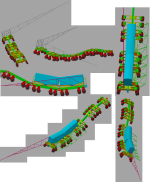
the main frame of the SSTT this is FOUR 15 foot section version, that i have been considering over THREE 20 foot section setup.

disc, that can adjusted to any "angle" wanted. i kinda butchered the disc pretty good, so i could approximately space the discs, to line up with edges of individual bottom plow beside it. i tried other ways to "angle" the discs. but every time i did, i ended up not finding enough room to fold things up.

bottom plow, from the first post i noted, i simply was not real eager to follow current age bottom plows, to turn over plows. i need something to fold up better. i needed to make 2 sets of bottom plows, so you could do a 180 at end of field, and switch over to the other set / row to keep all the furrows going in same direction. not my best work for "trip plow" so if a bottom plow snagged a rock or root or something else, the plow would flip back, but at this point was more focused to see if a bottom plow like this setup could possibly work.

i tried to make a FEL (front end loader) heavy duty bucket. to try and describe the bottom plows, and how they work, but how i was going to explain things has done left the building.

i tried making some sort of "hay rake" along with some sort of multi blade bush hog, to deal with hay, to try and see how things might line up. and overlap one another to perhaps save on cost and keep things more simpler.

decided to toss a few boxes on SSTT, just to see what it might look like. and figure out how much space i had.

hopefully as more things get figured out, better detail will be done to move things more closer to a finalized rough draft of things.

boggen elec sstt23.png
 
   / new tractor idea possibly....
  • Thread Starter
#300  
have not done a lot.

decided to try turning SSTT into a spray rig.

15 foot lengths per section 4 total sections for 60 foot lengths, and then another 60 foot each side booms, for 180 feet wide spray.

and then i got myself in trouble...

the 60 footer swing outs, when folded up, would tear themselves apart as they went into linkages for the wheels.

tried, mounting a couple tanks, and fold out 15 footer booms, and there all catching up were the sections rotate to allow for hills within the field.

overall, i think it could very well be possible. little tilt there, little longer there for over lap for the 15 footer booms.

ideas of how to make more of a universial connections. for sprayers, to wagons (box wagon), to trailer flat bed tops. is finally starting to hit me.

boggen elec sstt24.png
 

Marketplace Items

2012 FREIGHTLINER CASCADIA SLEEPER TRUCK (A59904)
2012 FREIGHTLINER...
2023 CATERPILLAR 972 WHEEL LOADER (A60429)
2023 CATERPILLAR...
5th Wheel Hitch (A59230)
5th Wheel Hitch...
2019 GALYEAN EQUIPMENT CO. 150BBL STEEL (A58214)
2019 GALYEAN...
2014 MAGNUM PRODUCTS LIGHT TOWER COMBO (A55745)
2014 MAGNUM...
2019 F150 (A61306)
2019 F150 (A61306)
 
Top