Need opinions on project

   / Need opinions on project #1  

Cdash

Silver Member
Joined
Feb 15, 2002
Messages
115
Location
Milford, MI
Tractor
JD 4100
I have a project in my head, and have put it on computer to see what all of you think.

What I wanted was a tooth bar, but more of an implement rather than an attachment for my bucket. Also, I can get the steel for free to do this, where a toothbar would be $$$, so that kind of drove the design as well.

This concept is built around steel I have or can get free. What I am thinking, is a FEL attachment that is a dedicated toothbar. Main thought for it is to use it as a scarifier for road maintenance and for clearing brush by running the "teeth" about 3-4" in ground and catching roots. Since it's not connected to my bucket, no worries of bending my bucket up.

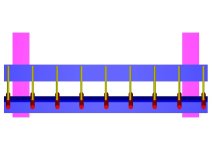
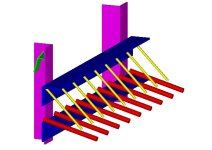
Here is one of 3 pictures (see attachment)
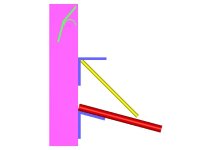
The purple is angle iron uprights to attach to my JD4100 loader arms with green quick-tach brackets. The blue is steel I have laying around. The bottom one is not 90 degrees (you'll see in the side view), the top one is. Both are like angle iron, but are actually 3/8" plates welded together. The red is 1" diameter re-rod (reinforcing steel) (thinking about 12" long) and the yellow is 1/2" diameter re-rod bracing the 1" teeth.
When attached to the loader the range of motion will be from the uprights being vertical (as shown in this picture) to the uprights being completely horizontal, and everywhere in-between.

The only cost will be supplies (cutting wheels, welding wire and torch gas) so before you tell me to buy a tooth bar, I am doing this because $$. But, if enough of you tell me that I am crazy, I will save my $$ for a tooth bar. Building is more fun though, and nothing beats that satisified feeling you get after a few hours of work and having somthing usefull when your done and it's fun to "invent" stuff.

I know there will be downsides since it's not part of a bucket, like digging, but for clearing roots, scraping the road (in combination with a back blade) and general raking, I think it should fit my needs well.

Open up and let me know what you think. I am looking to get opinions to see the downsides that I have not considered yet. Of course, compliments and refinements are welcome also.

Thanks for your help! (this place is great, but gets me in trouble for giving me more ideas!!)
 

Attachments

  • 53-129028-tooth.jpg
    53-129028-tooth.jpg
    52 KB · Views: 877
   / Need opinions on project
  • Thread Starter
#2  
Picture # 2 front view
 

Attachments

  • 53-129029-toothfront.jpg
    53-129029-toothfront.jpg
    26.6 KB · Views: 529
   / Need opinions on project
  • Thread Starter
#3  
Picture #3 side view
 

Attachments

  • 53-129030-toothside.jpg
    53-129030-toothside.jpg
    19.6 KB · Views: 406
   / Need opinions on project #4  
hmm, dont know what to say..umm, I dont think it will be as useful as teeth on a bucket lip. The #4 reinforcements might be a waste of time. I dont know, it definetly give you some practice though.
 
   / Need opinions on project #5  
Looks like a good plan, but I would make the following modifications.

First, flip the bottom piece of angle over, so the flat part is on the bottom.
Second, shorten the 1" rebar to 6" lengths, less likely to bend, and sharpen the points.
Finally, lower the top angle and shorten the 1/2" rebar braces.

This should make for a stouter unit, more able to handle the stresses put on it.

Hope this helps.
 
   / Need opinions on project #6  
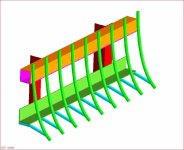
A little more laborious but would this be an improvement, trying to improve the sifting abilitly to seperate the roots from the dirt.
 

Attachments

  • 53-129106-junk.jpg
    53-129106-junk.jpg
    61.2 KB · Views: 448
   / Need opinions on project #7  
I like Steve's model a little better, because he has the orange colored top element shown as tubing. I would add yet another tube at the bottom, shown on Steve's model as the green angle. I feel you need at least one, better yet use two tubular elements from side to side, to keep the attachment from twisting. Angle iron offers very little torsional strength (twist resistance). So if lifting more from one side of the attachment than from the other, you'd like some torsional strength built in. That way you get better contribution from both loader arms, and the whole attachment works together even if the load is less than evenly distributed.
Compare two trailers, one built of tubular material, and another of angle. Noticable difference in bed twist. When I built a gin-pole option for my combo base frame (before it had tines), I then had a frame of angle iron lower element to mount to. When the gin pole was added, and I hung from it, the 5/16" x 4" x4" angle bent and sagged in the middle. I felt like Superman. I weigh 200, the gin pole is six feet long. Compare these numbers (200x6feet= 1200 foot pounds force) to the lift capacity of your loader against one tine a foot long. Later, to improve the torsional strength of the base frame I added another angle on top of the first, to form a square tube. Not perfect but night and day difference in strength. My upper cross-element is round, actually made of two layers of pipe, 1 1/2" inside of 2". Some trial and error evolved there too...long story...sorry. My 2 cents worth.
 
   / Need opinions on project #8  
I so admire you guys that have the ability to make up varies attachments. If I understand the purpose of the attachment here is what I would be concerned about. With the tooth bar on my loader if I am running the bucket near parallel with the ground things work fine. If I angle the teeth towards the ground, on my small 21hp tractor, it will either try and dig in or not engage the irregularities of the grade. Guess I am trying to say it has not worked well for me as a rake for sub surface material while driving forward. If the ground is not to hard, I can break up ground back dragging with the teeth tilted down.

MarkV
 
   / Need opinions on project #9  
Before I knew what tooth bars were I made a device to do something similar. I was cleaning an area of woods to be made into pasture. Ground irregularities, small roots, and stones were a concern. I did not have a 3PH rake.

I did have several lengths of 6" square steel tubing that has a 1/4 inch wall. I bolted four pieces together to make a square, actually two parallel pieces on top of two perpendicular parallel pieces. In one end I drilled a row of 1/2 inch diameter holes 2-3 inches apart. The whole thing is about 6 feet square.

Into these holes I placed some 1/2 inch diameter round stock that stuck down or out about 2 inches. The whole think is over 300 pounds, I pulled this behind the tractor with a chain attached to it and the tractor drawbar.

With the teeth side down it loosened up the ground and
up-rooted rocks and roots. Because there was a flat piece parallel to the front 6 feet back this surface filled in the dips with the material the front dug up.

Flipping it over presented two smooth sides to make the ground flat and smooth. By adjusting the chain pulling it I can angle the whole thing which tends to push material off to the side, which comes in handy grading a road I can move material from the ditch side to the center and make a slight crown.

Randy
 
   / Need opinions on project #10  
That's a great idea! Might not be a bad idea to put an 'edge' on the front and rear faces of those 1" teeth. Maybe a nice 3/8" plate x 3/4" with a nice angle ground on it. Might help ease it's way through the ground as well as acting as a stiffener. Manganese plate would be great for this application.
 
   / Need opinions on project #11  
For my tines Id use car axle shafts most junkyards have several laying around for little or nothing, Ive had little luck with rebar. The axles are already heat treated and pretty stout. Oltimers here showed me how to use them for a manut fork bucket. Since then ive built several things with them.
 
   / Need opinions on project #12  
I'm can't even spell "injuneer" so all I can offer is opinion. I'd be afraid of causing damage to the loader arms - based on my experience. I had a loader on the front of my 450 IHC back in Alberta and I did a huge amount of damage to one cylinder (had to get it rebuilt) and one arm (had to cut, reweld and strengthen) when my foot slipped on the clutch while digging in a rock pile. The forward force of the tractor and the immovability of the rock pile caused the whole loader assembly to bend to one side.
I would be worried that the same thing could happen if you were pushing your tooth assembly underground in front of you ... catch a good solid root structure and what's going to give first?

My stepdad was a heck of an inventor and tinkerer before his death ... he built an FEL for his 8N, as well as a snowblade and wing and an entire backhoe assembly (which he finished the week before he passed away ... never got to use it). Anyway ... his experience with clearing his farm from wilderness in northern Alberta (with horses and later, his 8N) led him to drag rather than push. He dragged chains and other stuff to clear roots out. And for the really tough roots, he built my stepbrother (who has an old 'bota) a ripper tooth that fits on the 3ph. When he needs to yank a root, he puts the tooth down, snags the root, and then uses the top cylinder to lift it out.

Good luck ! and have fun ...
 
   / Need opinions on project #13  
<font color=blue>My stepdad was a heck of an inventor and tinkerer ... he built my stepbrother </font color=blue>

I for one am impressed. /w3tcompact/icons/laugh.gif

Anyway, this weekend I was pulling hedgeposts and locust trees with my brother-in-law's JD3020. 70HP lots of 3point lift ability. There was one very stubborn tree that refused to let go of mother earth. I look over and HEY! there are his hay forks, I could just slide them under the tree and pop that sucker right out of the ground. Well not exactly.

Even though the ground is fairly wet and everything else had popped out easily, when I lifted the hayforks there was a sudden "pop" but it wasn't the root, it was the hay forks that twisted under the force. One fork now points downward at about a 15 degree angle from the other.

I think Wingnut is right, considering the damage I did to the forks (and it happened very quickly) you might do considerably more damage to you FEL if you were to catch hold of a stubborn root

BTW, when I told my brother-in-law what I had done, all he said was "You did what?!" I know he's mad but he hasn't said so yet.
 
   / Need opinions on project #14  
The idea is OK but for what you want to use it for, I think this would be better as a 3 point implement to pull rather than something to push. Pushing it will naturally try to drive it deeper and I think it will be difficult to control. Also, I think the scarifiers will need to be much more substantial to run 3"-4" deep and pull roots. Probably rectangular bars with hardened points. My 2 cents.
 
   / Need opinions on project #15  
I had to go back and reread my post to see how you got that out of my comments and got a good chuckle. I always seem to use brackets to show the asides - and likely end up with far too many of these potential kneeslappers.
Good one!
 
   / Need opinions on project #16  
Interesting idea. In my area, I can see this thing digging into a hidden rock or massive root with a sudden stop! Consider flipping the teeth slightly backwards and pulling it backwards. At the end of a pull, you could raise the loader and pull your rear blade or boxblade forward and clean up or smoothe out your pull.
(Your computer drawings are awesome!)
Good job!
 
   / Need opinions on project #17  
mine works very well and as you can see I added a small grapple. the one inch rebar is PLENTY strong at 30 inches long.
 

Attachments

  • Picture 028.jpg
    Picture 028.jpg
    740.4 KB · Views: 167
  • Picture 029.jpg
    Picture 029.jpg
    817 KB · Views: 145

Tractor & Equipment Auctions

207275 (A52708)
207275 (A52708)
2004 TAKEUCHI TL140 SKID STEER (A60429)
2004 TAKEUCHI...
Chemical Containers Tank (A57148)
Chemical...
WOOD GRABBER FOR MINI EXCAVATOR (A58214)
WOOD GRABBER FOR...
25 DUAL AXLE GOOSENECK TRAILER (A55745)
25 DUAL AXLE...
2014 BOBCAT E32 EXCAVATOR (A60429)
2014 BOBCAT E32...
 
Top