Making an A frame for a heater vent

/ Making an A frame for a heater vent #1  

Garandman

Elite Member
Joined
Aug 3, 2014
Messages
3,152
Location
Mount Sunapee NH / Dorchester, MA
Tractor
Kubota L3200 HST
We have a Rinnai wall heater in NH. There is an exhaust vent to outside about 12" above ground. It snows a lot here and if the snow covers the vent while we are away, the unit will not run.

I guess most people make an A frame to shield it. I'm obsessing over the height, width, and whether to plank in the sides or not. We can easily get four feet of accumulation though I clear it a few times a winter.

Anyone built one? I'm probably making this too complicated....
 
/ Making an A frame for a heater vent #2  
I don't know the building codes but why not just extend it upwards and put a rain cap on it? Typically, vents need free air around them to work.
 
/ Making an A frame for a heater vent
  • Thread Starter
#3  
It's what everyone seems to do around here. Took five minutes.
IMG_3049-L.jpg
 
/ Making an A frame for a heater vent #4  
Who are the idiots (no offense if it was self-installed) who vent these things near ground level in parts of the country where there's snow? They did the same thing with a direct-vent oil furnace at a friend of my wife's house. One would think that building codes would address this potentially hazardous situation. Or at least common sense.

When we had a direct-vent furnace put in a few years ago the contractor insisted that the vent be at least 4' above ground.
 
/ Making an A frame for a heater vent #5  
I assume this is a 95+% efficient furnace. We have no shortage of snow here and they are all vented horizontal close to the ground (if they are installed low or in the basement). I think they are not supposed to have a significant vertical run. A simple cover will do it. I'm fortunate that mine vents under the deck. The only bad point on that is I had to run a lengthy inlet to make sure it was separated from the exhaust.
 
/ Making an A frame for a heater vent #6  
Usually, the reason they are close to the ground is because the main run is in the ground floor joists. There are "snorkel" contraptions for raising the discharge height but they are expensive. They have to be double or triple wall to meet clearance to combustibles requirements (that entire wall looks like it will burn). That kind of thing will not pass a building inspection here where I live in MI.
 
/ Making an A frame for a heater vent #7  
Most if not all codes, manufacture instructions state to terminate vents a min. of xxx above grade, and xxx above grade in areas prone to have heavy snow..
You shouldn't install an appliance how ever you want ,Just because you can't meet min. code or manufacture requirements
 
/ Making an A frame for a heater vent
  • Thread Starter
#8  
This Rinnai wall heater was installed by a dealer and the vent pretty much comes straight out the back and through the wall. The original unit was there for at least 10 years. We replaced it with a newer model this summer but the vent is in exactly the same place.

Bottom line, this keeps snow out of it, and that's what I needed. It's around 18" off the ground.
 
/ Making an A frame for a heater vent #9  
Guess you have to do what ever works.. I would have never install a vent existing or other wise that low in an area that gets 4 feet of snow.. The mfg. instruction sheet may state a min. of 18'' off the ground for an area like I'm in. but , not yours...
 
/ Making an A frame for a heater vent #10  
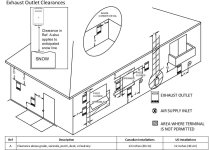
Clearances.jpg

The image above is from a current Rinnai tankless water heater install manual. One can note how they have added the image clarifying height above the "anticipated snow pack" to the install manual. Perhaps it was open to interpretation before leading to the kind of situation described by the OP. Best course of action would be of course to raise the unit to a more acceptable height in the first place.
 
/ Making an A frame for a heater vent
  • Thread Starter
#11  
I think the installer's rationale was "Well it's been here 10 years, must be OK."

We clean the snow out of there so they can get to the propane tank, anyway.
 
/ Making an A frame for a heater vent #12  
View attachment 451428

The image above is from a current Rinnai tankless water heater install manual. One can note how they have added the image clarifying height above the "anticipated snow pack" to the install manual. Perhaps it was open to interpretation before leading to the kind of situation described by the OP.

installation instructions reference things like this for a reason..
Any Licensed installer that installs in states that have this much snow , should know how to properly install equipment..
You can bet, If I were a installer in 1 of those states that can have 4-5-etc ft of snow.. I sure wouldn't terminate a vent only 18 '' off grade
 
/ Making an A frame for a heater vent #14  
Just guessing here, but if those vents are anything like my clothes drier vent, the heat creates its own tunnel. Actually the flowers even want to grow during winter.
Heck my central vacuum exhaust keeps a good swath open.
And we are in a snow belt area!
 
/ Making an A frame for a heater vent #15  
It must not be a condensing unit as it is SS metal duct. All of my appliances in my house are condensing (2 on-demand water heaters and a forced air furnace) so all exhausts and intakes are Sch40 PVC pipe. When I put them in, the intakes are high up on one wall, but the exhausts are like yours near ground level around the corner (limited spaces that met code for these on the house). I made a snorkel for them with a 90 sweep up, a couple feet of pipe, then a pair of 45's with a stub in between them to point it back towards the ground. Then I later wrapped hardware cloth around them to keep critters out, but didn't do it fast enough and a couple birds got into my furnace and died. You can get SS hardware cloth/mesh too, so it won't react and corrode with your SS pipe. Even cutting a disc of it that is snug inside the pipe is a good measure.
 
/ Making an A frame for a heater vent #16  
When ever I do a job...I always leave the installations with the customer.. That way, the customer can read them ,and know that they were installed correctly..Some instructions are more strict than the code.. When they are, MFG instructions prevail
 
 
Top