Loader leak down.

/ Loader leak down. #1  

J_J

Super Star Member
Joined
Sep 6, 2003
Messages
18,973
Location
JACKSONVILLE, FL
Tractor
Power-Trac 1445, KUBOTA B-9200HST
I wrote this for the PT machines, but it applies to any machine that uses loaders or BH.

Here is the main reason that the lift cyl will drift down even if the lift cyls are good.

Excerpt:

Most hydraulic valves are a metal-to-metal fit spool design, so do not depend on the cylinder setting dead still with a tandem center spool. If there are outside forces on the cylinder, it will creep when the valve centers.

Any metal-to-metal fit spool valve never fully blocks flow. With external forces working on the cylinder, it may slowly creep with the valve centered.

Well, you have the outside forces with the weight of the lift arms. Then add leaky cyl and down it drops before your eyes.

What does the metal to metal contact tell you about the leakage. Spool tolerance to bore tolerance.

It speaks to the quality of the hyd components a manufacturer wants in their machines.

They can brag about tight tolerance, but do you think the would brag about loose tolerance.

However, some of you say PT brags about how they really wanted valves that leak more than other valve competitors.

Their reasoning, is not valid.

They could say, they were purchased on price alone, and that might be true.

Need I say more, you have the facts.

My loader arms leak down over night, but if I need better, I have some needle valves that can be used.

If it leaks down after that, it has to be the cyl seals.
 
/ Loader leak down. #2  
Nice writeup.

I know cylinder seals get blamed frequently for cylinder drift. Bit cylinder seals alone wouldn't cause it. There has to be something else leaking somewhere. Either a fitting, rod gland, or the spool.

There are different volumes of fluid on the two sides. You can totally remove the piston seals and if everything else is tight, there should still be no drifting. Picture a cylinder with no piston seals. Heck, no piston for that matter. To collapse (drift), toe rod gets shoved into the cylinder. The rod has to displace fluid. That fluid has to go somewhere. If it cannot, no drift.
 
/ Loader leak down.
  • Thread Starter
#3  
With no load you would be correct.

The cyl will extend or retract is theres is a load on it.
 
/ Loader leak down. #4  
the more i think about it, the more threads i remember of cylinder rebuilds. but, i rarely see threads about tearing apart a valve, putting in new seals/o-rings, possibly balls / check valves, and any springs within the valve. lots of different talks about type of valves, but not actually repairing them. i don't remember anyone replacing any sort of needle.
 
/ Loader leak down.
  • Thread Starter
#5  
When people talk about rebuilding valves, they are talking about the spools that have spool seals on them, thinking that will help their valve. It might help if the spool is leaking to the outside, making a mess. A worn spool will bypass internally.

If your cyl wall are good, then new seals will greatly improve the functionally of the cyl.

People install good filters, say about 10 microns, and that gets rid of the large chunks. What they don't realise is that the smaller particles are what contribute to the wear on all metal parts, and there is nothing you can do about that unless you go to a bypass 1 micron filter and that will clean up the fluid over time.
 
/ Loader leak down. #6  
a reference point, you say 1 mircon crud, someone might see that as carbon build up in a sense on inside of a engine cylinder. were the metal kinda looks burned in a sense. or perhaps a better idea might be, if you live on a well with hardwater, and having kitchen sink stains, bathroom sink stains, shower stall stains. from the hard water building up and then drying on the surfaces.

so why is it, that you see hyd systems. were hyd pump is constantly running, vs a on demand hyd pump. constant fluid flowing through every hyd valve, before the hyd oil finally reaches back to the pump. with on demand, the hyd pump maintains a pressure in the hyd hoses and valves, but the pump is not constantly running if it does not need to. i am scratching my head some. it does take HP (horse power) to pump the hyd oil constantly. just from friction alone of all the hoses, valves, connection points etc....

i would also think there would be extra wear tear... from hyd oil being heated up, from constantly being pumped non stop, and causing everything to heat up every time tractor is ran,
 
/ Loader leak down. #7  
Shouldn't matter if there is a load or don't. For all intents and purposes, the fluid won't compress. Therefore, for the cylinder to drift, fluid has to go somewhere OUTSIDE the cylinder. Be it past the spool, or external leak.

Sure, without seals the performance would suck. The fluid would be allowed to leak past the piston and return through the other work port. But with valve in neutral, the fluid is trapped and the cylinder ain't moving.
 
/ Loader leak down. #8  
Same reason crossover valves don't work on a DA cylinder. Difference in fluid volume. If you are leaking down, its a valve issue or external leak PR something external to the cylinder. If you are having poor performance or lack of power, that could certainly be a cylinder though.
 
/ Loader leak down.
  • Thread Starter
#9  
The best way to test a cyl is to pressurize one side of the cyl and open the opposite port.

Pressurize the other sides of the cyl in case the seals leak in one direction only.
 
/ Loader leak down. #10  
Shouldn't matter if there is a load or don't. For all intents and purposes, the fluid won't
compress. Therefore, for the cylinder to drift, fluid has to go somewhere OUTSIDE the cylinder. Be it past the
spool, or external leak.

You are correct. This is one of the reasons that I posted the other day about "displacement cylinders", which
are hydraulic cylinders that have no piston seals at all.

As you said, loader leakdown is in the valve if you don't have external leaks. If you can't see the leakdown
causing visible FEL motion, your valve is generally in-spec. Some are clearly better than others.
 
/ Loader leak down. #11  
Obviously this is true for boom cylinders where the weight of the boom is applying force to the fluid on the base side of the piston opposite of the rod. I've seen people try to use the same physics on bucket cylinders, which doesn't work. The load on bucket cylinders is trying to pull the rod out. Rod side displacement is less so there is no way it can ever equalize.

I will say this. In 27 years as a mechanic working on utilty tractors and equipment, I have replaced very few control valves. If they needed to be replaced it was typically from metal contamination (transmission failure etc.) or somebody bending a spool (abuse).

Brian
 
Last edited:
/ Loader leak down. #12  
This is why cylinder drift is a bigger problem on top & tilt cylinders on the 3-pt. Especially on the 2" cylinders with the 1 1/8" rods. The drift is so exaggerated because of the huge differential of volumes on the two sides of the piston.

Brian
 
/ Loader leak down. #13  
You are correct. This is one of the reasons that I posted the other day about "displacement cylinders", which
are hydraulic cylinders that have no piston seals at all.

As you said, loader leakdown is in the valve if you don't have external leaks. If you can't see the leakdown
causing visible FEL motion, your valve is generally in-spec. Some are clearly better than others.

Displacement cylinders are exactly what snow plow angle cylinders are. And with port plugged off, they become hydraulically locked, just like a DA would with worn seals.
 
/ Loader leak down. #14  
Shouldn't matter if there is a load or don't. For all intents and purposes, the fluid won't compress. Therefore, for the cylinder to drift, fluid has to go somewhere OUTSIDE the cylinder. Be it past the spool, or external leak.

Sure, without seals the performance would suck. The fluid would be allowed to leak past the piston and return through the other work port. But with valve in neutral, the fluid is trapped and the cylinder ain't moving.

*rubbing chin* not so sure about that.

have seen multi FELs lifted up into the air all the way and the FEL takes a day to drop, but as soon as you hang a deer carcass to the FEL, the FEL is on the ground within a couple hours.

the more weight / pressure placed on the system after the tractor is off, the quicker fluid will by pass what ever part it should not.

the same can be applied when tractor is on. but with tractor on, extra weight / pressure on the system, has to combat the hyd pump pressure. and you may not see any thing.
 
/ Loader leak down. #15  
Obviously this is true for boom cylinders where the weight of the boom is applying force to the fluid on the base side of the piston opposite of the rod. I've seen people try to use the same physics on bucket cylinders, which doesn't work. The load on bucket cylinders is trying to pull the rod out. Rod side displacement is less so there is no way it can ever equalize.

I will say this. In 27 years as a mechanic working on utilty tractors and equipment, I have replaced very few control valves. If they needed to be replaced it was typically from metal contamination (transmission failure etc.) or somebody bending a spool (abuse).

Brian

*rubs chin* i gotta wonder, i have seen many older tractors, that folks just don't want to repair to fix leak or like. in cylinders and/or valves. i would imagine cost is one part, but also having second machine around, to man handle some of the bigger cylinders, and then with valves dealing with all the leaking hyd oil as you undo the hoses to the valve. (no quick disconnects.). also cost of pressure gauges, that can handle 1500, 2000, 3000, 5000 PSI pending on max pressure the hyd pump creates, as a test equipment to see what is wrong puts many folks off.
 
/ Loader leak down. #16  
Obviously this is true for boom cylinders where the weight of the boom is applying force to the fluid on the base side of the piston opposite of the rod. I've seen people try to use the same physics on bucket cylinders, which doesn't work. The load on bucket cylinders is trying to pull the rod out. Rod side displacement is less so there is no way it can ever equalize

Brian

When people refer to a loader drifting down, I automatically think the lift cylinders. And they have alot ore residual force on them when the valve is in neutral and an empty bucket does. And while you are right, in that the same physics do not apply, there is a different thing going on.

When a cylinder tries to extend, and ports are blocked via the valve in neutral, it will try to draw a vacuum on the base end. And while fluid is not compressable , vacuum acts.more like air, which is. So there would be some drift. But without any external leaks allowing air in, an equilibrium point will be reached and as long as no more load is added, drift will be arrested.

*rubbing chin* not so sure about that.

have seen multi FELs lifted up into the air all the way and the FEL takes a day to drop, but as soon as you hang a deer carcass to the FEL, the FEL is on the ground within a couple hours.

the more weight / pressure placed on the system after the tractor is off, the quicker fluid will by pass what ever part it should not.

the same can be applied when tractor is on. but with tractor on, extra weight / pressure on the system, has to combat the hyd pump pressure. and you may not see any thing.

More load does increase the pressure on the fluid that may allow it to leak past and drift down. But it still isn't the piston seals that it is leaking past.
 
/ Loader leak down. #17  
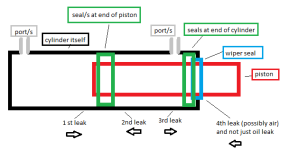
hyd leak cylinder piston.png

*rubs chin to shaking his head no*, i would have to say your could be wrong LD1.

going by diagram, leak 1 or leak 2. could allow the piston to either contract or extend.

leak 3, have seen multi pistons look "oily" and felt oily to the touch.

leak 4, with air possibly being drawn in over a given amount of time and not fully extending and fully contracting cylinders, could cause air to build up, causing the piston to "bounce around" a tad bit more.
 
/ Loader leak down. #18  
Leak 1 or 2 would not cause the piston to move with the type of valves we have on our tractors or backhoes. Like I said earlier, differing volumes of fluid. The base end has more fluid. There isn't room to put it on the rod side unless fluid leaves the cylinder somehow via leaky fitting, gland seal, valve, etc. And if the force is trying to extend the cylinder, it would be drawing a vacuum on the base end, as there ist enough fluid on the rod side to occupied the volume freed up on the base end. In this case, the cylinder will drift a little, but soon reaches equilibrium.

Leak 3 would allow drift but would show in the form of a leak at the gland/packing around the rod.

Leak 4 allowing air in would only happen if there is a leak at 1-2 AND you were trying to extent the cylinder. But the rod if the rod seals were not bad but the gland is, it would leak oil out instead of sucking air when trying to extend.

It's just how the valves on out equip is. They are designed to hold the load. Now in lots of industrial settings, we use valves that have the work ports open to tank when in neutral. If piston seals leak, it would indeed cause drift. But valves like that aren't used on out loaders or backhoes cause the second we let off the joystick, the loader would drop.
 
/ Loader leak down. #19  
Leak 1 or 2 would not cause the piston to move with the type of valves we have on our tractors or backhoes.
*scratches head* huh? a leak is a leak, what/how? does a valve have anything to do with seals at the cylinder and piston leaking.
 
/ Loader leak down. #20  
The piston seals can leak all they want. As long as there is no leaked external to the cylider, it won't move. It is hydraulically locked on place.

Remember, you have to account for the rod. It takes up volume. The cylinder is full of fluid. Forget about the piston and seals for a minute. If the cylinder is full of fluid and the rod is extended, you cannot push the rod into the cylinder without that fluid having somewhere to go.

Now attach the piston. Same principal. Even if the seals are removed, you CANNOT collapse the cylinder unless itnhas some way of getting out of the cylinder entirely. That's where a leaky valve, or leaky fitting, or leaky clans come into play.

Again, bad piston seals won't cause drift. Especially drift in the direction of retracting the cylinder. It may cause poor performance, but not drift.

Many things can cause drift, but not the piston. At least not with the type of valves on our tractors, where the work ports are isolated when in neutral.
 

Marketplace Items

2012 International WorkStar 7300 AWD Altec DC47TR Insulated Digger Derrick Truck (A60460)
2012 International...
Chevrolet 2500 Flat bed (A61307)
Chevrolet 2500...
2019 PJ  40FT GOOSENECK TRAILER (A58214)
2019 PJ 40FT...
SKIDDED WASTE WATER FIBERGLASS TANKS (A60736)
SKIDDED WASTE...
2019 Ford F-150 4x4 Crew Cab Pickup Truck (A60460)
2019 Ford F-150...
John Deere 4520 (A60462)
John Deere 4520...
 
Top