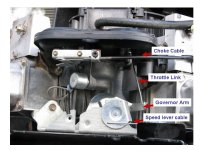
The governors job is simple. It limits the maximum RPM the engine will run. When unloaded the throttle is open less than 1/4, even with the throttle set to full. When the engine is put under work load, it will be slowed slightly, allowing the governor to open the throttle until the engine reaches the limit RPM. The type of governor that is in the crankcase is centrifugal. It is lubricated by oil, but does not rely on oil pressure to function. At lower throttle settings, the governor has an effect on the throttle. If the engine slows for any reason, it will open the throttle in an attempt to keep the engine running at the set RPM's
Enter a carburetor that won't idle. While free running a full throttle, (No load) the governor closes the throttle on the carb. to limit RPM. The engine starts to stall, and the governor opens the throttle to attempt to restore the set RPM. This causes the engine to rev too high, and the throttle closes. This cycle will repeat over and over until the engine is put under enough load to get the governor to open the throttle past the point of where the idle fuel circuit has an effect. (All fuel is entering from the main jet, which is much larger than the idle jet, and is less prone to clog.) This is probably somewhere around 1/3 or more of actual throttle opening. If you were to hold the carb throttle open at 1/3, the engine would be revving much higher than the governor is set to allow.
Bottom line: Restore your idle by cleaning the carburetor. Once the engine runs smooth at idle, it will run at any throttle setting without surging.