Traction Hydraulic wheel motor question

/ Hydraulic wheel motor question #1  

CreativeGuy

Bronze Member
Joined
Jul 16, 2011
Messages
83
Location
Newport, Oregon
Tractor
PowerTrac PT-425
Well, I managed to get Artie (PT425) stuck the other day. I was dumping some dirt and there was a really soft spot under the left front wheel. When I went to back up, the left front wheel dug itself into a hole and the right rear wheel came off the ground. I couldn't go forward as i was at the edge of an embankment. I'm new to hydraulic wheel motors so I don't understand why the right from wheel didn't turn when I tried to go in reverse. (the left wheel was spinning away) Is there some sort of traction control sending fluid to the wheel that has the least resistance?

I was abel to move forward enough to get out of the hole which I filled with gravel and then dug out the excess earth on the right side.

Guess I have to start working on getting a degree in fluid dynamics.

Cheers and thanks in advance for your responses.

Steve
 
/ Hydraulic wheel motor question #2  
It has a differential. It's supposed to work that way. The wheel with the least traction spins. If you have a locking differential, then both wheels try to pull equally regardless of traction.
 
/ Hydraulic wheel motor question #3  
The one with the least traction will slip but the opposite corner will get that flow so there is some torque loss, but you still have torque on the other wheels. I have found that when I get stuck if I turn the steering when left and right the side walls will get some extra traction and sometimes I can get out. It kinda walks out when I do this. Mostly use for going up hills that are too steep for motor torque. Try it and see. Couldn稚 hurt. There is no differential in this hydraulic tractor.
 
/ Hydraulic wheel motor question #4  
It has a differential. It's supposed to work that way. The wheel with the least traction spins. If you have a locking differential, then both wheels try to pull equally regardless of traction.

It does not have a differential.
It has four hydraulic wheel motors, one at each wheel, connected in a series/parallel configuration.
 
/ Hydraulic wheel motor question #5  
Usually, you can dump the bucket to vertical, push it down into the soil so it lifts the front wheels off the ground, push the reverse pedal slowly while curling the bucket and move backwards enough to get the front wheel out of the hole. Set down and repeat. In simple terms, use the bucke to push you backwards.

However, you mentioned dumping over an embankment, so your bucket probably had nothing to push down on anyway.

As I understand it:
- the left front and right rear wheels are in series(one in-line with the other), forming a circuit I'll call A.
- the right front and left rear wheels are in series(one in-line with the other), forming a circuit I'll call B.

-The variable volume pump provides FLOW to the wheel motor circuits. NOT PRESSURE.
-The pressure is developed at the wheel motors, not by the pump.

-The pressure is developed when the flow hits resistance.
-The resistance in circuit A, in this case, would be your left front tire against the dirt, and your right rear up in the air resisting nothing.
-The left front is spinning due to loss of traction, not due to loss of pressure or flow.

So why didn't the right front tire and left rear tire pull you out?

-Circuits A and B are connected to each other in parallel (side-by-side).
-Hydraulic oil takes the path of least resistance.

Once a wheel motor in circuit A starts spinning, that circuit becomes the path of least resistance and all the flow starts flowing towards circuit A, away from circuit B.

The more you spin the left front tire, the less flow will be available to the right front and left rear wheel motors.

Let off your foot pedal.

With very minimal reverse foot pressure, as Bob mentioned, turn the steering wheel lock to lock left and right, and you almost always can wiggle your way out of a stuck situation. It may take a while, but most times it will walk its way out. In 17 years, I've only been stuck one time, and that was when I drove over a hidden log and dropped both front tires over the log, and left them a few inches off the ground and the log holding up the tractor in space. Chainsaw to the rescue.

Do you have an owner's manual with the hydraulic schematic?
 
/ Hydraulic wheel motor question #6  
Here's a good video that explains flow and pressure... a very good video.

 
/ Hydraulic wheel motor question #9  
I got mine stuck once in the first few hours of use, too. Then I learned the wiggle and the trick of using the FEL from folks here, and I haven't been stuck since.

I rototill a terrace, our garden, every year, and there is a greed / fear dynamic. I want to till as much as possible, but I fear that the soft bank will slide out from under the PT. So far, I haven't tipped it over the edge, and I have been able to unstick the tractor by pressing down on the tiller and pushing myself out. Pucker factor...high. Somehow putting in a concrete retaining wall hasn't made it to the top of my do list, but it is getting there.

Welcome to the stucker club!

All the best,

Peter
 
/ Hydraulic wheel motor question #10  
It has a differential. It's supposed to work that way. The wheel with the least traction spins. If you have a locking differential, then both wheels try to pull equally regardless of traction.

It does not have a differential.
It has four hydraulic wheel motors, one at each wheel, connected in a series/parallel configuration.

I guess I have to disagree and say the machine in fact does have differentials.

A differential can be constructed in several ways,,,

Here is a test that can demonstrate that the PT has differentials;
With your pickup truck in park (automatic transmission), jack both rear tires off the ground.
Rotate one rear tire,,, note that the other tire will rotate in the opposite direction.

Now, lift the front tires of the PT off the ground with the bucket,, then rotate one tire.
The other tire, like the differential equipped pickup,, will rotate in the opposite direction.

The PT is equipped with hydraulic differentials.

Back in the 1960's, some cars had a "posi-traction" rearend.
In those cars, you could not rotate one tire forward, and cause the other to rotate in reverse.

I was never able to see in one of those,, but, they were a BIG problem, after they were a couple years old,,
clutches refused to slip,, the car would "hop" when going around a corner,, like an ATV does today.

My pickup has a locking rearend,, it will forward-reverse rotate the tires, as long as you do it slowly.
Speed the rotation up too much,, the differential will instantly "lock",,

I am getting off base,, slightly,, but,, the PT DOES have differentials,,, IMHO,,
 
/ Hydraulic wheel motor question #11  
Too bad we don't have a hydraulic block which would shift the series-parallel flow path of the wheel motors into a complete series flow path at the flip of a switch.

Turning corners might be difficult (not sure the steering ram would overcome the grip of wheels not turning different speeds), but it would be handy in getting you out when stuck, because then none of the wheels would spin if they lost traction... all the wheels would be forced to turn at the same speed.
 
/ Hydraulic wheel motor question #12  
Great thought!

Yes, a hydraulic differential would be a way to describe it. If you think about it, the fluid bypasses left / right are the hydraulic equivalent of a differential. It is the feature that keeps them from tearing up grass, and enables them to operate on soft ground without slippage.

There is a nice article over at Wikipedia on limited slip differentials and the many variations that exist today. It is an old problem with lots of interesting solutions.

All the best,

Peter

I guess I have to disagree and say the machine in fact does have differentials.

A differential can be constructed in several ways,,,

Here is a test that can demonstrate that the PT has differentials;
With your pickup truck in park (automatic transmission), jack both rear tires off the ground.
Rotate one rear tire,,, note that the other tire will rotate in the opposite direction.

Now, lift the front tires of the PT off the ground with the bucket,, then rotate one tire.
The other tire, like the differential equipped pickup,, will rotate in the opposite direction.

The PT is equipped with hydraulic differentials.

Back in the 1960's, some cars had a "posi-traction" rearend.
In those cars, you could not rotate one tire forward, and cause the other to rotate in reverse.

I was never able to see in one of those,, but, they were a BIG problem, after they were a couple years old,,
clutches refused to slip,, the car would "hop" when going around a corner,, like an ATV does today.

My pickup has a locking rearend,, it will forward-reverse rotate the tires, as long as you do it slowly.
Speed the rotation up too much,, the differential will instantly "lock",,

I am getting off base,, slightly,, but,, the PT DOES have differentials,,, IMHO,,
 
/ Hydraulic wheel motor question #13  
The differential in the PT allows one corner to spin, but the fluid goes through the spinning wheel and generates torque at the opposite corner. Very different from a standard differential. Only if the two in series loose traction do you loose all traction. I think this is a rare condition. Overall a good design.
 
/ Hydraulic wheel motor question #14  
I'm gonna try it first chance I get. Is I recall, I can't move any wheel on the tractor manually when its jacked up, regardless if the tractor is running or off. We'll see.
 
/ Hydraulic wheel motor question #15  
Hey creative. Lots of side tracking here. Wondering how you survived our first big storm. A couple of things about getting stuck. My property is clay which is real slick when wet. I have a set of chains that Helo immensely in the winter. Second is you have a quad with a winch ot another tractor or a come along then go get stuck. It’s a pita to walk out for a second machine but you do learn you limits which are often much greater than you think
 
/ Hydraulic wheel motor question
  • Thread Starter
#16  
Greeting All,
Thanks for the Hydraulics lesson and the great tips for getting unstuck. Wóodland, We also have mostly Saprolitic clay and yes, it’s sure slippery when wet. The chains sound like a good addition for traction. Though Artie will mostly be operating on gravel.
We survived the first big storm of the Season. 2.33” of rain since midnight and winds gusting to over 40mph in the last few days. Our earth sheltered home faces South which is where the big PNW storms come from. It can get quite dramatic to watch the storms from the comfort of a house protected under 1000 tons of earth.

Cheers,
Steve
 
/ Hydraulic wheel motor question #17  
I used to get stuck once or twice a year pulling loads of firewood out of the woods. My land is steep and has lots of springs. We also are unfamiliar with the concept of dirt - we have shale and clay. It is very easy to bury the PT in wet clay in just a couple of seconds. But I was not able to use traditional tractors on the trails because they would get buried in good conditions. I have been adding ditches where that makes sense and building up low spots as much as possible. That has improved things significantly if I stick to the trails, so much so that I do not believe I have put my duals on ever since I made the wheel adapters which give my PT a wider stance and clearance for chains. There are now only 4 or 5 areas where it is easy to get stuck during non-rainy weather if one os making multiple trips.

Ken
 
/ Hydraulic wheel motor question #19  
They were for those tires that JJ found at Surplus Supply, I believe. They have been great tires. They came mounted on rims so I made adapter plates so I could use them as is and get a wider stance as well. I had expected to put my duals back on during the warmer months but so far, I have not needed to. My recollection is that the tires were less than $60 with rims. I liked them so much and they were so cheap that I bought a spare set.

Here is the link
http://www.tractorbynet.com/forums/...adapters-pt1850.html?highlight=wheel+adapters

I updated the thread with the correct link for the CAD drawing etc
PT1850 Wheel Adapters

Ken
 
/ Hydraulic wheel motor question #20  
They have been great tires.
They came mounted on rims so I made adapter plates so I could use them as is and get a wider stance as well.
Ken

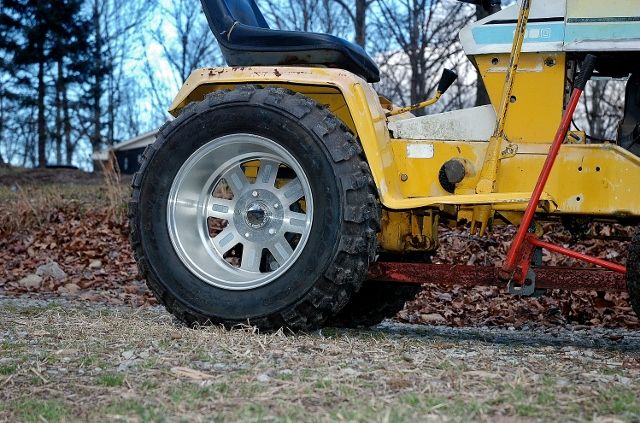
I purchased a set of ATV takeoffs from a surplus supply, and I had planned on doing the same thing,,
Before I got a chance to measure, the wheels looked close,, so I tried them,, mine was a perfect fit!

DSC_0016640x423.jpg


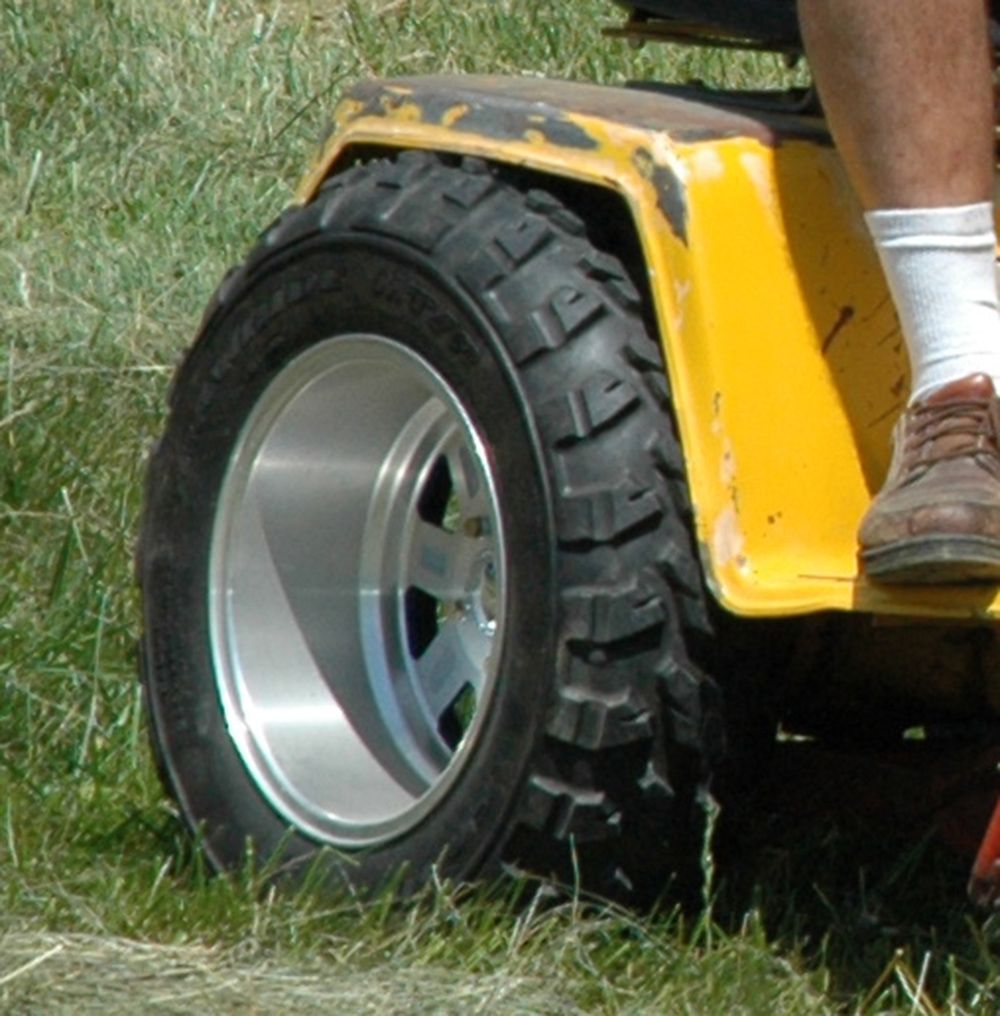
I had to mount them reversed (inside out), and, the tires are RADIALS!! :eek:

I never had so much traction with a GT in my life. this GT could back up a pretty steep grade,,,
backing up a grade with a GT is unheard of,, even with chains,, I love radials!! :D

tire_zps51651398.jpg


Yes,,, I had over 1/8" of clearance between the fender, and tire! It JUST looks like it is close,,, :laughing:
 
 
Top