Hydraulic Line Help Please

/ Hydraulic Line Help Please #1  

mustangfarm

Bronze Member
Joined
Jun 20, 2018
Messages
56
Tractor
L3400
I have a new to me L3400 with a Bradco backhoe.. There were no leaks or anything that I know about until this past week when I disconnected the backhoe.
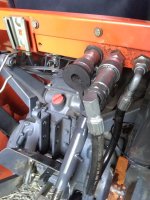
The tractor has a male and female quick connect at the back where the 2 backhoe hoses connect.
When the backhoe is off there is a short hose coming out of a 3rd port on the aux block with a female coupler that hooks back to return the fluid.

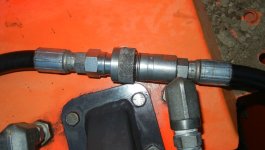
So my problem is that regardless if I have the loop/bypass hose hooked to the tractor OR the backhoe female hose , the coupler drips constantly.
I have tried cleaning everything but still drips. The fitting on the tractor is male and all the orings and moving parts seem to be in the female side. Seems odd that
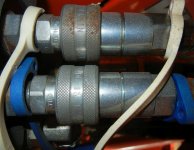
both the backhoe female fitting AND the Bypass fitting would both have bad orings , doesn't it?? The drip is enough to soak a rag in 5-10 min of use. (I tied a rag around the dripping fittings)

Another question is when the backhoe is off, I connected it's 2 hoses to each other, thinking that would keep the ends clean as it sits in the yard. That connection is now dripping as well.
I guess that makes sense since it is the same female end that was dripping on the tractor. Should I be looping them to each other in storage like this or is that a bad idea?

Also when you connect/disconnect these fittings, is it normal to get a dribble of fluid out? I have tried moving the levers around before doing so to relieve pressure but I always get a dribble.

My last question has to do with the safety of this fluid that is leaking? Is this basically the same sort of thing as ATF from my car in terms of toxicity/handling? I got it all over myself and I am sure some drips have reached the ground. I have read horror stories of people getting poisoned by hydraulic fluid.

thanks for any guidance. IMG_20190413_135118952 (1).jpg
 
/ Hydraulic Line Help Please #2  
The quick connectors can wear out over time or the o-rings can go bad in then. It should be a bulkhead fitting on the male and female side so it should be fairly easy and cheap to replace. Temperature changes makes the pressure change on the hoses with the connectors connected on the hoe and can make it leak if the o-rings or quick connects are bad. I have put o-rings in very old ones on a weekend to get by till the parts house opened.
Hooking the hoses together should make the hoe easier to connect later on and keep the quick connects clean. Most ag couplers will always dribble alittle when you connect and disconnect them.
As far as the toxicity of hydraulic fluid it is kinda like transmission fluid. If you get it on you wash it off when as soon as you can, just like motor oil. I worked on planes for years and have been soaked in hydraulic fluid a lot. Keep it out of cuts if possible because it burns like he!! Most of the horror stories are from people that have been injected by hydraulic fluid under pressure cutting into the skin or have a severe cut and it pours in it. I have never been injected by have had it in cuts and cleaned the cut with soapy water and kept on eye on them and they were fine. If leaked on concrete, put cat litter or oil absorbent on it cause it makes it slicker than snot. Hopefully this helps alittle.
 
Last edited:
/ Hydraulic Line Help Please
  • Thread Starter
#3  
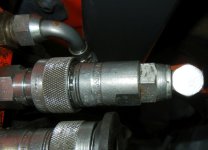
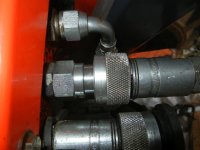
Thanks for the info. So I should be able to just remove those quick connects from my hoses and put new ones on? I originally was thinking they were the ends of the hose but it makes sense that the hose has a threaded end and these are attached to it. Here are photos of my ends that both seem to be bad. I assume the male end usually doesn't go bad. Hopefully they are not like pneumatic couplers where there are hundred different styles! My local Napa I know sells hydraulic lines and parts, I can check with them. Will I lose a ton of fluid when I remove these or will it be more of a dribble??backhoe.jpgtractor.jpg
 
/ Hydraulic Line Help Please #4  
They have different style and thread sizes and style of couplers just like pneumatics. Some are interchangeable but it will be easier to get 2 new male and female couplers that are the same style and and thread as the hose. It would be easier just to take one with you to the parts house. I haven’t used skid steer couplers ( flat faced) but some like them better than standard ag style couplers. If the hose on the tractor side is not valve operated until the backhoe is on it like the return hose on a loader, there should be no pressure in the line with the tractor off, just fluid and it being as high as it is you shouldn’t loose more than a teacup full changing those 2 quick connects. If you have a detent valve that you have to push on the tractor to use the backhoe( most aren’t plumbed this way), I would move it back and forth to relieve the pressure on the hoses with the tractor off. The valves on the backhoe should keep the backhoe from moving when you disconnect the quick connects on it to replace them but to be on the safe side I would mount it to the tractor before I change the quick connects on the backhoe. I would keep the hoses as high as comfortable to change the quick connects to keep fluid from draining out on the ground with the hoses laying flat. You shouldn’t loose much on those either.
 
/ Hydraulic Line Help Please #5  
Best to get male and female parts as a set. There are two types of ag connector- ball valve and poppet valve. Poppet is the newer style and most tractor makers use them. Most poppet connectors are supposed to handle ball too but sometimes they don't. The male sides cost $5-6 so there's not a lot of reason to use old ones.

The female connector with the 90 elbow on it does not look like the standard NPT female. You may need an adaptor between the connector and the elbow.

Connectors with two way release sleeves are easier to use especially when the connectors are not mounted to a bulkhead.
I use Loctite 545 on hydraulic NPT threads. It's better than teflon tape and teflon thread dope.
 
/ Hydraulic Line Help Please #6  
I would also recommend replacing the male ends as dents or worn areas may be the reason it leaks as much or more so than the female end. The female has the o-rings but the male maybe the cause of the damaged o-rings.
 
/ Hydraulic Line Help Please
  • Thread Starter
#7  
Thanks guys. Further investigation today and it looks like the part is 4050-15P Pioneer and they are 3/4-16 ORB
I might try just the O rings 1st to see how that works as the fitting sets are quite expensive and they are not very old.
I see many on ebay but they all seem to be 3/4-14... Tomorrow I will check the local NAPA that makes hyd hoses to order.

I went to Tractor Supply but nobody there knew anything about hydraulics and the selection was very limited. The couplers that they had that said 3/4" looked huge compared to what I have.
I believe my hose is 1/2" but my thread is clearly marked 3/4-16 ORB


Another thought, could I be doing something wrong and causing this?? There were no leaks until I took the backhoe off and put it back on.. Is it possible to have them not seated all the way?? I would think I would have much larger problems if that was the case.. Perhaps I just got some dirt in there when I opened them?
 
/ Hydraulic Line Help Please #8  
The 3/4-16 is the tread size, and they are likely -8 ORB which is 1/2". Make sure the 0-rings are duro 90. 70 is what you find in common 0-ring assortments and won't last long.
 
/ Hydraulic Line Help Please
  • Thread Starter
#9  
Yes I think the hose is 1/2".. one of the hose ends has a Gates number 8G-8MB which I believe is 3/4"-16 for a 1/2" hose
 
/ Hydraulic Line Help Please #10  
Another thought, could I be doing something wrong and causing this?? There were no leaks until I took the backhoe off and put it back on.. Is it possible to have them not seated all the way?? I would think I would have much larger problems if that was the case.. Perhaps I just got some dirt in there when I opened them?

When I first read your post, my reaction was that something is not connected correctly.

People tend to think hydraulic pressures are limited by relief valves in the system. Not so.

Think of this simple example. Using a loader, you pick up a bucket of wet gravel. The loader just barely gets it off the ground!
.
To save time, you decide to pile some interlocking pavers on top of the gravel by hand. The hydraulic fluid is locked in the cylinders as the loader valve is in its neutral position.
Because of the additional weight you are adding, the hydraulic pressures just go up and up. Eventually something breaks. The relief valve is not involved..

Make certain you do not have a hose in the wrong place. You might be creating pressures beyond what the couplers were designed for and they leak.

Perhaps there is residual pressure in the disconnected hoe. Not uncommon with any implement. This residual pressure is preventing the couplers from seating completely when you try and reconnect. With great care, unscrew the coupler from the backhoe hoses and allow a small amount of fluid to escape. It does not take much, if the hoe is supported and not relying on the hydraulic pressure in which case you need to support the hoe and then create the leak.

Dave M7040
 
/ Hydraulic Line Help Please
  • Thread Starter
#11  
Hi, thanks for your reply. I don't think I would need to open/release any as the backhoe was on it's bucket and stabilizers when i removed it but has since lowered itself so the mounting frame is sitting on the ground too. It has released a few teaspoons of fluid, even though the 2 hoses are looped/connected to each other. Maybe I should just open them and clean them and reconnect? There is only 1 way these hoses all can connect. There is only 1 male and 1 female on the tractor and same on the backhoe. When the hoe is removed there is a bypass hose on the tractor that loops the fluid back, it can only go on the 1 male fitting too. With it not connected the bucket won't even work, I tried! With it connected, the hydraulics work but it drips.. So it's connecting at least enough to pass fluid and make things work but maybe not seated fully? It could not be pulled out and I did about 15-20min of work with it dripping and a rag tied around it.
 
/ Hydraulic Line Help Please #12  
When the bypass hose is on and you do something on the tractor's rear end to make the hydraulic pressure build up. ... raising the 3 pt with a load on it for example, then the bypass hose should be under pressure and leak if the couplers are bad.

Try borrowing the coupler halves from the bypass hose and put them on the hoe hoses.

Dave M7040
 
/ Hydraulic Line Help Please
  • Thread Starter
#13  
Well that is the thing, they both are leaking.. The hoe couplers on or off the tractor and the bypass hose on the tractor.
 
/ Hydraulic Line Help Please #14  
Well that is the thing, they both are leaking.. The hoe couplers on or off the tractor and the bypass hose on the tractor.

Weird. Suggest you take the bypass hose to a local hydraulic shop and ask them to sell you one coupler pair to match the two different ends on the bypass hose.

Then use one new end of the coupler on the one of the hoe hoses. Use the other half of the new coupler on the tractor so you have a new mating pair of couplers. Do this on the line that you believe to be the high pressure one not the return,,, It the leak stop.... success. Couplers bought at independent shops are usually reasonably price in my experience often lower if you offer to pay cash with no receipt. There is no need to go with sophisticated couplers in your application.

Dave M7040
 
/ Hydraulic Line Help Please
  • Thread Starter
#15  
My feeling now is that I am not getting these hoses on all the way. They are on enough to not fly off and for fluid to pass but not to make a good seal. I notice a shiny area that is exposed when I have the couplers connected. I look at my loader couplers and there is no such space. I also looked at some at the dealer on backhoes and no such space.. Granted the loader and the dealer backhoes are different brand couplers, kubota ones.. Mine say made in italy.. so maybe they connect differently but it seems mine should go on more but I have moved the bucket control every which way til nothing moves and I have lowered my 2 pt hitch all the way to the ground and I still can not push this on any further. I have tried with/without the collar retracted.. See photos.fittingopen.jpgloaderfitting.jpg
 
/ Hydraulic Line Help Please #16  
My feeling now is that I am not getting these hoses on all the way. They are on enough to not fly off and for fluid to pass but not to make a good seal. I notice a shiny area that is exposed when I have the couplers connected. I look at my loader couplers and there is no such space. I also looked at some at the dealer on backhoes and no such space.. Granted the loader and the dealer backhoes are different brand couplers, kubota ones.. Mine say made in italy.. so maybe they connect differently but it seems mine should go on more but I have moved the bucket control every which way til nothing moves and I have lowered my 2 pt hitch all the way to the ground and I still can not push this on any further. I have tried with/without the collar retracted.. See photos.View attachment 600502View attachment 600503

I had couplers on an older Allied Loader, a 660, which required me to twist the knurled coupler collar in order to draw the coupler together. the coupler would never close with just pushing. The male end had a spiral grove which meshed with balls in the female knurled part. As you turned the knurled collar it screwed the male end into complete closure and lock

Try this and see what happens

Dave M7040
 
/ Hydraulic Line Help Please #17  
Pioneer 4050s have the regular collar that pulls back to unlock. When the male part is fully seated the collar snaps back and there's a click.

1/2" couplers can have 3/4" threads.
 
/ Hydraulic Line Help Please
  • Thread Starter
#18  
I'm thinking I may have pressure in the lines keeping me from putting them together correctly. The hose goes on though and the machine operates but just drips..
I would have thought moving all the levers on the bucket/3point would have released it..
I should have moved all the hoe levers before I disconnected it but I didn't. In fact i had weight of the hoe on the stabilizers when i disconnected it..
 
/ Hydraulic Line Help Please #19  
Moving the levers on the tractor should release the pressure. Maybe they need to be moved in reverse order, last in the chain first?

I've had my BH lines be pressurized even though I connected them together when I took it off the tractor. The way it was sitting there was weight on the boom. That pressurized the female connector and I could not get it's male to seat. It was obvious that it was not in and seated. I ended up removing the connector from its hose to let the pressure out.
 
/ Hydraulic Line Help Please
  • Thread Starter
#20  
Revisited this today with a clear mind.. The coupler is going on all the way. That exposed band in my pic is normal, based on the distance from the ball bearings to the end of the female 1/2 and the distance of the groove in the male... Fired it up again and let it idle about 5min, still got a drip at the bottom. Doesn't seem as bad as it was the other day but it's 50 deg out and it is all cold.. The other day when it was dripping fast, the fluid was hot as I was working it pretty hard.. I think I just need to replace these and be done with it. thanks all
 

Marketplace Items

2018 Chevrolet Trax SUV (A61569)
2018 Chevrolet...
UNUSED KJ 20'X12' LIVESTOCK METAL SHED (A62131)
UNUSED KJ 20'X12'...
UNUSED WOLVERINE HEAVY DUTY PALLET FORK FRAME (A62130)
UNUSED WOLVERINE...
HARDEE 5' ROTARY MOWER (A62130)
HARDEE 5' ROTARY...
2020 BOBCAT T770 SKID STEER (A62129)
2020 BOBCAT T770...
DYNAPAC CA250D SMOOTH DRUM ROLLER (A62129)
DYNAPAC CA250D...
 
Top