HST differences between brands

/ HST differences between brands #1  

getut

Platinum Member
Joined
May 18, 2004
Messages
751
Location
NC
Tractor
Kioti CK20HST
This post if half question and half statement, but I see in thread after thread on here discussions of HST's and comparing them to automatics and people talking about the infinitely variable speed. Never once have I heard mention that there is actually a minimum speed at which full torque is available even with an HST (at least on my Kioti CK20HST). The question part is... is that behavior unique to Kioti? It is also possible that due to this, just like with a gear tractor, the combination of needed speed and needed torque could be impossible, even with an HST tractor that otherwise has enough oomph. It just may not have enough at a slow enough speed or high enough speed, albeit this is probably much less likely than with a geared tractor.

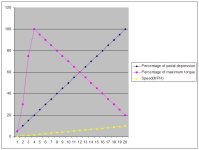
Using my CK20HST for example (and I have no idea if this same effect is reproducible on other brands or if it is specific to the Kioti CK20): If I slowly start pushing forward on the HST pedal, the torque and speed BOTH build up to about 20% of pedal depression (due to going from no hydraulic flow through the tranny up to the valve being 100% open at about 20% pedal depression). Then after the flow has reached maximum, then normal HST tranny physics are at work just as you guys talk about. See the graph that I made purely with fudged numbers, but just to explain the effect that I see, and that was also described to my by the dealer.

In effect, even HST, or at least MY HST does in fact have a minimum speed at which full torque can be applied... are all of them like this? I suspect so since I can't imagine any way around it.
 

Attachments

  • 577246-HSTExample.jpg
    577246-HSTExample.jpg
    49 KB · Views: 478
/ HST differences between brands #2  
The available torque and HP is dependant on the engine rpm. Setting the engine at 2600 rpm creates max power in my case. The amount you apply to the ground is then dependant on how far you push the peddle.

For example pulling a box blade with the rippers down. I have on occasion stopped the tractor catching really hard with the tires just spinning. As long as the rpm is up the power is being applied. If you start pulling down the rpm then your applying all the power and then some.
 
/ HST differences between brands #3  
I'll reply as not an expert on HSTs or tractors, but from my automotive engineering experience.

First, I'm assuming that in your post the term torque referrs to torque at the wheels, not PTOs. If not, please clearify.

Assuming that the engine is at PTO speed, then I would expect that your graph for torque be linear (negative slope) without any peaks. I haven't pulled much (yet) with mine, but at the slowest speed, just touching the pedal, the torque would be greatist.

I'll wait for the real experts...

- Eric
 
/ HST differences between brands
  • Thread Starter
#4  
ericinmich... that is exactly what it sounds like people are saying about HST that it is linear, but in fact it can't be unless I am missing something huge and Kioti also explained it this way to me.

When you aren't depressing the pedal, there is no flow through the transmission, no torque to the wheels and no speed. When you first start depressing the pedal, you are at a point of less than 100% hydraulic fluid flow, so even though the HST internals at that point would be configured for maximum torque and minimum speed, it can't actually achieve maximum torque because flow of fluid through it has not yet reached 100%.

The valve that opens and feeds the HST transmission does not fully open until approxitmately 10-20% pedal input. This is what causes the spike in torque at about that pedal input level, 100% flow has been achieved. From that point on through the rest of the pedal travel, the flow remains at 100% but the HST configuration changes to alter speed/torque.
 
/ HST differences between brands
  • Thread Starter
#5  
I guess another way to look at it like this. The HST pedal does not JUST reconfigure the internals of the HST to alter speed/torque. The first 10-20% of travel progressively opens the valve that provides flow to the HST in the first place. Until that valve is fully open, the HST is not recieving 100% flow (for the given RPM) on the input side.

Edit: This is the way that I understood it when it was explained to me.
 
/ HST differences between brands #6  
Why would you have to have 100% flow thru the HST(pump) to use all the available torque from the engine?

The HST is a pump, the more you press on the peddle the more you open the valve. You don't need the peddle pushed all the way to use all the engine torque.

If your tied to a tree and push the peddle down 20% and pull the engine down until it smokes and the tires are not turning you have applied 100% of the engines torque.

What is there to miss?
 
/ HST differences between brands
  • Thread Starter
#7  
Everywhere above I mention torque, I am talking about torque at the wheels, not engine torque. You will probably get what I am saying if you re-read it with that.
 
/ HST differences between brands #8  
There would be additional flow through the pump the faster the wheels turn. However I don't follow why the torque at the wheels would be less.
 
/ HST differences between brands
  • Thread Starter
#9  
No.. thats where the difference is.. flow through the pump (HST) is the same once the valve opens up (first 10-20% of pedal travel).

Same input flow (100%), but the geometry of that flow changes... large input reservoir/small output path = high torque slow speed, but push the pedal further and you get a small input reservoir/larger output path and you get higher speed but less torque. The amount of flow through the system is the same in both cases though.. speed doesn't change the AMOUNT of flow, just how fast it is flowing.

The case I am talking about is that 20% of pedal input BEFORE the amount of flow reaches 100%.
 
/ HST differences between brands #10  
You're talking about the "flow" of hydraulic fluid when it seems to me that the pressure might be a more important factor. /forums/images/graemlins/confused.gif But I'm certainly no expert on the topic.
 
/ HST differences between brands #11  
There is only so much flow and yes the geometry will be different as you step on the peddle. I did not make my statement very well, way to broad.

I don't claim to be an expert by any means but have a fair understanding of how it works.
 
/ HST differences between brands
  • Thread Starter
#12  
Ok.. that leaves just the single question. Is a hydro transmissions output torque a function of simply the input pressure and nothing else or is it a function of all factors (rate, volume, and pressure)?
 
/ HST differences between brands #13  
I sounds like you would like to view this mathematically. That is a good way to look at it. I recommend you review the hydraulic formulas.

The drive train is driven by a hydraulic motor. Torque this motor can produce is a function of pressure X displacement. So if you know the displacement and know the pressure, you can compute the torque. However...

The engine drives a hydraulic pump that drives the motor controlled by the hydro pedal. As far as I know there is no relief valve in this circuit. Therefore if you lock the wheels, the pressure will try to approach infinity until all hp has been exhausted from the engine which will promptly stall the engine. This is what I call a "hydraulic lock" (just my term, have no idea if it is a valid term).

Flow only comes into the equation when you start evaluating hp.
 
/ HST differences between brands #14  
It is easiest to think of it as the pedal controling the displacement of the variable displacement pump. For each revolution of the input shaft, it can push a variable amount of fluid through the wheel-drive half of the system. At the neutral pedal position, the pump has zero displacement - no fluid is actually pumped in either direction.

As the pedal is depressed, the pump increases its displacement. Assuming constant input RPM's (mechanical power source not lugging-down yet), the amount of fluid per rev increases. Conversely, the torque required on the input shaft for a given output hydraulic pressure also increases. To get maximum output torque on the wheels, the minimum displacement position of the pump will produce the most output pressure for the least input torque from the engine. This is the lowest "gear".

In a perfect HST pump, this holds true all the way down to zero displacement. At you approach that point, you would have max output pressure with zero flow.

In the real world, the pump is not perfect. Some of the fluid slips by the pistons (or wahtever mechanism it uses) and avoids being pumped. At low output flow rates (wheels not turning) and high pressures (trying to push an immovable object), the leakage becomes more than the output flow of the pump. This limits the lowest ratio the pump can operate at for a given RPM. This leads to a maximum in the torque curve similar to the graph posted.

Additionally, there could very well be a pressure relief in the system, limiting the maximum output pressure. Also, there could be pilot operated valves where a minimum flow is required before full pressure is developed or some other mechanism as was described to help produce a dead zone so as to prevent the tractor from creeping when the pedal is released.

- Rick
 
/ HST differences between brands #15  
Very well put Rick. The "leakage" or bypass flow (that portion of flow not producing work, just heat) also occurs in the motor portion of the circuit as well. It will also change as componants and oil heat up or cool down and with age (wear).
 
/ HST differences between brands #16  
There is no valve to open when depressing your hydro pedal.
Max tourqe is with hydrostate pump fully stroked.
 
/ HST differences between brands
  • Thread Starter
#17  
Thank you very much Keeney. That was pretty much exactly as it was described to me from Kioti. It does in fact create the torque curve as I posted. The numbers are made up, but the graph is very similar to what you would see in real life from what I understand.

I just see so many postings that seem to indicate that HST increases torque the lighter that you depress the pedal. To a point this is correct, but not entirely. Assuming a steady engine RPM for the all of the following.... both speed and wheel torque increase together for the first 10-20% of pedal input. Wheel torque reaches maximum somewhere in that 10-20% range of pedal input then starts declining again. Speed continues to increase through the entire range of pedal input.

For my tractor, which is HST, the "sweet spot" speed at which I can get full torque to the wheels is what I would guess to be around 1MPH. If I go faster I lose torque, and if I go slower I also lose torque. I have hit that magical borderline before where pulling an implement that is requiring just about everything my tractor could muster, I would like to go SLOWER than 1MPH, but couldn't because I would stall the HST.
 

Marketplace Items

JLG E300AJ (A60462)
JLG E300AJ (A60462)
2020 DRAGON 150 BBL ALUMINUM VACUUM TRAILER (A60736)
2020 DRAGON 150...
1005 (A61166)
1005 (A61166)
2000 Hyster S50FT (A55973)
2000 Hyster S50FT...
Komatsu HM-400 (A60462)
Komatsu HM-400...
KAESER COMPRESSOR (A60736)
KAESER COMPRESSOR...
 
Top