How to do engineering calculations?

   / How to do engineering calculations? #1  

TORQUIN

Silver Member
Joined
May 22, 2004
Messages
230
Location
Powhatan, Virginia
Tractor
Kubota L3830
Is there a web site or book I can get to learn how to calculate material strengths for a project?
For example, I just bought a stock trailer to store my stump grinder in, for the shelter and transportation. It was much cheaper than an enclosed cargo trailer, from the prices I see around here. The trailer came with a 3' ramp that was too short for the height of the trailer, when driving a stump grinding up it. I used some angle and expanded metal from a dirt strainer project I did a few years ago to lengthen the ramp. The angle iron used is 2"x2"x1/8" cold roll and I overlapped the old ramp by 12", and extended the ramp out 45" from the original 3'. I welded it on to the old ramp in strategic locations and proceeded to try it out.
As I drove the 3000 lb stump grinder across the ramp it bowed beginning where the ramp extension overlaps the old ramp and extending along the ramp extension.
My best guess at this time is that the 2"x2"x1/8" angle on the sides is not strong enough and I need to reinforce it. I'm thinking that I could just overlay another piece of angle there, of the same dimensions, and double my thickness for that area. I'm not sure how long a piece I should use, if I should go the entire length of the ramp extension or just a 12-18", or what.

This is why I would like to learn how to calculate what I need, so I don't have to be back and redo these things. Usually I overbuild things so I don't have to worry about it, but in this case I need to keep the weight down as I'm the one that has to lift this ramp twice at every stump job.

20131112_075020[1].jpg

Not sure why the pic uploaded sideways.

Thanks,
Chris
 
   / How to do engineering calculations? #3  
google 'steel engineering calcs', or, go here to learn more: Angle Iron Stress

I like the 'T' idea with 2 angles back-to-back..
 
   / How to do engineering calculations? #4  
   / How to do engineering calculations? #5  
for internet searches (rather than hard copy literature) you might search for "loads and resistances"
 
   / How to do engineering calculations? #6  
Unless you have engineering experience, you might still have a hard time working with some references. You will probably be using hot-rolled steel stock regardless, so that simplifies the material characteristics. From there, you'd want to look at beam calculations or tables. Might be easier to look at commercially built trailer ramps and copy what they do.

If you want some free advice from a mech engineer, I'd say you absolutely need some supports in the middle (ie, parallel to the sides, so that they are vertical when the gate is folded up). That would keep the expanded metal "deck" from bowing and dragging the sides down with it. For a 3000# machine, it's going to have to be heavy, no way around it.

For reference, my 7x16 landscape trailer gate uses 0.065" square tube framing, 1.5" square, which has about 2.9X the load capacity of equivalent sized angle iron according to my engineering handbook. There are 8 of the tubes across the width of the 7' ramp, about 12" apart. It's strong enough for my Kubota B2920 and implements, which gets into the 2500# range. One man can tilt it up/down, but it takes two people to easily remove and re-attach the gate (or I use the tractor).

If I reverse engineer my gate design and then re-engineer it using 1/8"x2" angle iron, it suggests I'd need approximately 6 pieces of 1/8"x2" angle to have about the same strength as 8 0.065"x1.5" square tubes. Right now you only have 2 pieces of angle, so you're about 1/3 of where you need to be. Add 4 more angles spaced evenly in between the existing two sides, and I bet you'll be in good shape. Add an extra if there is any doubt, or for extra margin.

I hope that helps.
 
   / How to do engineering calculations? #7  
Personally, I would remove the paint on the bottom of the "ribs" and weld on 4 1.5"x3/16 square tubes. Then, I would add on 4 "feet" that were welded about there the old gate ends and are long enough to reach the ground (possibly make them adjustable?).
I don't see any lift assist springs, so I would also make something like a Gorilla-Lift 2-Sided Tailgate Lift Assist, Model# 40101042G | Trailer Lift Gates| Northern Tool + Equipment to help lift the gate.
I would probbaly also remove the swinging back door to save on weight.

Our 3000# landscape trailer uses six pieces of 2"x2"x3/16" angle for the tailgate (its a split gate so each side goes down separately) and those aren't quite strong enough for our BX2660 and B7500.


Aaron Z
 
   / How to do engineering calculations? #8  
( "Is there a web site or book I can get to learn how to calculate material strengths for a project?" )

The fellows who do that for a living have usually spent fours years learning how to do it.:)
 
   / How to do engineering calculations? #9  
The fellows who do that for a living have usually spent fours years learning how to do it.

When I was being schooled on how to calculate loads and resistances I learned using a slide rule...these days they just plug their data into a software algorithm...
 
   / How to do engineering calculations? #10  
The fellows who do that for a living have usually spent fours years learning how to do it.:)

I doubt they spent their entire 4 years just studying load calculations and/or strength of materials. I don't believe he needs a four year degree to build some ramps, in fact I commend him for trying to this this a little more scientifically than "that looks about right" like most people (myself included) do. Do I need a chemistry degree to look at and understand a periodic table? No, but I bet can put salt on ice to get it melted.

I subscribed to this thread before there were any responses because I was interested in what people had to say. I too was interested in this same question because I have wondered the same thing.
 
   / How to do engineering calculations? #11  
the depth of the beam is the major key to strength,

most likely you can make a small and light weight addition on your current ramps that will nearly eliminate the problems, if the ram is not bent.
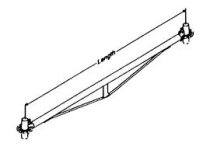
if you can straighten it out, use a 1/2 to 5/8" rod and put a few spacers, for a web, (flat, rod, small angle, etc.), and make a rod that will truss the under of the ramp most like a nice bow will be fine, I would say about 6" in the center, and then use the short pieces to fill in for a web, in the truss,

the pictures are not ideal but represents what I am trying to say,

years ago I made a moving ramp, abut 3 foot wide and 20 foot long, use some rebar for truss and it was made out of one inch square tubes and the 1/2 rebar truss I had two points in it to widen the truss, now I know it would not have most likely supported a 3000 pound machine, but it was not designed to, but the truss can strengthen them greatly and not add a lot of weight,

if all else a flat iron 1/8 on the bottom edge of the angle and increase it depth to 6" and trim the ends so it can work same as the angle to the earth would be (just a solid web),
 

Attachments

  • truss.jpg
    truss.jpg
    5 KB · Views: 175
  • TRUSS_PUTLOG.jpg
    TRUSS_PUTLOG.jpg
    26.6 KB · Views: 146
   / How to do engineering calculations? #12  
search around for a program called 'beam boy'. You can pick your shape/thickness and length and type of loading/support. It will tell you the peak stress and the deflection.

For smart phones, try 'epicFEM'.
 
   / How to do engineering calculations? #13  
the depth of the beam is the major key to strength,

most likely you can make a small and light weight addition on your current ramps that will nearly eliminate the problems, if the ram is not bent.
if you can straighten it out, use a 1/2 to 5/8" rod and put a few spacers, for a web, (flat, rod, small angle, etc.), and make a rod that will truss the under of the ramp most like a nice bow will be fine, I would say about 6" in the center, and then use the short pieces to fill in for a web, in the truss,

the pictures are not ideal but represents what I am trying to say,

years ago I made a moving ramp, abut 3 foot wide and 20 foot long, use some rebar for truss and it was made out of one inch square tubes and the 1/2 rebar truss I had two points in it to widen the truss, now I know it would not have most likely supported a 3000 pound machine, but it was not designed to, but the truss can strengthen them greatly and not add a lot of weight,

if all else a flat iron 1/8 on the bottom edge of the angle and increase it depth to 6" and trim the ends so it can work same as the angle to the earth would be (just a solid web),
Trusses are the strongest and lightest structure you can build. Something like in the first photo should do the trick for you and not be too terribly heavy. Just make sure the ends are welded securely. I would use 3/4" solid A36 steel rod for the truss with a tensile of 36,000 PSI it would have to stretch or break prior to the ramp bending.
 
   / How to do engineering calculations? #14  
the depth of the beam is the major key to strength,
First thing to fail on a beam is the flange. That's why engineers will have you add plate / flatbar to the flanges if the beam is in question.

A "PE" used this analogy to explain to me how a beam fails under load. Take a yardstick, support the ends, push down in the center of the yardstick, what happens? The yardstick bows out to one side or the other. It doesn't go straight down. It bows out to the side until it buckles. So if you beef up the flanges of the beam. Or box the beam in some how. The trick is to keep the beam from bowing to the side. The web has little effect to the strength on the beam.
 

Attachments

  • Flange Stiffeners.jpg
    Flange Stiffeners.jpg
    93 KB · Views: 195
  • Yard stick.JPG
    Yard stick.JPG
    242.1 KB · Views: 177
  • Yard stick bow.JPG
    Yard stick bow.JPG
    233 KB · Views: 162
   / How to do engineering calculations? #15  
simple --> go to school like the rest of us!

I am very leery of trying to explain how to perform calcs over the internet for various reasons. Your best bet would be to simply overbuild whatever your trying to do. Copying another design is also a pretty safe route to take. Steel shapes are rathering fascinating because depending on the loading and connections there are several different failure modes that could occur and each one needs to be examined to determine which one controls in a specific example.


Many individuals like asking about bridges and what size beam do I need? Simple question, not an easy answer. Everyone runs to the online calculators without knowing what they are actually looking at. They have no idea if the answer is reasonable or accurate. Close enough is usually the name of the game, or using whatever they were given for a good deal. I'm not trying to be critical, just trying to explain an engineer's point of view.


Shieldarc, the DEPTH of the web is critical to the strength of the beam. A simple "I" or "W" shape that acts like a simple machine if you will. Each piece contributes a unique attribute to the structural shape and is chosen for that exact reason.
 
   / How to do engineering calculations? #16  
So why does the same height W-shape take more weight than the same height S-shape?
 
   / How to do engineering calculations? #17  
First thing to fail on a beam is the flange. That's why engineers will have you add plate / flatbar to the flanges if the beam is in question.

A "PE" used this analogy to explain to me how a beam fails under load. Take a yardstick, support the ends, push down in the center of the yardstick, what happens? The yardstick bows out to one side or the other. It doesn't go straight down. It bows out to the side until it buckles. So if you beef up the flanges of the beam. Or box the beam in some how. The trick is to keep the beam from bowing to the side. The web has little effect to the strength on the beam.


The contributions of parts of an i-beam is a chicken/egg phenomena. All of the tension/compression strength is in the flanges. However, all of the shear strength, which is what holds it together, is in the web. The maximum shear is dead center in the web, in fact. If you can't handle the shear load in the web associated with the tension/compression in the flanges, they may as well be noodles. So the whole cross-section of the i-beam is important and matters. You can't have one characteristic without the other.
 
   / How to do engineering calculations? #19  
Reading a book on welding should be enough to get me a job as a pressure welder??:)
 
   / How to do engineering calculations? #20  
Why read a book when you have the internet and youtube? All you would ever need to know...


Seriously, they are many things you can learn and do on your own with the help of the internet. Building a skyscraper is not one of them however :)
 

Tractor & Equipment Auctions

SDLD25 MINI DUMPER (A58214)
SDLD25 MINI DUMPER...
2008 MACK CHU613 TRI AXLE 16FT DUMP TRUCK (A58018)
2008 MACK CHU613...
2004 Ford E-350 Bus -6.0 Powerstroke Diesel - 55k Miles - Inoperable/Non-Running (A56438)
2004 Ford E-350...
2020 PETERBILT 567 (A58214)
2020 PETERBILT 567...
2005 Komatsu PC 200 LC (A60462)
2005 Komatsu PC...
iDrive TDS-2010H ProJack M2 Electric Trailer Dolly (A59228)
iDrive TDS-2010H...
 
Top