How I check my torque wrench

/ How I check my torque wrench #1  

MillWeld

Gold Member
Joined
Feb 17, 2011
Messages
421
Location
Durham NC
Tractor
Ford 641
I got a lot of help on this forum when I was building my trailer including the importance of proper torque on the lug nuts. I bought an adjustable T wrench that clicked at the "proper" torque. I tested it by torquing a 1/2-20 nut at 10 ft-lbs. I stripped the bolt and it never clicked. Took it back equipped to demonstrate this but they had no vise or other equipment so I took my $ and went to Sears and bought one of simpler technology. I tested it too but more accurately.
I attached a "see/saw" arm to a vertical post in the barn. It pivots on a pair of pillowblock bearings and 2 feet away from the pivot point are hooks to attach a bucket filled with weights. I wanted to see if 90 ft-lbs on my wrench was accurate so I put weights in the bucket til it weighed 45 lbs. (2 feet x 45 lbs = 90 ft lbs).
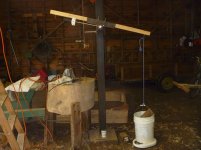
torque_calib 003.jpg


I put the wrench on a nut welded at the pivot point and leveled the "see/saw". The pic shows 95 ft lbs. Not too bad.
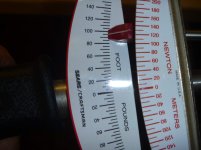
torque_calib 004.jpg


It is important to use 2 pillow blocks because I used self-aligning ones. Only one would misalign.
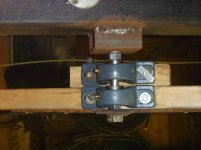
torque_calib 005.jpg

The assembly is well balanced when empty: It will remain stationary in the level position. It was a fair amount of work for a calibration that does not have to be done often but like most of us on this forum we like to do things like this and I know what my lugnuts are torqued to.
Bob
 
/ How I check my torque wrench #2  
I would have thought you would make the bolt head unmoveable (weld the bolt), then hang the weight from the center of the handle with the appropriate weight for the arm length to see if it is accurate. Otherwise there is still some friction in the pillow blocks. But otherwise it is about 5% off. Good enough for gumvent work.
 
/ How I check my torque wrench #3  
I just read up on this topic, by coincidence. Two thoughts. The longer your lever arm, the more precise your calibration. The site I saw recommended 8 feet. Also, they recommended calibrating all the way up and down the range, since the wrench's response may not be linear. They suggested buckets of water as easily adjustable weight.
 
/ How I check my torque wrench #5  
Yes, but how do you calibrate the calibrator? Who watches the Watchers?
The callibrator is cool, though. I want one - thanks for posting that link.
I like MillWeld's idea and edlegault's refinement.
Using both ideas gives you a physical measurement, rather than a reference to compare to.
 
/ How I check my torque wrench #6  
I just use a spring scale and clamp the square drive part of the wrench in a vise. Use the spring scale to pull on the torque wrench 12" away from the head. The spring scale should read the same as the torque wrench.

If a clicker type, I just set it, and see that it "clicks" at the right poundage.
 
/ How I check my torque wrench #7  
Yes, they do go up the line. The lab I work in, we take test equipment in to an internal Cal Lab to be calibrated. They in turn, have to take their equipment in to a higher rated Cal Lab. And on up the line of higher rated labs. It is all traceable.

Yes, but how do you calibrate the calibrator? Who watches the Watchers?
The callibrator is cool, though. I want one - thanks for posting that link.
 
/ How I check my torque wrench #8  
If you press "mem" and the "on" button at the same time, it goes into calibration mode and then IT can be calibrated. But I suspect I am down to feet and pounds at that point. All I wanted it for was to make sure my set of wrenches are right, and the calibrator came with a calibration certificate for itself, and I will quickly have my wrenches calibrated.
 
/ How I check my torque wrench #9  
If you press "mem" and the "on" button at the same time, it goes into calibration mode and then IT can be calibrated. But I suspect I am down to feet and pounds at that point. All I wanted it for was to make sure my set of wrenches are right, and the calibrator came with a calibration certificate for itself, and I will quickly have my wrenches calibrated.

The certificate of calibration will expire eventually. Still for most of our purposes it is good enough.
 
/ How I check my torque wrench #10  
This was discusses not too long ago.

There are palces that will calibrate torque qrenches. Sometimes even the Snap-On truck. Otherwise if you google/search in your local area, often there are calibration houses that have the strain gauges to do the measurements.

Also, most torque wrenches are accurate in the middle of their range. They fall off the bell curve as you go ove/under the middle of thier range... If you meaure 20ftlbs on a 150ftlb torque wrench, it will not be in it's more accurate range.
 
/ How I check my torque wrench #11  
Also, most torque wrenches are accurate in the middle of their range. They fall off the bell curve as you go ove/under the middle of thier range... If you meaure 20ftlbs on a 150ftlb torque wrench, it will not be in it's more accurate range.

A good question is, just how accurate do you really need the wrench to be? I have read that a typical wrench is accurate to +/- 4% of its read value, for a total precision of about 8%. That's pretty substantial if you're thinking of it as a scientific instrument, but do you really need your lug nuts to be tightened down more precisely than that?
 
/ How I check my torque wrench #12  
For lug nuts no. But after working in high-tech labs for years, I'm so used to critical tolerances :D

A good question is, just how accurate do you really need the wrench to be? I have read that a typical wrench is accurate to +/- 4% of its read value, for a total precision of about 8%. That's pretty substantial if you're thinking of it as a scientific instrument, but do you really need your lug nuts to be tightened down more precisely than that?
 
/ How I check my torque wrench #13  
I check mine by letting the tire shop put on my lug nuts. If it takes about 300 ft lbs to take them off, my torque wrench is perfect.
 
/ How I check my torque wrench #14  
I check mine by letting the tire shop put on my lug nuts. If it takes about 300 ft lbs to take them off, my torque wrench is perfect.

i don't think i'd ever resort to an adjustable torque wrench for installing lug nuts. it's torque sticks and an impact for me. good job to the original poster though, for coming up with a homemade method to calibrate.
 
/ How I check my torque wrench #15  
For lug nuts no. But after working in high-tech labs for years, I'm so used to critical tolerances :D

The older I get, the more I appreciate tolerance ranges. If something has to be accurate to within 1/10th of a degree, or 2 ft-lbs, then I will take great pleasure in devising a mechanism to accomplish that. But the rest of the time, I get it in the ballpark and get on to something else. Git-R-Done!
 
/ How I check my torque wrench #16  
I find this thread interesting because I picked up an OTC 10-250# torque wrench at flea mkt. It's in really nice shape and I was wondering just how to check calibration. Now I have several options on doing that. If it's within 5% I'll be a happy camper.
 
/ How I check my torque wrench #17  
This was discusses not too long ago.

There are palces that will calibrate torque qrenches. Sometimes even the Snap-On truck. Otherwise if you google/search in your local area, often there are calibration houses that have the strain gauges to do the measurements.

Also, most torque wrenches are accurate in the middle of their range. They fall off the bell curve as you go ove/under the middle of thier range... If you meaure 20ftlbs on a 150ftlb torque wrench, it will not be in it's more accurate range.

at work we were taught to not use a torque wrench if the value needed is in the top or bottom 10% of its range.

A good question is, just how accurate do you really need the wrench to be? I have read that a typical wrench is accurate to +/- 4% of its read value, for a total precision of about 8%. That's pretty substantial if you're thinking of it as a scientific instrument, but do you really need your lug nuts to be tightened down more precisely than that?


I check mine by letting the tire shop put on my lug nuts. If it takes about 300 ft lbs to take them off, my torque wrench is perfect.

I was also taught to NEVER use a torque wrench to break torque on a fastener! it is only for tightening! what I was told is that breaking torque on a fastener with a torque wrench screws up the calibration of the torque wrench.
 
/ How I check my torque wrench #18  
at work we were taught to not use a torque wrench if the value needed is in the top or bottom 10% of its range.

I think what you were taught is fine.

The internals are fairly robust, but the spring should be stored slack, and care should be used with the setting process.

How does a torque wrench work?
 
/ How I check my torque wrench #19  
scrappy isb67 said:
I was also taught to NEVER use a torque wrench to break torque on a fastener! it is only for tightening! what I was told is that breaking torque on a fastener with a torque wrench screws up the calibration of the torque wrench.

My understanding is that is because the nuts can sieze up and the torque to remove them can exceed the wrench's range, even if they were put on to spec.
 
/ How I check my torque wrench #20  
I check mine by letting the tire shop put on my lug nuts. If it takes about 300 ft lbs to take them off, my torque wrench is perfect.

I forgot to hit the "sarcasm button" when I posted this. I'm not sure how high my torque wrench goes, but not anywhere near 300 ft-lbs.

Years ago I checked my torque wrench just by comparing it to a lug nut tightened by another torque wrench. They seemed close.
 
Last edited:
 
Top