Help with creek crossing

/ Help with creek crossing #1  

Jisgren

Bronze Member
Joined
Dec 13, 2013
Messages
86
Location
Houston, tx
Tractor
None
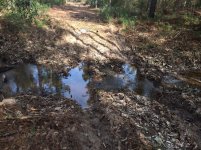
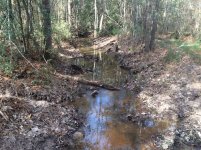
Need to put in our main road to our house and cross this creek. It is normally a dry creek and only flows during large rains. Creek is very flat so current does not look too fast. Bank to bank is about 10 ft and depth looks like about 2-3 feet. Any suggestion - culvert, pipe arch, box culvert? Also any idea on size?

image.jpgimage.jpg
 
/ Help with creek crossing #2  
Some question for you
Are there any culverts on same creek close by? Are they working without problems?
How many acres does this creek drain.
What is growing on drainage area? Trees have debris which must get through structure.
What is the highest amount of rain expected in the area
Any other access points if culvert washes out in high rain event
 
/ Help with creek crossing #3  
Not knowing the amount of water in a large rain, but from the pics the flow area appears to be about 3' w 12" deep

A single pipe arch might work 36" at the base but your cover height needed for heavy loads (cement truck) may be 20" or more. This may be too high making a ramp or needing a lot of fill before and after the stream.

Two 18-20" side by metal culverts with 12-16" compacted cover height would allow the grade to be lower.

Concrete box or similar would probably be best for heavy loads and need less cover - but best to check on the specs for cover on these.
 
/ Help with creek crossing #4  
When the creek is flowing the fastest- what is the depth and width? That is what you have to plan for in sizing your culvert to avoid wash outs. Corrugated culverts come in all sizes - even on craigs list. I have only opinion- but I would think that you would never want as much as a 1/3 of the culvert full during peak flow to avoid a washout.
Found this:

Instructions
Sizing
1
Find the high-water mark of the stream. This is the level at which vegetation meets bare earth and rock. Drive a stake into the high-water line on either bank. Connect the stakes with string and measure the distance.

2
Find the low-water level of the stream. This is typically the level at which the slopes of the stream banks flatten into the stream bottom. Measure the width at this level.


3
Find the depth of the stream at high water. Simply measure the height from the stream bottom to the string marking the high-water line. You can take several measurements and average them if the depth is very irregular.

4
To find the cross-sectional area of the stream, simply take the average of the high-water width and the low-water width and multiply it by the depth at high water. The cross-sectional area of the culvert should be at least 1.25 times that of the stream. If the stream is at high risk of flooding, though, the factor should be 1.75 for 25-year floods or 3 for 50- to 100-year floods. Use the chart in Resources if you need help converting the culvert's cross-sectional area to a diameter.

5
Measure the width of the roadway and its adjacent side slopes to determine the length of your culvert. The length of your culvert should equal this width plus two feet.

Installation
1
Excavate at least 6 inches from the bed of the stream. Follow the slope of the stream when you excavate, which typically measures between 2 and 6 percent. If your excavated slope is less than 2 percent, water can stagnate in the culvert.

2
Fill the 6-inch trough you've created with soil or sand. Pack it in with the soil compactor.

3
Place and center your culvert. All but the smallest of culverts will require a backhoe for this operation.

4
Fill around the culvert with soil or sand. Pack the material in after every 6 inches of fill, and be sure that it is free of rocks. Cover the culvert with at least a foot of fill material.

5
Seed the top of the culvert with grass, or lay sod over it. You may choose to spread and pack gravel over the roadway section. Protect the dirt around the culvert by jamming flat rocks or broken concrete into the stream bed around each mouth of the culvert.


Read more : How to Lay Culverts | eHow
 
/ Help with creek crossing #5  
Where is your place located? Looks like grimes county

Brett
 
/ Help with creek crossing
  • Thread Starter
#7  
Some question for you
Are there any culverts on same creek close by? Are they working without problems?
How many acres does this creek drain.
What is growing on drainage area? Trees have debris which must get through structure.
What is the highest amount of rain expected in the area
Any other access points if culvert washes out in high rain event

About 30-40 acres of pine plantation. No culverts upstream. Will have to cross creek to get out, planning on putting second crossing in later. 90 % of the time the creek is dry. - I was told that someone actually hand dug the creek out years ago to drain a lake on their property.

We just bough the property last April so haven't been out there enough to see creek, although last weekend was the first time I have seen any water in it. That being said this will be our main road so want to do the crossing correctly. I was thinking about 4x3 box culvert with concrete wing walls, but not sure the cost -- don't want to go cheap but need to stay within reason.
 
/ Help with creek crossing #8  
I'd ditch the culvert :) plans and go with a concrete slab. Initial cost is higher, but there's less maintenance. Volume is not an issue either.
 
/ Help with creek crossing #9  
Or, buy a flat rail car, they hold upwards of 100,000k#'s and plenty long. Another option would be a flatbed trailer (semi size), they also have a good load rating.

This place has a distributor in Houston for RC bridges
Paragon home
 
/ Help with creek crossing #10  
I built a 16' X 10' bridge using RR Ties; three 16' stringers setting on 12' sill logs and decked with 2" rough fir deck. I drive my 1 ton dually full of sand or gravel over it all the time. Way back I responded to several of these threads with more details. My creek is similar to yours.

Ron
 
/ Help with creek crossing #11  
Co-worker had a dry creek crossing about that size that went to the house he was having built. The culverts kept getting washed out during flash floods. He went with a concrete bridge and has not had a problem since.
 
/ Help with creek crossing #13  
Since the approach(s) will also flood I don't think a bridge would have any advantage. I would go with several smaller culverts(18-20") side by side, then pour concrete over them. During a real flood they will just go under water and let the debris go over top of them. Of course during the flood you won't be able to drive in or out but as long as you are prepared for that it's not a big deal. Many driveways are done this way in my area and none have washed out.

The creek that runs through my place is 35' wide bank to bank and has 6-8' banks. The county put in a million dollar concrete bridge over it to serve the 4 houses on this other side. During the winter we average anywhere from 2-10 floods that flood the approach. The nice fancy bridge is high and dry, but the road is 3' under water.
 
/ Help with creek crossing
  • Thread Starter
#14  
Neither approach/road shows any sign of floddong - both are covered in pine straw
 
/ Help with creek crossing #15  
I have much the same issue with a piece of the lake backing up onto my property. Look at the houston craigslist and type in "flat shipping rack". I found this guy who sells these things, he goes by Forklift Mike. They are 40ft long, weigh 11k lbs and can handle a load upwards of 100k lbs. I plan on building a couple piers on both sides of the lake and then setting this across. I think the weight will keep it in place during the worst of floods but I'll chain it to a tree or something just in case. If you don't have the equipment, you'll probably need an excavator or crane for an hr or so to set it in place. Just a thought. Mike said he sells alot of these for bridges. He sold two last in the last couple of weeks to guys in Madisonville for bridges. My place is in limestone county so I'm paying Mike to bring it up there. I only have a 27' flatbed.
 
/ Help with creek crossing #16  
Lucky guy, vpracer! I couldn't find anybody with a used flat rack for sale up here. In any case, pricing is outrageous...even regular 20 ft shipping containers are nearly 3X the SE US price.

Back to the OP...I was wondering if a concrete-floored ford wouldn't work for that crossing. You could install when things are totally dry and the only potential problem would be during rainstorms (or snowmelt?) when the water might be too deep/swift to safely drive through.
 

Marketplace Items

SHORTWOOD 5 BOLTSTER LOG TRAILER (A64276)
SHORTWOOD 5...
2019 Ford F-550 4x4 Altec AT40G 40ft. Insulated Bucket Truck (A64556)
2019 Ford F-550...
2004 INTERNATIONAL 4300 4X2 S/A UTILITY BODY TRUCK (A66091)
2004 INTERNATIONAL...
2023 JCB S3246E ELECTIC SCISSOR LIFT (A63276)
2023 JCB S3246E...
6 Band Wood Barrel (A64557)
6 Band Wood Barrel...
2022 International LONESTAR 6X4 T/A SLEEPER TRUCK TRACTOR (A67148)
2022 International...
 
Top