Help needed on HVAC duct and moisture

/ Help needed on HVAC duct and moisture #1  

EddieWalker

Epic Contributor
Joined
May 26, 2003
Messages
27,628
Location
Tyler, Texas
Tractor
Several, all used and abused.
This is something new to me. I have a client who owns an older double wide mobile home with some soft spots in her floor. Normally this is a pretty simple repair, I remove the carpet, cut out the bad area of particle board and install new particle board. When I pulled up the carpet, I saw this!!!
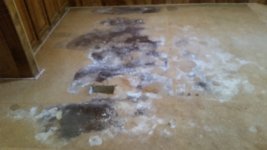

12042821_10207966575344925_8625606338168659079_n.jpg


I removed some of the wood and realized that the mold and rot was fallowing the path of the HVAC duct under the floor
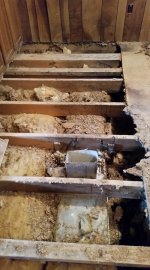

12047095_10207972424611153_4148140138484772455_n.jpg


Then I felt the top of the duct and found it to be wet. Some spots where so wet that the insulation around the duct would drip water.
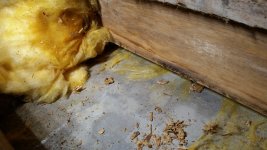

12019873_10207972684417648_1495452384544013850_n.jpg


So my first thought was there is a leak somewhere. On the other side of the wall is a bathroom. The vanity is right over the duct, so I removed the vanity, cut a hole in the floor and found learned that the duct there is totally dry, and the only pipe that crosses over the duct is the sink drain line, which is also perfectly dry. That was a waste of time, but at least we know it's not the problem.

I removed more of the sub floor and opened up the area so I could get under it and discovered that their is a big air vent line coming from the other side of the mobile home to this side. It's a big flex line, maybe 15 inches. It comes along the ground and then straight up into the bottom of the metal duct that you see in the pictures. The metal is very thin. I cut it with my sheetrock knife. The insulation around the metal duct is also very thin.
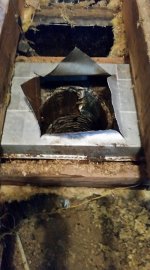
12038322_10207973247991737_7622405624830730832_n.jpg


If I was to guess, I think that the moisture is thickest, or heaviest at the point where the big duct comes into the metal line, and then goes left to right. I think that the cold air hitting the metal causes condensation on the outside of the metal duct. It is wet on the bottom too, but not as much. I think the moisture on the bottom drops to the dirt below, but it's so dry under there I can't prove that. I think that the moisture on the top has slowly spread out, down along the top of the duct. The joists show wet staining where the duct touches the insulation on top of the duct. Over time, the moisture has led to the particle board growing mold, and then rotting.

Does that makes sense, or am I way off base?

My solution is to super seal up any holes that might be in the fitting that connects the flex supply line to the metal duct. Then I plan to use expanding foam between the 2x6 floor joists and the metal duct. There is about a half inch gap there after I removed the insulation. Then I will cut and fit 3/4 inch Styrofoam boards on top of the metal duct, then R19 insulation of top of the foam with the vapor barrier facing down.

Will this stop the condensation from forming? Will this protect the new 3/4 inch plywood that I'm going to put down instead of the 5/8 particle board that was there?

What else can I do, or what should I do instead?

Thanks, I'm struggling with trying to make this right without any real experience. Every AC guy I know, I called, and they all said that they have never seen this before, only water build up inside the ducts from dirty coils.
 
/ Help needed on HVAC duct and moisture #2  
Any access to drop the duct, wrap it and reattach it with separation from the joists? Vapor barrier around the pipe/separation from absorbent material would solve it.
 
/ Help needed on HVAC duct and moisture #3  
Just today Eddie I was talking to the guy on the job installing the ductwork. He was wrapping all the supply ducts with that bubble/foil stuff. We were BS-ing about stuff (ductwork) and he mentioned that they'll drip water in the A/C season. Sounds like you are right on. I guess the ff bubble wrap will not absorb the condensation, but that makes me wonder what or where does this condensation/water eventually go?
 
/ Help needed on HVAC duct and moisture #4  
Any duct work that runs thru uncontrolled area must be wrapped in insulation. Like the Beer can affect with moisture on the sides.
 
/ Help needed on HVAC duct and moisture #5  
Any duct work that runs thru uncontrolled area must be wrapped in insulation. Like the Beer can affect with moisture on the sides.

This guy was installing it in "conditioned" space, I could see it being even more important under a trailer.
 
/ Help needed on HVAC duct and moisture #6  
This guy was installing it in "conditioned" space, I could see it being even more important under a trailer.

Wasn't talking about you.
 
/ Help needed on HVAC duct and moisture #7  
Eddie, Make sure all duct is off the ground, Even insulated duct will wick moisture if there's ground contact.
 
/ Help needed on HVAC duct and moisture #8  
Anything you can do Eddie to keep the moist air from making contact with the duct will eliminate the condensation problem for you.Sounds like your plan is on the right track.
 
/ Help needed on HVAC duct and moisture #9  
I think you have the diagnosis correct.

Anything I have read about insulation and moisture is all about isolating cold surfaces from warm moist air, so that the warm side of the insulation is warmer than the dew point temperature. Otherwise, you'll get condensation. No difference whether we're talking about cold AC ducts and warm exterior air in summer (condensation on the outside of duct) or warm heating ducts and cold exterior air in winter (condensation on the inside of duct).

So yeah, insulate it best you can. Also, if you can isolate/separate the ducts from the subfloor and framing as much as possible, that can only help. Anything that puts the duct in contact with the framing or subfloor (even insulation) can potentially conduct cold to the framing and subfloor where moisture can condense. If there is an air break between the duct and the framing and subfloor, you remove that possibility. So I'd say insulate the heck out of the duct, and move it away from framing and subfloor if possible. If space is so tight that you can't move the duct down away from the framing and floor and the duct insulation must contact the floor, then you have no choice about avoiding the conduction aspect.
 
/ Help needed on HVAC duct and moisture
  • Thread Starter
#10  
Thank you. I've been confused on this one and it's real important to me to understand a problem before fixing or covering it up. The duct is tucked right up to the bottom of the floor joists, so I have a 5 1/2 inch space between the top of the duct and the bottom of the sub floor. What amazes me is how much moisture the sub floor absorbed from the vapors of the condensation. I'm thinking that moisture caused mold to grow, which led to the rot and buckling of the particle board. I'm going with 3/4 inch plywood that will be glued and screwed down to make it stronger then before.
 
/ Help needed on HVAC duct and moisture #11  
You need to get insulation BETWEEN the bottom of the joists and the top of the duct. I know what a pain working under a trailer is, so it will not be easy. Try to loosen the duct hangers enough to get a 1/2" gap to fill with insulation- vapor barrier on the outside. Even a 1/4" gap with the foil-faced "bubble wrap" insulation will help.
Another solution is to cover the ground under the trailer with heavy plastic sheeting to minimize moisture coming from the earth below- your source of most humidity problems. Make sure the space is well ventilated also.
 
/ Help needed on HVAC duct and moisture #12  
What about using treated plywood as a back up plan in case the moisture problem isn't solved?
 
/ Help needed on HVAC duct and moisture #13  
What do you think of dropping the duct 1/2" and using spray foam between the duct and the floor joists? Spray foam might be good on the duct everywhere to. Ed
 
/ Help needed on HVAC duct and moisture #14  
As mentioned, insulating the duct (preferably by wrapping it in R8 duct wrap) is the way to do it.

However, mobile / modular homes should use a blower with a high static blower drive due to the possible ductwork size. Guys installing equipment in mobile homes tend to use a standard air handler, and you can get away with it and never get bit. However, I can remember two jobs where guys got bit due to moisture/water issues, and it did come down to wrong air handler being used. It's a roll of the dice and generally you don't get bit (which is why a lot of guys do it), but it can happen.

If the HVAC system is old as the mobile home, this is probably not the case, but wanted to ensure that this possibility was eliminated.
 
/ Help needed on HVAC duct and moisture
  • Thread Starter
#15  
The HVAC system is around 6 years old according to my client. She had it serviced a few months ago, and there does not appear to be any moisture inside the duct that I can find. Bone dry.

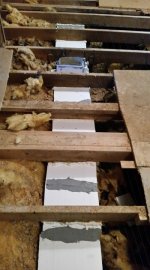
There was enough room under the joists that I was able to slide 3/4 inch Styrofoam between the duct and the joists. Then I sealed up all the edges with HVAC sealant stuff that they sold at Lowes. There was two types, I went with the more expensive.


12075034_10207978927813729_7410145513733680576_n.jpg


Then I wrapped the duct with R19 insulation with the paper towards the duct. Then I filled in the rest of the floor with the same insulation keeping the paper facing down. I also added a couple boxes of mothballs to the insulation. I think the main reason for this problem is from squirrels getting into the insulation and making their home in there. Most of it's all gone and I found acorns, leaves and sticks in there. She had the siding redone and put in all new skirting around the bottom of the mobile home a few years ago, so that probably stopped the squirrels. I didn't see or smell anything to indicate that they are still a problem.

12096157_10207979254781903_4977299845022224276_n.jpg

Monday I will finish gluing and screwing down the 3/4 inch plywood that I'm using to replace the 5/8's particle board.


Thank you for the advice and helping me wrap my head around this.
 
/ Help needed on HVAC duct and moisture #16  
You've done a thorough job Eddie I can't see where there could possibly be any more condensation problem.
 
/ Help needed on HVAC duct and moisture #17  
I suspect there was an air leak at the round to rectangle junction because that area wasn't sealed properly.

Vapor barrier should go to the warm moist air side of the insulation which is the outside.
 
/ Help needed on HVAC duct and moisture #18  
That's a first for me to Eddie. I think you're on the right track for the repair, try to minimize porous insulation as much as possible sticking with the foam everywhere you can to prevent future troubles. A method that is becoming more popular around me is to insulate and condition crawlspace areas and not insulate ductwork there. Also a vapor barrier of plastic on the floor of the crawlspace area under the trailer should help minimize humidity levels.
 
/ Help needed on HVAC duct and moisture
  • Thread Starter
#19  
I suspect there was an air leak at the round to rectangle junction because that area wasn't sealed properly.

Vapor barrier should go to the warm moist air side of the insulation which is the outside.

I forgot to mention there was a quarter sized hole where the duct was installed for the room and most of the foil tape was coming off where the supply line attached to the duct. I sealed both up
 
/ Help needed on HVAC duct and moisture #20  
Already mentioned, dew point temperature was reached because of the leaks and caused the moisture problem. Here is an example. If the temperature under the house is 88° with a relative humidity of 72 percent the dew point temperature will be 78°. It's common for supply air in the ducts to be 60 or so degrees and even lower so we can see that if that leaking air cooled the surrounding material to 78 or lower there is a moisture problem that you and home owner have encountered.

When rebuilding I might even go as far as to drop a dial thermometer in a 1/4" hole of the sub floor in that area just to monitor it for a few days while the A/C is in operation.
 

Attachments

  • A C supply 58 - 2015.jpg
    A C supply 58 - 2015.jpg
    125 KB · Views: 103

Marketplace Items

2014 Bobcat T550 Compact Track Loader Skid Steer (A59228)
2014 Bobcat T550...
2019 Jeep Grand Cherokee SUV (A59231)
2019 Jeep Grand...
2016 Ford F-150 Crew Cab Pickup Truck (A59230)
2016 Ford F-150...
FRONT MOUNT TANK BRACKET (A60430)
FRONT MOUNT TANK...
MORBARK WOOD HOG 3400 XT HORIZONTAL GRINDER (A60429)
MORBARK WOOD HOG...
Unused 2025 CFG Industrial MH12R Mini Excavator (A59228)
Unused 2025 CFG...
 
Top