Hay Making for Dummies

   / Hay Making for Dummies #1  

Dave5264

Gold Member
Joined
May 25, 2009
Messages
376
Location
Near North Ontario Canada
Tractor
08 Montana C5264, 2011 McCormick CX100 XS
Hi Guys, I'm the Dummy in this post, and I need educating by the experts and seasoned farmers out there.

This is my first year on the farm doing my own hay.

Im trying to collect as much info/knowledge as I can before the harvest season arrives.

I have some older New Holland equipment - late 70's/early 80's - 9ft NH hay bine, a late 50's NH Rake (real nice shape) and a late 70's/early 80's Sm Square NH Baler.

Tractor is a 2008 52 hp 4wd Montana c5264, 80 hrs on it

I know the basics (the real basics), cut one day, rake the next, bale the day after that. Dont let the hay get wet after its cut. Keep the machinery well oiled and Greased (alot)

I plan to mow a row or two (or maybe one lap around the field), Rake and Bale that first, just to get used to it. I dont think mowing all 75 acres at once would be wise for a newbie.

I have no clue on anything else, here are but a few of my unknowns:

-how high the cuting bar of the mower should be off the ground
-how high the Rake tines should be off the ground
-the PTO RMP speed to run the Mower at
-the PTO rpm to run the Baler at
-what speed/gear to run my tractor at while, mowing, raking, baling -- is slower better? e.g. i tend to use Low gear when working but not sure if 2nd or 3rd gear low is too slow (or good since it doesnt over stretch my 52 hp tractor)
-Baling is the part that worries me most -- seems like that twine has a lot of places to be routed and get bunged up.
-how do i test for moisture content, doe everyone have one of those testers?
-should i search for a farmer to assist me on Day 1 (I wonder if any of them would really have the time to do this) ?
-what oil to use on the chains
-what oil/greas to use on the knotters
-what grease to use on the wobble box etc
-i heard of a trick when joining the sp0ols of baler twine to keep the knots real tight (moistened by spit), and cut off the excess so it doesnt get caught up...what other tricks are there?
-what directiuon to i mow, rake, bale ? do I do laps, or side by side row's ?
-If i rake the 1st row will it land on the second row?
- do i rake in only 1 direction to avoid lumping 2 rows of hay together?


and, to be honest, I dont know what I dont know.

I've looked forward to this for a while now, but....now its almost here Im darn' terrified of getting it all wrong.

what would those of you that have done this for years teach me?

what would those of you that have done this once or twice tell me you wish you'd have known in advance ?


Thanks in advance
 
   / Hay Making for Dummies #2  
If it were me, I would find a nearby farmer to go offer my services to for their first week or so of haying and learn by doing. There is lots of advice to give and it would be pretty easy to answer a bunch of your questions but there is nothing I could write that would make it as clear or easy as a little experience beneath the wings of somebody who knows this stuff real well.

With that said:
Most mowing and baling will be done at pretty near full pto speed 540 rpm pto.(or 1000)
You mow in a clockwise direction around the whole field and I would do three or four swaths the first day. The mower blades should be pretty close to the ground but different mowers operate quite differently. The rake should be as high as possible without leaving hay behind. Speed will be governed by how rough the field is, how thick the grass etc... etc..

I know these are only some of the answers but it is a start.
 
   / Hay Making for Dummies #3  
Watch or help someone in your area, if you can.

Your haybine will stick out from your tractor on the right, so make clockwise rounds around the field. You'll have to run over the outside row on your first round, but come back for that later when you have room to turn around. Set your haybine to spread the hay all the way across its width. Make sure you open the tongue on your haybine from the transport to the mow position. Same for the baler. If your field is smooth, a 3" tall stubble might be enough. By the time you cut a round or two, you will figure out the best speed for the tractor and the RPM.

Rake your hay towards the center of the field one or two rounds, depending on how much hay is laying there, then roll the windrow part the way back out in order to pickup the hay that your windrow has covered. A couple more rounds in, then partly back out, until the field is done. Rake teeth should not gouge the ground, and should kick over almost all of the cut hay. Drying time will depend on hay thickness and weather. A good rule of thumb on dryness is to watch the hay as the rake rolls it. Hay should be picked up by the front part of the rake, kept off the ground in a continuos roll until its dropped out the rear of the rake.


Be sure to open your baler. Lower the pickup head to almost touch the ground, have at it. If you can, travel speed and PTO speed should work together so that the pickup head gathers hay in a smooth pickup. The head should not be crowded with hay, but it should not be reaching for hay, either.

If your twine breaks, run the end through the needle eye and tie it to a solid place somewhere on the baler, and continue baling. As the baler cycles a bale the knotter will pick up the twine and the next bale will tie, and hold the twine properly.No oil on the knotter, just grease the knotter zerk.

Hope this helps. Maybe some of the others here can add better or more advice. Visit a neighbor's farm, even if you have to work a day or two for him.
 
   / Hay Making for Dummies
  • Thread Starter
#4  
Thanks for the Tips !!

I agree, helping a local would be a good way to learn.

Backdoor, I wasnt quite sure what you meant on part of the raking advice.."then roll the windrow part the way back out in order to pickup the hay that your windrow has covered" .. are you saying that as i rake the second time round the field, that freshly raked row will have rolled partly onto the 3rd windrow and i need to roll it back by raking it counter clockwise?
 
   / Hay Making for Dummies #5  
A lot of questions but I've been there and I'll try my best.

First off depending on your drying conditions you don't necessary want to rake the first day after cutting. Where I'm at (south eastern Ontario) it's usually cut, sit for 1-2 days, rake, then bale the next day. If you rake too quickly the top won't be dry yet.

-how high the cuting bar of the mower should be off the ground
You want it to sort of "float" on the ground, touching but not dragging hard.

-how high the Rake tines should be off the ground
Low enough to grab all the hay. You'll find out after a few seconds if you need to lower it.

-the PTO RMP speed to run the Mower at
-the PTO rpm to run the Baler at
You want to run the PTO at 540rpm -- there will be a marking/sign somewhere on your tractor telling you what engine rpm that is.


-what speed/gear to run my tractor at

When cutting, you want to be slower rather than faster with a haybine. Too fast and you'll miss hay and clog up faster, too slow and you're wasting your time. It's really trial and error. Go as fast as you can while making sure you aren't leaving scraps behind.

For raking, slower is better so you don't shatter dry leaves, stems, etc. You should be raking slower than you were mowing.

For baling, it's all about how windrow size. The thicker it is the slower you go, and vice versa. Again, trial and error.


-Baling is the part that worries me most -- seems like that twine has a lot of places to be routed and get bunged up.
Nature of the beast. Routing twine isn't a big deal. Just make sure you know where it goes before you head out into the field.

-how do i test for moisture content, doe everyone have one of those testers?
You don't need one as you can tell by feel if hay is dry enough.

-what directiuon to i mow, rake, bale ? do I do laps, or side by side row's ?

You mow counter-clockwise first so that you can get closest to the edge of the field all the way around. I usually repeat this 2-4 times to get myself a lot of room to turn around at the end of a row. Then you can start doing straight lines with the rest of the field. Someone else said start clockwise, but I've never heard of this.

-If i rake the 1st row will it land on the second row?

Depends on the position of your rake. Ideally you want to flip half the row over, then the other half of the second row to make one.

- do i rake in only 1 direction to avoid lumping 2 rows of hay together?
The point is to make two rows together so you need to rake in different directions.
 
   / Hay Making for Dummies #6  
And a few other things I thought I'd chip in:

- Make sure your sickle knives are sharp and your knife guards in alignment. Leaving hay standing is annoying.

- 75 acres is a large field for a first-timer, I would cut 3-4 laps around the outside and some rows down the center to get used to it.

- Make sure you have spare rake tines, fuel, knife guards, and shear bolts for mower and baler. Especially baler.

- Try not to cut through a swath of hay on the ground as you will clog quickly. If you have to, gear down and take it slow.

I learned by doing (I had no help, I just hooked on and learned as I went) and you can too. It's not as hard or daunting as it seems. You don't need help, just patience and tolerance for frustrating breakdowns or slowdowns -- they will happen!
 
   / Hay Making for Dummies #7  
I usually rake 2, 3, maybe 4 times around, depending on how thick or tall my hay is, then turn around and kick that windrow back out one round. That gets all the hay off the stubble and into the windrow. Everything has been raked into the windrow. Easier for the baler to pick up that way.

You can mow counterclockwise on your first round, last round as you finish an area, anytime in between. No matter how you do it, you will have to run your tractor in uncut hay at least one round. Your haybine should have adjustable shoes to hold the sickle off the ground at your desired height. One shoe at each end. The cutterhead is spring loaded to keep some of the head weight off the ground.

On exceptionally thick hay you may need to rake two swaths into one windrow today, let it dry more, then in a day or two, run your rake just far enough onto the windrows to turn them bottom up to dry the bottom more. Just the outer couple of feet of rake will do that.

Bale grass hay up in the day, after dew has dried off good. Leafy hay like alfalfa or clover needs a little dew to help keep the leaves from shattering off.

If your baler kicks quite a bit of hay along the ground as you're baling the hay may be a little too wet, or not cured enough. It won't get too dry to bale.
 
   / Hay Making for Dummies #8  
if you want to test you're baler, you can get it hooked to the tractor. get it in the bailing position. buy 5 or 6 bales from a farmer. break the bales and feed them into the baler by hand. (be careful) this will tell you if the baler is working properly. any problems can be fixed before you need it.
 
   / Hay Making for Dummies #9  
if you want to test you're baler, you can get it hooked to the tractor. get it in the bailing position. buy 5 or 6 bales from a farmer. break the bales and feed them into the baler by hand. (be careful) this will tell you if the baler is working properly. any problems can be fixed before you need it.
Spread the bales out on the ground and bale them, DO NOT handfeed them into the baler.

Aaron Z
 
   / Hay Making for Dummies #10  
aczlan, you are right. i forgot that he was new to this.
 
   / Hay Making for Dummies #11  
aczlan, you are right. i forgot that he was new to this.

I am sort of new to this (I have only been baling hay since 2007), but I grew up around farm equipment and I have great respect for machinery. I try to always have present in my mind that a baler (for example) cannot tell the difference between a heavy plug of hay and me. I would recommend as a rule that if you have a baler or a mower conditioner connected to the PTO of the tractor, you do not leave the seat with the engine on.
Yes, I know that shutting the engine down when hot is not good for it, but I believe it is too dangerous to do otherwise.

With the engine off, the parking brake locked and the tractor in 4x4, it is highly unlikely that a baler or mower will do much damage to you unless it rolls over or falls onto you.

As for testing the baler, the idea of splitting up a half dozen bales in to a row on the ground and baling that up sounds good to me.

Aaron Z
 
   / Hay Making for Dummies #12  
If it were me. These are the questions I would ask myself. What am I going to do with the hay after it is cut? You do have to do something with it. Store it, feed it, sell it. Seventy-five acres of hay is a lot of ground. If you are going to sell it, it must be of a quality that you get top dollar for it just to make it pay for the effort. If you are going to feed it yourself it must be put up right and stored to minimize spoilage. If you have never picked up hay and stored it, that in itself can be major expense and time consuming. As you can quess by now it may not be feasable to do this yourself.
Again if it were me I would have someone else hay on shares or outright purchase. Less worries. Good luck.
 
   / Hay Making for Dummies #13  
If it were me, I would set 10 acres aside for you to bale this year while learning and testing your equipment. Let someone else do the other 65 for shares. That way you will find out how everything works and how much work it is while still having hay for your needs.

MarkV
 
   / Hay Making for Dummies
  • Thread Starter
#14  
Great Tips Guys, thanks.

My first Hope was that someone else would cut/bale it for Shares. I was actively seeking this last year, and had no takers. So rather than let the Hay fields sit, i decided to pickup some equipment and do it myself.

I have a 30x70 bank barn with a huge Mow. storage is no issue.

I had someone else haying it for the past 5 yrs, he's now quit due to acquiring a larger farm himself and no time/further away etc.

I'd still consider having someone come in and do the bulk of it for shares, if i can find someone.

the other factor is, i want small Sq bales for the horses, most folks near me are only interested in Large rounds. Now I have my own Sq Baler, my options may open up again.
 
   / Hay Making for Dummies #15  
Hi Guys, I'm the Dummy in this post, and I need educating by the experts and seasoned farmers out there.

This is my first year on the farm doing my own hay.

Im trying to collect as much info/knowledge as I can before the harvest season arrives.

I have some older New Holland equipment - late 70's/early 80's - 9ft NH hay bine, a late 50's NH Rake (real nice shape) and a late 70's/early 80's Sm Square NH Baler.

Tractor is a 2008 52 hp 4wd Montana c5264, 80 hrs on it

I know the basics (the real basics), cut one day, rake the next, bale the day after that. Dont let the hay get wet after its cut. Keep the machinery well oiled and Greased (alot)

I plan to mow a row or two (or maybe one lap around the field), Rake and Bale that first, just to get used to it. I dont think mowing all 75 acres at once would be wise for a newbie.

I have no clue on anything else, here are but a few of my unknowns:

-how high the cuting bar of the mower should be off the ground
-how high the Rake tines should be off the ground
-the PTO RMP speed to run the Mower at
-the PTO rpm to run the Baler at
-what speed/gear to run my tractor at while, mowing, raking, baling -- is slower better? e.g. i tend to use Low gear when working but not sure if 2nd or 3rd gear low is too slow (or good since it doesnt over stretch my 52 hp tractor)
-Baling is the part that worries me most -- seems like that twine has a lot of places to be routed and get bunged up.
-how do i test for moisture content, doe everyone have one of those testers?
-should i search for a farmer to assist me on Day 1 (I wonder if any of them would really have the time to do this) ?
-what oil to use on the chains
-what oil/greas to use on the knotters
-what grease to use on the wobble box etc
-i heard of a trick when joining the sp0ols of baler twine to keep the knots real tight (moistened by spit), and cut off the excess so it doesnt get caught up...what other tricks are there?
-what directiuon to i mow, rake, bale ? do I do laps, or side by side row's ?
-If i rake the 1st row will it land on the second row?
- do i rake in only 1 direction to avoid lumping 2 rows of hay together?


and, to be honest, I dont know what I dont know.

I've looked forward to this for a while now, but....now its almost here Im darn' terrified of getting it all wrong.

what would those of you that have done this for years teach me?

what would those of you that have done this once or twice tell me you wish you'd have known in advance ?


Thanks in advance

First things first--your equipment--what shape is it in? Do you have spare parts on hand now (belts, shear bolts, replacement tines for the baler pickup, etc). Have you sharpened the twine knives and the shear knives in the baler? Have you oiled the baler chains and done all the alignments? If your mower has a sicklebar, are the sickle sections and guards in good shape?

I'm in the same boat as you--my first year with an oat crop--but I only have 5 acres. Right now I'm setting up the MF-124 baler (small squares). I've completed most of the baler setup and alignment. Today I'll sharpen the twine knives. Last year I replaced all the sections on my MF-41 sicklebar mower (7-ft). My JD 350 5 bar rake is in good shape. I have spare belts for the rake and the sicklebar on hand.
 
   / Hay Making for Dummies #16  
Hi Guys, I'm the Dummy in this post, and I need educating by the experts and seasoned farmers out there.

This is my first year on the farm doing my own hay.

Im trying to collect as much info/knowledge as I can before the harvest season arrives.

I have some older New Holland equipment - late 70's/early 80's - 9ft NH hay bine, a late 50's NH Rake (real nice shape) and a late 70's/early 80's Sm Square NH Baler.

Tractor is a 2008 52 hp 4wd Montana c5264, 80 hrs on it

I know the basics (the real basics), cut one day, rake the next, bale the day after that. Dont let the hay get wet after its cut. Keep the machinery well oiled and Greased (alot)

I plan to mow a row or two (or maybe one lap around the field), Rake and Bale that first, just to get used to it. I dont think mowing all 75 acres at once would be wise for a newbie.

I have no clue on anything else, here are but a few of my unknowns:

-how high the cuting bar of the mower should be off the ground
-how high the Rake tines should be off the ground
-the PTO RMP speed to run the Mower at
-the PTO rpm to run the Baler at
-what speed/gear to run my tractor at while, mowing, raking, baling -- is slower better? e.g. i tend to use Low gear when working but not sure if 2nd or 3rd gear low is too slow (or good since it doesnt over stretch my 52 hp tractor)
-Baling is the part that worries me most -- seems like that twine has a lot of places to be routed and get bunged up.
-how do i test for moisture content, doe everyone have one of those testers?
-should i search for a farmer to assist me on Day 1 (I wonder if any of them would really have the time to do this) ?
-what oil to use on the chains
-what oil/greas to use on the knotters
-what grease to use on the wobble box etc
-i heard of a trick when joining the sp0ols of baler twine to keep the knots real tight (moistened by spit), and cut off the excess so it doesnt get caught up...what other tricks are there?
-what directiuon to i mow, rake, bale ? do I do laps, or side by side row's ?
-If i rake the 1st row will it land on the second row?
- do i rake in only 1 direction to avoid lumping 2 rows of hay together?


and, to be honest, I dont know what I dont know.

I've looked forward to this for a while now, but....now its almost here Im darn' terrified of getting it all wrong.

what would those of you that have done this for years teach me?

what would those of you that have done this once or twice tell me you wish you'd have known in advance ?

Thanks in advance
Baler speed--walking speed, but you need to have the windrows set up to feed the baler pickup effectively--not too much, not too little. This part takes some trial and error to get it right. If your crop is thin, you may have to combine windrows to get enough hay moving through the baler to make tight bales.

Baler chains-I used 20W motor oil and a sponge to oil the chains. The chain that drives the pickup is a little hard to reach so I tape the sponge to a 3-ft piece of steel conduit to reach the chain.

Baler gear box--80W gear oil

Knotters-I spray with WD-40 every few weeks when the baler is in the equipment shed to prevent rust. Grease the knotter at the zerks, but no oil on the outside of the knotter--just WD-40

PTO speed--my MF124 is designed for 540 rpm and 80 strokes per minute. You need to keep rpms up so the baler packs the hay firmly in the bale chamber.

Cutting bar--I leave about 4" stubble height. The mowed hay dries better laying on tall stubble, or so I'm told.

Bale wedges--my baler can accommodate 3 pairs of wedges. It came with only one pair. So I welded up two additional pairs using steel angle and bar stock. You add wedges to the sides of the bale chamber to compensate for a hay crop that's producing loose bales. Again, it's a matter of trial and error to figure out if you need the wedges and then how many to install.

Slip clutch--check out the SC on your baler--the SC on mine was worn out. I had to order new clutch discs. My SC has a built-in sprag clutch that has to be greased.

Needles--my MF124 is a two-twine baler and one of the needles was banging into the twine disc. So I had to realign that needle (two bolts for adjustment and 5 minutes of labor). Needle alignment is fairly critical to get the knotter to work properly.

You also need to check the alignment and operation of the plunger stop that keeps the needles from being damaged by the plunger if the knotter chain breaks. The plunger stop operates off the needle swing bar.

I hope you have operating, service and parts manuals for all your haying equipment--otherwise you're flying blind.

If I think of anything else, I'll post back.
 
   / Hay Making for Dummies #17  
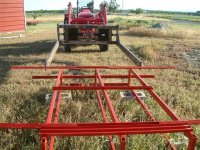
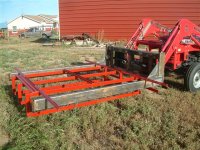
One other thing--you need to consider how to handle 75 acres of baled hay-getting off the hayfield to the barn. Some folks use balers with kickers and tow a bale wagon behind the baler. Relatively inexpensive but you still have to manhandle the bales to unload the bale wagon. Another way is with bale stackers--either towed behind the tractor or self propelled--like these

Jim Wilhite's New Holland Balewagons, by your Balewagon / Bale Wagon from Jim

I've seen used stackers on eBay go for under $10K.

I'm too old to buck even small square bales, but with my piddly 5-acre hayfield, I can't justify a stacker. So last year I made a bale accumulator/bale squeeze combo that attaches to the FEL skid steer plate on my 2008 Mahindra 5525. It handles 8 small bales.

DSCF0146 (Small).JPG

DSCF0151 (Small).JPG

There's about $1500 in steel and hydraulic parts and a month of my labor invested in this thing. It's fine for small fields, but 75 acres is a stretch for this kind of equipment.
 
   / Hay Making for Dummies #18  
Lots of good advice here, but the one thing I haven't seen mentioned is how to cut a square corner with a mower conditioner. Once you figure it out you will be amazed at how slick it works, if you don't figure it out you will either spend lots of time circling on the corners, or leave hay standing when you turn.

It's a little tough to describe how to do it without actually showing someone, (and its also slightly dependent on the tractor/mower combo) but here it goes: You're mowing along coming up to a 90* corner, when your back tires get right to the edge of the uncut hay, turn away from the corner slightly, then the second the cutter bar gets near the cut edge of the turn, turn back hard in the direction of the turn. The mower will pivot around and if you do it right should leave a square corner and no uncut hay. In heavy hay you also need to pick up the mower as soon as it cuts through the edge of the hay, and set it back down as soon as it pivots around before it starts in to the next edge of the corner. If you don't you will leave a pile of hay bunched up that will be tough to get dry, in light hay you can leave the mower on the ground. It will take a bit of practice to get everything figured out, and the best way to learn would be to watch/ride a round or two with someone who is good at it.

Also, while there has been a lot of good advice on here about baling speeds, mowing speeds, drying times, when to bale, etc, it all comes down to your particular conditions and equipment, which is something that you'll have to figure out. I've baled with square balers that will take hay almost as fast as a round baler, and some that struggle with a light windrow at a couple miles an hour. Same holds true with mowers and most other hay equipment, lots of variables.

As to the hay itself, there are no set amounts of time when you should rake bale, etc. You do each when the hay is 'right'. Also, its best to mow hay after about 12:00 noon, as it will have a higher brix content and will be more palatable for the animals. This isn't always practical, but will make a difference. I like to let the hay dry a while after its been cut, then go over it with the tedder to spread it out and speed up drying. You must be careful though not to 'over work' the hay or you will beat all the leaves off of it (not as much of a problem in grass hay.) The quicker you get the hay baled after mowing the better the overall quality of the hay will be (so long as its dry.) When raking with a side delivery rake like yours, don't go too fast, it will absolutely beat the leaves off of the hay, eventually you might want to look into a 'wheel rake', as it will handle the hay more gently and cover ground faster. Lastly, a good way to check hay to see if its ready to bale is by grabbing a handful with both hands and twisting it round and round. If most of the stems break within a few twists it should be good to go. You can also buy moisture testers, or take a small sample of hay weigh it, microwave it until it's completely dry, weigh it again, and the difference in weight is the moisture content (takes a good scale though.)

Hope some of this is helpful, but like I said before, the best advice will come from being with someone who's been making hay for years when they do it.

BTW, with the equipment you described, 75ac will be a pretty good undertaking. One of our farms has about 60ac of hay ground that is somewhat continuous, and with a 9' mower conditioner really moving it takes all day to mow. Also, you could be dealing with numbers of bales in the thousands, depending on conditions, so you should be ready with plenty of help (or machinery) to get it up.
 
   / Hay Making for Dummies #19  
Hi Guys, I'm the Dummy in this post, and I need educating by the experts and seasoned farmers out there.

This is my first year on the farm doing my own hay.

Im trying to collect as much info/knowledge as I can before the harvest season arrives.

I have some older New Holland equipment - late 70's/early 80's - 9ft NH hay bine, a late 50's NH Rake (real nice shape) and a late 70's/early 80's Sm Square NH Baler.

Tractor is a 2008 52 hp 4wd Montana c5264, 80 hrs on it

I know the basics (the real basics), cut one day, rake the next, bale the day after that. Dont let the hay get wet after its cut. Keep the machinery well oiled and Greased (alot)

I plan to mow a row or two (or maybe one lap around the field), Rake and Bale that first, just to get used to it. I dont think mowing all 75 acres at once would be wise for a newbie.

I have no clue on anything else, here are but a few of my unknowns:

-how high the cuting bar of the mower should be off the ground
-how high the Rake tines should be off the ground
-the PTO RMP speed to run the Mower at
-the PTO rpm to run the Baler at
-what speed/gear to run my tractor at while, mowing, raking, baling -- is slower better? e.g. i tend to use Low gear when working but not sure if 2nd or 3rd gear low is too slow (or good since it doesnt over stretch my 52 hp tractor)
-Baling is the part that worries me most -- seems like that twine has a lot of places to be routed and get bunged up.
-how do i test for moisture content, doe everyone have one of those testers?
-should i search for a farmer to assist me on Day 1 (I wonder if any of them would really have the time to do this) ?
-what oil to use on the chains
-what oil/greas to use on the knotters
-what grease to use on the wobble box etc
-i heard of a trick when joining the sp0ols of baler twine to keep the knots real tight (moistened by spit), and cut off the excess so it doesnt get caught up...what other tricks are there?
-what directiuon to i mow, rake, bale ? do I do laps, or side by side row's ?
-If i rake the 1st row will it land on the second row?
- do i rake in only 1 direction to avoid lumping 2 rows of hay together?


and, to be honest, I dont know what I dont know.

I've looked forward to this for a while now, but....now its almost here Im darn' terrified of getting it all wrong.

what would those of you that have done this for years teach me?

what would those of you that have done this once or twice tell me you wish you'd have known in advance ?


Thanks in advance
Not tedding the hay?
 
   / Hay Making for Dummies
  • Thread Starter
#20  
No tedder.

Well, I asked, and you guys have given me lots of info & sound advice.:thumbsup:

Im now more terrified than ever :laughing:, This may be too much for my first year. I think i will see if I can find someone to take off of the bulk of the hay, and Ill deal with just one of the fields for now.

Assisting someone locally is good advice too. I know someone further south, where they hay earlier in the season, that may be a good idea to get the experience several weeks in advance of when I need to start.
 

Tractor & Equipment Auctions

2020 John Deere 1025R MFWD Compact Tractor (A56438)
2020 John Deere...
2013 Frieghtliner with Altec Bucket Model LR760 (A56438)
2013 Frieghtliner...
*Selling at Royal Auction Tampa, FL Location* (A59228)
*Selling at Royal...
2015 VANTAGE TRAILER 3 POD PNEUMATIC TRAILER (A55745)
2015 VANTAGE...
2023 CAN-AM DEFENDER RTV (A59823)
2023 CAN-AM...
2022 John Deere 1023E MFWD Compact Utility Tractor with 120R Front Loader (A56438)
2022 John Deere...
 
Top