Ground compaction

   / Ground compaction #1  

tsperry88

New member
Joined
Apr 4, 2021
Messages
18
Tractor
Kubota B7610
If you don't want to read my long post, the basic question is this. What tears up wooded property the least, as far as soil compaction and rutting. A lightweight tracked skid steer with 3psi of ground pressure or something like a 1025R that probably has higher ground pressure.

I have 4 acres of woods that have been attacked by vines for an extremely long time. They have killed a lot of trees, leaving the woods less dense with an unusually large amount of fallen dead trees and branches.

I would like to clean it up and hit the whole area with a brush mower. My brother has a T770 skid that I have had in my possession for a few months. I avoid the woods with it, as it just ruts the soft ground up. It's ground pressure is just over 4psi, which doesn't sound bad. My Kubota B7610 probably has higher ground pressure due to less contact area, but seems to compact the woods less. I havnt spend much time in the the woods with either machine.

I have a few options. Use the skid and tear the crap out of the place. It's a 10.5k machine + and 1.5k grapple.

I could rent an RSV RC30 for a week. That machine has 3psi of ground pressure and is 1/3 the size and weight, but I don't know if it will make that much difference.

The last option and one I have been thinking the hardest about, is replacing my Kubota with 2 tractors. A good old farm tractor for pulling driveway implements and a Deere 1025R with turf tires for property chores and grapple work.
 
   / Ground compaction #2  
You will probably want the low ground pressure tracked machine
 
   / Ground compaction #3  
By the sounds you have answer your own question.
 
   / Ground compaction
  • Thread Starter
#4  
By the sounds you have answer your own question.

Not really. I know the answer from a spec sheet. In the real world, what would tear up my woods less.

From the net:
"
When I ask users why they have tracks, the number one response I get is, “I want to get rid of compaction and the track has a much larger footprint area.” While it is true the total footprint area of a track is larger than a tire, the weight of the machine is not equally distributed under the track. When measuring the contact pressure of the track system, there are pressure spikes under each one of the boggy wheels. In wet or moist soils, the soil is damaged by the highest contact pressures, which would be under those boggy wheels. Firestone Ag has conducted studies on soil contact pressures on two and four track systems and wheeled tractors and has published technical papers with the American Society of Agricultural and Biological Engineers (ASABE). The results show:

  • If the inflation pressure of the tires is less than 20 psi, tires transmit less contact pressure to the soil compared to tracks.
  • From 20 to 35 psi, the tracks and wheel systems were comparable.
  • If the inflation pressure of the tires are above 35 psi, the track system had lower contact pressure than the tires.
However, there is still the perception that tracks reduce soil compaction when compared to tires, in all situations. What we have heard, anecdotally, is that the absence of a rut in the field means there must be no compaction. In wet soils, it does not matter which system is being used — compaction occurs with or without ruts. The rutting is a function on how the wheel and track system operate differently.


"
 
   / Ground compaction #5  
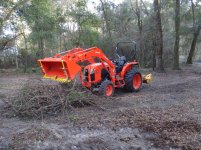
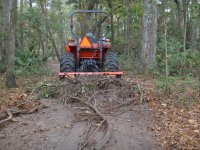
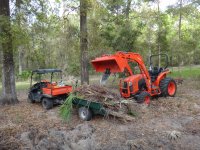
I have cleared six acres of Florida jungle over seven years creating a lovely meadow, with Rotundfolia grape vines and wild, climbing rose the worst vines removed.

Soil compaction has never been an issue. I have R4/industrial tires inflated with air.

Many times I have tried to pull a 6" grape vine out of a tall Oak and rather than the vine coming down, the rear of my 5,400 pound operating weight tractor came off the ground, eliminating traction. Fortunately, grape vines deteriorate fast once cut and fall out of the trees in two, sometimes three years.

" My brother has a T770 skid steer. It's a 10.5k machine + and 1.5k grapple."
The perfect machine for your application.

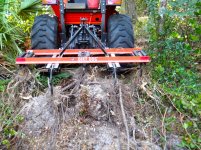
A Ratchet Rake attached to your bucket is extremely helpful as two rows of teeth will hold vines, allowing you to pull vines out of trees from the tractor seat. Chain to the tractor rear/center drawbar with a slip hook on the end is necessary for the largest vines.


A Bucket Spade exhumes wild rose corms with one, two or three stabs.

Attachments

  • DSC00129.jpg
    DSC00129.jpg
    1.1 MB · Views: 395
  • DSC00554.JPG
    DSC00554.JPG
    5 MB · Views: 464
  • DSC00377.jpg
    DSC00377.jpg
    1.1 MB · Views: 468

Attachments

  • DSC00692.JPG
    DSC00692.JPG
    4.7 MB · Views: 1,515
  • IMG_0471.JPG
    IMG_0471.JPG
    102.4 KB · Views: 742
 
Last edited:
   / Ground compaction #7  
I think that the tracks can cause some damage from what is called "berming" which results from turning in soft ground conditions. Also, i question to what extend lower tire pressure reduces compaction, Yes, the plate area tends to increase as tire PSI is reduced but the tractor weighs the same regardless of tire PSI.

Edit: Looks like I was posting same time as Egon above. Yes, PSI in tire pressure and PSI in ground pressure are two difference animals.
 
   / Ground compaction #9  
It's not just about (average) ground contact pressure though. Think about how you turn on a skid steer..... by ripping the track sideways. If your goal is minimal ground disturbance, you're much better off with a lightweight tractor with tires that ROLL and steer. Unless you only drive in exactly straight lines forward and backwards with the tracked skid, you're going to rip out all the ground cover and churn the topsoil.
 
   / Ground compaction #10  
How about ground tearing when turning with a tracked vehicle? Doesn't it damage the ground more than wheels with differentials?
 
   / Ground compaction #11  
Don't confuse compaction with turf damage. Tracks have low compaction but will rip op the turf everytime they turn. That's why you don't see tracked lawnmowers. Tires will have more compaction but compaction is really only an issue for lawns and row crops. I'm not sure why it would be a concern with either option in the woods.
 
   / Ground compaction #13  
^ I'd wager that more people have issues with tracks coming off, than they do with tires coming off the rim. Pretty easy to notice a low tire inflation and correct the issue before it comes off the wheel.
 
   / Ground compaction #14  
I wouldn't be all knotted up over particular psi as I would with your repetitive travel in and out of your woods. If you worry more about the number of times you pass across any single point to avoid root damage. You'll be doing a net positive for the woods with your cleaning/clearing and being aware of this. Compaction in general (in the woods) is less important than root damage to your surviving trees.👍
I'd recommend a wheeled tractor with enough weight and hp to not spin the tires when doing the work you need.
 
Last edited:
   / Ground compaction #15  
^ agreed. No one wants to be cutting big ugly ruts into the ground, but as long as you dont do much of that, the forest floor will recover. Organisms and natural root growth will break it all up again over a few years.
 
   / Ground compaction #16  
Sure, the CTL has very low lbs per sq in when driving across FLAT GROUND. Most woods around here are not flat ground. It is uneven and there are rocks, stumps, and logs to climb over. Now you don't have even pressure over the entire track like you did on the level parking lot...... and guess what, you leave ruts.
 
   / Ground compaction #17  
I own four things on rubber tracks. The one that gets the most use weighs over 20,000lb but has tracks 2’ wide and approximately 10’ long. That is approximately 40 square feet of ground contact vs a wheeled vehicle which may have 5-10 sq feet? There are days I run this machine over 15 miles across all types of terrain. I haven‘t seen it sink yet. I have been in muddy fields where a person on foot will sink to the top of their boots and I don’t make deep ruts. A couple weeks ago I made several trips across a center pivot of Bermuda grass that was mowed super short and is cut for sod. You could barely tell where I went.

Turning yes you can do a lot of damage if you turn sharp. If you are careful you can minimize damage. My machine has 8 rollers on each side - four sets of two. I can see how the load could be concentrated at the rollers but there are a lot of them and they are spread out. I haven’t noticed any severe compaction even in rough terrain. The biggest downside is travel speed. Tracks are slow. This particular machine goes 9 mph which is pretty darned fast for tracks but still a snails pace if you have a long way to go. Tracks are amazing if you need them due to the terrain but if you don‘t need them there are quite a few downsides like the speed and maintenance costs.
 
   / Ground compaction #18  
Sure, the CTL has very low lbs per sq in when driving across FLAT GROUND. Most woods around here are not flat ground. It is uneven and there are rocks, stumps, and logs to climb over. Now you don't have even pressure over the entire track like you did on the level parking lot...... and guess what, you leave ruts.
Not really. The tracks have a fair amount of articulation in them. If you are climbing over a rock, log, stump, etc yeah you will put a lot of weight on it as you go over but that doesn’t equal ruts. CTLs do have quite a bit higher ground pressure than other tracked machines though. I have seen one get absolutely buried and in my bigger crawler I drove right over where it got stuck and didn’t sink a bit.
 
   / Ground compaction #19  
A skid steer will tear the crap out of the ground tracks or no tracks. I can do a lot less destruction with my mini x mostly because I can drive straight in and straight out and work with the boom vs having to move the tracks a lot. Also the mini can lift the tracks to help with turns. Why would you need to replace your tractor with another one vs just putting a grapple on it?
 
   / Ground compaction #20  
If you turn hard and fast it doesn't matter which machine you have it will make a mess by churning the soil. Wheeled skid steers can make a big mess. Same with tractors in 4WD.

With tracks you can drive on the soft stuff and float where the wheels dig in. Start turning hard with the tracks and you start to dig right in and you can get stuck.

Small wheels are bad.
 

Tractor & Equipment Auctions

2021 Unverferth 432 Rigid 4 Row 36-inch 3PT Ripper Bedder (A56438)
2021 Unverferth...
2017 CATERPILLAR 120M2 MOTORGRADER (A52709)
2017 CATERPILLAR...
JLG 20MVL MANLIFT (A58214)
JLG 20MVL MANLIFT...
500 Gallon Fuel Tank with Pump (A55853)
500 Gallon Fuel...
FORD F SERIES DUMP TRUCK (A52707)
FORD F SERIES DUMP...
2000 Sterling L9513 Winch Truck (A56438)
2000 Sterling...
 
Top