Grid-tied solar

/ Grid-tied solar #461  
Dave,

Just found this thread and haven't had a chance to read it all the way through. But I was wondering how much this had actually reduced your utility bills. How much of your usage did you intend on replacing. Seems like you are running as expected maybe a little better.

We don't have net metering. Our electric bill is about $200/month less. Predicted pay back is about 15 years. If the cost of power goes up or we buy electric car it might be significantly shorter. I estimate that with net metering our system would be paid off in about 8 years because of our electric bill would be zero.

Our utility is hostile to alternative sources of energy. We used to have a discount heating rate during winter and since I generate my own power they took it away.

BTW we are on our way to about match the predicted energy generated 36MWh.

So to answer your question: It depends on the deal you get from your utility and size of the system.
If you get net metering it is best to match your yearly consumption.
 
/ Grid-tied solar
  • Thread Starter
#462  
Dave,

Just found this thread and haven't had a chance to read it all the way through. But I was wondering how much this had acuaully reduced your utility bills. How much of your usage did you intend on replacing. Seems like you are running as expected maybe a little better.

So far, it's doing a lot better than we thought it would. The original thought was to replace propane with sunshine, and maybe make a dent in the rest of the electric bill. The way it has worked out, it replaces the propane and ~75% of the electric bill over all.

We were buying ~315 gallons of propane yearly and I think >90% of that was for the water heater now that it's gone and I can see how little we use for cooking.

Once in a while we get an electric bill of $15-$25 dollars when our use exceeds the system output. Right now, we are carrying a 122 kWh credit into December. The way the sun has been playing hide 'n seek this month, I'm pretty sure we will use those up on the next bill.

We always pay $9.36 per month for being connected to the utility no matter how little we use. The credits are on a use them or lose them within twelve months rule in Maine. So here, you want to produce just a little less than you use over a year's time.

The system has been trouble free. We've had a couple of good, close lightening storms the past year too. I think lightening is probably the biggest threat of damage to the inverter.

It's just the wife and I and we weren't big electric power users to begin with. We are considering installing AC. If we do, I would like to add another set of panels and inverter. I have a smaller but otherwise identical install location available on the tractor garage, and our main service panel is out there too which would make it simple.
 
/ Grid-tied solar #463  
Thanks Dave and Ladia. One more question and it may show my knowledge of solar, but if your system is a 5 kWh system how long of a time frame before you produce that. Is it a day, week, or year or something else.
 
/ Grid-tied solar
  • Thread Starter
#464  
Thanks Dave and Ladia. One more question and it may show my knowledge of solar, but if your system is a 5 kWh system how long of a time frame before you produce that. Is it a day, week, or year or something else.

A 5 kW system is one that can produce 5,000 watts at any given moment, or an instant in time is a way to think of it. If it produces that much continuously for one hour, you have 5 KWh. If it did that continuously for 4 hours, you have 20 kWh.

The system would be rated in kilowatts by multiplying the number of panels by the output of each panel. The panel rating assumes more or less ideal conditions: perpendicular light angle of incidence, 70*F ambient temp.

What the total system may produce in a month or a year is estimated/modeled in kilowatt hours because the model "knows" how many hours of daylight and of what quality you could expect on average.
 
/ Grid-tied solar #465  
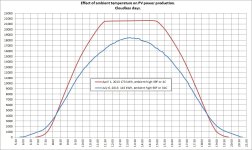
The production curve has a bell shape. The panels wake up when sun comes up and gradually increase production to maximum at noon (Provided that they are facing south. If they face somewhat south-east or south-west the peak will come earlier or later.) and gradually decline as the sun travels west. Attached image shows two curves at different sunny days and at different ambient temperature. The curve is instantaneous power while the area under the curve is produced energy for the day. The flat part of one of the curves is caused by inverter clamping. That hapens when panels produce more DC power than the inverter can convert to AC. The biggest enemy of solar is shading such as trees, hills, buildings and also clouds. Therefore selection of location is important. There are models available on Internet where "what if" analysis is easily done. PVWatts Calculator

Effect of temperature on PV power..jpg
 
/ Grid-tied solar #467  
Thanks guys. That helps shine some light on it. That is a nice link too.
 
/ Grid-tied solar #469  
I just wanted to say "great thread" and thanks for keeping it going. Our electricity has gone up very substantially over the last few years and is predicted to go up 10% per year each of the next 5 so my wife and I are very interested in this topic. I will likely be posting more about it next year once we get into it and thank you in advance for answering some of our questions already.

Jim
 
/ Grid-tied solar
  • Thread Starter
#470  
I just wanted to say "great thread" and thanks for keeping it going. Our electricity has gone up very substantially over the last few years and is predicted to go up 10% per year each of the next 5 so my wife and I are very interested in this topic. I will likely be posting more about it next year once we get into it and thank you in advance for answering some of our questions already.

Jim

Glad you are enjoying it.

What's up with your power prices? I noticed Jason (Scooby74) saying his power is high too. Do you get supplied from Hydro Quebec?
 
/ Grid-tied solar #471  
Concerning rates, I just checked Hydro Quebec:
Fixed charge per day 40.64 「

First 30 kWh/day 5.41 「/kWh
Remaining energy consumption 7.78 「/kWh

It appears that the highest rate is $0.078/kWh!!! This is incredibly low. Here in Northern California, the lowest rate is $0.11 and ranges up to $0.55, and is sure to go higher, much higher in coming years. The average rate is $0.23/kWh! Thus solar makes sense, big time! My previous average PG&E monthly bill was $330+, now it is $0.00. Those of you who enjoy cheap rates, don't take it for granted.
 
Last edited:
/ Grid-tied solar #472  
Glad you are enjoying it.

What's up with your power prices? I noticed Jason (Scooby74) saying his power is high too. Do you get supplied from Hydro Quebec?

What's up is horrendous government mis-management.
 
/ Grid-tied solar
  • Thread Starter
#475  
The December, 2013 results.

Below the model this month, and well below last December. This December has been a gloomy one, even by December standards. :)

Month--NREL Model (AC kWh)-----2012 Actual-----2013 Actual

Jan.----388----------------------NA--------------440
Feb.----412----------------------NA--------------375
Mar.----509----------------------NA--------------462
Apr.----374----------------------NA--------------487
May----353----------------------NA--------------375
Jun.----308----------------------NA--------------379
Jul.-----341----------------------NA--------------377
Aug.----383----------------------461-------------470
Sep.----394----------------------481-------------476
Oct.----369----------------------378-------------453
Nov.----283----------------------400-------------414
Dec.----331----------------------297-------------278
 
/ Grid-tied solar
  • Thread Starter
#476  
Advances in organic-based "flow" battery development for grid-scale storage:
Organic mega flow battery promises breakthrough for renewable energy

"Quinones are abundant in crude oil as well as in green plants. The molecule that the Harvard team used in its first quinone-based flow battery is almost identical to one found in rhubarb. The quinones are dissolved in water, which prevents them from catching fire."
 
/ Grid-tied solar #477  
I've been keenly interested in flow batteries since first hearing of them. The idea of being able to store the power in the electrolyte instead of on the electrodes is appealing. Storage capacity becomes a matter of tank size. Quick recharging can be done with a tanker truck.
 
/ Grid-tied solar
  • Thread Starter
#478  
Getting near the end of the month, so I had to hunt down this thread. :laughing:

Some summary information for the 2013 calendar year.

The system produced 4,987 AC kWh, (13.7 AC kWh per day average).
I took 4,312 AC kWh from the utility.
I sent 3,635 AC kWh to the utility.
My net use for the year was 5,664 AC kWh, (15.5 AC kWh per day average).

The system produced 88% of my total power used. That's more than the ~75% I was guessing at, but I will guess it was probably a pretty good, or above average year for solar.
 
/ Grid-tied solar #479  
Hey Dave,

I usually look at the output of our 4kW system versus our total electric use in Sept (around the annual anniversary of the array). By Sept of 2013, we made 17,805 kWh of electricity in 3 years. Over that same time period we bought an additional 3028 kWh from our utility. Our system produced an average of 85.5% of our power over the 3 year period.

Frank
 
/ Grid-tied solar
  • Thread Starter
#480  
Hey Dave,

I usually look at the output of our 4kW system versus our total electric use in Sept (around the annual anniversary of the array). By Sept of 2013, we made 17,805 kWh of electricity in 3 years. Over that same time period we bought an additional 3028 kWh from our utility. Our system produced an average of 85.5% of our power over the 3 year period.

Frank

That's pretty good. I don't think I can do that well.

Ours is a 4.2kW system, but the 70 degree (from horizontal) mounting is shaving some performance off. Our best day ever was 30kW last March around the equinox. We've had three 27kW days just lately. We also had a 0.1kW day. :laughing:
 

Marketplace Items

2013 GMC Sierra Service Truck, VIN # 1GD422C84DF134632 (A61165)
2013 GMC Sierra...
2025 Miscellaneous Mini Excavator Attachments (A61567)
2025 Miscellaneous...
2025 Pabreak 80in. Bucket Skid Steer Attachment (A61567)
2025 Pabreak 80in...
John Deere 568 Mega Wide Plus (A60462)
John Deere 568...
2013 Freightliner M2 106 Altec TA45M 44ft. Insulated Bucket Truck (A60352)
2013 Freightliner...
2017 Ford F-150 Ext. Cab Pickup Truck (A60352)
2017 Ford F-150...
 
Top