Grid-tied solar

/ Grid-tied solar #361  
I have a large rackmount UPS which (once I put some batteries in it) should be big enough to handle overnight loads (fans in the summer or circ pumps and zone valves in the winter) if we need heat or cooling. Just thinking about possibilities with the ~15'x24' roof of the shed (which is not too sloped, is close to the ground and faces South) and what could be done in a long term outage to help stretch fuel supplies.

Aaron Z
 
/ Grid-tied solar #362  
You don't want to over-think setting up a grid-tied solar system to be tricked into functioning when the grid power is out. It won't do anything during the night time hours which is 50% of the time on a yearly average, and if your power is out because it is stormy, you may not have that much sun to work with anyways.

If you must have power overnight, then you will need a generator in any case. Or, install an off-grid system with enough battery capacity. That will cost more than a generator, needs a dedicated battery area that doesn't get too hot or cold, and requires some maintenance. The hybrid grid-tied/off-grid systems with some minimal battery capacity are also expensive.

There is a KISS element to it.

I don't want overnight power though it would be nice. It is ironic that if one has power production on the roof, that one cannot use it unless the grid is running. I understand the safety side of the issue but there should be a way.

Once you touch a battery for backup it seems micro inverters are out of the picture and costs go up.

Later,
Dan
 
/ Grid-tied solar #363  
...and what could be done in a long term outage to help stretch fuel supplies.

Aaron Z

We just want enough power to run the fridge, freezer and well for a few hours. The well only has to be run once or twice a day to fill up buckets to flush the toilets, provide a bit of drinking water, and maybe taking a shower. This could be done with solar power during the daytime. It would be nice to be able to power with batteries all of the above plus a few lights and most importantly, the network to get to TBN! :dance1::laughing::laughing::laughing:

One thought I had was to use micro inverters on the house and put panels on the well house to supply battery power but that is getting complicated. The first problem is that I would have to BUILD the well house. :laughing::laughing::laughing: Second problem is that the well house is shaded. :rolleyes: I could pole mount the panels but that is more complication....

Later,
Dan
 
/ Grid-tied solar
  • Thread Starter
#364  
I have a large rackmount UPS which (once I put some batteries in it) should be big enough to handle overnight loads (fans in the summer or circ pumps and zone valves in the winter) if we need heat or cooling. Just thinking about possibilities with the ~15'x24' roof of the shed (which is not too sloped, is close to the ground and faces South) and what could be done in a long term outage to help stretch fuel supplies.

Aaron Z

I don't want overnight power though it would be nice. It is ironic that if one has power production on the roof, that one cannot use it unless the grid is running. I understand the safety side of the issue but there should be a way.

Once you touch a battery for backup it seems micro inverters are out of the picture and costs go up.

Later,
Dan

I know several people who have totally off-grid systems; they all have generators. Off-grid systems are generally designed with enough battery capacity to get through a three day period of poor solar production. My point is that it is hard to escape the necessity of having a generator, especially in rural areas. Any complexity and expense you add to a grid-tied system is duplicating the function of the generator. It will be less costly and more useful to ensure the generator has a fuel supply than to mess with the solar system.

For the frequency and duration of power outages for most people, there is no way you could make a business case for spending a bunch of money to cover those events when you will have a generator in any case.

If I were on an off-grid system, since mid-February I would have had to use a generator to charge the batteries several times. We have had a streak of storms and cloudy weather resulting in very low solar production for over three weeks now. All the solar technology and work-arounds in the world cannot overcome a lack of sunshine.

I know it goes against the grain to see solar power go unused when the utility power is out, but in reality, how much is really going to get away when you consider night time and the possibility of low sunshine?
 
/ Grid-tied solar #365  
I know several people who have totally off-grid systems; they all have generators. Off-grid systems are generally designed with enough battery capacity to get through a three day period of poor solar production. My point is that it is hard to escape the necessity of having a generator, especially in rural areas. Any complexity and expense you add to a grid-tied system is duplicating the function of the generator. It will be less costly and more useful to ensure the generator has a fuel supply than to mess with the solar system.

For the frequency and duration of power outages for most people, there is no way you could make a business case for spending a bunch of money to cover those events when you will have a generator in any case.

It depends on the length of the outage. In our case, knock on wood, the longest the outage has been 10-12 hours over night. Usually it is four hours or so. While these are not long outages, it is a bit of the PITA. It would be nice to have a few batteries to run a few essentials until power is restored but the cost to do this with PV is high and almost certainly does not make money sense.

If I were on an off-grid system, since mid-February I would have had to use a generator to charge the batteries several times. We have had a streak of storms and cloudy weather resulting in very low solar production for over three weeks now. All the solar technology and work-arounds in the world cannot overcome a lack of sunshine.

I know it goes against the grain to see solar power go unused when the utility power is out, but in reality, how much is really going to get away when you consider night time and the possibility of low sunshine?

When we lived in the city we were lucky in that our power came right off a main distribution line so even in a power outage the longest we were without power was 8-12 hours. Subdivisions next door were out for almost a week because their power was from a different direction. Where we are now, people were without power for about a week after Fran. Our outages are wind storms, ice storms and hurricanes. All three blow through very quickly and we have sunshine back quickly. While a generator would still be needed in a long outage having PV doing most of the work, especially if it is on the roof, would be more than helpful. The fact that one cannot use the PV in an outage without expensive batteries is a big negative.

I think you are too hung up on night time. We do not plan to run the generator 24 hours nor would we want too. No way we could afford to run that long. Even running an hour or so every 3-4 hours gets expensive after a few days. We would just want to power the fridge, freezer, and well a few times during the day. The well not as much since we can store water. Even if the PV only provided power for the five hours a day, it would be the critical hours when we would be accessing the fridge for food, and the PV could keep it cool. Generator usage/expense would be much reduced.

Because PV CANNOT do this at low cost, one of the guys in class is most unhappy, since this is exactly what he wants to do.

Later,
Dan
 
/ Grid-tied solar #366  
The off grid system are always compromise. Well, unless you are rich and can overkill it. You have to watch your consumption, take short shower, sleep in hotter house etc. Off grid systems make sense when the house is remote making the power line too expensive and when the house is built as energy efficient.
We are spoiled and don't want to sacrifice our comfort though. Therefore the grid tie makes sense to us. Nevertheless I am thinking about a storage of energy because we don't have net metering. We are selling power for 3.5 cent during the day and buying it back at night for 11.5. It sucks.
One way is to put pressure free tank in the garage and heat or cool it during the day when there is an excess generation and then use it at night to heat and cool the house. We have floor heating so for heating we need only about 100F and for cooling about 34F. That is the easy part. The hard part is to match the power consumption with power available because we don't want use more than what is available and also no less.
Another option would be to place a large tank (in example a swimming pool) on the high point of our place and pump there water from the pond that is located around 50 ft or so lower. Then release the water during t high demand through a turbine running a DC generator with inverter.
Third option is to win a lottery and forget all this nonsense. And that is my real plan. They just don't want to sell me the wining ticket.
 
/ Grid-tied solar
  • Thread Starter
#367  
It depends on the length of the outage. In our case, knock on wood, the longest the outage has been 10-12 hours over night. Usually it is four hours or so. While these are not long outages, it is a bit of the PITA. It would be nice to have a few batteries to run a few essentials until power is restored but the cost to do this with PV is high and almost certainly does not make money sense.


When we lived in the city we were lucky in that our power came right off a main distribution line so even in a power outage the longest we were without power was 8-12 hours. Subdivisions next door were out for almost a week because their power was from a different direction. Where we are now, people were without power for about a week after Fran. Our outages are wind storms, ice storms and hurricanes. All three blow through very quickly and we have sunshine back quickly. While a generator would still be needed in a long outage having PV doing most of the work, especially if it is on the roof, would be more than helpful. The fact that one cannot use the PV in an outage without expensive batteries is a big negative.

I think you are too hung up on night time. We do not plan to run the generator 24 hours nor would we want too. No way we could afford to run that long. Even running an hour or so every 3-4 hours gets expensive after a few days. We would just want to power the fridge, freezer, and well a few times during the day. The well not as much since we can store water. Even if the PV only provided power for the five hours a day, it would be the critical hours when we would be accessing the fridge for food, and the PV could keep it cool. Generator usage/expense would be much reduced.

Because PV CANNOT do this at low cost, one of the guys in class is most unhappy, since this is exactly what he wants to do.

Later,
Dan

It's always possible to find negatives if we look for them. But tasking a grid-tied system with something it is not designed to do is sort of silly in the big picture. 99% of the time, grid-tied systems do an excellent job of doing what they are designed to do: make power when the sun shines and reduce our dependency on non-renewable energy sources. If they become commonplace, they will also allow re-thinking some of the grid management and load growth challenges.

Extending the design capabilities of grid-tied systems to function off grid would not be rocket science. It would require some parallel hardware that is engaged when grid power is off like an oscillator chip driven circuit to provide the 60 cycle clocking, and some device to satisfy the on-demand aspect of home power use.

A grid-tied system relies on the grid to supply on-demand usage peaks. It also gets its 60 cycle clocking from the grid, whether you use distributed micro inverters or centralized inverter(s). The system must be in phase with the grid to push power back to the grid.

An off-grid system relies on its batteries to supply those peak demands. As long the demand does not exceed the battery/inverter capacity, the power stored in the batteries fills in for what the panels are momentarily not producing. The off-grid inverter also supplies the 60 cycle clocking, and of course it need not be in phase with anything.

Filling the on-demand peak usage is the challenge to using a grid-tied system with no grid. Power has to be more or less instantaneously supplied because that is what most electric devices expect and take for granted in their own designs.

If you have to have it, there are a couple of manufactures of hybrid grid-tied/off-grid systems with limited battery capacity. They are expensive, and I think you would still want to have generator. It is just a question of cost versus utility.
 
/ Grid-tied solar #368  
It's always possible to find negatives if we look for them. But tasking a grid-tied system with something it is not designed to do is sort of silly in the big picture. 99% of the time, grid-tied systems do an excellent job of doing what they are designed to do: make power when the sun shines and reduce our dependency on non-renewable energy sources. If they become commonplace, they will also allow re-thinking some of the grid management and load growth challenges.

Extending the design capabilities of grid-tied systems to function off grid would not be rocket science. It would require some parallel hardware that is engaged when grid power is off like an oscillator chip driven circuit to provide the 60 cycle clocking, and some device to satisfy the on-demand aspect of home power use.

A grid-tied system relies on the grid to supply on-demand usage peaks. It also gets its 60 cycle clocking from the grid, whether you use distributed micro inverters or centralized inverter(s). The system must be in phase with the grid to push power back to the grid.

An off-grid system relies on its batteries to supply those peak demands. As long the demand does not exceed the battery/inverter capacity, the power stored in the batteries fills in for what the panels are momentarily not producing. The off-grid inverter also supplies the 60 cycle clocking, and of course it need not be in phase with anything.

Filling the on-demand peak usage is the challenge to using a grid-tied system with no grid. Power has to be more or less instantaneously supplied because that is what most electric devices expect and take for granted in their own designs.

If you have to have it, there are a couple of manufactures of hybrid grid-tied/off-grid systems with limited battery capacity. They are expensive, and I think you would still want to have generator. It is just a question of cost versus utility.

Could you define expensive. We have an "off grid" system as hydro is "$150,000 due south of our location". We installed a PV system with a dual centralized inverter system and batteries that handle our complete home for up to 5 days, with generator backup. Total cost is about $27,000. My battery bank is large and expensive at $8,000. For an existing system, needing battery backup for a 1 day coverage, would probably be in the $1,500 - $2,000 range. The other option as has been said by others, is a backup generator. The problem is, generators wear out. Depending on usage, 2 - 5 years and your done. So, $1,500 gone.

Some would argue, batteries wear out too. Most batteries will handle 1,500 charge cycles. If you dont use 'em its not a charge cycle. So they should last you for years with proper care and maintenance...just sayin'.
 
/ Grid-tied solar #369  
For the record my knowledge of solar is extremely limited. But if you wanted a grid tied system with a separated battery bank couldn't you use the electricity made through your solar array to charge a battery bank with a float type charger from an outlet in the basement. Then treat the battery bank like a generator, when the grid goes down throw a switch on your electric panel in the basement and transfer to battery power? I understand this is a grossly simplified description and by going from dc to ac back to dc there would be efficiencies lost but wouldn't this allow a battery back up to a grid tied system?
 
/ Grid-tied solar #370  
For the record my knowledge of solar is extremely limited. But if you wanted a grid tied system with a separated battery bank couldn't you use the electricity made through your solar array to charge a battery bank with a float type charger from an outlet in the basement. Then treat the battery bank like a generator, when the grid goes down throw a switch on your electric panel in the basement and transfer to battery power? I understand this is a grossly simplified description and by going from dc to ac back to dc there would be efficiencies lost but wouldn't this allow a battery back up to a grid tied system?
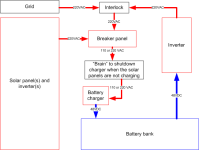
Are you talking about a charger feeding a battery bank, then a inverter running off of that? Something like the diagram below?
Solar Backup Power.png
I could see that working with a couple of caveats:
  1. You would have to have a mechanical interlock so that the battery bank inverter couldn't be turned on when the utility power is on
  2. You would have to have some way to shut the battery bank charger off when the panels or a generator are not running (perhaps a trigger on the battery bank inverter to turn on/off when it is putting out more than x amps)
  3. You might need an additional loadbank depending on how the solar panel inverters handle less than a full load

Aaron Z
 
/ Grid-tied solar #371  
If you install a battery bank, you need a "charge controller" "like a voltage regulator in a car", to cut the voltage to the bank when its charged.
 
/ Grid-tied solar
  • Thread Starter
#372  
Are you talking about a charger feeding a battery bank, then a inverter running off of that? Something like the diagram below?
View attachment 307868
I could see that working with a couple of caveats:
  1. You would have to have a mechanical interlock so that the battery bank inverter couldn't be turned on when the utility power is on
  2. You would have to have some way to shut the battery bank charger off when the panels or a generator are not running (perhaps a trigger on the battery bank inverter to turn on/off when it is putting out more than x amps)
  3. You might need an additional loadbank depending on how the solar panel inverters handle less than a full load

Aaron Z

It could be something along those lines.

If you have grid power available at a reasonable installation cost, the cost and reduced maintenance advantage lies with a grid-tied system. I think that is especially true in situations where high electric demand cannot be dodged, such as 24/7 AC for six-eight months.

If your situation is such that you don't need AC, use LP or natural gas for cooking, refrigerator & freezer, clothes dryer, domestic hot water, and heat and domestic HW with wood in winter, turn off the vampires when not in use, then you can cut your electric usage to a very small number that can be supplied by an inexpensive off-grid solar system. That number is a baseline that can be worked up from if a person wants to use more solar PV, less gas, and lower cost standard appliances.

A generator is going to be part of any system strategy, so that is a wash purchase cost and maintenance-wise.

In terms of "green-ness" 30% of the grid power I purchase comes from renewable sources, and 100% of what I produce is from a green resource. Of course, the renewable percentage of grid power varies by state regulations.
 
/ Grid-tied solar #373  
It's always possible to find negatives if we look for them. But tasking a grid-tied system with something it is not designed to do is sort of silly in the big picture. 99% of the time, grid-tied systems do an excellent job of doing what they are designed to do: make power when the sun shines and reduce our dependency on non-renewable energy sources. If they become commonplace, they will also allow re-thinking some of the grid management and load growth challenges.
...
If you have to have it, there are a couple of manufactures of hybrid grid-tied/off-grid systems with limited battery capacity. They are expensive, and I think you would still want to have generator. It is just a question of cost versus utility.

PV has its limitations aka negatives and they are not obvious.

In the class I am taking, I know far more than the other students, and watching them understand that 10,000 watts on the roof is not 10,000 watts at the outlets is interesting. They also are shocked that they won't be able to use the PV system in a power outage unless they install batteries. Microinverters are the way to go but wait, they or single point inverters, won't work with out grid power. "We don't get power all day but only for five hours?" is another moment of understanding.

These are limitations on PV. They are big limitations and these limitations ARE NOT known to the vast majority of people.

PV is talked about as a wonderful idea that everyone should use but the reality is that it has limitations, negatives to use your word, and most people don't realize this at all. This is not a exercise in finding the negatives, the limitations, but understanding them to make intelligent decisions.

EVERYONE in my class, with me being the exception, was surprised that they would not be able to use the PV panels in an outage without having to use batteries. I think microinverters are the way to go and if we install a PV system we will use them, but for us to have some limited backup power we will have to have batteries which means no microinverters thus a secondary set of panels, a single inverter, different wiring, and of course batteries. This drastically increases the cost and complexity which most people do not understand about PV.

One of the things I have learned in this class is that in NC it is not worth the cost and effort to net meter. I still wonder if that is true and I will be investigating to make sure the numberd have not changed but this was surprising information to me. If the expense and trouble of NC net metering is not worth it, this changes how much power we should put on the roof. If net metering is not going to pay off, then the size of our PV system would be based on what power we use during five hours of daytime. I don't think we use much power during the daytime. Instead of putting up 10K watts we would be looking at far less because we just don't use that much power in the week day except in the summer. For most of the year we would be producing power and giving it back to the power company for nothing.

For us to cut our power bill by a meaningful manner we have to balance the install watts with what we use during the day without NC net metering. This drastically reduces the number of watts on the roof and would force us to install a solar water heater to cut the power bill further. A solar water heat is just more complexity which I would rather avoid while almost certainly driving up costs.

Later,
Dan
 
/ Grid-tied solar #374  
We discussed in class today the idea of using a generator to allow the microinverters to all power into the AC wiring.

The instructor THINKS this should work. There was a conversation with one of the microinverter companies who were very adamant that this would void your warranty. They did not say this would not work though. But how would they know and why would it not work? The instructor was having this conversation with some PV installers.

I think the trick is to not have power demand exceed power supply. Hopefully the generator would allow the PC system to produce AC and power most of the power demand with the generator just enabling the system and providing extra power when needed. Kinda a PITA though since you still have to hook up and run the generator.

Later,
Dan
 
/ Grid-tied solar
  • Thread Starter
#375  
PV has its limitations aka negatives and they are not obvious.

In the class I am taking, I know far more than the other students, and watching them understand that 10,000 watts on the roof is not 10,000 watts at the outlets is interesting. They also are shocked that they won't be able to use the PV system in a power outage unless they install batteries. Microinverters are the way to go but wait, they or single point inverters, won't work with out grid power. "We don't get power all day but only for five hours?" is another moment of understanding.

These are limitations on PV. They are big limitations and these limitations ARE NOT known to the vast majority of people.

PV is talked about as a wonderful idea that everyone should use but the reality is that it has limitations, negatives to use your word, and most people don't realize this at all. This is not a exercise in finding the negatives, the limitations, but understanding them to make intelligent decisions.

EVERYONE in my class, with me being the exception, was surprised that they would not be able to use the PV panels in an outage without having to use batteries. I think microinverters are the way to go and if we install a PV system we will use them, but for us to have some limited backup power we will have to have batteries which means no microinverters thus a secondary set of panels, a single inverter, different wiring, and of course batteries. This drastically increases the cost and complexity which most people do not understand about PV.

One of the things I have learned in this class is that in NC it is not worth the cost and effort to net meter. I still wonder if that is true and I will be investigating to make sure the numberd have not changed but this was surprising information to me. If the expense and trouble of NC net metering is not worth it, this changes how much power we should put on the roof. If net metering is not going to pay off, then the size of our PV system would be based on what power we use during five hours of daytime. I don't think we use much power during the daytime. Instead of putting up 10K watts we would be looking at far less because we just don't use that much power in the week day except in the summer. For most of the year we would be producing power and giving it back to the power company for nothing.

For us to cut our power bill by a meaningful manner we have to balance the install watts with what we use during the day without NC net metering. This drastically reduces the number of watts on the roof and would force us to install a solar water heater to cut the power bill further. A solar water heat is just more complexity which I would rather avoid while almost certainly driving up costs.

Later,
Dan

I dunno Dan, it should be fairly obvious that solar pv only works when the sun shines. It's a good thing those folks are taking the class. :laughing:

It is not as obvious that without grid power, grid-tied solar will not pass the power being produced to the breaker panel. Those are things people learn as they dig into the subject. I don't think of those things as limitations, just design parameters that one needs to understand: this sort of system can do these things, and another sort of system can do other things. Everyone needs to weigh those design parameters against their situations.

It doesn't sound like the NC legislature and PUC cut consumers a very good net metering deal with the utilities. That is a failure or imposed limitation of politics, not solar pv. Net-metering is worth it under Maine's rules, and some states do a lot better from what others have posted.

For domestic hot water, you will probably find that powering an electric water heater from solar pv is less trouble and cheaper over time than a solar water heater. Either system can only produce hot water while the sun is shining, there is no inherent advantage to solar water over solar pv since panel prices are so low. With the plumbing, pumps, valves, thermostats, etc. involved in solar water, there is likely an inherent disadvantage.

One advantage to solar pv hot water is that the water heater is just another component of the total load, whereas any excess hot water just results in waste, it cannot be applied to running the clothes dryer, for example.

Both types will likely need some other fuel make-up capability to satisfy total usage requirements. What the best "other" fuel is in your area plays some role in selecting a system type, but any combination is possible if we put our noodles to work.

I think it is better to use the yearly output models from NREL's PVWatts calculator compared to your homes average annual usage, than to think of it as five hours per day. Is the five hours per day is some sort of rule of thumb? My annual AC kWh estimate of 4,447 divided by 20 kWh (4 kW max system output X 5 hours) is 222 days (at 5 hours per day). That isn't a very useful number.
 
/ Grid-tied solar #376  
It is true hat inverters designed for grid-tie will not work without a grid power. The reason is that they will try to push all the available power to the grid until voltage limit is reached. They would work together with a generator only if you can absorb all the power available. In other words absorb enough power so the voltage wouldn't rise to inverter voltage limit. In example you could design an energy absorber (in example hot water tank) with a heater about the same capacity and as the peak power of your source and controller that would adjust the heater such a way that it would maintain certain voltage. The tank would have to be large enough to absorb all the energy produced during the day. Then you could use the hot water to heat your house during the night.
There are inverters the can do both grid tie and stand alone. When they are on grid they work in similar fashion like the microinvereters but when grid goes down they will switch to stand alone mode and control voltage. In other words they will match power delivery to the demand. They will shut down when power demand exceeds available power generation.
 
/ Grid-tied solar #377  
Dan,

If net metering doesn't help you, could you use the money that would have been spent on more solar panels and put it into batteries and go off grid?
 
/ Grid-tied solar
  • Thread Starter
#378  
By buckeyefarmer: http://www.tractorbynet.com/forums/related-topics/253320-electric-knowledge-needed-please-3.html

Google Kirchhoffs current law.

Your bus is a node. It has incoming power from the solar, incoming or outgoing power from the utility, and outgoing power to all your house breaker loads. If your house load is greater than your solar source, then you will use your solar power and draw additional from the utility. If your house load is less than your solar source, they you will transmit power out to the utility to other loads.


The above post is a concise explanation by buckeyefarmer of what is happening electrically between multiple potentials (voltages) being applied to a common node (your service panel).

Keeping that in mind, plus what Ladia explained above, you can understand why the generator, when being used to make it look like grid power is present to the inverter when it really isn't, has to absorb any unused output produced by the solar system. Common generators are not designed to do that.

As Ladia explained, a resistive heat element(s) could be sized to sink all the power produced by a solar pv system. Since a house does not represent a known constant electrical load, and could be zero at any given moment, the sink would have to be sized to handle the total solar output. To actively sink the excess in combination with other coming and going power users like appliances, etc., some sort of switching/regulating circuit would have to apportion the power between the desired uses and the heat element(s) as needed.
 
/ Grid-tied solar #379  
You can also waste the excess in a resistance in example electric heater sized to sink total peak power. The heater would have to be controlled by a voltage regulator. If the voltage starts rising the regulator would add load until equilibrium between supply and demand is reached. That way you could use power from your PV when the grid goes down. Since the microinverters are grid commutated and have only +/- 0.5 Hz tolerance you would need source with steady frequency. In example inverter generator.
 
/ Grid-tied solar
  • Thread Starter
#380  
You can also waste the excess in a resistance in example electric heater sized to sink total peak power. The heater would have to be controlled by a voltage regulator. If the voltage starts rising the regulator would add load until equilibrium between supply and demand is reached. That way you could use power from your PV when the grid goes down. Since the microinverters are grid commutated and have only +/- 0.5 Hz tolerance you would need source with steady frequency. In example inverter generator.

It should also be possible to make the inverters believe grid power is present by using a pair of automotive-type 120v, 60 hz inverters powered by a 12v battery. The DC cables on the battery could be diode protected, at least the battery wouldn't get fried if things aren't working well.
 

Marketplace Items

2017 FORD F-150 (A60736)
2017 FORD F-150...
PIPEHUNTER HYDRO EXCAVATION TRAILER (A60736)
PIPEHUNTER HYDRO...
GROVE RT 63S HEAVY DUTY HYDRAULIC CRANE (A60736)
GROVE RT 63S HEAVY...
2016 TEXT 26ft T/A Dovetail Flatbed Equipment Trailer (A59230)
2016 TEXT 26ft T/A...
2017 FREIGHTLINER M2 106 (A60736)
2017 FREIGHTLINER...
Blue Diamond 103709 (A53317)
Blue Diamond...
 
Top