Framing questions about this picture

/ Framing questions about this picture #1  

EddieWalker

Epic Contributor
Joined
May 26, 2003
Messages
27,876
Location
Tyler, Texas
Tractor
Several, all used and abused.
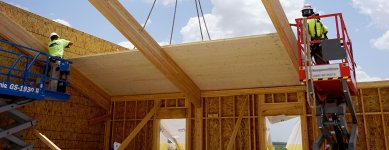
I saw this picture in an advertisement and was wondering about why they did a few things. If anybody knows, I'd appreciate the help in understanding it.

Timber framing.jpg

Why 4 top plates?

Why are there 3 cripple studs on each side, above the header?

Thanks
 
/ Framing questions about this picture #2  
I saw this picture in an advertisement and was wondering about why they did a few things. If anybody knows, I'd appreciate the help in understanding it.

View attachment 623535

Why 4 top plates?

Why are there 3 cripple studs on each side, above the header?

Thanks

Blocking for interior doo dads.
 
/ Framing questions about this picture #3  
Where's the build site?
 
/ Framing questions about this picture #4  
Looks to me like a strength issue given the engineered beams. Maybe planning for something above the roof.
 
/ Framing questions about this picture #5  
Based on the beams the “extra” top plate isn’t needed to provide an engineering advantage. It’s most likely used to makeup a few inches over a standard stud length. Probably cheaper than cutting every stud. If it was needed for engineering the top plates would be under the beams with little cripple walls between the beams. As built, every beam breaks the top plate and creates a hinge point.

Every framing job and spec is different. But it’s common to see the cripples match the jack studs below the headers. The “extra” one is probably something that framer does- not an engineering requirement.

I’m surprised the posts under the beams are sandwiched 2x instead of an engineered or solid post. Who knows on that one....
 
/ Framing questions about this picture #6  
My amateur's view: that wall has been engineered to take a significant load, much more than a typical side-wall. One tip-off for me is the horizontal blocking, I don't think that's fire-blocking, it's too high up. When you load up a stud, there are two failure modes: either it buckles, or the end grain gets crushed. Unless a stud is short it will buckle before it gets crushed. The horizontal blocking shortens the effective length of the stud so it can carry a heavier load.

You can't see the width of the building, but it looks like a significant span, which would create significant side-wall loads, particularly in a place with high snow or wind loads. What's weird is that it looks like residential construction using pole barn techniques, where all the weight of the roof is on trusses and the trusses rest on poles. If there were some connector that we're not seeing that transferred the weight of the roof onto the entire wall and the roof were really wide then the wall would make sense.

Where did you see this? It looks interesting.
 
/ Framing questions about this picture #7  
The blocking is required by the engineer to nail off the OSB for shear. If it was just to prevent twisting or bowing it would be in the middle of the wall or at a nice height when working from the ground. They would also typically stagger the blocking as it’s easier to nail.

I don’t think the load is that great. The roof panels have quite a span and I don’t see any purlins. Th roof actually doesn’t look like it was designed for much of a load.
 
/ Framing questions about this picture #8  
Count stud spacing between rafters, at 16" oc rafters are 12' oc. Extra plating probably for wind wall loading between the rafters. Extra blocking on top of the header could serve 2 purposes. 1. Tie the header to the top plate due to extra wall height. 2. Avoid those irritating 1"-2" narrow spaces for insulation while maintaining stud spacing above the window.
 
/ Framing questions about this picture #9  
If it was wind loading, the top plate wouldn’t be broken with every beam- it would be continuous......
 
/ Framing questions about this picture #10  
I'm inexperienced but: Seems unusual having alot of jack and cripples. From what I think, I guess it's to transmit the load from the top plate to the foundation. From things I have read, extra king studs are more important than extra jacks.

I also don't understand the top plate being broken by the beams.

Maybe the contractor is just trying to use more lumber so he makes more money. Lol!
 
/ Framing questions about this picture #11  
I'm inexperienced but: Seems unusual having alot of jack and cripples. From what I think, I guess it's to transmit the load from the top plate to the foundation. From things I have read, extra king studs are more important than extra jacks.

I also don't understand the top plate being broken by the beams.

Maybe the contractor is just trying to use more lumber so he makes more money. Lol!

Makes one wonder what is outside? flying buttresses?
 
/ Framing questions about this picture #12  
Judging from the wind turbine in the background, I'd guess they get a bit there...
 
/ Framing questions about this picture #13  
Based on the beams the 兎xtra top plate isn稚 needed to provide an engineering advantage. It痴 most likely used to makeup a few inches over a standard stud length. Probably cheaper than cutting every stud..............................

I'm doing just that on a shed I'm working on. The overhead door guy asked for 16" clear above the door opening so I could have access at full door opening height.
 
/ Framing questions about this picture #14  
A thought. At the last minuet the size of the glue-lam beams were changed - bigger. The walls were bilt to accommodate the original glue-lam height. Therefore the four layer header to get to the top of the glue-lam. Are we sure there isn't a steel strap over the top of each glue-lam - making the header one continuous beam.

On my Pan Abode cedar home the main beams WERE increased in size at the very last minuet( increased snow load). The manufacturer was unable to make last minuet changes in the construction plans. I had to notch the cedar double walls to allow the beams to fit & extend out beyond the outer wall. There was a page of added instructions noting this beam size change and the need to cut deeper & wider beam pockets. The type on this single page was 120 point and in red ink. Impossible to miss. Plus the Pan Abode rep in Spokane made a special tip out here to ensure I understood this change.
 
/ Framing questions about this picture #15  
The beam height would account for the 4 top plates. The cripples on the windows may be to narrow the opening for the window size. If this is a church, judging from the beams, the stained glass windows are usually narrower than a standard window. Just a guess on my part.
 
/ Framing questions about this picture #16  
Quite possible the beam needs to be set at a certain height to clear things like kitchen cabinets. And building up the top plate allows for that. Here in the people's republic of Mass, every stud you pull out of a window opening, needs to be added to the side of the opening. May be the same thing there.
 
/ Framing questions about this picture #17  
Quite possible the beam needs to be set at a certain height to clear things like kitchen cabinets. And building up the top plate allows for that. Here in the people's republic of Mass, every stud you pull out of a window opening, needs to be added to the side of the opening. May be the same thing there.

On my garage with 10ft wide x 10ft high garage doors we were able to use precuts 2x6'x at 116 5/8" on top of 16" concrete walls. Header over doors were 12" glulam beams. On other garage with 16ft wide x 10ft high garage doors, the header is 18" glulam. Had to use 10ft studs and trim to full 10ft. Could have used the precuts with extra top plates instead of trimming every stud. Again on 16" concrete walls. OSB on exterior was 8ft plus a 2ft pieced above with a 2x6 laid flat against OSB seam for a nailer. In the picture the extra plates could be to line up the other double top plates not shown to accomodate a tall door or something. Without seeing other walls, we can only guess as to why this build has extra plates. Our prints on both garages had a bunch of jack studs under these headers. Something to do with uplift and shear wall. (don't understand that portion). The roof over the doors had a 8/12 pitch and then a 4/12 pitch at the eave with a 5ft overhang cantilevered over the wall with no extra posts underneath. Jon
 
/ Framing questions about this picture #18  
Not conventional 'stick built' construction at all. It just looks that way because the wall studs are logically spaced for sheeting and/or insulation.

Look at all the 'stacks' of 2x lumber and recognize "Post and Beam" construction. Lams make better/cheaper beams, and when exposed are easier to dress up. (ceiling, etc.)

The extra cripples, jacks, and top plates represent P&B layout and spacing per code where built. Same under each roof beam's base for same reason.

Havent Sunset Books and Reader's Digest had do-homie books with carpentry sections since the 70's or so?

College texts are easy to find at yard sales, often help describe/explain just this kind of thing to customers with all the illustrations.
 
/ Framing questions about this picture #19  
Maybe the extra plates are to help stop twist and roll of the beams plus transfer load ? If you look close the pocket its loose at the bottom but the plates are tight.
 
/ Framing questions about this picture #20  
As stated, engineered for excessive load, and keeping the beams from moving. It's the only thing that makes sense.

Those beams are trying to push the top of the wall out. I don't see what is going to resist it from bending?

My basement has a 2x6 wall with a triple top plate running down the middle in lieu of a support beam.

The quad top plate, and cripple studs on an exterior wall are not helping any with energy insulation.
 
 
Top