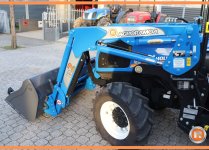
DIY Mechanical Self leveling loader

   / DIY Mechanical Self leveling loader #1  

Roger66

Silver Member
Joined
Jan 2, 2017
Messages
146
Location
Shelton
Tractor
2017 Mahindra 1526, John Deere LX255
I'd like to modify my loader to add a mechanical self leveling feature. It does not look difficult to fabricate, just a top link and a triangular pivot. Doing some reading it seems there are many people that don't like self leveling loaders while using the bucket or are good enough to do this with the stick themselves manually. I primarily use forks on my tractor and I'm not a daily user so I'll never get enough hours to be good enough to do this manually. I've seen the hydraulic options, but I want to try mechanical. Anyone done this before or have any advice? I will be doing this on a spare loader frame so I can always revert to stock, should this prove to be a bad idea.

Thanks
 
   / DIY Mechanical Self leveling loader #2  
It could be done but I think you’re under estimating the amount of work. You’d have to drill holes in the middle of the loader to mount the triangle piece and you’d have to add another pivot at the back of the loader and everything would have to be precise and have pin bosses welded on. What’s your tool setup and fab ability like?
 
   / DIY Mechanical Self leveling loader
  • Thread Starter
#3  
It could be done but I think you’re under estimating the amount of work. You’d have to drill holes in the middle of the loader to mount the triangle piece and you’d have to add another pivot at the back of the loader and everything would have to be precise and have pin retainers welded on.

It's safe to say I'm a much better fabricator than I am a tractor operator :) I can model the parts in CAD and cut them on my CNC mill, welding is also no challenge. Just need some design ideas to start.
 
   / DIY Mechanical Self leveling loader #4  
If you have a CNC mill, welder and a mag drill would probably help it wouldn’t be that hard.
 
   / DIY Mechanical Self leveling loader #5  
Isn't it just two parallelograms?
 
   / DIY Mechanical Self leveling loader #6  
Definitely model everything in CAD to see how it works out. When I built my loader from scratch, I took the time to model everything in CAD and see how it moves. Took a lot of adjustments in CAD but in the end it paid off and everything just fitted as it should.

I have a feeling the curl cylinders will be a tad longer for a self leveling loading though. You'll also need a crossover relief valve on the curl circuit, so the cylinders gives under a certain condition and won't bend stuff.

Another alternative is doing a hydraulic self leveling, instead of a mechanical one.

A loader manufacturer here in my country, uses two cylinders mounted above the lift cylinders. These are tied into the curl circuit. Here is a picture of it:

91817471_2852425054853124_1255514095621242880_o.jpg84701935_2735897679839196_5252415557541560320_o.jpg

It seems to work very well as they sell more hydraulic self leveling loaders than mechanical and non self leveling loaders. The trick is figure out the volume needed on these two extra cylinders, so it keeps the forks leveled.
 
   / DIY Mechanical Self leveling loader #7  
I think you could also get a self-leveling hydraulic feature if a person mounted a short hydraulic cylinder between the oscillating front axle, and the tractor frame. That would force the pivot point on the front axle instead of pivoting the loader. A person would have to have a float position on the hydraulic valve though so that it could be free to float when not needed for self-leveling.
 
   / DIY Mechanical Self leveling loader
  • Thread Starter
#8  
Definitely model everything in CAD to see how it works out. When I built my loader from scratch, I took the time to model everything in CAD and see how it moves. Took a lot of adjustments in CAD but in the end it paid off and everything just fitted as it should.

I have a feeling the curl cylinders will be a tad longer for a self leveling loading though. You'll also need a crossover relief valve on the curl circuit, so the cylinders gives under a certain condition and won't bend stuff.

Another alternative is doing a hydraulic self leveling, instead of a mechanical one.

A loader manufacturer here in my country, uses two cylinders mounted above the lift cylinders. These are tied into the curl circuit. Here is a picture of it:

View attachment 667387View attachment 667386

It seems to work very well as they sell more hydraulic self leveling loaders than mechanical and non self leveling loaders. The trick is figure out the volume needed on these two extra cylinders, so it keeps the forks leveled.

This is a very interesting style. I've seen it on tele-handlers, it's a great way to go, but I have no idea how to determine the volume and no way to tune it later. Need to get this perfect on the first shot! With the conventional overarm style, I figure I can change the triangles if I need to tune it.
 
   / DIY Mechanical Self leveling loader #9  
This is a very interesting style. I've seen it on tele-handlers, it's a great way to go, but I have no idea how to determine the volume and no way to tune it later. Need to get this perfect on the first shot! With the conventional overarm style, I figure I can change the triangles if I need to tune it.

Totally agree with you. From a fabrication standpoint, the hydraulic route it's easier to make and adapt but harder to figure out, while the mechanical linkage it's the opposite. From what I've seen, the hydraulic one is less prone to have the bucket kinda floppy when in full dump position versus the mechanical one.
 
   / DIY Mechanical Self leveling loader
  • Thread Starter
#10  
Totally agree with you. From a fabrication standpoint, the hydraulic route it's easier to make and adapt but harder to figure out, while the mechanical linkage it's the opposite. From what I've seen, the hydraulic one is less prone to have the bucket kinda floppy when in full dump position versus the mechanical one.

Hate when my implement gets floppy! ;-)

I see Orange and Green seem to have some self leveling options. Although when I was shopping these options did not seem common out in the real world. Had I known about this option, It might have changed my purchase decision.

Tested | B1671 Self-leveling loader kit | Performance Impact? - YouTube
Loaders | Front End Loaders | John Deere US
 
   / DIY Mechanical Self leveling loader #11  
Hate when my implement gets floppy! ;-)

I see Orange and Green seem to have some self leveling options. Although when I was shopping these options did not seem common out in the real world. Had I known about this option, It might have changed my purchase decision.

Tested | B1671 Self-leveling loader kit | Performance Impact? - YouTube
Loaders | Front End Loaders | John Deere US

And looks like they pretty much did it as an add-on to the original loader and they can also maintain the stock curl cylinders.

That might also give you something to work out from. You can possibly copy the linkages and adapt to your loader.
 
   / DIY Mechanical Self leveling loader #13  
Roger,
Any luck on building your own self leveling loader. I am also interested in possibly adding one to my (Stoll HDPM8) loader. I am just wondering about your progress and if you have encountered any challenges. I would also model it in AutoCAD but fab it up all manually. I have built a FEL for my small Kubota garden tractor (18HP) and it works well.
Also I am not understanding the need for a crossover relief valve (AS per ptsg) on the curl circuit, so the cylinders give under a certain condition and won't bend stuff. Under what condition will the cylinders need to give?
Thanks
 
Last edited:
   / DIY Mechanical Self leveling loader #15  
In the real world things are not always perfect. If the cylinders get out of sync there needs to be a way to protect metal from bending.

The cylinders aren’t in sync. They rely on the loader frame to keep them together. If you removed the pins you could move the cylinders independently by hand.
 
   / DIY Mechanical Self leveling loader #16  
The cylinders aren’t in sync. They rely on the loader frame to keep them together. If you removed the pins you could move the cylinders independently by hand.

I guess I didn't explain my point well enough. What I was talking about is the synchronization between the leveling cylinders and the bucket cylinders.
 
   / DIY Mechanical Self leveling loader #17  
Roger,
Any luck on building your own self leveling loader. I am also interested in possibly adding one to my (Stoll HDPM8) loader. I am just wondering about your progress and if you have encountered any challenges. I would also model it in AutoCAD but fab it up all manually. I have built a FEL for my small Kubota garden tractor (18HP) and it works well.
Also I am not understanding the need for a crossover relief valve (AS per ptsg) on the curl circuit, so the cylinders give under a certain condition and won't bend stuff. Under what condition will the cylinders need to give?
Thanks

Imagine that you have fully dumped your bucket near the ground. Basically, till it hits the hard stops on the loader arms. If you then lift the loader, the self leveling linkage will try to push the dump/curl cylinders forward but it can't go because of the stops. That is where the relief valve is important, as it will allow the dump cylinders to give before something breaks or bends.
 
   / DIY Mechanical Self leveling loader #18  
Imagine that you have fully dumped your bucket near the ground. Basically, till it hits the hard stops on the loader arms. If you then lift the loader, the self leveling linkage will try to push the dump/curl cylinders forward but it can't go because of the stops. That is where the relief valve is important, as it will allow the dump cylinders to give before something breaks or bends.

Many misunderstand that on a ‘self leveling’ loader, it does not level, but constantly adjust the hydraulic cylinders to maintain the same position of attachments. This means there is constant fluid flow within the hydraulic system. Since this is done independent of valve operation, there is the need for a pressure relief system to be present.
 
   / DIY Mechanical Self leveling loader #19  
Thanks for the clarification ptsg, I now understand. I realize that as you raise the loader that there is a constant leveling of the the curl cylinders happening, and that it is possible that if they are at the end of their extended travel that something will need to give!! (I suspect the cylinders would probably bend) Is this cross over valve typically built into the loader valve, is it usually a visible part? I will need to be more observant when I see a loader on a tractor.
 
   / DIY Mechanical Self leveling loader #20  
Thanks for the clarification ptsg, I now understand. I realize that as you raise the loader that there is a constant leveling of the the curl cylinders happening, and that it is possible that if they are at the end of their extended travel that something will need to give!! (I suspect the cylinders would probably bend) Is this cross over valve typically built into the loader valve, is it usually a visible part? I will need to be more observant when I see a loader on a tractor.

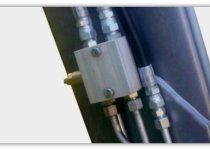
Some more expensive loaders, usually for bigger tractors too, will have the relief valves built in at the work ports of the loader valve.

But most loaders will have the relief valve block connected to the hard lines on the loader arms.

Some loaders won't have hard stops and are built slightly different and can get away without the relief valve though. I've seen a couple without it.

Here is an example of one mounted on the loader arms.

9cb4904a91140c3dddd4a7ad920c5d4d.jpg
 

Tractor & Equipment Auctions

2015 Dodge Journey Van (A59231)
2015 Dodge Journey...
1999 Thompson H3 S/A Towable Vacuum Water Pump (A59228)
1999 Thompson H3...
2005 JOHN DEERE 310SG BACKHOE (A60429)
2005 JOHN DEERE...
2017 TAKEUCHI TL10V2 SKID STEER (A60429)
2017 TAKEUCHI...
2024 CATERPILLAR 305 CR EXCAVATOR (A52709)
2024 CATERPILLAR...
2014 Cadillac ATS Sedan (A59231)
2014 Cadillac ATS...
 
Top