Disc Questions - food plots

   / Disc Questions - food plots #1  

Bohnsack

New member
Joined
May 7, 2018
Messages
4
Tractor
Kubota B3200
I'm considering buying a 60 inch disc for doing wildlife food plot work. I do not have a plow or any other implements for that work. My primary areas have been broken and planted before, so I think most of my disc work would be re-working soil to prepare for summer plot planting. I do have a light drag I can pull behind my ATV.

My questions:

1) You can get disc frames that are either angle iron or full tube. Full tube is more expensive. Given the relatively light work I will do, is the tube frame worth the extra money? I'm sure tube frame
is stronger. I am willing to go over the ground a few extra times if I have to, in order to take it easy on the implement.
2) I have some areas currently in tall grass that I would like to plant. If I cut the grass with my rotary cutter and then kill it off, will a disc work to break ground, or am I going to have to get a small
plow in there to turn it over?
3) Is a disc the right implement for food plot work if I can only have one implement? I don稚 have the money or space to add a plow, tiller, digger, etc.
 
Last edited:
   / Disc Questions - food plots #2  
The two most commonly used tractor implements for game food plots are a Disc Harrow for soil preparation and a Cultipacker to roll in the seed and decrease soil erosion during rain, until seed germination.

As your food plot land has been cultivated before you may get by with a box frame Disc Harrow with 18" diameter pans, although multiple passes will be required. Unlikely a Disc Harrow with 18" diameter pans will cut through sod, dead or alive.


A Disc Harrow with 20" diameter pans would be more effective and a max load for a Kubota B3200 with 4-WD. A Disc Harrow with 20" diameter pans may cut and chop dead sod if moisture is just right.

Box Frame Tandem Disc Harrows are adjustable. Angle Iron frame Disc Harrows are usually fixed.

A Disc Harrow with 9" spacing between pans cuts soil better. It will till stoney ground better.
A Disc Harrow with 7" spacing between pans leaves soil behind the harrow slightly smoother.


ADD YOUR LOCATION TO YOUR T-B-N PROFILE. YOUR LOCATION WOULD BE HELPFUL RELATIVE TO THIS POST.


ADJUSTING Three Point Hitch Mounted TANDEM DISC HARROWS - Version 1

If you are considering the acquisition of a Disc Harrow, first read this LINK covering Disc Harrow selection:

LINK: http://www.tractorbynet.com/forums/a...tml?highlight=


The Three Point Hitch mounted Tandem Disc Harrow is a secondary tillage implement. The Disc Harrow is a form of tiller, most efficient mixing and smoothing soil in long runs, i.e. fields. The goals in harrowing are mixed soil and a smooth bed behind the implement.

Primary tillage implements are mostly plows: most often traditional Moldboard Plows, less often Disc Plows (which are NOT Disc Harrows). The primary purpose of plowing is to turn over the upper layer of the soil, often sod, bringing nutrients to the surface, burying sod, weeds and the remains of previous crops; encouraging decomposition. Plow goals are distinct from Tandem Disc Harrow goals.

Other primary tillage implements are Offset Discs, and Chisel Plows. Primary tillage implements should break sod in a single pass.

Light tractor implements pressed into service for sod breaking include Subsoilers, Middle Busters, (aka Potato Plows) and Field Cultivators. None flip/turn sod like a plow.


ADJUSTING THREE POINT HITCH MOUNTED, BOX FRAME, TANDEM DISC HARROWS
Version 1

Convention: I call Disc Harrow 'discs', "pans".

INITIAL ADJUSTMENT OF A NEW TANDEM DISC HARROW

When you take delivery of a new Tandem Disc Harrow from a common carrier, you will receive it mal-adjusted. To save space Disc Harrows are shipped with the gangs collapsed inward, to minimize shipping width.

So, to start, mount the Disc Harrow on your tractor's Three Point Hitch, raise the implement with your hydraulic control to float all pans above the ground, PLACE BLOCKS TO SUPPORT HARROW BOX FRAME SO FRAME CANNOT DROP, loosen gang hangers, usually U-bolts, and slide the gangs out/wider along the frame. Usually, thumb pressure will suffice. As the paint ages and dust accumulates, spray lube helps overcome stickiness and a soft-blow mallet helps overcome inertia.

FRONT GANGS, which are the CUTTING GANGS, throw soil OUT, and should be fairly close together. You do not want an untilled center strip between the left/right front gangs. Neither do you want the inside pans of the two gangs to collide when tractor bucks over rough ground.

(Very large Disc Harrows sometimes have an optional Middle Buster shank, center mounted after the front gang, to disturb soil between two front gangs.)

REAR GANGS, which are SMOOTHING GANGS, throw soil IN, are set wider apart. Rule of thumb for initial spacing between rear gangs: Diameter of rear pans, less two inches. So a rear gang with 18" pans should be trial-set with 16" space between the inner pans on the right and left rear gangs. The rear gangs collect soil. The widest point on an operating Disc Harrow will be rear collecting and smoothing gangs.

Level Disc Harrow left-to-right, adjustment via 3-Pt. (threaded) right Lifting Rod.


FIELD ADJUSTMENT OF THE TANDEM DISC HARROW

The FRONT GANGS are the CUTTING GANGS. Increasing pan angles and increasing weight/pressure on the front gang will increase front gang's ability to cut. Draft force resistance to the tractor increases as pan angles increase.

To increase pan angles, slacken retainers and move gangs on center pivot to increase 'V' angle/angle of attack. As either front or rear gangs are adjusted more aggressively, its working width decreases.

To increase weight/pressure on front gangs, shorten the Top Link, which raises the rear of the Disc Harrow, shifting weight from the rear gangs to the front gangs. (Some rear gang weight is transferred to the Disc Harrow front gang, some weight is transferred to the tractor's front and rear tires through the 3-Pt Lower Links, increasing traction.) It is possible to shorten the Top Link until the rear gangs are lifted entirely above the soil. However, start with a weight distribution of around 55% front, 45% rear.

Output of the front gangs is input to the rear, smoothing gangs. So if front gangs are set very aggressively the input received by the rear smoothing gangs will be large lumps and the output bed behind the implement will be less than smooth.


The REAR GANGS are SMOOTHING GANGS. Start with the rear pans set two increments less aggressively than the front pans. Shortening 3-Pt. Top Link decreases weight on the rear gang. As the rear gang is a long distance from the 3-Pt., a half-turn adjustment of the Top Link will make a difference. Modify angle of attack of rear gangs as necessary. If you have "outrigger" furrows trailing the outboard pans of the rear gang, slightly lift entire Disc Harrow, perhaps one inch, with hydraulic control.

Too much rear pan angle will cause too much 'return' soil to be thrown in the center, leaving a low swell in the field. This is aggravated if the rear gang hangers are set too narrow. The rear gangs should collect from a wider swath than the front gangs, as the center space between the rear gangs is wider. The widest point on the implement should be the outer dimension of the rear gangs.

The goal in harrowing is a smooth bed behind the implement.

For good soil mixing a Disc Harrow must be pulled at brisk speed, so soil is thrown in and out vigorously. Pulled too slowly, soil falls off the pans and does not mix. Pulling a Disc Harrow as wide, or wider than tractor tire width, aggressively adjusted, will remind you to engage tractor 4-WD.


REASONS TO CHANGE DISC HARROW ADJUSTMENT IN THE FIELD.

More Aggressive
Crop residue or field has not been broken or soil is hard: Adjusting the front/rear gangs to more aggressive settings may increase pan penetration, however tilled ground will be relatively rough. Increasing gang angles will make the Disc Harrow pull harder so tractor may require a lower gear. (Typical wild game food plot scenario.)

Less Aggressive
With each pass of the Disc Harrow tilled ground is softer, so tractor and pans sink deeper, increasing draft force. Tractor may stall out or not be able to pull Disc Harrow at 4-5 mph, to mix soil. Decreasing front/rear gang angles will decrease draft force, allowing tractor to pull Disc Harrow faster and leaving a smoother finish, to a certain degree. Lifting the entire implement via hydraulic control will decrease draft force on tractor.

During second pass lengthen Top Link to shift weight 40% front gang, 60% rear gang, increasing implement float.

If you decide to make multiple passes, steer tractor at 45 degree angles, preferred to 90 degree angles, on successive passes. (Because of bias angle on Disc Harrow pans.)

Do not over till.


Last edited by jeff9366; 03-31-2016 at 08:11 PM.

 
   / Disc Questions - food plots #3  
Small tractors(and ATV's) that can only pull a small disc will be an exercise in futility.You just won't have enough weight to get anything accomplished.Definatley will not cut sod.I would cut,spray and plow with an inexpensive "middle buster type plow" then try your disc or better yet a roto-tiller.
We do ten acres a year in food plots.
 
   / Disc Questions - food plots #4  
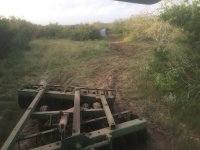
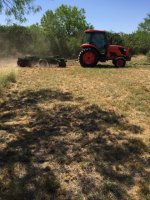
D4F987F3-9AA7-45FB-9DC6-0EBA786849F2.jpegC0548C83-989F-4429-B9CB-99F5FD14E7E2.jpeg

Picture is my primary tillage tool for game plot. Heavier is better.
 
   / Disc Questions - food plots #5  
Small tractors(and ATV's) that can only pull a small disc will be an exercise in futility.You just won't have enough weight to get anything accomplished. Definatley will not cut sod.I would cut,spray and plow with an inexpensive "middle buster type plow" then try your disc or better yet a roto-tiller................
I agree!

I also believe a rota-tiller works best for small food plots and is the quickest and most efficient implement, particularly on heavily sodded areas. I only have two make two passes with my 3Pt tiller, one pass in one direction and the second pass in the opposite direction and the plot is ready for seeding. This in old pasture and hay fields.
 
   / Disc Questions - food plots #6  
I have a B7100 and a 48 inch angle iron disc. I used it to loosen an area about 50 x 50 took an hour.Back and forth, back and forth, back and forth. But it worked. Only needed it once. Why buy more than you have to, only to use once a year.
 
   / Disc Questions - food plots #7  
The key to using a light disk is killing all of the sod and allowing it enough time to decay in the ground, You will also need some moisture in the soil.Then put some extra weight on top of your disk and go to work , just don't get in a hurry A good drag and a cultipacker are also important.
 
   / Disc Questions - food plots #8  
My older Ford tandem hinges in the middle so that you can fold the rear gangs up and only use them he front gang. This works well for cutting up sod to kill it off. Did this in the fall for expanding my garden and then disced a couple times in the spring with both gangs down.

My middle buster tater plow just plugged in sod.
 
   / Disc Questions - food plots #9  
Small light fixed angle iron frame disks DO work great for plots on small tractors! I used to have a one similar to this one CountyLine Disc Sub-Compact at Tractor Supply Co. I pulled with my BX2200 and it did great. Everyone that witnessed it was amazed. You do not need to deep tilt for a food plot. An aggressive angle, that most fixed position angle frames have, cut well enough in hard ground and sod but really shine if there is a bit of moisture in the soil.
 
   / Disc Questions - food plots #10  
When I put in food plots, I have better success plowing to cut sod then disking. A lot depends on soil type, but with the money you save on a light duty disk, you might check into also buying a used plow. I see 2-bottoms on Craigslist and at auctions all the time in $200-$300 range. I don't see 1-bottoms as often, but they are out there. Use it to cut the sod the first time and sell it off this winter if you don't think you'll need it any longer and you should recoup your money.
 
   / Disc Questions - food plots #11  
When I put in food plots, I have better success plowing to cut sod then disking. A lot depends on soil type, but with the money you save on a light duty disk, you might check into also buying a used plow. I see 2-bottoms on Craigslist and at auctions all the time in $200-$300 range. I don't see 1-bottoms as often, but they are out there. Use it to cut the sod the first time and sell it off this winter if you don't think you'll need it any longer and you should recoup your money.

Actually some sound advice and good idea.

OP, I have a Kubota 32hp tractor I've used 5' disk with angle iron frame on for years prepping food plots in tight areas. It works, but of course worked better when I added weight to it, but you start stressing things on the weaker frame doing this, made several repairs on our small disk.

My advice, do the above like Fordman said or Buy the tube frame disk (you will be glad you did years down the road I promise). With lighter disk without a plow I personally if feasible like to rotary cut if the vegetation is tall, give a week, spray, come back in 3-4 weeks and disk. If vegetation is short spray then come back in a few weeks and disk. We had places we couldn't get our big tractor to and this is how we started doing things with the smaller one and worked great.
 
   / Disc Questions - food plots #12  
weight is your friend with a harrow...but even that may not be enough.
consider spraying roundup 2 weeks before discing areas that have not been worked up in a while. it makes a huge difference in how well your harrow will turn the soil
 
   / Disc Questions - food plots #13  
I don't have a lot of experience with disks, just have used them once. they worked well, but the soil had already been worked at that spot before and the disks were a larger set my brother had that I used when I had a larger tractor (L3800).

I have a tiller with my BX and generally just use it. Usually first time working an area, I run it twice. Have always had good success with food plots. Even better when tall grass/weeds were cut and sprayed prior to tilling. The tiller cuts sod very well, but the tall stuff will kind of wrap up on it if still green and you need to unwind it from time to time. More of a pain. If grass/weeds are relatively short, no issue at all whether you kill it first or not other than if you don't kill it, it some will regrow in your food plot.
 
   / Disc Questions - food plots #14  
I have a 35 hp 4 wheel drive tractor and a used 5 foot angle iron disk that does the job. I'd love to have a bigger disk, and I think square tubing would be better, but I paid $300 for this one on Craigslist, and that made the decision for me. I've replaced a few disks that have broken and grease it before using it. My soil is red clay, and the fist time I disked it, I wasn't sure if it would ever work. But eventually, it gets the job done and turns the soil into powder. Now I do the food plot twice a year. In spring to mix in my fertilizer and lime, and then in the fall to plant my seeds and add more fertilizer.

First I spray the area with round up. Then wait about a month. The disk does not like cutting grass, or any other plants, so after everything is dead, I mow as close to the ground as I can before disking it. '
 
   / Disc Questions - food plots #15  
I have a 72" disk with 4 gangs (two rows) that weighs about 600 lbs. I have prepared 5 acres of recently cleared land that had not been plowed previously. The disc harrow worked well in our local soil especially when it had some moisture. I am adding some weight to improve the performance of the disc harrow for future tilling (I'll be tilling in my Berseem clover cover crop) in preparation for seeding Bermuda.

I also used the disc for preparing a small vegetable garden after plowing about 10 inches deep with a middle buster. My M-F is about 45 hp and pulls either implement without difficulty.
 
   / Disc Questions - food plots #16  
We have a two-bottom plow but last summer and early fall used only our tube-framed disk to prep two food plots. It is pretty heavy and worked well. I think our disk is 72". It took two passes to prep the ground well. We also have a cultipacker so we made an additional pass with the cultipacker, then the seed and fertilizer, then made another pass with the cultipacker. Before we got the cultipacker we did a similar thing dragging a pretty heavy plank behind the tractor (which we didn't think worked very well but we got good stands of millet). One mistake we made was not cutting the tall weeds, etc., with the brush hog well in advance of the disking. We ended up disking twice on one day, spraying two weeks later, and disking twice again about two weeks after that. The disk works well on bare ground but the thick vegetation laying on top of the ground makes it more difficult for the disk to penetrate the ground. This year we will mow probably a month before we disk, and if the mowed vegetation doesn't degrade well in a month we will probably use our pine straw rake and rake off the excess before we disk.


Marketplace Items

2014 FORREST RIVER SALEM TRAVEL TRAILER (A55745)
2014 FORREST RIVER...
General Purpose Loader Bucket (A59228)
General Purpose...
2008 New Holland B110 MFWD Loader Backhoe (A57024)
2008 New Holland...
2023 Unverferth 3PT 10 FT Perfecta Field Cultivator (A61307)
2023 Unverferth...
SWICT 60" SKID STEER BUCKET (A60430)
SWICT 60" SKID...
2000 Freightliner FL112 S/A Day Cab Truck Tractor (A59230)
2000 Freightliner...
 
Top