Cutting side hill trails

/ Cutting side hill trails #1  

bfisherman11

Silver Member
Joined
Apr 20, 2015
Messages
104
Location
IL and WI
Tractor
LS G3033H
I have a lot of hillside on my WI property and have a few existing side hill trails that if I had one leg shorter than the other would be no problem to walk. Ha

Anyhow, I would like to level them out a bit to make walking easier.

Attachments I have are as follows:

  • Front loader
  • 5' back blade
  • 5' disc

The places I have these trails (sorry no pic) are not that bad of a side hill. I would guess on a 5' wide trail were are talking a rise of about 12-18". Just makes for a less comfortable walk.

I think I should work a spot from the down hill side flat the length of my tractor to start. Then from that flat spot use the bucket to dig the up hill dirt out as I drive forward. I could occasionally dump the extra dirt. Once done, I could go over with the back blade to smooth it out.

Does that sound like a good way to do it?

Tractor is an LS G3033 4x4

I did a search, I know I have seen some discussion in the past on this but sure did not find any when I just looked.

Thanks,
Bill
 
/ Cutting side hill trails #2  
With gauge wheels your back blade would work well. Otherwise your method is the way to go.
 
/ Cutting side hill trails
  • Thread Starter
#3  
Egon, Hate sounding like a novice but I am not that familiar with gauge whls. If your blade was not originally equipped with them can you add these to your back blade so it runs level?

Thanks!
 
/ Cutting side hill trails #4  
This is how I've done it:
Use the back blade. Angle it, with the leading edge on the high hill side and lowered so the cutting edge is level not parallel to the hill. You can experiment with the top link length until the blade cuts aggressively on it's own. Drive in very low gear so you can raise/lower the blade as needed. That will pull the high soil to the low side. First pass is crude. Each pass cleans and refines the trail. That's worked great for me. Soil condition will be the determining factor though.
 
/ Cutting side hill trails #5  
3pt hitch box blade, more likely better at leveling / cutting and moving the dirt...
--most box blades have "rippers / teeth" that you can drop. and can really help break up hard compacted dirt.
--and then box blades simply has "sides" that hold the dirt in unlike a 3pt hitch rear blade. some rear blades you can get "bolt on" side wings" that can turn a rear blade into a box blade in thought.

FEL with general duty bucket. well STINKS. the bucket will want to skip jump all about. getting some sort of removable "tooth bar" for the FEL bucket can help when digging with FEL. being able to remove tooth bar. so you can back drag with FEL for me comes in really handy.

TNT (top and tilt) replacing top link and one of the side links on 3pt hitch with hydrualic cylinder. so you can adjust on the fly. can make life even easier. and overall dealing with drive ways / trails much more easier / quicker. more so when keeping a crown (slight hill in center on straight aways, to slight angls in corners so water runs off of driveway / trail) trying to make adjust manually 3pt hitch links is way to time consuming, and most likely not really done / used a whole bunch, except a couple adjustments if that.

============
with above noted.... i would say get a "box blade" with rippers / teeth on it. and if lot of curves / corners and different grades wanted see about TNT for the 3pt hitch.

FEL, rear blade, disc can go so far. but ya need those ripper teeth, a tooth bar for FEL might do it. but that is more for straight digging with FEL. vs trying to level out and remove ruts / high spots / low spots. and that is were a box blade shines more.
 
/ Cutting side hill trails #6  
Agree about the box blade but there could be a few exceptions...especially agree about T&T...
A couple of questions for the OP...

Are you planning on making the trails fairly level? What type of storm water run off/control ?

Are you planning on cutting the high side and filling the low? or making a full (trail wide) cut ?
 
/ Cutting side hill trails #7  
Looking at the implements you have I would try to do in either of two ways depending on your soil before I bought a box blade. Personally I would use a rear blade to do what you want to do but many other would prefer a box blade. If you can cut the soil with the rear blade ie not loaded with roots, boulders. or hard packed clay and such, then I would just use the rear blade. If you angle the blade to roll the dirt from the high side to the low side you can then tilt the blade back to level by shortening your top link. Each time you make a cut adjust the top link to keep you blade level if you have to. Make sure you start the cut far enough up on the up hill side edge of the trail because if you decide later to widen it on the up hill side it will be difficult with the step you have already cut in the side hill.

You can also tilt your blade using what ever adjustments you have in the lower links of your 3ph but when the blade is angled the top link is a simple way to get tilt on the blade.

If your soil is to tough to cut with just the blade try using your disc to rip it up then go at it with your blade as described above.
 
Last edited:
/ Cutting side hill trails #8  
I had to cut out a hill on one of my trails. It was steep enough it made me uncomfortable to drive my Mule across. I used my backhoe to dig out the high side and dump it on the low side. Then I used a box blade to level it more accurately. A FEL would substitute a backhoe, but in my case would have been much harder to get a level spot to start with.
 
/ Cutting side hill trails #9  
The tool I would choose, yes I know you don't have this one, is a plow. just plow a pass or two throwing the soil down hill and level it out with your back blade. Ed
 
/ Cutting side hill trails #10  
Egon, Hate sounding like a novice but I am not that familiar with gauge whls. If your blade was not originally equipped with them can you add these to your back blade so it runs level?

Thanks!

Yes you can add them later. They allow you to angle the blade, put weight on it, dig material from the inside and roll it to the outside. It would allow for easy transition to level path depending on soil conditions. Also works well for crowning and smoothing road surface. They allow you to roll a windrow back and forth while dropping off a little with each pass. This really helps make a smooth road with few shadows. Rolling the windrow actually moves the soil slightly in the direction you are travelling and evens out the distribution of material. Even lets you roll unwanted rocks to the side without piles of dirt.

The fell works well for digging in the side hill and dumping on the low side. Work down hill when doing this. Just make sure you start level side to side and keep it that way. Your disk would do a nice job of loosening up the trail for the final grading.


( you can actually make the blade replicate the work of a grader.

Do a search on this site and you will find many examples. "Henro" has a post showing some real nice ones.

The ones I made have a piece of Square tubing welded to the back of the blade with an insert that has caster wheel attached. Height is adjusted by drilled holes and pins. Weight is any piece of flat slate I can lift. It's crude but does work.

If you wish I could switch computers and show an example of a back blade graded area.
 
Last edited:
/ Cutting side hill trails #11  
I have had problems getting a back blade to cut into the ground if there is any veg. matter growing there.
 
/ Cutting side hill trails #12  
I have limited experience with dirt work at home. A few years ago I did a project here that required cutting and filling. The FEL worked OK on level ground (mostly topsoil) to shave an inch or two off at a pass. The rear blade was useless except for rough spreading loose material. The box blade was very useful. I can see how it would work to set one side lower to do what you want.

The nice thing with the box blade is that I bought it on CL, used it for the project, and sold it almost two years later without losing money. No work planned that would require it again.
 
/ Cutting side hill trails #13  
If you set up the rear blade to use one corner it can dig in pretty good. I've done shallow ditches with it fairly easily. You will need multiple passes but it's just time and diesel.
 
/ Cutting side hill trails #14  
I have no experience with a back blade and sounds as if it's better for spreading than cutting. Using what you have, I would start with the bucket as you were thinking and just keep working at it and you'll find a rhythm and process that works. Then use the blade to pread the spoils from the cut and smooth everything off. It may just take longer. Sure, a box blade would work great, that's how I've done mine, but if you don't have one and the project doesn't justify(only you can make that decision for yourself) buying a new implement, then use what you have and make it work. In an ideal world we would all have 5 different tractors in varying sizes with all the attachments for them, a skid steer, and an excavator. Just take it slow, find what works, and have fun learning something new!
 
/ Cutting side hill trails #15  
re-reading my own post, (one sided)...

==============
using the "3pt hitch rear blade"

adjusting the "top link" on the 3pt hitch can adjust your blade angle. and might help in getting the blade to begin to cut into the ground.

by nature a 3pt hitch "floats" meaning you only control how far it will drop. and it will rise up and down between lowest point you set it at. to max lifting height. due to this. you might want to see about rigging some sort of extra weight to the rear blade.
--right on top of the blade = most benefit most likely but rather hard to achieve or less you can weld something on top of the blade.
--between blade and tractor = easier for 3pt hitch to lift blade up.
--extending back behind tractor = harder for tractor to lift blade and weight up.

=======
gauge wheels

every finishing mower out there from push mower, to riding lawn mower, to larger size finish mowers for bigger tractors have little gauge wheels on the decks that hold the deck up off the ground. and you can adjust the gauge wheels to wanted cutting height of the finishing mower deck.

gauge wheels for a rear blade to box blade to other 3pt hitch stuff, heck even FEL some folks have done gauge wheels ((dealing with snow on pavement / concrete driveways))
--for rear blade instead of gauge wheels you might see things noted as "shoes" or "skid shoes" kinda of a sliding round saucer. that slids across the ground vs an actual wheel that rolls / turns across the ground. gauge wheels kinda bind up some when going from forward / reverse directions as the wheel turns around. and more likely reason folks going with "skid shoes" for dealing with paved / concrete drive ways. and making sure they don't leave a little "bump" of snow every time they go from forward / reverse.

==============
your disc will most likely also require extra weight to be placed on top of it. to help get the blades to sink down.
--if you can adjust the discs so they are straight and not at an angle they should sink down further.
--remember to pickup the disc when ever you go into a turn. or you will break/bend, one of the individual discs most likely.

==============
if you do not already have them....get check and sway chains / bars

you will be putting a lot of forces on the lower lift arms of the 3pt hitch. and more so you will be loading up a single side of rear blade to box blade to even the disc at times. the check chains and sway bar chains/bars will help limit the lower lift arms in how much they move back and forth. and give some extra strength to the lower lift arms.

==============
COMPACTION!
if moving dirt from high side to low side....

just like compacting dirt when filling a trench up or like.... back drag with FEL, or use rear blade, or box blade. and thin / smooth things out a few inches deep of loose material. then simply drive back and forth over the area with the tractor. ONE tire width at a time.
--then go back over the area 90 degrees of last compaction runs. while the tractor may not weight a huge amount like a compaction machine or some sort. generally if you have a bucket of dirt in the FEL. plus the normal counter weight on the rear of tractor. the dirt should get pretty smashed and compacted.

the more it is compacted the less likely you will have issues with "erosion" both while waiting for grass and like to grow back. to even after grass has grown.

towards finishing things up.... you may need to let things dry out, rain some, dry just a little. then run tractor over it all to compact it a bit more. then wait for things to dry out and run over things again to smooth things out... when the ground is "wet" you will just make ruts. trying to work the dirt so you end up with a nice 1/2" to 2" deep compaction layer on top takes time. and not driving on things. till everything has had to dry out. and when it is not to dry and not to wet..... when dirt is to dry you just skip along with FEL or rear blade or box blade. there is a middlish gray area you will need to figure out.
 
/ Cutting side hill trails #16  
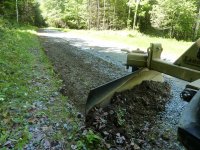
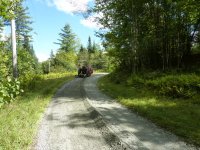
I have good luck using my rear blade to cut road and trail surfaces. That is what they are designed to do. Here are a couple pictures cutting a 2 to 3 degree road crown. The cut is about 3" deeper on the ditch end of the blade than it is on the other end. The material that is cut out flows along the blade and either fills low spots under the blade or gets deposited as a berm at the outside of the blade as it travels forward. A cut and fill operation to flatten a side hill is similar - cut material on the high side and deposit it on the low side. If you have to cut a foot off the high side it will take several passes a couple inches at a time.

P1100934.JPG

CornerRearBlade.JPG
 
/ Cutting side hill trails #18  
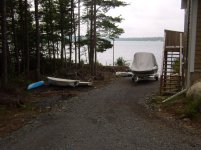
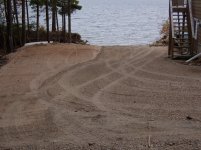
BX and box blade made this sidehill road, about 200 feet long.

Bruce
 

Attachments

  • wideningroad.JPG
    wideningroad.JPG
    277.4 KB · Views: 671
/ Cutting side hill trails #20  
This is how I've done it:
Use the back blade. Angle it, with the leading edge on the high hill side and lowered so the cutting edge is level not parallel to the hill. You can experiment with the top link length until the blade cuts aggressively on it's own. Drive in very low gear so you can raise/lower the blade as needed. That will pull the high soil to the low side. First pass is crude. Each pass cleans and refines the trail. That's worked great for me. Soil condition will be the determining factor though.

^ With the equipment you have now, I'd try this first. As others have said, success will depend on the type of soil you are working in. Big rocks & roots will make rear blade work slow to unproductive. As the soil conditions get more difficult, you will need a sturdier & heavier blade to cut-in and to avoid damaging the blade due to the leverage of tip loading the outer edge of the blade - a long lever that wants to bend your blade and it's frame. Also, as the tip loading increases, the tractor itself will tend to get pulled off it's course, so you will need more traction/weight to keep working effectively.
-Jim
 

Marketplace Items

John Deere 50 (A60462)
CAT D8 (A58214)
CAT D8 (A58214)
2015 Caterpillar 430F 4x4 Extendahoe Loader Backhoe (A60352)
2015 Caterpillar...
2020 MACK P164T (A60736)
2020 MACK P164T...
2019 Dodge Grand Caravan Van, VIN # 2C4RDGBG8KR553728 (A61165)
2019 Dodge Grand...
500BBL WHEELED FRAC TANK (A58214)
500BBL WHEELED...
 
Top