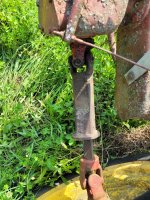
Mowing Cutter death trap

   / Cutter death trap #41  
The drawbar length is crucial for proper PTO shaft engagement and operation. A 1000 RPM PTO system is typically found on more modern and higher horsepower tractors and is designed to handle heavier implements. The 16-inch measurement is a standard for 1000 RPM PTOs and ensures the PTO shaft can properly telescope and retract as the implement moves over varying terrain. This is especially important when using a three-joint driveline on a drag implement, where the tipping bearing should be close to vertical on level ground with the correct drawbar length.

Anybody remember the special hitch JD used on the balers? Special adjustable casting the slipped over the drawbar and extended it to about 1/2 the length of the PTO shaft.
 
   / Cutter death trap #42  
I'm under the impression that distance should be 14" for a 540 rpm and 16" for a 1,000rpm shaft.
That is per maiuk in 2010.
Incorrect. It requires equal co-linear AND co-planar alignment of the input and output shafts, with the center of the intermediate shaft being over the hitch pin. This is for Non-C.V. jointed drive shafts.

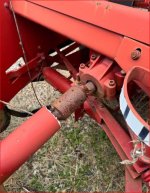
BTW: Here is an example of a non-zero phased drive shaft found in many hay rakes where the axle stub is NOT aligned with the gearbox stub. An angle is installed on the intermediate drive shaft to compensate for the mis-aligned (non-colinear) mechanism. Other examples of non-zero phased shafts are in the steering system of FWD cars. This is needed because the steering column does not line up with the pinion of the steering gear. This condition exists for crashworthiness reasons so a frontal impact does not punch the driver with the steering wheel during a collision.
 

Attachments

  • 20250708_161403.jpg
    20250708_161403.jpg
    7.6 MB · Views: 146
   / Cutter death trap #43  
Incorrect. It requires equal co-linear AND co-planar alignment of the input and output shafts, with the center of the intermediate shaft being over the hitch pin. This is for Non-C.V. jointed drive shafts.

BTW: Here is an example of a non-zero phased drive shaft found in many hay rakes where the axle stub is NOT aligned with the gearbox stub. An angle is installed on the intermediate drive shaft to compensate for the mis-aligned (non-colinear) mechanism. Other examples of non-zero phased shafts are in the steering system of FWD cars. This is needed because the steering column does not line up with the pinion of the steering gear. This condition exists for crashworthiness reasons so a frontal impact does not punch the driver with the steering wheel during a collision.
Please explain what that has to do with drawbar length.
 
   / Cutter death trap #44  
Please explain what that has to do with drawbar length.
The drawbar length sets the position of the hitch pin relative to the tractor's pto shaft's u-joint coupling on a driven shaft. This should be the same distance as the implement's hitch pin location relative to it's first u-joint coupling distance. Implements I'm familiar with seldom have a movable pto shaft bearing mount, so the drawbar is the only other way to get the correct geometry This is most important for powered/trailered implements which get large tow angles, (like a mower, baler, chopper, etc.) Even a pto generator where you would want good sine wave voltage & current flow. This means top and side view alignment as well. There are also PTO stub shaft extensions which might also help get the correct driveshaft geometry.

All of this configuration stuff also applies to front PTO applications (like a broom or snow blower). In the case of a blower, lifting the blower up and down also manipulates the driveshaft geometry, so that most of these powered front implements come with a c.v. jointed drive shaft.

BTW: In the O.P.'s description, the damage to the mower's u-joint (blown out yoke bearing and end cap) was probably the direct result of the shaft's mis-configuration. That might have worked for a tiller which is fixed, doesn't have a tow angle, and doesn't have a load when raised up, but not his trailered mower.
 
   / Cutter death trap #45  
Here's another example of an incorrect installation on a Kuhn combo tedder / rake. The photo shows the driveshaft's C.V. joint now at the tractor end. The shaft has 6 spline 540 type couplings at both ends, so an unsuspecting user could install it backwards (C.V. joint at the implement gearbox). OK in tedder mode, but vibrates more than a pickle in a women's prison when raking.
The second photo shows a baler in a local MarketPlace sale with a gearbox shaft that appears to have been broken more than once. Yep, the guy used a standard shaft hooked up to a 4020 which easily won the contest.
 

Attachments

  • 20250708_161422.jpg
    20250708_161422.jpg
    11.6 MB · Views: 119
  • No C.V. shaft results.JPG
    No C.V. shaft results.JPG
    242.3 KB · Views: 110
   / Cutter death trap #46  
I'm under the impression that distance should be 14" for a 540 rpm and 16" for a 1,000rpm shaft.
That is per maiuk in 2010.
Sure if every thing is ideal and built to that standard.
It's much easier to make sure the shaft is the correct length and that the mid point of the shaft is over the hitch pin.
 
   / Cutter death trap #47  
Please explain what that has to do with drawbar length.
A pto shaft with a plain u-joint on each end works best if the angles of each joint is equal. So, with the hitch pin near the center of the pto shaft, as you turn, the u-joints will be at similar angles.
 
   / Cutter death trap
  • Thread Starter
#48  
Wow, this post really has since great information. Thank you for all the details, most of which were unknown.
I finally got the shaft fixed and was ready to hook it back up and I see that they put a 540 yoke on there vs the 1000 that I dropped it off with. My manual says that 1000pto only runs at a higher rpm vs the 540 along with the different shaft splines.
My question is can I just run this with my 540 shaft at the higher rpm to achieve the 1000pto requirement as there doesn’t appear to be a mechanical difference other than rpm. Tractor is a JD4230.
I can certainly take it back and have them fix, but it’s an hour away and I have little time.
 
   / Cutter death trap #49  
Wow, this post really has since great information. Thank you for all the details, most of which were unknown.
I finally got the shaft fixed and was ready to hook it back up and I see that they put a 540 yoke on there vs the 1000 that I dropped it off with. My manual says that 1000pto only runs at a higher rpm vs the 540 along with the different shaft splines.
My question is can I just run this with my 540 shaft at the higher rpm to achieve the 1000pto requirement as there doesn’t appear to be a mechanical difference other than rpm. Tractor is a JD4230.
I can certainly take it back and have them fix, but it’s an hour away and I have little time.
If your mower was setup to run on the 1000 rpm input, it will not get to the proper rpm on the 540 RPM PTO.
On your tractor when you change the output shaft for the 1000 or 540 pto output it engages a different gear internally. At your tractors rated rpm for pto speed the 1000 rpm shaft will do 1000 rpm, with the 540 shaft installed you will only turn 540 rpm.
I do not believe that you can achieve 1000 rpm out on the 540 shaft.

Also looking at your first post and picture it wouldn't hurt to lower that carrier bearing down a hole or two to get a straighter pto drive line.
 
   / Cutter death trap
  • Thread Starter
#50  
If your mower was setup to run on the 1000 rpm input, it will not get to the proper rpm on the 540 RPM PTO.
On your tractor when you change the output shaft for the 1000 or 540 pto output it engages a different gear internally. At your tractors rated rpm for pto speed the 1000 rpm shaft will do 1000 rpm, with the 540 shaft installed you will only turn 540 rpm.
I do not believe that you can achieve 1000 rpm out on the 540 shaft.

Also looking at your first post and picture it wouldn't hurt to lower that carrier bearing down a hole or two to get a straighter pto drive line.

Thank you for all the input. Very helpful!
 
   / Cutter death trap
  • Thread Starter
#51  
Well I finally got the pto shafts all setup, fixed a flat tire, sharpened blades, and was ready to go. I get 3 acres done and this happened…. I swear I never learn my lesson on buying cheap used equipment. Granted I know this isn’t the end of the world, but the whole reason I went to 10ft cutter is because I don’t have time it takes for the 5ft.
What would cause this spindle to fall out while cutting? And any idea on the chances that I don’t have catastrophic damage to the gearbox? This mower is too heavy for my loader to lift and tilt up. I might could put one wheel on my Deckover trailer and get up underneath there.
I suppose I should just pull the gearbox and see what it looks like.
Thoughts?
IMG_2746.jpg

View attachment IMG_2747.jpg
 
   / Cutter death trap #52  
My experience is, every time I bought used, I was buying someone else's problem.
I don't like propping something up to work underneath. I always use wood blocking. I keep thinking, what's the chance of survival if it falls.
 
Last edited:
   / Cutter death trap #53  
Buying used equipment is perfectly fine as long as you know what you are looking at when you buy it and you know how to inspect it. I bought my Frontier 21' finish mower used from an individual. It had a bent deck wheel and one bad spindle. I knew the blades on it were the original blades but they were worn out so I had to put blades on it as well. That's an awful lot of cutter for your tractor size.
 
   / Cutter death trap #54  
My experience is, every time I bought used, I was buying someone else's problem.
I don't like propping something up to work underneath. I always use wood blocking. I keep thinking, what's the chance of survival if it falls.
I mean when you buy so used that it looks like it's got rust holes in it yes it's a problem. I'm also hoping that the huge hole in the deck is from the blade flying off.
 
   / Cutter death trap
  • Thread Starter
#55  
Hole in deck is to access blade hardware. Someone did cut a line with a torch, no idea why.
I had no expectations that this mower would last years. I was just hoping to use it for at least 2 years.
 
   / Cutter death trap #56  
Well I finally got the pto shafts all setup, fixed a flat tire, sharpened blades, and was ready to go. I get 3 acres done and this happened…. I swear I never learn my lesson on buying cheap used equipment. Granted I know this isn’t the end of the world, but the whole reason I went to 10ft cutter is because I don’t have time it takes for the 5ft.
What would cause this spindle to fall out while cutting? And any idea on the chances that I don’t have catastrophic damage to the gearbox? This mower is too heavy for my loader to lift and tilt up. I might could put one wheel on my Deckover trailer and get up underneath there.
I suppose I should just pull the gearbox and see what it looks like.
Thoughts?
View attachment 4434034
View attachment 4434035
Spindle broke
 
   / Cutter death trap #57  
Ok, it took me a bit to get oriented. So that is the shaft and blade that should be below the mower. It doesn't really look sheared to me, but cleaning up the shaft stub will tell you a lot.

Can you open the top or side of your gearbox before removing it? What holds everything together? Is there a missing bolt? Pin?

I realize there is dirt, muck, dust, etc, but was your shaft in oil or in grease?

I found the output shaft for the JD HX10 mower. You don't want to see the price, but it looks different from what you have.

 
   / Cutter death trap #58  
I mean when you buy so used that it looks like it's got rust holes in it yes it's a problem. I'm also hoping that the huge hole in the deck is from the blade flying off.
Speaking of a blade flying off, this it the LF side-corner of my 40 yr old King Kutter, 1/8"steel:
1763959497033.jpeg
 
   / Cutter death trap #59  
Speaking of a blade flying off, this it the LF side-corner of my 40 yr old King Kutter, 1/8"steel:
View attachment 4434204
I the blade dosnt even have to fly off on these things, there dangerous. I worked maintence for a municipality where a mower shot a sign post through a car door and landed in the back seat.
 
   / Cutter death trap
  • Thread Starter
#60  
Ok, it took me a bit to get oriented. So that is the shaft and blade that should be below the mower. It doesn't really look sheared to me, but cleaning up the shaft stub will tell you a lot.

Can you open the top or side of your gearbox before removing it? What holds everything together? Is there a missing bolt? Pin?

I realize there is dirt, muck, dust, etc, but was your shaft in oil or in grease?

I found the output shaft for the JD HX10 mower. You don't want to see the price, but it looks different from what you have.


That link is very helpful. Thank you. The shaft doesn’t look sheared. It seems to have just fallen out. I haven’t looked at it closely to see what held it in there, but I didn’t see a pin. The gearbox was filled with a combination of grease and oil due to leaking seals. Luckily I work for a gear shop and I can get something done cheaper than retail if needed. I’ll pop the cover and go ahead and also see if I can get the gear box off of there.
 

Tractor & Equipment Auctions

1000 Gallon Supply Tank (A53314)
1000 Gallon Supply...
2019 CATERPILLAR  XQ35 GENERATOR (A58214)
2019 CATERPILLAR...
EZ-GO Utility Cart (A55851)
EZ-GO Utility Cart...
JOHN DEERE 750 GRAIN DRILL (A58216)
JOHN DEERE 750...
SKIDDED FRAC TANK (A58214)
SKIDDED FRAC TANK...
2016 KENWORTH T680 TANDEM AXLE DAY CAB (A59905)
2016 KENWORTH T680...
 
Top