Conversion Factor for 3PH load capacity

/ Conversion Factor for 3PH load capacity #41  
Wow I don't know how I have managed to miss this thread for the last few days:rolleyes:

There is an easier way of measuring lift capacities of loaders and 3ph's.

It has to do with ratios and percentages. The force of a cylinder/length of travel is directally proportional to the lift force/distance of the lift. This is a whole lot easier than trying to figure angles and forces.
[SNIP]
Sorry for the extremely long post, but I was bored.:D
Very good post. I was going to suggest such an empirical aided method as you, but got stuck on just alluding to how the semi //ogram was overiding the lever analogy such that it was the more prevalent effect. I would definitely use your method; however taking the lift force [&distance] at the eyes because that force is usually available in the spec sheet.
larry
 
/ Conversion Factor for 3PH load capacity #42  
Pondering, measuring, pondering, considering alternatives, pondering potential DISadvantages of the parallelogram that I sketched out and have cardboard cut out ready.

Here's the BIG ONE.
Any LONG ground engaging implement, say a 3 or 4 bottom plow, needs to have it's tail end lifted quite a bit more than it's front end when coming out of a row to make the turn-around.

The relatively short top link helps to achieve this and I suspect that it is no accident of design.
Ever notice that the shorter you have your top link the quicker the implement "kicks up and forwards" when you lift it ?
This is almost certainly a deliberate part of the design.

So far I can make a (near PERFECT)parallelogram 3PH that would be quickly removable/detachable and return the tractor to "stock".
Only trouble is that (for the tractor in use as a design platform) I would sacrifice draft control while the lelloparagram is installed.
BTW, yes to the Tommy Gate example.
More thunkin' will be thunked.

PS "near PERFECT" above means within the limits of my measurements, tools and skills.
There is no deliberate "within an inch or two here or there" approach, this is as accurate as I can get it.
 
/ Conversion Factor for 3PH load capacity #43  
Hey,
I did another search this morning for "tractor stability", some interesting stuff, but mostly about side hills and trying to pull with the chain in the RIGHT place vs the WRONG place and a claim that back flips take 3/4 of a second.
What I was HOPING to find was a suggestion/recommendation for the % of weight on the front wheels to maintain steering control.
My guess is that it is the number that limits (overrules) manufacturers' published 3PH lift capacity numbers, the numbers that they claim and still feel relatively safe from liability.
 
/ Conversion Factor for 3PH load capacity #44  
All I can say is that I do agree with Spyderlk. His fundamentals and math seem to be right on with everything I know. However their is an easier way of measuring lift capacities of loaders and 3ph's...

In A perfect parallelogram, it doesn't matter how far back you go, it raises the same as the ball ends, thus what SPYDER said, would have no effect on lift capacity. But in the real world, none of us have perfect parallelograms, and even one tractor can be changed to lessen or increase the lift @24" just by adjusting the length or position of the toplink to make the implement raise slower or faster.

Sorry for the extremely long post, but I was bored.:D

This is simply incorrect:(. A perfect parallelogram does not allow you to extend a load an infinite distance with no loss of lift capability.

Forget the parallelogram, you can't get something for nothing. Think of the lift arm as torque wrench; the further out you apply a load the greater the torque value. Adjusting the toplink will screw with the rotation of the implement during travel but that does not change the lift capacity.

SPYDER, LD1, with out taking offence, try answering these two questions to prove your view:

Given:
OEM hitch spec at ball ends is 1000 lbs
dimension from drag link pivot (axle ball end) to lift arm bolt is 12"
dimension from lift arm to ball end 24" (total effective length of 36")

a) If you extend the length of the dimension from lift arm to ball end from 24" to 48", what is the lift capacity?

b) Assuming a perfect parallelogram, what is the lift capacity 24" beyond the ball ends?

My answer to a) is

the original ball end is 36" from the axle pivot and is rated at 1000 lbs. The lift force at the lift arm is 36 x 1000 / 12 = 3000 lbs.

A load extended 24" past the ball ends cannot exceed the 3000 lbs lift at the lift arm. Using length times mass we can easily use the torque to calculate that. 12x3000 = (12 + 48) x M. The lift capacity with longer drag links is 600 lbs.

My answer to b) is

Exactly the same.
 
/ Conversion Factor for 3PH load capacity #45  
This is simply incorrect:(. A perfect parallelogram does not allow you to extend a load an infinite distance with no loss of lift capability.

Forget the parallelogram, you can't get something for nothing. Think of the lift arm as torque wrench; the further out you apply a load the greater the torque value. Adjusting the toplink will screw with the rotation of the implement during travel but that does not change the lift capacity.

SPYDER, LD1, with out taking offence, try answering these two questions to prove your view:

Given:
OEM hitch spec at ball ends is 1000 lbs
dimension from drag link pivot (axle ball end) to lift arm bolt is 12"
dimension from lift arm to ball end 24" (total effective length of 36")

a) If you extend the length of the dimension from lift arm to ball end from 24" to 48", what is the lift capacity?

b) Assuming a perfect parallelogram, what is the lift capacity 24" beyond the ball ends?

My answer to a) is

the original ball end is 36" from the axle pivot and is rated at 1000 lbs. The lift force at the lift arm is 36 x 1000 / 12 = 3000 lbs.

A load extended 24" past the ball ends cannot exceed the 3000 lbs lift at the lift arm. Using length times mass we can easily use the torque to calculate that. 12x3000 = (12 + 48) x M. The lift capacity with longer drag links is 600 lbs.

My answer to b) is

Exactly the same.

I believe you have it wrong. I do agree with your answer in example A, but example B is not the same. If the implement were attached solid to the pivot points of the lower arms, then yes they would be correct. But due to the geometry of a parallelogram, it is not a simple lever, which is what you are comparing it to.

It is actually more like forks on a forklift. It doesn't matter if the load is 2" out on the forks of 4' out on the forks, the lift force is the same, because it raises at the same proportional rate to the cylinder, no matter where it is. Whether on not the forklift can handle it without tipping is another story, same with the tractor. But if you have a perfect parallelogram, and it can lift 2000lbs at the ball ends, it has the force to lift the same at 24", if the links are strong enough and the tractor heavy enough not to flip or break anything.

A real world example. My tactor has 25" long lower arms and the lift point @ 12" back from axle, and can lift 1998lbs @ ball ends. Acording to your figures 12/25=.48
1998/.48=4162.5lbs of lift force at lift points (12" back from axle end)

a load at 24" behind ball ends
12/49=.244
.244*4162.5=1019lbs @ 24" back.

But wait, the kubota spec for 24" back is almost 1500lbs?????
So there is obviously something wrong with your formula for simple levers..........o wait, it's NOT simple lever.

Now you may wonder why it can't lift 1998lbs @ 24" like I am claiming.

Simple, it's not a perfect parallelogram. The topink is not the same length or on the same angle as the lower arms. And even then can the 24" capacity be varied just by changing the location or length of the toplink.
 
/ Conversion Factor for 3PH load capacity #46  
Using the example I gave you, calculate the lift of a perfect parallelogram then. No good to say I am wrong unless you calculate it to prove your point.

Note that a forklift is NOT the same as a 3ph. A forklift lifts vertically, the position of the load CG on the forks do not affect the lift capacity (agreed!). When you load the forks you generate a torque effect that is carried by the bearings between the fork and the vertical track. This cancels the effect or torque on the lift mechanism itself.

I just don't get your (and SPYDER's) calculations and my trade is mechanical engineering.
I calculate your tractors lift capacity at 24" to be approximately 1213 lbs. Please tell me what the answer should be for my previous question (a and b) and why so I can try to understand what you think the advantage is.
 
/ Conversion Factor for 3PH load capacity #47  
Using the example I gave you, calculate the lift of a perfect parallelogram then. No good to say I am wrong unless you calculate it to prove your point.

Note that a forklift is NOT the same as a 3ph. A forklift lifts vertically, the position of the load CG on the forks do not affect the lift capacity (agreed!). When you load the forks you generate a torque effect that is carried by the bearings between the fork and the vertical track. This cancels the effect or torque on the lift mechanism itself.

I just don't get your (and SPYDER's) calculations and my trade is mechanical engineering.
I calculate your tractors lift capacity at 24" to be approximately 1213 lbs. Please tell me what the answer should be for my previous question (a and b) and why so I can try to understand what you think the advantage is.

My answer to your question B would be 1000lbs, IF and ONLY IF it is a perfect parallelogram. Because it would cause the load to raise exactally the same distance as the ball ends, a ratio of 1:1. Howerecer it would cause more tension on the toplink and more compression on the lower link, it would still be able to lift it.

But I have yet to see a perfect parallelogram 3ph. And 3ph's are adjsutable. The only accurate way to calculate it without having to measure EVERYTHING is to measure from the ground to to lower link and from the ground to a fixed point on the implement @24" back, and then raise the hitch and measure again. Take the differences in the measurments (amount the two points travelled) as the ratio(or %) of lift capacity at the ball ends.

In your example B, if you did this and the ball end moved 2" and the implement moved 3", that's 66% which would be 667lbs. But even then, you could adust the top link to make the point at 24" back move 4" to ever 2" at the ball end(or twice as fast). Thus with the same implement, just by adjusting the toplink, you gould now only lift 500lbs. And the further you deviate from a perfect parallelogram, the less the percent of lift capacity, and the more the implement will angle when raised, instead of remaining level.
 
/ Conversion Factor for 3PH load capacity #48  
THAT is IMPOSSIBLE!:D

Not be be argumentative or anything...

Cheers,
Mike
 
/ Conversion Factor for 3PH load capacity #49  
THAT is IMPOSSIBLE!:D

Not be be argumentative or anything...

Cheers,
Mike

Since you are the self-proclaimed expert mechanical engineer, can you please explain why that is impossible???

And can you explain how you determined that the lift capacity of MY tractor @24" is 1213 lbs. Because weather you do it your way (length x Mass) or my way (ratio) it calculates to ~1019 lbs.
(25 x 1996) = (49 x X)
49,900 = 49x
49,900/49 = x
1019 = X

Your length times mass formula is correct.........If it was a simple lever, which it IS NOT
 
/ Conversion Factor for 3PH load capacity #50  
My answer to your question ...
Boy Im glad youre here. Now I can take a rest!

mwb, there are other ways to to get a handle on how much force can be applied where. Use an energy calculation combined with empirical observation. As you know E=FxD. In lifting a load the tractor eyes apply a force for a distance. This Energy is stored in the load. Thus if the load rises more than the eyes it has to weigh proportionately less than the upward force provided by the eyes. [Since there will be rotation in this case it will be necessary to measure the rise of the estimated center of mass.] Alternately, if the load rises the same as the eyes [as it does w a perfect // linkage] the eyes provided a force of exactly the loads weight.
larry
 
/ Conversion Factor for 3PH load capacity #51  
Boy Im glad youre here. Now I can take a rest!

mwb, there are other ways to to get a handle on how much force can be applied where. Use an energy calculation combined with empirical observation. As you know E=FxD. In lifting a load the tractor eyes apply a force for a distance. This Energy is stored in the load. Thus if the load rises more than the eyes it has to weigh proportionately less than the upward force provided by the eyes. [Since there will be rotation in this case it will be necessary to measure the rise of the estimated center of mass.] Alternately, if the load rises the same as the eyes [as it does w a perfect // linkage] the eyes provided a force of exactly the loads weight.
larry

I'm glad there are at least two of us that understand how things like this work.

I think the forklift example I gave in an earlier post is a perfect comparison for this. A force is applied in an upward motion and a load at some distance away, it doesn't matter what the distance is, it takes the same upward motion to lift, however, the further the load is away, the greater the stress on the components, and more likely to tip over, but same force. A perfect //ogram is the same in that it applies an upward force to a load that will remain leved (ie, move the same distance as the ball ends). It's just the method for applying the force is different, but the same force is required.
 
/ Conversion Factor for 3PH load capacity #52  
/ Conversion Factor for 3PH load capacity #53  
The earth was also the center of the universe too.
 
/ Conversion Factor for 3PH load capacity #54  
To sum up everything about hydraulics, weather it be loaders, forklifts, 3ph's, dumptrucks, or whatever else you can think of it is pretty simple

The amount that can be lifted and the distance it is lifted is DIRECTALLY proprotional to the force applied and the travel distance of the object of force. (minus any small frictional losses of pivots and bushing and whayever else)

Yes it really is that simple:D
 
/ Conversion Factor for 3PH load capacity #55  
I'm glad there are at least two of us that understand how things like this work.

I think the forklift example I gave in an earlier post is a perfect comparison for this.
Yes. I was tempted but consciously never used it because I thot there would be a focus on extraneous differences by those acustomed to only simple action reaction mechanisms. Told me so.:D
larry
 
/ Conversion Factor for 3PH load capacity #56  
Maybe we scared off mwb. He hasn't posted in awhile.

I'm kiinda disappointed as I answered his questions and he hasnt answered mine:(
 
/ Conversion Factor for 3PH load capacity #57  
Jeeze, I thought I had a handle on it... :D

Another example of a // lift mechanism is the car lift that is found on the rear of race car haulers.
 
/ Conversion Factor for 3PH load capacity #58  
Hi,

Thanks everyone. I didn't know this was such in interesting subject.

I was not able to follow this thread completly because it had grow so large while I was buying and driving my new tractor. My comparisions are done.

If a reasonable conversion factor exists it may be useful to others.
At 24" setback, 80+/-5% of the lift available at the eyes seems about right based on the statstics iv seen and heard.
larry
 
/ Conversion Factor for 3PH load capacity #59  
Maybe we scared off mwb. He hasn't posted in awhile.

I'm kiinda disappointed as I answered his questions and he hasnt answered mine:(

Gotta eat and sleep sometime...

I don't know why you two are so aggressive about this. You would rather accuse me of thinking that the world is flat than explain...

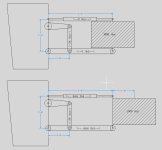
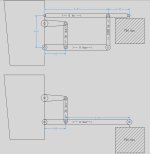
Anyway, while I was run off I did some sketches of the problem - and I stand corrected - a perfect //gram does not change the lift force as the load is extended past the ball ends. BUT this is not a practical answer. I have attached four sketches; note I have not included all of the forces (i.e. in the tractor frame) and I did not calculate a Mohrç—´ circle for each component

#1 is a "at ball ends" load
#2 is what SPYDER and LD1 are trying to explain (note that there is no change in the lift force but the top link and drag link are put in tension, compression).
#3 and #4 are what I think is a more practical application.
3pnt 1.JPG

3pnt 2.JPG

I don't know what manufactures use to calculate extended loads (this is what the OP was asking for) and your theory does not come close to answering the question. Maybe the extended load is limited by the tension in the top link? This would not help someone trying to calculate a lift capacity of a boom pole though.

My intention was to give the OP an answer that made sense and that could be used in a practical application.

Do you have any constructive comments on this?

Peace,
Mike
 
/ Conversion Factor for 3PH load capacity #60  
Well I'm glad you came around and now their are 3 of us that understand how a perfect //ogram work. In previous post too I also mentioned that it would increase the tension and compression of the top and lower arms. I also mentioned that it would be harder on all the pins as well. So now we agree on all that.

As I have mentioned in several posts before, to calculate the load at a given distance away, there is no set number or percentage. It varies with every tractor, and it can even vary on the same tractor by mounting the top link into a different hole. The further you deviate from a //ogram, the more capacity you loose. The best way is to measure the travel distances of the pins, and a know point however far back you want, and then you have your percentage.

On my tractor I have 3 mounting locations for the toplink. The top hole is the closest to parallel. Hooking their and extending the toplink about the same length as the lower arms, I may only loose 5% capacity @ 24".
But on the same implement, If I shorten all the way and mount toplink to lower hole, this causes the implement to raise much faster in proportion to the ball ends, thus reducing my capacity @ 24" by more than the first setup.
 

Marketplace Items

New/Unused Quick Attach Pallet Forks (A61166)
New/Unused Quick...
2020 MACK GRANITE QUIT AXLE DUMP TRUCK (A59906)
2020 MACK GRANITE...
Countyline 3pt 5' Box Blade (A60462)
Countyline 3pt 5'...
2010 KMC 3376 Peanut Combine (A61307)
2010 KMC 3376...
CFG NT18K (A60463)
CFG NT18K (A60463)
Snap-On Southern Thunder Edition 24-drawer tool box (A61307)
Snap-On Southern...
 
Top