You are using an out of date browser. It may not display this or other websites correctly.
You should upgrade or use an alternative browser.
You should upgrade or use an alternative browser.
California Drought
- Thread starter NoTrespassing
- Start date
- Views: 134531
More options
Who Replied?
/ California Drought
#721

ponytug
Super Member
In most cities, you can't put in a well. In rural areas, yes people have wells, but many would like to have city water.Does anybody out there avoid meters by putting a well in, or is water too deep to drill a well. Around here everybody out of town has a well.
Why? Because then it is someone else's responsibility to make sure that there is enough. Lots of wells have gone dry, and water tables are much lower than they used to be.
A few years ago, California voted to manage underground water with a goal is sustainable water use. It is not yet fully enacted, but in principle the state is divided into water management districts that have to plan and regulate the water usage within their districts.

Sustainable Groundwater Management Act (SGMA)
In 2014, Governor Edmund G. Brown Jr. signed three bills known collectively as the Sustainable Groundwater Management Act (SGMA) . For the first time in its history, California had a framework for sustainable, groundwater management - “management and use of groundwater in a manner that can be...
 water.ca.gov
As currently structured, it regulates larger users, and exempts household sized wells.
No definite plans yet about restoring aquifer levels, and managing contamination. Step one is stopping the depletion of the aquifers.
All the best,
Peter
ultrarunner
Epic Contributor
- Joined
- Apr 6, 2004
- Messages
- 30,154
- Tractor
- Cat D3, Deere 110 TLB, Kubota BX23 and L3800 and RTV900 with restored 1948 Deere M, 1949 Farmall Cub, 1953 Ford Jubliee and 1957 Ford 740 Row Crop, Craftsman Mower, Deere 350C Dozer 50 assorted vehicles from 1905 to 2006
A few have them in the city but annual backflow testing required and they were often put in many decades ago.Does anybody out there avoid meters by putting a well in, or is water too deep to drill a well. Around here everybody out of town has a well.
My brother spent 50k drilling two wells and came up dry.
Neighbor had a well drilled when I was a kid and I helped the son find it...
It pumps 4.5 minutes every 12 hours and less end of summer... he did set up a tank and a timer for 4 minutes twice a day and able to get some usable water...
Water here is about a penny a gallon not counting all the add on fees.

MossRoad
Super Moderator
- Joined
- Aug 31, 2001
- Messages
- 67,361
- Location
- South Bend, Indiana (near)
- Tractor
- Power Trac PT425 2001 Model Year
When we lived in town, we had city water. It was quite good. You had to pay both water and sewage charge on the same bill. To avoid confusing irrigation with sewage, they based your monthly sewage flow on the amount of water you used in January, February and March, when you were not likely to be irrigating. Pretty fair if you ask me.
Now that we live in the county, we have a well. We're lucky that it's pretty good here, too. Out on our rural property, it has a lot of iron.
Now that we live in the county, we have a well. We're lucky that it's pretty good here, too. Out on our rural property, it has a lot of iron.

California
Super Star Member
- Joined
- Jan 22, 2004
- Messages
- 16,947
- Location
- An hour north of San Francisco
- Tractor
- Yanmar YM240 Yanmar YM186D
After watching a Project Farm review, I bought a Zerowater dispenser. It works! The well water tests well within municipal water specs except just within the upper limit for acidity. The filter's element should be replaced when ppm of Total Dissolved Solids exceeds 35. (It comes with a ppm tester). I changed the element after a year even though the raw and filtered water continue to test 0 ppm - compared to just under 50 ppm for municipal at home in town. Recommended!Now that we live in the county, we have a well. We're lucky that it's pretty good here, too. Out on our rural property, it has a lot of iron.
California
Super Star Member
- Joined
- Jan 22, 2004
- Messages
- 16,947
- Location
- An hour north of San Francisco
- Tractor
- Yanmar YM240 Yanmar YM186D
Summary by Dan Walters - by far the best journalist to cover the California legislature and courts, with emphasis on the broad issues affected by their decisions:

 calmatters.org
California's water wars see some breakthroughs but more clashes loom
There have been a few major breakthroughs in California's water wars recently. But other battles still remain unsettled.
calmatters.org
OP

NoTrespassing
Elite Member
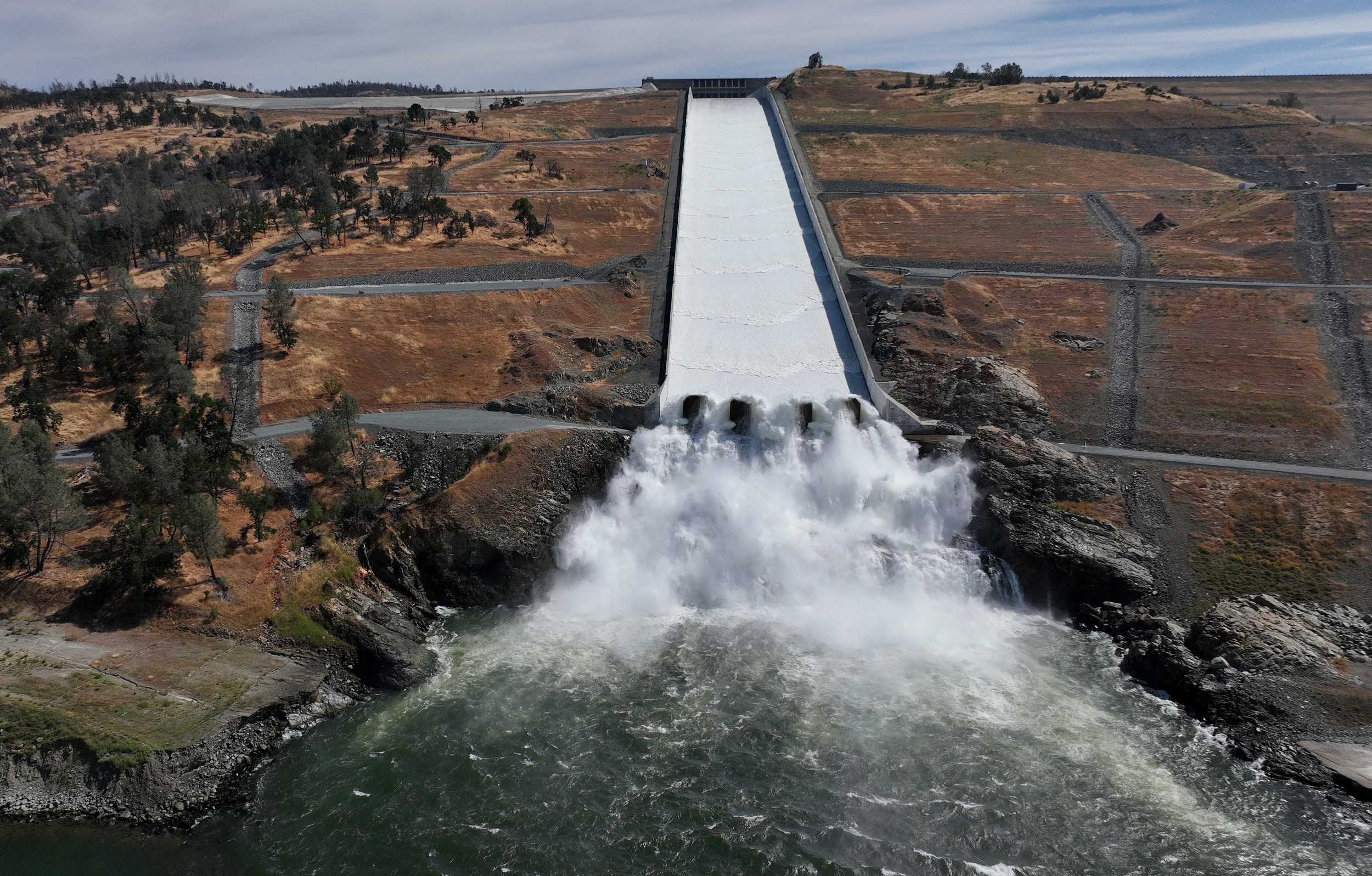
California reservoir "spectacular" release of billions of gallons of water
Water levels have risen significantly at the reservoir since the beginning of January.
 www.newsweek.com
California Reservoir 'Spectacular' Release of Billions of Gallons of Water

lilranch2001
Super Member
- Joined
- Nov 25, 2009
- Messages
- 9,143
- Tractor
- Bobcat CT 235
That video doesn’t begin to do the release justice!
California
Super Star Member
- Joined
- Jan 22, 2004
- Messages
- 16,947
- Location
- An hour north of San Francisco
- Tractor
- Yanmar YM240 Yanmar YM186D
That's the spillway that failed 6 years ago and washed a lot of the hillside down, plugging the river below.
The article notes that this present release has dropped the reservoir level less than a foot. And it's interesting that the volume in the spillway is 1/3 of the total release, the other 2/3 is going through the powerhouse.
I'm 70 miles downstream from there and it's been raining extremely hard, with winds that might be making new records. I'm not aware of any crises here like we read about in southern California, however.
The article notes that this present release has dropped the reservoir level less than a foot. And it's interesting that the volume in the spillway is 1/3 of the total release, the other 2/3 is going through the powerhouse.
I'm 70 miles downstream from there and it's been raining extremely hard, with winds that might be making new records. I'm not aware of any crises here like we read about in southern California, however.
lilranch2001
Super Member
- Joined
- Nov 25, 2009
- Messages
- 9,143
- Tractor
- Bobcat CT 235
Yea, I was thinking about that damage as I viewed the vid.That's the spillway that failed 6 years ago and washed a lot of the hillside down, plugging the river below.
The article notes that this present release has dropped the reservoir level less than a foot. And it's interesting that the volume in the spillway is 1/3 of the total release, the other 2/3 is going through the powerhouse.
I'm 70 miles downstream from there and it's been raining extremely hard, with winds that might be making new records. I'm not aware of any crises here like we read about in southern California, however.
It would be amazing to be those guys at the top watching

jyoutz
Super Star Member
Are they pumping excess storm water to recharge the aquifers?In most cities, you can't put in a well. In rural areas, yes people have wells, but many would like to have city water.
Why? Because then it is someone else's responsibility to make sure that there is enough. Lots of wells have gone dry, and water tables are much lower than they used to be.
A few years ago, California voted to manage underground water with a goal is sustainable water use. It is not yet fully enacted, but in principle the state is divided into water management districts that have to plan and regulate the water usage within their districts.
Sustainable Groundwater Management Act (SGMA)
In 2014, Governor Edmund G. Brown Jr. signed three bills known collectively as the Sustainable Groundwater Management Act (SGMA) . For the first time in its history, California had a framework for sustainable, groundwater management - “management and use of groundwater in a manner that can be...
As currently structured, it regulates larger users, and exempts household sized wells.
No definite plans yet about restoring aquifer levels, and managing contamination. Step one is stopping the depletion of the aquifers.
All the best,
Peter
ponytug
Super Member
Not directly, no.
Aquifer recharge by wells is, I think, not straightforward. Yes, it gets water to the aquifer quickly, but it gets there without any natural filtration of soils, wetlands and lakes. So a simple well plugs pretty quickly with silt, not to mention microbes and trace chemicals. It is much easier to add things like weirs, retention ponds, and wetlands that facilitate both natural infiltration as well as biological remediation (purification) of the water. Denver has done a bunch of work and requires on site capture of runoff to improve ground water recharge.
There is a trend in the Central Valley for going back to flood irrigation in times rainfall. Some farmers have been doing it there for thirty years with positive results, but it can affect crops, and is perhaps best suited to more established orchards.
Los Angeles recycles quite a bit of their water by aquifer reinjection, but the water for well injection is highly purified: micro-filtered, reverse osmosis purified, UV treated, and ozonated before injection. Some of the injection wells are on the coast to help prevent salt water intrusion into the aquifer. Slightly less treated water used for landscape irrigation, which also indirectly recharges the aquifers. Something like 80% of the water used to irrigate trees ends up back in the Los Angeles aquifer.

 www.ladwp.com
The latest plant:
www.ladwp.com
The latest plant:

 www.enr.com
Personally, I try to reduce hardscapes and try to have runoff take low slope paths to maximize infiltration. For most places on the ranch the clay soils don't exactly facilitate ground water acceptance. After a couple days of rain, the ground squirrel burrows are bubbling springs. I have a few places that can take 20gpm or so and have it underground in thirty feet or so. I am always mesmerized watching it happen. I admit to feeling a bit like a miser counting his gold watching the water disappear underground. The water there seems to feed the oaks, and there is a spring a couple hundred feet downhill from the sink and I always wonder if they are hydrologically linked.
All the best,
Peter
Aquifer recharge by wells is, I think, not straightforward. Yes, it gets water to the aquifer quickly, but it gets there without any natural filtration of soils, wetlands and lakes. So a simple well plugs pretty quickly with silt, not to mention microbes and trace chemicals. It is much easier to add things like weirs, retention ponds, and wetlands that facilitate both natural infiltration as well as biological remediation (purification) of the water. Denver has done a bunch of work and requires on site capture of runoff to improve ground water recharge.
There is a trend in the Central Valley for going back to flood irrigation in times rainfall. Some farmers have been doing it there for thirty years with positive results, but it can affect crops, and is perhaps best suited to more established orchards.
Los Angeles recycles quite a bit of their water by aquifer reinjection, but the water for well injection is highly purified: micro-filtered, reverse osmosis purified, UV treated, and ozonated before injection. Some of the injection wells are on the coast to help prevent salt water intrusion into the aquifer. Slightly less treated water used for landscape irrigation, which also indirectly recharges the aquifers. Something like 80% of the water used to irrigate trees ends up back in the Los Angeles aquifer.
Recycled Water General Information
Los Angeles has long relied on water imported from hundreds of miles away to support its water demands, but environmental programs, court rulings, periods of dry weather and low snowpack, and climate change have threatened the reliability of these imported supplies.
www.ladwp.com
Work Begins on $500M Advanced Water Treatment Facility for Los Angeles
When completed, the facility will produce 15 million gallons per day of purified water suitable for groundwater replenishment in the Los Angeles area.
www.enr.com
Personally, I try to reduce hardscapes and try to have runoff take low slope paths to maximize infiltration. For most places on the ranch the clay soils don't exactly facilitate ground water acceptance. After a couple days of rain, the ground squirrel burrows are bubbling springs. I have a few places that can take 20gpm or so and have it underground in thirty feet or so. I am always mesmerized watching it happen. I admit to feeling a bit like a miser counting his gold watching the water disappear underground. The water there seems to feed the oaks, and there is a spring a couple hundred feet downhill from the sink and I always wonder if they are hydrologically linked.
All the best,
Peter
California
Super Star Member
- Joined
- Jan 22, 2004
- Messages
- 16,947
- Location
- An hour north of San Francisco
- Tractor
- Yanmar YM240 Yanmar YM186D
Not that I know of.Are they pumping excess storm water to recharge the aquifers?
Areas like Yolo Bypass get flooded when the rivers are running high but I don't think water percolates down fast enough to capture it before it runs to the ocean. Too many impervious layers between surface and aquifer. As I understand it aquifers aren't replenished mostly from surfaced water above, but rather from far upstream. But someone who knows more might explain it better. [ I see ponytug posted while I was drafting this. Listen to him.]
There is one project under development that is unique: Sites Reservoir. It doesn't have enough upstream watershed to put much water in it, rather, water is to be pumped uphill into it from the Sacramento River when that is running at full capacity. It's the last site in the Sacramento River drainage with geography suitable for a reservoir, everything else is already dammed.
Promotional stuff. Your Tax Dollars At Work!


This reservoir on the Sacramento River has been planned for decades. What’s taking so long?
The Sites Reservoir — a $4.4 billion system to add dams and store more water to be sent south — is still years away from completion.
 calmatters.org
Critique: Sites Reservoir project is not the water solution California needs
jyoutz
Super Star Member
I’m not a hydrologist, but I’m aware of groundwater recharge programs in western Arizona where they drill injection wells and pump flood water into the aquifers. There are also weir and drainage basins in New Mexico where flood water is allowed to pool and percolate into the Rio Grande groundwater basin.Not that I know of.
Areas like Yolo Bypass get flooded when the rivers are running high but I don't think water percolates down fast enough to capture it before it runs to the ocean. Too many impervious layers between surface and aquifer. As I understand it aquifers aren't replenished mostly from surfaced water above, but rather from far upstream. But someone who knows more might explain it better. [ I see ponytug posted while I was drafting this. Listen to him.]
There is one project under development that is unique: Sites Reservoir. It doesn't have enough upstream watershed to put much water in it, rather, water is to be pumped uphill into it from the Sacramento River when that is running at full capacity. It's the last site in the Sacramento River drainage with geography suitable for a reservoir, everything else is already dammed.
Promotional stuff. Your Tax Dollars At Work!
This reservoir on the Sacramento River has been planned for decades. What’s taking so long?
The Sites Reservoir — a $4.4 billion system to add dams and store more water to be sent south — is still years away from completion.
Critique: Sites Reservoir project is not the water solution California needs
Last edited:
ultrarunner
Epic Contributor
- Joined
- Apr 6, 2004
- Messages
- 30,154
- Tractor
- Cat D3, Deere 110 TLB, Kubota BX23 and L3800 and RTV900 with restored 1948 Deere M, 1949 Farmall Cub, 1953 Ford Jubliee and 1957 Ford 740 Row Crop, Craftsman Mower, Deere 350C Dozer 50 assorted vehicles from 1905 to 2006
Some really heavy clouds bursts at times in Oakland with 80mph wind gusts…
Took down the flag as the pole was starting to flex like a fishing pole.
Have not walked the hillside to look for downed trees and or slides or washouts.
Took down the flag as the pole was starting to flex like a fishing pole.
Have not walked the hillside to look for downed trees and or slides or washouts.
OP
NoTrespassing
Elite Member
Shasta is 40 ft. higher than it was on this date in 2023. Are they releasing water there also?

orezok
Super Member
Here in the desert area municipalities are requiring projects to build water retention basins to improve water percolation and conservation.
It accomplishes 2 things. Improves the aquifer and reduces storm damage due to runoff. Due to minimal annual rainfall, most water is handled by surface rather than storm drainage systems. They are not designed to handle a large storms typically.
The cost is minimal, but developers complain about the loss of buildable area. Bu they save by not installing storm drainage systems.
It accomplishes 2 things. Improves the aquifer and reduces storm damage due to runoff. Due to minimal annual rainfall, most water is handled by surface rather than storm drainage systems. They are not designed to handle a large storms typically.
The cost is minimal, but developers complain about the loss of buildable area. Bu they save by not installing storm drainage systems.
California
Super Star Member
- Joined
- Jan 22, 2004
- Messages
- 16,947
- Location
- An hour north of San Francisco
- Tractor
- Yanmar YM240 Yanmar YM186D
We're safe and warm here at home in the Central Valley, Sacramento region. Like Ultrarunner noted in Oakland there has been severe wind, also heavy rain but just a normal winter storm. Not the disaster that SoCal is experiencing.
I got a robocall last night from PGE saying electricity at the ranch (apple orchard), north of SF, may not be restored for another 24 hours. Their online map shows miles, whole regions, down.
That outage is confirmed personally - my critter-cams at the ranch have been down since yesterday afternoon. Before the cams went down the wildlife looked miserable with soggy racoons, foxes, bobcat, scurrying along when the rain let up a little. Pobrecitos.
Added: pix from just before the deluge.


I got a robocall last night from PGE saying electricity at the ranch (apple orchard), north of SF, may not be restored for another 24 hours. Their online map shows miles, whole regions, down.
That outage is confirmed personally - my critter-cams at the ranch have been down since yesterday afternoon. Before the cams went down the wildlife looked miserable with soggy racoons, foxes, bobcat, scurrying along when the rain let up a little. Pobrecitos.
Added: pix from just before the deluge.
Last edited:
Gen2
New member
- Joined
- Feb 6, 2022
- Messages
- 2
- Location
- Rancho Cordova, CA
- Tractor
- 2005 John Deere 790 4x4; 1958 Ford 601
We had quite a wind event here just east of Sacramento yesterday with 60+mph winds.
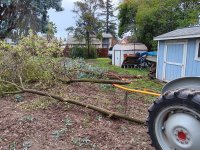
Power was out for more than 6 hours, but was back on by 10 PM. I had some fence sections blow out; had 2 limbs snapped off my Eucalyptus tree, and 2 more off a nearby Modesto Ash.
Fortunately, I had just finished building a boom pole for my Ford 601, and it worked like a champ to relocate the downed branches.
Power was out for more than 6 hours, but was back on by 10 PM. I had some fence sections blow out; had 2 limbs snapped off my Eucalyptus tree, and 2 more off a nearby Modesto Ash.
Fortunately, I had just finished building a boom pole for my Ford 601, and it worked like a champ to relocate the downed branches.
Attachments

CliffordK
Veteran Member
- Joined
- Mar 8, 2013
- Messages
- 2,456
- Location
- Eugene, Oregon
- Tractor
- Toro D200, Ford 1715, International 884,
There apparently is an effort to deliberately flood fields to allow water to soak back in.Are they pumping excess storm water to recharge the aquifers?


California farmers flood fields to boost groundwater basin
With water gushing through California’s rivers, some farmers have started devoting a portion of their land to capture these flows and let them seep into the ground.
 apnews.com
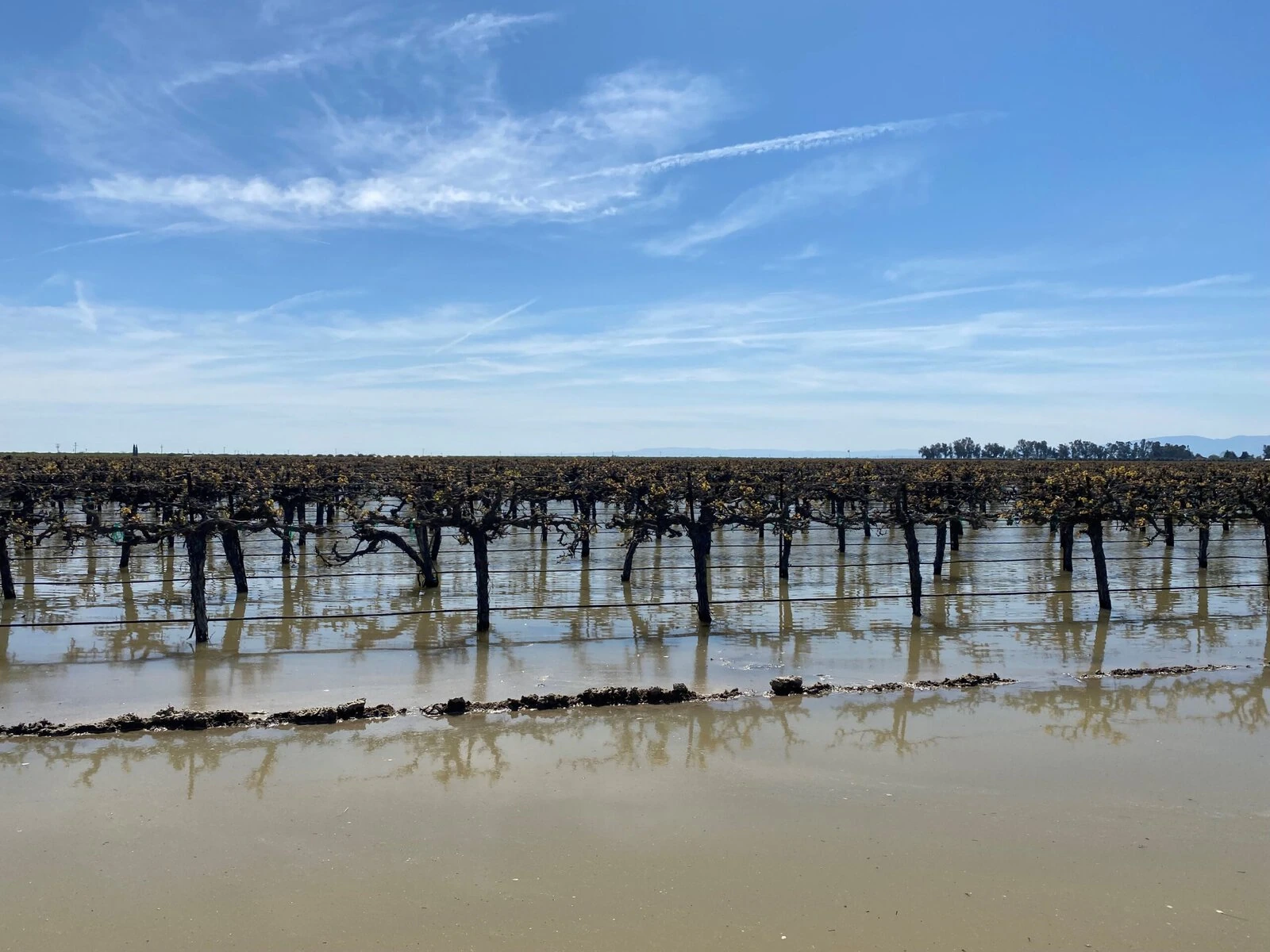
How Farmers Used California's Floods to Revive Underground Aquifers
Farms designed to recharge groundwater are answering the state's existential question: How do you make sure devastating rainfall doesn't go to waste?
 reasonstobecheerful.world
There also is a hunt for glacial valleys (paleo valleys) with sandy/rocky soil well suited for absorbing a lot of water quickly.

