12 volt conversion swap part 1

/ 12 volt conversion swap part 1 #1  

lennyzx11

Veteran Member
Joined
Dec 20, 2015
Messages
1,257
Location
Bennington Vermont
Tractor
Kubota L3301 HST/LA525 & 1964 Ford 2000 gas
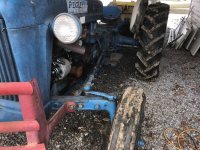
After finding out I was going to have to replace the battery in my recently acquired 64 Ford 2000, I decided to go ahead and convert it to 12 volt.

There are numerous ways of doing this.
You can
1. Tweak the 6 volt regulator to have a 12 volt output or replace it with a 12 volt regulator. This only has a weak amp output though so may not keep battery charged. And it’s hard on the 6 volt generator field windings due to more heat from the higher voltage.
2. Farmer conversion. This is just throwing a 12 volt battery in it and recharging it occasionally back in the barn with a charger. Nothing else electrical will work and probably smoke if you turn it on.
Points may suffer burning and pitting rapidly also.
3. Rebuild the 6 volt generator and replace or rebuild the regulator to 12 volt specs. This is the best for a show off restoration and that generator is a lot more water resistant than an open framed alternator. Still will have lower amperage but probably plenty for a tractor’s system
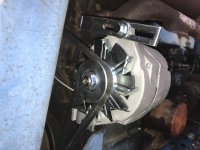
4. And the most popular. Replace with a GM internally regulated alternator. 63 amps right out of the box, less than 100 bucks. And maybe 4 hours to do.
That’s what I did.

MORE COMING
 
/ 12 volt conversion swap part 1 #2  
Thanks for the informative post, food for thought since I have thought of doing the conversion.
 
/ 12 volt conversion swap part 1
  • Thread Starter
#3  
PART 2

I bought a kit. Steiner Tractors, eBay, Yesterday’s tractors, Walt’s, and others offer various versions.

It was pretty straight forward.

Remove the battery and cables for now.
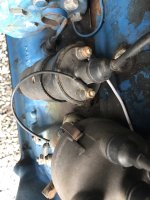
Disconnect the wires to the coil.
Reconnect the distributor wire to the NEGATIVE side of the coil.
Points make a connection to ground. You are switching to a Negative ground.
IMG_1295.jpg

On the opposite side of the engine, remove the wires to the generator and pull the wire going to the coil back from around the front. Whether you replace the harness or not with a new one from the kit, it’s easier to build one and tape it all together off the tractor.

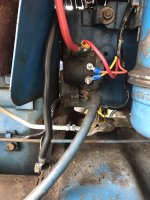
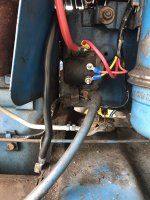
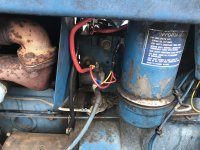
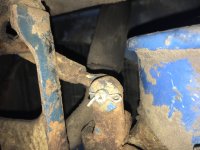
Now we are at the solenoid. Mine is a 4 post. This is NOT the average 4 post ford solenoid you get at NAPA though they look similar. One terminal goes to the starter switch push button on the transmission. Pay attention to which one that is. Mine was on the bottom small terminal as a single wire. (The YELLOW one)
IMG_1298.jpg
The other end of that yellow wire goes to the starter button. That rubber boot will be hard and crack when you try to get it off. It pulls straight back sliding on the wire to reveal the screw terminal connection inside. I’ll edit this when I find a replacement for that boot. IMG_1297.jpg

The POSITIVE battery cable goes on that top large post. I used 24 inch battery cables so I could move the battery out to connect and disconnect the battery terminals easier. Since you are doubling the voltage the current will decrease so you don’t need those huge stiff 6 volt cables any more.

This large top terminal is also where another wire (RED) goes. The other end of that wire is going up under the dash to feed the terminal block and key switch. We’ll get to that shortly.

The other small wire (my original had 2 tied together) on the top small terminal goes to the terminal block under the dash (we’re getting there) IMG_1298.jpg

EDIT My original wiring had two slip on terminals for the two small studs on the solenoid. I had to go find nuts for the ring terminals on the new harness.
#10 -32 fine thread was what I needed. Your mileage may vary.

The Orange and Yellow wires are discussed later in nauseating detail. Stay tuned.

MORE TO COME > Part 3
 
Last edited:
/ 12 volt conversion swap part 1
  • Thread Starter
#4  
Part 3

So where was I ? Oh yeah moving toward the dash. This part kinda sucks since it’s all one handed operation. Looking up through the empty battery box or down through behind the gas tank with the hood open is what you have to work with. Get a good light in there to see.

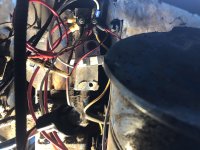
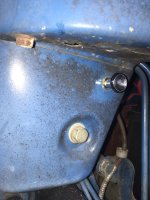
The old regulator is in there with 3 flat tip screws to remove it. Disconnect all the wires and unfasten the regulator and set it aside. Don’t be scared. And don’t lose the screws. We’re going to need them. We’ll get it all connected back up. (Hopefully)

There is a small terminal board above the regulator. Those two nuts come off too BUT PAY attention to what is connected to which one. Some we will have to put back on.
(I missed the before picture of this. If someone takes one, I’ll add it later.)
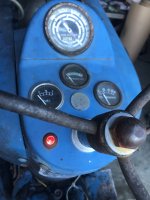
So whether you have an ammeter, a voltmeter, or a warning light, you are probably going to have to disconnect that particular thing and you will be ready to remove the harness from the dash. I have a light so I just twisted the socket from behind slightly and pulled the socket bulb and wiring out.
One side of that terminal strip is going to be hot from the battery positive connection on the starter relay. And it will have a wire going TO the key switch. The other wire coming FROM the key switch will go to the other one. This is how the key switch powers everything it should when ON.

MORE MORE MORE COMING
 
/ 12 volt conversion swap part 1 #5  
If you only desired more "oomph" you could have replaced your six volt battery with an eight volt battery and left everything else alone. Yes, eight volt batteries do exist for just that reason.
 
/ 12 volt conversion swap part 1
  • Thread Starter
#6  
If you only desired more "oomph" you could have replaced your six volt battery with an eight volt battery and left everything else alone. Yes, eight volt batteries do exist for just that reason.

Very good point.
In my case, I am replacing lights and work lights. And wanted the full standardized 12 volt system.
And that 8 volt battery was expensive!
 
/ 12 volt conversion swap part 1
  • Thread Starter
#7  
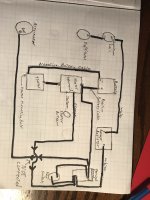
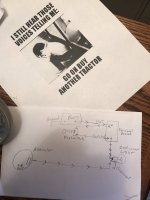
This is what we are working towards.
IMG_1299.jpg

This doesn’t show the accessories like fuel gage, lights, indicator lights, etc. We’ll add them back on later.

More to come. I have to go out and take a few more pictures first.
 
/ 12 volt conversion swap part 1 #8  
Good job on the conversion and thread so far.
Keep it coming!
 
/ 12 volt conversion swap part 1
  • Thread Starter
#9  
Part 4 Under the dash

IMG_1294.jpg

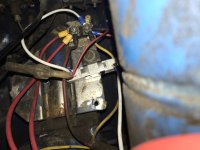
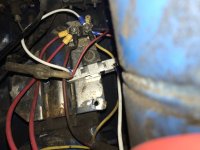
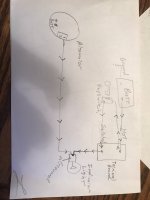
So. Looking at this picture the rectangular white thing is the ballast resistor. This cuts the voltage down from the charging voltage down to an acceptable level to feed the primary side of the coil. (The WHITE Wire)
It is mounted in one of the original holes where the Regulator was with one of the original screws.
White wire goes from positive side of the coil > to one side of the resistor (doesn’t matter which side). Opposite terminal of resistor with short White wire goes up to the Terminal board for the side that only has Power when the Key Switch is ON.

The Terminal board.

One side is Hot from the battery at all times. This is powered from that small wire (Red) that we put on top of the solenoid large terminal with the positive battery cable.
IMG_1298.jpg

That old looking original red wire is going TO the key switch to supply power. That old looking Yellow wire is returning FROM the key switch to power everything on that side when the key is ON.

Next part describes more of the wires.
More to follow.
 
/ 12 volt conversion swap part 1
  • Thread Starter
#10  
Part 5
Safety interlock wiring. And Ammeter.

IMG_1294.jpg

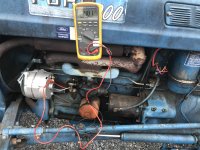
So now looking at the picture, there are two larger gauge RED wires on that left side. One of them is connected to the alternator output terminal. ( over there where I have the red lead of the multimeter attached.) completely off the subject you can see the White wire going to the coil from the ballast resistor routed behind the alternator and around the front of the engine.
(IMG_1289.jpg


The other one is connected to that large terminal on top of the solenoid with the positive battery cable aforementioned.IMG_1290.jpg

Here is where confusion could come in. That circuit is “supposed” to have the ammeter in it. I don’t have one and actually prefer a voltmeter. I haven’t got it yet.
The proper way for this circuit would be from the battery positive > to large terminal on solenoid top>Red wire to Ammeter terminal. Then from opposite Ammeter terminal that other Red wire goes to that alternator output (batt) terminal on back of alternator.
(Whew, clear as mud.)

You are in effect cutting the wire and inserting the Ammeter in series so it reads amps going to Battery (charging) and amps leaving battery to feed something like starter, lights, etc. (discharging). My kit harness was made for the Ammeter so I used the Terminal board for a convenient place to connect them.
By the way. If you managed to understand all this convoluted information and get it hooked up and the Ammeter is reading opposite of what it should be, just swap the wires on the back of it.

Remember to unhook the battery though! Let’s not make sparks near the gas tank (or anywhere) from that on always Hot wire connected.

And now that orange wire.

It is connected from the key powered on side of the terminal board to the solenoid on one of the small terminals.
It works like this.

When key is ON, power is supplied to one side of the solenoid coil inside the solenoid. But here’s the difference from a regular ford solenoid.
That other small terminal (Yellow) on the solenoid is connected to the starter push button down by the shifter. When the button is pushed, it grounds that side of the coil. That makes an electromagnet pulling the large contact inside the solenoid together to allow power to flow from the positive battery cable on top through to the large terminal on bottom and out to the starter.
Key has to be ON (to supply power).
Shifter in Neutral (to supply ground internally to starter button.
Button pressed to supply Ground to solenoid relay coil inside.
(More than you wanted to know Eh?)

Next will be the mounting of alternator part. Easy stuff.
 
/ 12 volt conversion swap part 1
  • Thread Starter
#11  
On to the physical mounting. We will come back to the wiring in a bit.

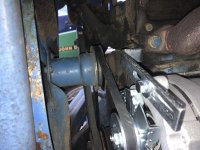
As said before, this was straight forward. Remove the old generator top bracket bolts, bottom bracket bolts and remove the generator. Now remove the brackets from the engine block but keep the bolts.

IMG_1338.jpgIMG_1340.jpgIMG_1337.jpgIMG_1338.jpgIMG_1336.jpg

My kit came with brackets. I have read that you can flip the original generator lower bracket, shim the alternator in line with flat washers and bolt it with a long all thread or stud with nuts.
I didn’t do that.

I have power steering so I had the extra step of removing the power steering belt in order to replace the generator belt with a new slightly longer one for the alternator. I don’t have id numbers for this or length. When I find that info, I’ll add it here.
I pulled one cotter pin and used a pin punch to remove and replace the mounting pin on the power steering pump. IMG_1339.jpg

Fairly easy stuff. I pulled the belt back with my hands “good nuff” and tightened the bolt.

Next. I’ll connect that existing indicator light.
 

Attachments

  • IMG_1335.jpg
    IMG_1335.jpg
    2.9 MB · Views: 137
Last edited:
/ 12 volt conversion swap part 1
  • Thread Starter
#12  
So we didn’t hook up that indicator light. Everything up to now let you get the tractor up and running and charging.

This is the first addition to the basic system.

There are three ways to monitor your fancy new alternator and charging. You can use one, two, or all the ways together. Up to you. I like the voltmeter and idiot light combination myself.

Ammeter.
Voltmeter.
Warning (Idiot) light.

Mine has the light so I wanted it to work. This also is a visual reminder that the key has been left on and the engine is off.

IMG_1349.jpg

So I removed the light socket from the original wiring. One wire had a ring terminal and another wire. We want to save that terminal. It’s gets connected back to the terminal board on the Key switched hot side. (On mine it’s that Right side).
IMG_1347.jpg

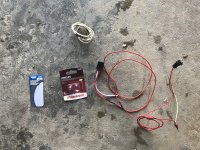
So I changed the bulb to a 12 volt (Sylvania 1445) and extended the wire on the opposite light socket wire long enough to reach the alternator. 4 ft was enough. You can scavenge from the old wiring or even the junkyard where you got your alternator if trying to cheap out. We need that terminal plug for the alternator also. It’s all cheap and at the parts store though. ( for a 76-92 GM worked for me) they are pretty standard.

So, from that terminal connection, wire goes up to light socket, bulb, down white wire to terminal 1 of the alternator.
IMG_1343.jpgIMG_1346.jpg

Here’s what we’ve done.
IMG_1352.jpg

A bigger version for this of us that can’t see.IMG_1353.jpg

And here’s the boring details.
Battery power 12 volt flows from the terminal board when key is ON, goes across bulb filament. Bulb lights up.
When engine is cranked, power is also applied from that one wire to the other. They are connected by that light bulb filament. To that Terminal 1 of the alternator. This starts the charging.
Power from the alternator starts flowing Back toward the battery now (14 volts) and meets the power coming from the battery at the light bulb. Since they are now the same. (Remember that big wire on the alternator is feeding charging voltage back to the battery positive?) there is no difference on either wire so the bulb doesn’t shine.

Different possibilities.
Key off, engine off. Light stays off.

Alternator stops charging with engine running. Light comes on.
Key is on but engine not running. Light comes on.
When you shut the engine off, the light will flicker as the charging voltage drops.
If the bulb burns out, the alternator may not charge unless it’s a true “one wire” without revving it up to get the field excited enough to begin.

If we didn’t go through the key switch and light bulb with a just straight wire here? The key switch wouldn’t turn off the engine. The charging voltage would keep backfeeding the coil and the ignition would continue working. The resistance of that bulb gives enough to halt the flow of electricity when the key is off.

Next will be Getting those 6 volts headlights working.
 
Last edited:
/ 12 volt conversion swap part 1
  • Thread Starter
#13  
The Headlights.

So here you have a choice to make.
You can keep the 6 volt light bulbs if they still work by rewiring them into a series circuit.

(I owe you a picture of that. Later edit)

But it’s a pain to try to rewire or cut and splice the wire required that would run from one to another.

And... if one bulb burns out, then both would go out.
Now just stop and imagine you are in a late night drag race against a Ford 8n and just as you reach top speed, your headlights go out ?
Why, you’d have to forfeit the race!

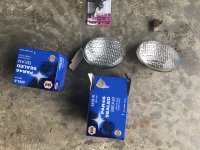
So the better way is to swap over to 12 volt headlights. Mine were 5 3/4 inches in diameter.
That crossed to a Napa 4419N.
They were around 13 bucks apiece.
IMG_1355.jpg

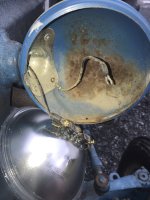
Simple to change the bulb. There’s a tab on the bulb that aligns with a slot in the housing. Get it right or it all won’t go back together.
It doesn’t matter which wire goes where.
IMG_1357.jpg
One point you will figure out. The retaining rings go to a certain side in order to get to the screw head with a screwdriver.

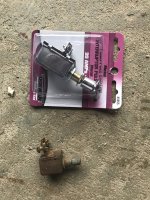
So button up the lights and if your switch is good, you’re set. Mine was rusted out though the original bulbs were good when I initially tested. So I had to change that.

I found a “close nuff” light switch at Oreilly’s auto parts here. (Napa didn’t have one when there), swapped them out old for new and ready for testing.
IMG_1354.jpgIMG_1358.jpg
This is wired to the Key switched side of that terminal board under the dash originally.
Soooo... key has to be ON to turn lights on. Or you can try to test your new headlights by pulling the knob out with Key OFF and watching them shine black for a few minutes while you scratch your head like I did. Then turn key on. Up to you.

Since these bulbs are 35 watts times 2 of them. We have a load of 70 watts on that switch.
Reaching back to old classes( or just Google), we find out that
WATTS = AMPS X VOLTS
70 watts / 12 volts = 5.83 AMPS
You can figure it for the 14 volts when running. I’m tired of doing everything.

So a 10 amp minimum switch rated for more than 12 volts should be a good replacement if you have to replace yours.
Mine’s in the picture below with the new bulbs and one of the old bulbs.IMG_1355.jpg

And the moment of truth..
Ta Daaaa...IMG_1360.jpg

Open items left.
That rear worklight. Do you think mine will buff out?IMG_1361.jpg

Fuel gage. (Measuring stick is working fine)
 
Last edited:

Marketplace Items

2018 Chevrolet Cruze Sedan (A61569)
2018 Chevrolet...
832708 (A61166)
832708 (A61166)
1016 (A61166)
1016 (A61166)
New/Unused Landhonor 50 Ton Capacity Hydraulic Shop Press (A61166)
New/Unused...
207272 (A52708)
207272 (A52708)
2025 Pabreak Hydraulic Vibratory Plate Compactor Skid Steer Attachment (A61567)
2025 Pabreak...
 
Top