denchen
Gold Member
Crazy I know, but is the inlet valve opening and closing as it should.

what are you calling the inlet valve?

Sorry guys, but Yea you call it the `intake` we use inlet and exhaust. The thinking was that if the valve was sticking partially open when warm.
Several years ago I took a trials motorcycle class taught by a British world champion. He was talking about tire pressure and used the term "bar". I really enjoyed telling him that he was wrong, tire pressure is measured in PSI. He took me seriously for a few seconds, but caught on very quickly. By the way, I also learned that my motorcycle had some kind of basic defect. HIS bike was able to do all kinds of magical feats of rock climbing, tight turns, and log-leaping, while mine kept falling down when trying the same stuff.

post up side view of the carb as it is installed.
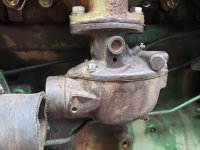
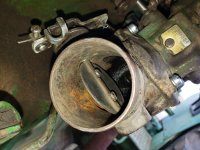
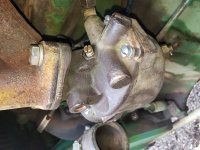

in the carb repair kit should have been an instruction sheet with all the settings [ per carb # ] for the float level and drop, the idle mixture adjustment,the main fuel adjustment and idle speed.
the float level and drop setting must be correct for the next 3 settings [ main jet, idle mixture and idle speed ] to get the engine started in an
adjustable state.
before starting the engine set the main fuel [ A ] at 1.0 turns out, set the idle mixture [ B ] at 2.0 turns out, and idle speed @ 600-700 rpm.
once started adjust the main jet to establish a smooth idle, the goal is to have a clean start-up and smooth throttle up, once that has been set adjust the idle speed, then the idle mixture.
I just went through a similar exercise on my Ford 2N; I had rebuilt the carburetor and the tractor ran essentially the same as you are describing. In my haste to get the tractor up and running again I skipped the step of chasing the passageways in the carburetor with a brass or aluminum wire when I was rebuilding. There must’ve been an obstruction because after I removed the carburetor for a second time and chased the all the passages, the tractor ran fine.