You are using an out of date browser. It may not display this or other websites correctly.
You should upgrade or use an alternative browser.
You should upgrade or use an alternative browser.
More options
Who Replied?
/ 425 again…movement problems…
#121
Tchamp
Silver Member
Hmmm.... If you don't have one already, now's a good time to get an extra quick attach plate for the 425 and weld a 2" receiver tube to it. Slip in a ball hitch, and weld a 2" hitch socket on the backhoe. Use that to move it longer distances around your place.
The 2" receiver tube on a QA plate is really handy for other things as well.
You could use the PTAs a counter balance on the digger as well win-win
Tchamp
Silver Member
And:
That is the same pump used on the Scag hstm
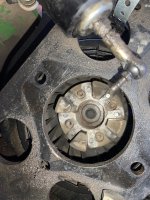
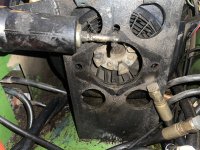
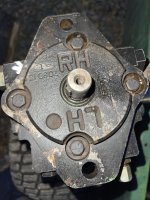
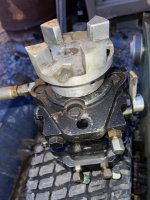
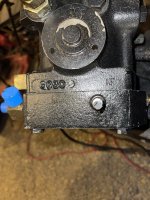
I bought one of these use for parts for $350 and pull the pump off of it and send it to Terry and have them rebuild it for around $1000 and put on my 2425 last month so if you can get your hands on one of those With a bad motor or a bad deck or something like that that’s the same exact pump the only difference is is you might have to turn the face of the pump so it’ll pump in the right direction because on the Scagg it turns I think clockwise and on the machine on the PT it has to turn counterclockwise And all you have to do is on both the four bolts on the pump end and turn it 180° then put it back together. Just be sure when you install it on your 2425 or your 425 that your love joy couplinghas some play in a get like a little gap in between the two and it’s not putting pressure on the pump because it’ll destroy the pump ask me how I know lol. So if you wanna resurrect your machine, you can locate one of those and have a rebuilt or you can go to Scagg if you can get the part numbers for it and get one for about $3500. New.

ponytug
Super Member
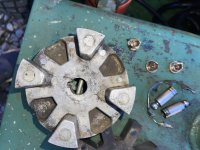
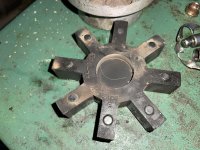
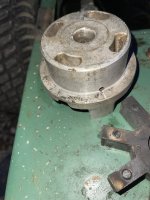
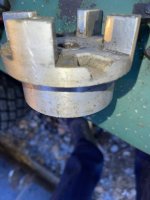
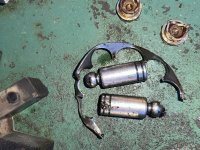
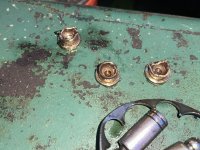
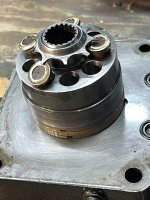
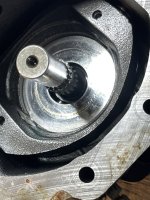
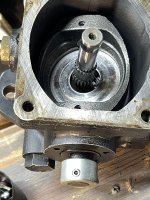
Thanks for the postmortem photos. Sad, but i pressive, though I found it interesting to see. Fascinating: I had not expected the variable volume pump cylinders to be brass, nor for the Lovejoy to be in as good a shape as it was.And:
All the best,
Peter
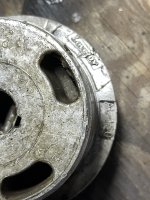
Yes! I’m amazed at how good the rest of the pump looks inside. What I call the “swash plate” (that chrome ring that surrounds the shaft) just lays down in there and comes right out. You can see some “chatter” marks on it—I’d think it has to be perfectly smooth. That would probably be hard to find…Thanks for the postmortem photos. Sad, but i pressive, though I found it interesting to see. Fascinating: I had not expected the variable volume pump cylinders to be brass, nor for the Lovejoy to be in as good a shape as it was.
All the best,
Peter
With my basic experience, seems like just a few new pieces and it would be good again. LOL (if only it were that easy)

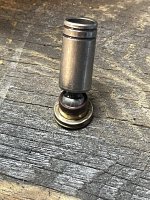
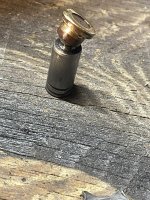
Those what I call “bullet” casings and the little gold caps attached, as well as the “retainer” ring and such…

I’ll have a few more pics later this evening.
oldnslo
Super Member
In looking at the pump failure I would suspect that loss of charge pressure was the cause along with elevated case pressure. If I recall correctly that pump is supplying oil to four wheel motors. If those motors have a case drain and one starts to fail it can cause low charge pressure.
Either way that pump needs some parts.
Either way that pump needs some parts.
“Loss of charge pressure” and the “case pressure”—could you teach me a little bit more by detailing what they are, and possible causes? Yes, it powers the 4 wheel motors.In looking at the pump failure I would suspect that loss of charge pressure was the cause along with elevated case pressure. If I recall correctly that pump is supplying oil to four wheel motors. If those motors have a case drain and one starts to fail it can cause low charge pressure.
Either way that pump needs some parts.
And yes,
it can surely use some parts. Probably more complex than what I see, but I like diving in to see how things work. We are definitely buying a new one, but I can’t just “walk away from this one”. As Terry advised, it’s not economical to spend a bunch of money on this problem, due to the age/hours, and the likelihood of more problems starting to pop up.

- Joined
- Aug 31, 2001
- Messages
- 66,099
- Location
- South Bend, Indiana (near)
- Tractor
- Power Trac PT425 2001 Model Year
That year 425 doesn't have case drains on the wheel motors. Don't know about newer ones.In looking at the pump failure I would suspect that loss of charge pressure was the cause along with elevated case pressure. If I recall correctly that pump is supplying oil to four wheel motors. If those motors have a case drain and one starts to fail it can cause low charge pressure.
Either way that pump needs some parts.
oldnslo
Super Member
Modrob
Closed loop hydrostatic drives require a separate charge pump to maintain a minimum “charge” pressure in the “closed loop” circuit.
Closed loop is where oil exits the pump and connects directly to a motor or motors. The outlet of the motor(s) connects back to the other work port on the pump. Since this circuit does NOT connect to the reservoir it requires make up oil to replace leakage losses or the charge circuit.
Some styles of motors used in closed loop applications have an external case drain which allows oil that leaks to drain to tank at low pressure so a high pressure shaft seal is not required. Per Moss Road your machine did not have that feature.
The hydrostatic pump does have a case drain to allow leakage past slippers, pistons, etc. to drain directly to tank. Typically case pressure should be less than 30 PSI to protect the shaft seal.
Typical cause of the slippers being pulled off the pistons is loss of charge pressure causing the slippers to lift off the swash plate.
High case pressures can also cause slipper lift off but that is more common on open loop applications.
Either way I agree most likely not cost effective to rebuild that old of a machine since I would be very surprised if the wheel motors are not damaged.
Closed loop hydrostatic drives require a separate charge pump to maintain a minimum “charge” pressure in the “closed loop” circuit.
Closed loop is where oil exits the pump and connects directly to a motor or motors. The outlet of the motor(s) connects back to the other work port on the pump. Since this circuit does NOT connect to the reservoir it requires make up oil to replace leakage losses or the charge circuit.
Some styles of motors used in closed loop applications have an external case drain which allows oil that leaks to drain to tank at low pressure so a high pressure shaft seal is not required. Per Moss Road your machine did not have that feature.
The hydrostatic pump does have a case drain to allow leakage past slippers, pistons, etc. to drain directly to tank. Typically case pressure should be less than 30 PSI to protect the shaft seal.
Typical cause of the slippers being pulled off the pistons is loss of charge pressure causing the slippers to lift off the swash plate.
High case pressures can also cause slipper lift off but that is more common on open loop applications.
Either way I agree most likely not cost effective to rebuild that old of a machine since I would be very surprised if the wheel motors are not damaged.
- Joined
- Aug 31, 2001
- Messages
- 66,099
- Location
- South Bend, Indiana (near)
- Tractor
- Power Trac PT425 2001 Model Year
It's tempting to rebuild, but let's look at what cost items are involved.
Carcass is there.
FEL is there.
Lift cylinders are there.
Steering valve and cylinders are there.
Don't know condition of engine, but appears to have had a looooong, productive life. Might be worth replacing.
If engine needs replacing, you'd have to cut the screen and transfer the PTO stub from the front of the engine for the VVP.
You'd need variable volume pump, 4 wheel motors, all new hoses. Hydraulic cooler is on the VVP circuit, too, I believe, so who knows if there's any chips in there.
Don't know condition of center joints or any cylinder ends.
People have said a new pump is around $3K. I don't know the cost of wheel motors, but if let's just say $800 for fun.
So you're looking a $6200 just for VVP and 4 wheel motors. Add in a new engine and that's another $3K.
So now up to say $9K... with no time, labor, etc.... the machine cost $8K new in 2001.
That's $14,350 in today's dollars.
A new machine on PT's price list is $15,900.
So value-wise, it's only gone up $1550 in 24 years.
Plus, the new one's have a bit higher lift in inches, and stronger wheel motors. I'm guessing the engine is probably more advanced VS 24 years ago, as well.
So really, a new machine is still a good value compared to the old machine.
Good luck in your decision.
Like I've said in the past, I'd buy another one for myself if ever needed.
Carcass is there.
FEL is there.
Lift cylinders are there.
Steering valve and cylinders are there.
Don't know condition of engine, but appears to have had a looooong, productive life. Might be worth replacing.
If engine needs replacing, you'd have to cut the screen and transfer the PTO stub from the front of the engine for the VVP.
You'd need variable volume pump, 4 wheel motors, all new hoses. Hydraulic cooler is on the VVP circuit, too, I believe, so who knows if there's any chips in there.
Don't know condition of center joints or any cylinder ends.
People have said a new pump is around $3K. I don't know the cost of wheel motors, but if let's just say $800 for fun.
So you're looking a $6200 just for VVP and 4 wheel motors. Add in a new engine and that's another $3K.
So now up to say $9K... with no time, labor, etc.... the machine cost $8K new in 2001.
That's $14,350 in today's dollars.
A new machine on PT's price list is $15,900.
So value-wise, it's only gone up $1550 in 24 years.
Plus, the new one's have a bit higher lift in inches, and stronger wheel motors. I'm guessing the engine is probably more advanced VS 24 years ago, as well.
So really, a new machine is still a good value compared to the old machine.
Good luck in your decision.
Like I've said in the past, I'd buy another one for myself if ever needed.
2manyrocks
Super Member
- Joined
- Jul 28, 2007
- Messages
- 9,516
I'd like to see some pictures of the entire machine.
I’ll display some hopefully later today.I'd like to see some pictures of the entire machine.
Modrob
Closed loop hydrostatic drives require a separate charge pump to maintain a minimum “charge” pressure in the “closed loop” circuit.
Closed loop is where oil exits the pump and connects directly to a motor or motors. The outlet of the motor(s) connects back to the other work port on the pump. Since this circuit does NOT connect to the reservoir it requires make up oil to replace leakage losses or the charge circuit.
Wow! Many thanks for such detail! I’ll have to study in more detail all of that…just for learning.
And yes, Moss breaks down cost issues very well. My thinking many times (as long as it doesn’t affect others in a negative way) is do just enough to make something work again—might get lucky sometimes and the effort might last for a good period. Or, it might start failing right away, in which case it’s pretty clear it’s “over”. LOL
Some styles of motors used in closed loop applications have an external case drain which allows oil that leaks to drain to tank at low pressure so a high pressure shaft seal is not required. Per Moss Road your machine did not have that feature.
The hydrostatic pump does have a case drain to allow leakage past slippers, pistons, etc. to drain directly to tank. Typically case pressure should be less than 30 PSI to protect the shaft seal.
Typical cause of the slippers being pulled off the pistons is loss of charge pressure causing the slippers to lift off the swash plate.
High case pressures can also cause slipper lift off but that is more common on open loop applications.
Either way I agree most likely not cost effective to rebuild that old of a machine since I would be very surprised if the wheel motors are not damaged.
Thanks again my good fellow. That kinda hits right-between-the-eyes. Wife is smarter—she already decided we’re going to get a new one. And seeing the new unit on display at HQ, it’s been updated in some areas…one area is much more room for knees and feet area. More comfortable now.It's tempting to rebuild, but let's look at what cost items are involved.
Carcass is there.
FEL is there.
Lift cylinders are there.
Steering valve and cylinders are there.
Don't know condition of engine, but appears to have had a looooong, productive life. Might be worth replacing.
If engine needs replacing, you'd have to cut the screen and transfer the PTO stub from the front of the engine for the VVP.
You'd need variable volume pump, 4 wheel motors, all new hoses. Hydraulic cooler is on the VVP circuit, too, I believe, so who knows if there's any chips in there.
Don't know condition of center joints or any cylinder ends.
People have said a new pump is around $3K. I don't know the cost of wheel motors, but if let's just say $800 for fun.
So you're looking a $6200 just for VVP and 4 wheel motors. Add in a new engine and that's another $3K.
So now up to say $9K... with no time, labor, etc.... the machine cost $8K new in 2001.
That's $14,350 in today's dollars.
A new machine on PT's price list is $15,900.
So value-wise, it's only gone up $1550 in 24 years.
Plus, the new one's have a bit higher lift in inches, and stronger wheel motors. I'm guessing the engine is probably more advanced VS 24 years ago, as well.
So really, a new machine is still a good value compared to the old machine.
Good luck in your decision.
Like I've said in the past, I'd buy another one for myself if ever needed.
Looking forward to getting it soon. (Was going to place the order this week, but wife got called to work out-of-town this coming week, so hopefully week after that.
- Joined
- Aug 31, 2001
- Messages
- 66,099
- Location
- South Bend, Indiana (near)
- Tractor
- Power Trac PT425 2001 Model Year
muncybob311
Member
- Joined
- Feb 27, 2024
- Messages
- 26
- Tractor
- PT 422
Good move! And like MR, I would not hesitate in buying another PT if needed. I can't imagine being w/o it.
I guess I should close out this epic.
The old 2001 unit was retired, and on April 10 we took delivery of a new PT425 at the front doors of Power Trac. And Terry was with us the whole way. (What a great guy, and so knowledgeable!)
For now the old girl sits forlornly, a shadow of her former self. (I can relate to that more every day ) I probably need to cover it up pretty tight in the meantime…until the wife decides what to do. Again, she’s had an attachment to it all those years and it’s hard to let go…me, I think if I could find those bad pump components and put it back together, it might still have a little more life. MIGHT.
  But I could only piddle with a project like that if I can ever get so many other things off me.
I’ll start a new thread for the new unit and post pics, and what I’ve learned about it so far.
Thanks again for all of your help and guidance.
The old 2001 unit was retired, and on April 10 we took delivery of a new PT425 at the front doors of Power Trac. And Terry was with us the whole way. (What a great guy, and so knowledgeable!)
For now the old girl sits forlornly, a shadow of her former self. (I can relate to that more every day
) I probably need to cover it up pretty tight in the meantime…until the wife decides what to do. Again, she’s had an attachment to it all those years and it’s hard to let go…me, I think if I could find those bad pump components and put it back together, it might still have a little more life. MIGHT. But I could only piddle with a project like that if I can ever get so many other things off me. I’ll start a new thread for the new unit and post pics, and what I’ve learned about it so far.
Thanks again for all of your help and guidance.


