paulsharvey
Super Member
Because the utility is legally obligated to continue an existing connection. A utility can't just disconnect a non-profitable customer.Not sure I follow you, why is he maintaining electric service to an abandoned building?
Because the utility is legally obligated to continue an existing connection. A utility can't just disconnect a non-profitable customer.Not sure I follow you, why is he maintaining electric service to an abandoned building?
San Ramon Pacific Telephone had a night time ice plant to make ice at night when electricity was cheap and during the day the ice floated in water and was used to cool the huge facility...The Australian megapack deployments are for time shifting solar to make the grid more reliable. They absorb solar power 10-3 and then act as peaker plants to support the grid 4-10pm.
(877MWh of capacity)
Tesla Megapack 2XL to power new giant 877 MWh Neoen battery project
The Tesla Megapack 2XL is going to power a new giant 877 MWh battery project developed by France’s Neoen in...electrek.co
(1,200MWh capacity)
Tesla Megapack to power new massive record-breaking 1.3 GWh battery system
Tesla Megapack has been selected to power a massive new record-breaking 1,3 GWh battery system from Neoen in Australia. This...
The currently (pun intended) largest version of this peaker battery storage system is on the California coast, not too far from here;
(3,000MWh of capacity)
The world’s largest battery storage system just got even larger
The Moss Landing Energy Storage Facility, the world's largest battery storage system, has been expanded to 750 MW/3,000 MWh.
These systems all help smooth out the difference in energy supply and demand. I suspect that as more renewables come on line, and more energy is used as electricity, there will be other versions of this, e.g. electrically heating brick piles for thermal energy storage (to lower the cost of things like baking and metal working, and simpler versions to store energy at home), and chemically storing the energy, e.g. hydrogen production for use in chemical manufacturing, or fuels, though not necessarily as hydrogen. There are also refrigeration versions as well, where you can freeze large blocks of ice for later use in cooling. A company, Thule energy, makes systems for small businesses, though they used to make a homeowner sized unit. Stanford University built one in the 80s that was so successful that they built a second, much, much larger version to provide heating and cooling for the entire campus and hospital systems.
If you know that energy is going to be 5-10% of the cost from 2-4 than it would be from 4-10pm, it starts to make economic sense to use more energy then.Central Energy Facility
The Central Energy Facility houses the innovations of Stanford’s Energy System Innovations (SESI): heat recovery technology, thermal storage tanks, thermal energy distribution network, and patented operational optimization software.sesi.stanford.edu
All the best,
Peter

As far as I know, there is not a storage requirement around here in Northern California (PG&E), nor in LA (LADPW), nor San Diego (SDE & SDGE), and that covers 85% of the power market in California. Do you have a reference?Kalifornia now has a storage requirement for new PV installations. Placing at least part of the burden on users.
I’ve long said parity net metering was theft from the utility. The notion one’s excess generated power placed on the grid is worth as much as power drawn from the grid. Effectively giving one a free battery.
My system will have battery storage because excess power is bought at 20% of what I buy power from the utility. Might cost me more in the end but it provides flexibility and data. Will know not just guess.
My misunderstanding that NEM 3.0 required storage. Is just that NEM 3.0 makes break even very difficult without storage.As far as I know, there is not a storage requirement around here in Northern California (PG&E), nor in LA (LADPW), nor San Diego (SDE & SDGE), and that covers 85% of the power market in California. Do you have a reference?
That said, given the low generation prices ($0.02-0.07) to some newer customers (NEM 3.0) who export power, storage does allow time shifting of solar generation, improving the economics for some of those customers, but that gets into the nitty gritty of what works for individual customers and how they value home storage.
For many business customers who are open 4-9pm, storage has a 2-3 year payback, given the commercial time of use rates, but like all of these cost-benefit analyses, it depends on individual details.
All the best,
Peter
Yes, you are right NEM 3.0 makes only solar installation break even for homeowners quite difficult on a purely economic analysis, especially with the cost of capital being what it is. Storage can help. (But only some in my view.)My misunderstanding that NEM 3.0 required storage. Is just that NEM 3.0 makes break even very difficult without storage.
IS there a customer? Is someone paying a monthly customer fee on an abandoned building? If yes, then you're right.Because the utility is legally obligated to continue an existing connection. A utility can't just disconnect a non-profitable customer.
They have to maintain connectivity once it's established. Sure, they can turn the switch off (in this case it is) will noone is paying the bill. If they removed the connection, then the home would have to be condemned, can't occupy a home without being tied to the grid. I dont know if the home is for sale, just unoccupied temporarily, or what it's status is.IS there a customer? Is someone paying a monthly customer fee on an abandoned building? If yes, then you're right.
At what point does a connection become "abandoned" in the eyes of the PUC and can be disconnected? You'll occasionally read a news story about some copper thief getting electrocuted in the act of stealing wire from an abandoned building...you'd think someone would have added an escape clause for the PoCo.
Plus if they don't maintain it, their right of way can be in jeopardy...They have to maintain connectivity once it's established. Sure, they can turn the switch off (in this case it is) will noone is paying the bill. If they removed the connection, then the home would have to be condemned, can't occupy a home without being tied to the grid. I dont know if the home is for sale, just unoccupied temporarily, or what it's status is.
So, a utility can charge the cost to connect a new customer, but once that connection is made, keeping it, rebuilding it, relocating it (as required, not just moving things for a customer), is on the utility.
Trust me (or don't that fine too), most rural connections cost more than a utility makes; that goes for everything from phone, power, water, gad, ect. Yes, they might be a for profit business, but they are also by default a monopoly, and regulated by the public service commission here, but I'm sure there is a similar government or semi government body where you are.
I know it doesn't make people feel any better about their $300 power bill, or their $100 internet bill, but these really do cost the utility a Lot to service rural customers. They make their money off commercial accounts, and denser, developed neighborhoods. Every time they send a crew out to flip a switch, that's probably atleast $500, add tree trimming, pole replacement, repairs, ect, and then the cost to generate or purchase the power...
..
We went through a long saga here with our utility that made me realize that having homes export solar is actually surprisingly hard on the grid. Grid design is old, and when local grids were planned nobody anticipated the voltage fluctuations that occur when homes export power sometimes and pull power at other times. It can be addressed, but not inexpensively, so add that to a hidden cost of home solar versus grid scale solar.
For us solar plus storage is about resilience in the face of adverse weather, fire and earthquakes. That's hard to price, but not impossible.
All the best,
Peter
Quite possible in peak sun hours. Is begging for a means of centrally throttling grid feed.I just read that in part of the Netherlands, the power company is paying homes with solar power to NOT produce power at certain times because the solar power is disrupting the grid in some areas. They have too many solar panels in some regions so PV can produce more power than can be used.
This one claims 96.5% to 99.9% efficiency:I am late to this discussion and the OP seems to have made the correct design decisions. Years ago I took a solar power class and I learned a few things:
- A rough estimate is that 77% of the power produced by the panels will make it to the power outlets. I wonder if this is still true due to more efficient invertors.
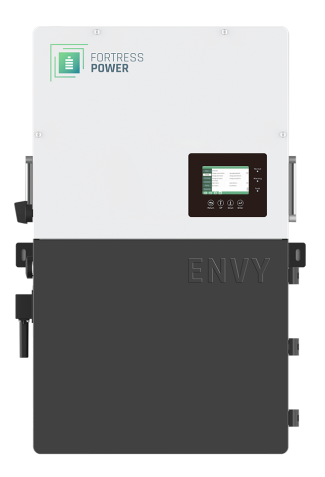
 www.fortresspower.com
A grid tie inverter requires a pilot signal to sync it's generation. Is AC, can't just parallel DC batteries. The Tesla Powerwall 2 is able to provide that signal keeping grid tie inverters online.- Many people think that solar panels will provide power during a power outage, but they don't realized without battery storage, the solar panels will be disconnected from the grid. and thus one won't get power.
Is a matter of how difficult the paperwork. Is better to sell power for 2.5¢/kWh rather than throw it away.- It was better, at least in NC and I suspect in other states, to produce slightly less power than one uses to avoid "selling" power to the power company. Regulations to sell power to the grid change and can be a PITA to follow. It is just better to produce slightly less power than needed and not worry with selling to the grid. Or if one is going to over produce power, except that one is giving money to the power company.
Yes, the LiFePO4 cells are safer, accept 100% charge without excessive wear, but weigh more than lithium-ion. The weight makes almost no difference for home storage.The price of LiFePo batteries has really fallen over the last few years which makes having battery storage more reasonable.
Microinverters? One on each panel such as Enphase features? The cost is greater but has the ability to optimize each panel's production. And networked so as to monitor each panel individually. If one is partially covered it affects production of all panels in a string using a larger conventional inverter.When the inverter panels showed up I thought they were a good idea since they lower wiring cost but I have heard that some brands have had failures of the inverters but I think I would rather have inverters off the hot roof in an easily accessible place. Today, I think I would use Victron equipment for the invertors, battery chargers, batteries, etc. Though, Tesla's power wall is certainly interesting.
Yes, I've seen that model. The 120V AC outlet was limited in power but it was able to run something relatively small without the grid or a battery.I've seen a grid tied inverter that has one outlet powered even when grid goes down and sun is out...
I like the idea and it showed a small refrigerator plugged in and a laptop.

linky400 Watts Solar Panel Kit 100A 12V Battery Charger w/ Controller Caravan Boat RV $26 w/ free shipping
Buyer beware!Has some calamity hit the fan that I missed?
I was on this thread about a month ago and about the same time I looked at ebay on panel costs. At that time panel costs looked slightly below what I paid for 1 a year ago. ~$60 for 100 watt.
Today I look and see:
linky
I was just looking to hook up a panel or two of 100watt panels for shade and charging batteries for an occasional use micro fridge and a light. 400 watts would let me add my laptop and Mobley.

this was also posted recentlyHas some calamity hit the fan that I missed?
I was on this thread about a month ago and about the same time I looked at ebay on panel costs. At that time panel costs looked slightly below what I paid for 1 a year ago. ~$60 for 100 watt.
Today I look and see:
linky
I was just looking to hook up a panel or two of 100watt panels for shade and charging batteries for an occasional use micro fridge and a light. 400 watts would let me add my laptop and Mobley.

 seia.org
THANKS!this was also posted recently
effective as of August 1, 2024: Under the Sec. 201 tariffs, all imported solar cells and panels (regardless of country of origin, except for a few minor exceptions) are currently tariff Free for the first 12.5 GW of solar cells imported. After that that the tariff is 14.25%
SEIA Statement on President Biden Action to Support U.S. Manufacturers by Raising Section 201 Tariff Rate Quote on Imported Solar Cells – SEIA
The Solar Energy Industries Association (SEIA) is leading the transformation to a clean energy economy. Learn more at seia.org
There were at least two problems, the paperwork and the rules were changing. So what was true today was not true tomorrow. If one over produced you did not 2.5 cent per KWH. You got nothing. You just gave the power company free power.Is a matter of how difficult the paperwork. Is better to sell power for 2.5¢/kWh rather than throw it away.
I ordered a pallet of panels a while back and the price today from that supplier is exactly the same it was before the announcement so not really sure what is going on. the company I bought from put out a video that says almost the opposite thing is likely in the near future as the 201 statement. Maybe they crossed in the mail. It does look like the prices are not going up so far.THANKS!
That may explain part of the drastic drop in price. I had been looking at spending ~$200 for 4 panels with nothing else, now it seems the bottom line price may be nearer $30.