sealants, hydraulic

/ sealants, hydraulic #2  
Is that to stop leaks? If yes, I wouldn't use any of those "stop leaks" products.

How bad is the leak? Are you sure you can't just replace a 2 cent o-ring and fix it?
 
/ sealants, hydraulic
  • Thread Starter
#3  
pisg, thank you for your reply. You not only live in a beautiful country, but you enjoy building things with your hands. So do I. Now at 90 years old I have slowed down.
My question is: have you actually used Bars hydraulic sealer? Do you have experience with the product? My 1989 New Holland Ford 445C is a solid machine and I notice when working hard there is a small leak here and there. Not always! Bars has been recommended by ??, I can't remember. It was suggested to use 1/2 oz. per quart of hydraulic, as a preventive. I just want to know who has tried it and results.

 
/ sealants, hydraulic #4  
pisg, thank you for your reply. You not only live in a beautiful country, but you enjoy building things with your hands. So do I. Now at 90 years old I have slowed down.
My question is: have you actually used Bars hydraulic sealer? Do you have experience with the product? My 1989 New Holland Ford 445C is a solid machine and I notice when working hard there is a small leak here and there. Not always! Bars has been recommended by ??, I can't remember. It was suggested to use 1/2 oz. per quart of hydraulic, as a preventive. I just want to know who has tried it and results.
Fred, it's great to see you still doing all of these projects at 90 years old! That's awesome.

As far as the product goes, no I have not use it. I've used those mean of engine coolant circuits and it makes a mess of the cooling system. Blocks lots of passages.

Of course you can always give it a try on that Bars product. Maybe some that used it can chime in.
 
/ sealants, hydraulic #5  
What I know about Hydraulics indicates that the Bars product is a terrible idea. It would be taken out by the filter (hopefully). Hydraulics do not handle contamination very well and I know that all hydraulic companies would decline any warranty if they know it was used in their system. I would strongly advise not using it.
 
/ sealants, hydraulic
  • Thread Starter
#6  
Fred, it's great to see you still doing all of these projects at 90 years old! That's awesome.

As far as the product goes, no I have not use it. I've used those mean of engine coolant circuits and it makes a mess of the cooling system. Blocks lots of passages.

Of course you can always give it a try on that Bars product. Maybe some that used it can chime in.
ptsg, Coolant stop leak has nothing in common with hydraulic stop leak, except both are hyped to stop leaks. With all the product out there, it appears there might be some hope with Bars. I thought I'd asked this forum for opinions from tractor people that have tried it for better or worse! Thank you for chiming in.
 
/ sealants, hydraulic #7  
I have no experience with Bars Hydraulic sealant but suspect it has some chemical(s) that react with nitrile seal material to cause it to soften and possibly swell to stop leaks past seals. Doubt it is intended to stop drips from a leaking fitting.
 
/ sealants, hydraulic
  • Thread Starter
#8  
I have no experience with Bars Hydraulic sealant but suspect it has some chemical(s) that react with nitrile seal material to cause it to soften and possibly swell to stop leaks past seals. Doubt it is intended to stop drips from a leaking fitting.
Yes, It states the swelling of the seal. I feel if that is true, then it will help to prevent leaks and stop slight leaks. A leaking fitting is a different matter. oldnslo, thank you.
 
/ sealants, hydraulic
  • Thread Starter
#9  
What I know about Hydraulics indicates that the Bars product is a terrible idea. It would be taken out by the filter (hopefully). Hydraulics do not handle contamination very well and I know that all hydraulic companies would decline any warranty if they know it was used in their system. I would strongly advise not using it.
Sportsman762, I appreciate your response, and I suspect you're knowledgeable, but there has got to be many people on this forum that have had personal experience with these hydraulic sealants. Specifically, Bars! I just don't want to pull my machine apart when there might be a solution that isn't snake oil!
 
/ sealants, hydraulic #10  
Perhaps i worded my message too politically correct.
Sportsman762, I appreciate your response, and I suspect you're knowledgeable, but there has got to be many people on this forum that have had personal experience with these hydraulic sealants. Specifically, Bars! I just don't want to pull my machine apart when there might be a solution that isn't snake oil!
The Bars product is snake oil. There is no magical fix to a leak other than to fix the cause. I would not suggest using this product or any other product that will cure the leak. It takes a great deal to hold back 2500 psi. If it can plug a hole with a 2500 psi pressure differential it will cause havoc elsewhere in the system. The tolerances in hydraulic systems are 0.0001" in spools on the valves. There is very little tolerance for foreign objects in a hydraulic system. In my current job we do testing on hydraulics with intentional debris in the system as part of the lifecycle testing. We go through several sets of valves before we can finish qualifying a unit. Softening of seals will just cause a premature failure elsewhere, potentially an immediate failure. Seals are specified to a particular durometer so that they can balance wear and sealing capabilities. There has been significant testing done on this to find the right balance. Please do not try to fix the leak with some magic cure all, it will in the long term make some not so magical mess.
 
/ sealants, hydraulic
  • Thread Starter
#11  
Perhaps i worded my message too politically correct.

The Bars product is snake oil. There is no magical fix to a leak other than to fix the cause. I would not suggest using this product or any other product that will cure the leak. It takes a great deal to hold back 2500 psi. If it can plug a hole with a 2500 psi pressure differential it will cause havoc elsewhere in the system. The tolerances in hydraulic systems are 0.0001" in spools on the valves. There is very little tolerance for foreign objects in a hydraulic system. In my current job we do testing on hydraulics with intentional debris in the system as part of the lifecycle testing. We go through several sets of valves before we can finish qualifying a unit. Softening of seals will just cause a premature failure elsewhere, potentially an immediate failure. Seals are specified to a particular durometer so that they can balance wear and sealing capabilities. There has been significant testing done on this to find the right balance. Please do not try to fix the leak with some magic cure all, it will in the long term make some not so magical mess.
Sportsman762, This time, you worded it correctly. It was actually a whack on the back of my head. I appreciate it. So far, I just added some Bars to the fronts wheels which carry 1 quart of fluid and I add ed 1 oz. Bars. I'll drain them. Thank you for the feedback! I didn't enjoy admitting anything, but I think you've helped others also...
 
/ sealants, hydraulic #12  
Sportsman762, This time, you worded it correctly. It was actually a whack on the back of my head. I appreciate it. So far, I just added some Bars to the fronts wheels which carry 1 quart of fluid and I add ed 1 oz. Bars. I'll drain them. Thank you for the feedback! I didn't enjoy admitting anything, but I think you've helped others also...
Well, lets back up here. What kind of tractor? Fred, what you just posted changes things.

There are a few tractors out there that have hydraulic drive to the front wheels and high hydraulic pressures. But most front wheels on 4wd are just mechanical drive with normal seals. While I agree with Ban the Bars on the hydraulic drive front wheels, those are pretty rare.

On the front wheel drive tractors with mechanical 4wd The Bars won't hurt....An ounce is negligible. There is no high hydraulic pressure in that type front end. But for small leaks the better solution on those is to change from hydraulic fluid to a 75w-90 gear oil and also make sure that the front axle is vented to atmosphere and not over filled. Proper fill on the mechanical type is just enough to touch the bottom of the rotating axle.
rScotty
 
Last edited:
/ sealants, hydraulic
  • Thread Starter
#13  
Well, lets back up here. What kind of tractor? Fred, what you just posted changes things.

There are a few tractors out there that have hydraulic drive to the front wheels and high hydraulic pressures. But most front wheels on 4wd are just mechanical drive with normal seals. While I agree with Ban the Bars on the hydraulic drive front wheels, those are pretty rare.

On the front wheel drive tractors with mechanical 4wd The Bars won't hurt....An ounce is negligible. There is no high hydraulic pressure in that type front end. But for small leaks the better solution on those is to change from hydraulic fluid to a 75w-90 gear oil and also make sure that the front axle is vented to atmosphere and not over filled. Proper fill on the mechanical type is just enough to touch the bottom of the rotating axle.
rScotty
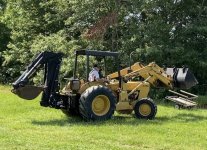
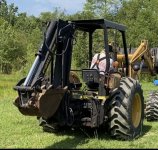
Boy, Oh Boy, the more I find out, the less I know. My tractor a New Holland Ford 445C loader 8 X 8 with a Ford 764 backhoe. BTW, I'm 90, the tractor did it's job. Anyone want to make an offer/
 

Attachments

  • 445 right side.jpg
    445 right side.jpg
    442.5 KB · Views: 89
  • 445 left side.jpg
    445 left side.jpg
    473.5 KB · Views: 84
  • 445 rear view.jpg
    445 rear view.jpg
    281.7 KB · Views: 87
  • 4798 photo digging.jpeg
    4798 photo digging.jpeg
    309.3 KB · Views: 73
Last edited:
/ sealants, hydraulic #14  
Boy, Oh Boy, the more I find out, the less I know. My tractor a New Holland Ford 445C loader 8 X 8 with a Ford 764 backhoe. BTW, I'm 90, the tractor did it's job. Anyone want to make an offer/
Wow! What a beautiful old machine that is! And in really nice shape, too. Lucky you .

Those old Fords had a common type of mechanical drive 4wd assist - the kind that you only use when you have to, and then put it back into 2wd when you are past the problem spot. There is no hydraulic pressure circulaton or filters in the front axle. It's a real strong front axle. The limitation is the type of Constant Velocity joint they have in each front wheel doesn't allow it to turn in 4wd as tightly as the bevel gear type in the more modern compact tractors.

If the only problem is in the front axle, my experience is most mechanical part time drive front axles leak a little oil after two or three decades. Mine do too - on our JD310SG 4wd that has a similar front axle. I believe there are actually three separate oil reservoirs in your front axle - one for the front axle and a wet CV out at each wheel.That's what our 310SG has & the Ford 445C looks similar. I don't believe that an ounce of Bars leak will hurt any of them.....or that it will do much good.....but it might.

If it has motor oil or trans/hydraulic in any of those front axle reservoirs then switching to a modern multi-viscosity gear lube in 75w-90 or 80w-90 will slow down a slow seep, but nothing except new seals will fix one completely. That's a lot of pain for a little gain.

If it were mine, I'd check that the levels are good, park on old gravel, and not worry about it past that.

rScotty
 
Last edited:

Marketplace Items

2018 CATERPILLAR 12M3 MOTORGRADER (A52709)
2018 CATERPILLAR...
2013 Peterbilt 365 IMT 40/275K6 9.5 Ton Knuckleboom Crane Truck (A60352)
2013 Peterbilt 365...
2020 FREIGHTLINER CASCAIDA 123 6X4 T/A  SLEEPER TRUCK TRACTOR (A59908)
2020 FREIGHTLINER...
SKID STEER BUCKET (A58214)
SKID STEER BUCKET...
2016 FREIGHTLINER CASCADIA 125 6X4  T/A  SLEEPER TRUCK TRACTOR (A59906)
2016 FREIGHTLINER...
2018 CATERPILLAR TL1255D TELESCOPIC FORKLIFT (A62129)
2018 CATERPILLAR...
 
Top