Hitch ball / coupler near disaster

/ Hitch ball / coupler near disaster #1  

plowhog

Elite Member
Joined
Dec 8, 2015
Messages
4,054
Location
North. NV, North. CA
Tractor
Massey 1710 / 1758, Ventrac 4500Y / TD9
I have constant problems with my hitch ball / coupler connections. No matter how I seem to manipulate the coupler latch device, the coupler does NOT want to come free of the ball as I jack the trailer up to disconnect. This is an ongoing problem and it nearly caused a disaster.

I brought a 4,000 lb load of gravel home using my dump trailer. Put blocks down, then tried to jack it using the hand crank. What a joke-- no chance. To make it worse it was on a slight side incline and I was on the downhill side. Got my floor jack to "help it" go up while I cranked. But then the coupler latch got hung up and the ball would not release. Instead of separating, the rear of my pickup truck started going up along with the trailer tongue as I jacked.

As I must do frequently when disconnecting, I got a pipe and pried the coupler latch upward a tiny additional amount, and all hell broke lose. The coupler/ball broke free, the rear of the truck rose further, the tongue shifted sideways, my blocks collapsed due to the sideways motion, and everything came crashing down. It was very close to almost landing on my leg and foot and I realized how stupid I was to be on the downhill side of something on a bind.

Is there some magic to couplers and balls? Before jacking I lift the coupler latch up and slide a pin in to hold it up. There is a special pin slot seemingly designed just for that. But it always seems to "hang up" and then I need to whack the coupler latch a bit more or pry it to get it to separate.
 
/ Hitch ball / coupler near disaster #2  
How much tongue weight did you have on this truck?
 
/ Hitch ball / coupler near disaster #3  
Coupler might be bent so that the ball isn't free to release even when it is supposed to release. Stamped steel couplers seem more prone to this.
 
/ Hitch ball / coupler near disaster #4  
There is a slight socket in the front part of the coupler. If there is forward pull on the ball, the coupler must move forward slightly, maybe 1/4 to 3/8 inch in relation to the ball, in order to lift off the ball. This can be hard to do with a heavy trailer. I've had to reverse a few inches sometimes to get the coupler off the ball. Maybe block a trailer tire and put the truck in reverse, then start your uncoupling routine.

Bruce
 
/ Hitch ball / coupler near disaster #5  
Only have this with my enclosed trailer and I find it simpler to pull my receiver pin and then drive forward a foot.

I must have found the sweet spot because it just slides out...

I know a few that tow a lot and they keep everything greased... saying it helps.

Some hitches are more forgiving... the bulldog on the horse trailer has never been a issue with the clamshell design...

I'm glad you were able to avoid disaster...
 
/ Hitch ball / coupler near disaster #6  
I will put the jack down to bgin pushing trailer up off ball, then move truck forward slightly to relieve pressure, then jack willlift trailer easily.
 
/ Hitch ball / coupler near disaster #7  
Is there some magic to couplers and balls? Before jacking I lift the coupler latch up and slide a pin in to hold it up. There is a special pin slot seemingly designed just for that. But it always seems to "hang up" and then I need to whack the coupler latch a bit more or pry it to get it to separate.
First, glad you're okay.

Second, maybe you're describing something different than all of my trailers (which are only 3k - 7k lb.), but usually the latch lever or screw pulls up on a pawl that grabs the bottom of the ball from the rear, with the socket of the hitch capturing the front of the ball. When released, this pawl travels down and aft, which is what allows the hitch to lift off the ball.

But lifting the latch or hand screw up would keep the pawl engaged on the bottom of the ball, and not allow it to release. Are you sure this isn't what you're doing, by holding it up or sliding a pin into it?

As already noted, popping the tow vehicle into neutral and letting it coast 1/2 inch after blocking the trailer tires often helps relieve whatever tension is on the coupler.

A picture of what you're describing might help.
 
/ Hitch ball / coupler near disaster #8  
A picture of what you're describing might help.
Right!!! There are a thousand different couplers.

My favorite type of couplers are the Bulldog Clam Shell couplers. Once locked down, they don't come off. And once the side is popped open, it will come off.

I usually start jacking until the trailer starts pulling the pickup up a little bit, then climb onto the bumper and jump up and down a couple of times. If everything is set right, it breaks the coupler loose every time. And in your case, you'll largely be out of the pinch zone.

Life isn't always flat. Make sure you have some good wheel chocks.
 
/ Hitch ball / coupler near disaster #9  
Is there some magic to couplers and balls? Before jacking I lift the coupler latch up and slide a pin in to hold it up. There is a special pin slot seemingly designed just for that. But it always seems to "hang up" and then I need to whack the coupler latch a bit more or pry it to get it to separate.
No magic, but like anything mechanical, they are not all created equal and even the best can wear out with use. What you're describing definitely is not the way that it should operate. It may need to be rebuilt or replaced or at the very least adjusted. You shouldn't need a pin to hold the latch up. The pin is a safety device used to hold the latch in place when it's down. A picture would help.
 
/ Hitch ball / coupler near disaster #10  
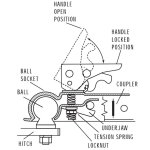
If this is what your coupler looks like, pulling up on the handle, or putting something under it, after it is vertical, will tighten the underjaw against the ball.

coupler-diagram.jpg


Bruce
 
/ Hitch ball / coupler near disaster #11  
I don't know how the latch on your coupler works but maybe you are experiencing the same problem I have had with a cheap trailer I own. The lever that must be pushed down to trap the ball pulls up a piece inside the hitch when it is pushed down. First of all this mechanism must be properly adjusted to trap the ball but also release it. But even when properly adjusted what often happens is that even though the lever is up it does not allow the piece inside to drop down. This is because the bolt attached to the lever does not drop down when the lever is raised. So the lever must be raised and then while still raised it must be pushed down such that the bolt is pushed down. This will let the piece inside the hitch drop and thus release the ball. I know, my description of the process is confusing but if you look at your hitch you will see what I mean. Pull the lever up and while in the raised position push straight down in line with the bolt. I'm sure someone will chime in with a better description of what I am trying to say. There should be a spring that does the job for you but sometimes it is either weak, missing, or things just get hung up. The spring is hidden in the hitch so you can't see if it is missing unless you look at the underside of the hitch. Oh, i saw after I made my post the Bruce posted a picture of the hitch mechanism. I shoulda done this. Bruce's post makes things much clearer.
Eric
 
/ Hitch ball / coupler near disaster #12  
I had this problem many times with an Airstream trailer.
The answer was to put the truck in neutral when the ball would not release and 99% of the time it would pop loose.
Any incline forward or reverse will add enough pressure to lock the ball to the trailer.
 
/ Hitch ball / coupler near disaster #14  
How easy would it be for you to change to a bulldog type coupler?
OP has a dump trailer on a ball hitch, so this is the way I'd be headed, as well. I'm assuming it's at least a 10k lb. trailer, and this is my favorite coupler for heavy trailers on ball hitches.

I will admit though, I hate them on lighter trailers. The main issues with the bulldog couplers are:

1. Often the tang that withdraws the sleeve isn't welded on quite straight from the factory. It makes the sleeve want to bind as it's drawn back, which makes releasing them a total PITA on trailers with this issue. Kicking the cam lever can sometimes work, but with a brake plunger usually mounted right behind the damn thing, you're likely to break that with any imperfectly-aimed kick.

2. They must be kept well-lubed, and not everyone will do that. When lubed, they can be messier than simple stamped lever hitches to be around. Not a big issue when you're wearing work clothes around an equipment trailer, but a little frustrating when you're wearing bathing trunks or clean shorts on a day out with the boat.
 
/ Hitch ball / coupler near disaster #15  
What type is it? Sounds to me like it needs to be adjusted a bit.
 
/ Hitch ball / coupler near disaster #17  
Along the lines of what Hay Dude and BCP said, I either push the trailer back or pull the truck forward a tiny bit. In my case I dealing with an empty car trailer I often can put my foot on the trailer and push it back a hair.
 
/ Hitch ball / coupler near disaster #18  
How easy would it be for you to change to a bulldog type coupler?
Bulldog or demco, I like them both. A pintle would be better than a latch type that doesn’t work the right way
 
/ Hitch ball / coupler near disaster
  • Thread Starter
#20  
Thank you for the replies. It is a light duty dump trailer. 5x10 with 5,000# payload capacity.

Tongue weight? I don't know but the dump function could not raise the load until I raked some material out and I also charged the battery.

I will get some pictures of the coupler. I have used WD40 but wondered if grease is better.
 
 
Top