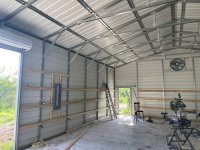
Help Me Design/ Build a Shop

   / Help Me Design/ Build a Shop #1  

LittleBittyBigJohn

Veteran Member
Joined
Jun 7, 2021
Messages
1,368
Location
Central Arkansas
Tractor
John Deere 1025R, Kubota ZD1211
I just started building my house, and all but decided to wait on the shop. My wife and parents are on me about going ahead and building it while the house is going up.... They have a point, I really want a shop and need indoor storage for several things. We are planning on this being our retirement spot. I'm 40 and My wife is 44 so it needs to last for many decades.

My dream was a 50x60x12 red iron framed building. With inflation driving the price of the house so high, not to mention the shop price, that is not in the cards. Now hoping for at least 40x50x12. I know I can get 40' wood trusses, potentially 45'.

Proposed shop use:

1) Honey house/ bathroom with shower/ kitchenette for canning etc. This will likely be a framed out room 15x15 - 20x20 no set size but large enough for chores with A/C and ideally set up like an efficiency apartment. Initially I will rough in the plumbing for the shop construction and build out the rest over time.
2) General shop related tasks. light/ medium wood work, wrenching on random stuff, tractors, mowers, etc.
3) storage/ I bought a big shelf system from Bed Bath and Beyond when they went under. 12' tall and probably 40' long. lightish duty. no pallets but great for totes.
4) Motorcycle, mower and additional vehicle parking.

Proposed style.

A) Red iron frame - too expensive
B) Post Frame - Wood in the ground, Rot, Termites etc. Longevity? Much worry.
C) Stick built - Looks like potentially the best option for me.

I plan on getting the pad ready myslef, hiring concrete finishers, hiring framers and hiring out the metal skin installation. Planning on pulling power to a sub-panel from the house and wiring myself. I don't know anything about foundation requirements. Would prefer to add any required footing type things and pour all at once as opposed to digging footers, laying blocks, filling, then pouring the slab. There is probably around a 2' fall on the pad location so I would need to build up with the fill I set aside from my pond. It's clay and Shale, it was almost all shale but when I dug it back out for the driveway lots of the shale has broken down into clay.

I might could do a lot of the framing myself but I don't know the requirements for door headers and anchoring to the floor etc. Basically I'm not scared of hard work and can follow a plan but I don't have the knowledge for what's required.

Planning on 2 man doors and 2-3 overhead doors. At least one of those being about 18' wide.

Please help me with this. I know there have probably been several threads about this exact thing so links would likely also be helpful.
 
   / Help Me Design/ Build a Shop #2  
Poke into my barn thread.


https://www.tractorbynet.com/forums/threads/doorman’s-next-big-adventure.462919/

We are building a 24x40 barndo setup.
Trusses go up this week and metal will be started also. Spray insulation is scheduled for July 6-7
 
   / Help Me Design/ Build a Shop
  • Thread Starter
#3  
Poke into my barn thread.


https://www.tractorbynet.com/forums/threads/doorman’s-next-big-adventure.462919/

We are building a 24x40 barndo setup.
Trusses go up this week and metal will be started also. Spray insulation is scheduled for July 6-7

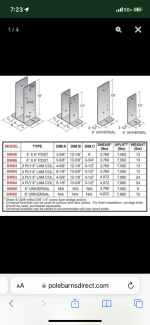
Just checked it out. Looking good. The wet-set post mounts look like a good solution.

Edit, just looked them up. Expensive.
 
   / Help Me Design/ Build a Shop #4  
Generally stick built costs more than pole barn. It's more material and more labor in the building and usually the foundation too.

I'd talk to local builders to find out what's normal for your area. Maybe with your soil and rainfall treated wood is ok. If not they'll know what else works.
 
   / Help Me Design/ Build a Shop #5  
I found that having a company install a 30X60 12 ft eave carport style building with 3 10X10 roll up doors and a man door on a concrete slab was the best option for me, I had a concrete contractor install a 4 - 5" thick slab (5" under the planned 2 post lift) for 12k and the building installed (shell with exterior doors) was 20k. down here pole barn with the posts in the ground is a no go for me.
 

Attachments

  • shop1.jpg
    shop1.jpg
    2 MB · Views: 468
  • shop2.jpg
    shop2.jpg
    2 MB · Views: 485
   / Help Me Design/ Build a Shop #6  
Pulling the power from the house is probably not a good idea. You are probably going to have 200 amp service at the house. How much can you spare to send to the barn? How much power do you need in the barn? If you are going to have things like a welder and/or large compressor you will need more power. Better option would be separate meter from the pole.
 
   / Help Me Design/ Build a Shop #7  
Pulling the power from the house is probably not a good idea. You are probably going to have 200 amp service at the house. How much can you spare to send to the barn? How much power do you need in the barn? If you are going to have things like a welder and/or large compressor you will need more power. Better option would be separate meter from the pole.
depends on a lot of things, a separate meter cost $$$ and the reoccurring bills add up also, I pulled a separate service to mine but that was more due to the obstacles in the way, it would have been cheaper for me to upgrade my service to 400amp and sub feed a 200 to the shop.
 
   / Help Me Design/ Build a Shop #8  
The "wet set" brackets are a lot cheaper than footers/stem wall that you'd be building for conventional framing.

Conventional framing is easier to finish and properly insulate the interior.

Your young and I appreciate your sense of budgeting. I'd think about building in affordable phases and using both techniques. Like build the storage/shop use portion first with "pole" construction using the perma colum brackets or the pre attached concrete base.
Then "down the road" when you're settled in and it's in the budget, build the other (use) part that sounds like it might be a more house like interior on either a slab or foundation with a shorter eave height.
These could be attached or independent of each other depending on your needs and wants (or design preferences).
 
   / Help Me Design/ Build a Shop #9  
Just checked it out. Looking good. The wet-set post mounts look like a good solution.

Edit, just looked them up. Expensive.
The builder made or had his own style fabricated.

They are two piece and he screws a chunk of post between them
 
   / Help Me Design/ Build a Shop #10  
A one man shop doesn't need a huge amount of power. You won't be running the welder and the milling machine at the same time. You can total up the draw of the things that can run on their own and add the largest intermittent draw. For example the compressor + HVAC + lights, and then add the welder or milling machine.

Depending on the house's draw, and how extensive the shop will be, you may well be able to get it all into 200a. On the other hand, the cost of adding a second service may be reasonable in your area. We have the power company from hell, so it's expensive here.

Also some planning depts (and not just in CA) get spooked by a shop that has enough stuff in it for people to live there, i.e. bathroom and shower and kitchen. They think you're trying to build an ADU on the cheap.
 
   / Help Me Design/ Build a Shop #11  
Well, not to split hairs, but you didn't actually ask a question, so what are you looking for help with?

Others have given some general advice on which type of building and such. If you are looking for stick frame, around here Menards has a service that will design the building for you and give you a full material take off list. I think they charge but credit it back if you buy the material package from them. I think Menards reaches to Arkansas but they aren't nationwide. Other lumberyards will likely have similar operations. That takes the guesswork out of the engineering of it for you.

A one man shop doesn't need a huge amount of power. You won't be running the welder and the milling machine at the same time. You can total up the draw of the things that can run on their own and add the largest intermittent draw. For example the compressor + HVAC + lights, and then add the welder or milling machine.
I agree to a point, but I can have running the compressor, lights, heat(or possibly AC where the OP is), dust collector, and wide belt sander all at once and those are all on 30 or 40A 240 circuits, except the lights & heat (not that they draw full amps). A 200A service has the advantages of max number of breaker spaces available, which is nice given the 240v ones take 2 spots and you can end up with a number of them. In my case we had the power co drop "400A" service to the site and I put a 200A panel in the house and another in the shop. the 400A is in air quotes as they call it that but it is actually 320A. No idea why they do that, but it has worked perfectly for me.

Another piece of general advice would be that if you think you might want to expand later on, make sure to set up the shop with open space at a gable end which will be the easiest to tack on more building if you want to later.
 
   / Help Me Design/ Build a Shop #12  
A few thoughts. When I had my garage built I went 2 story and so glad I did. I would price check to see. You have to have roof & floor, 2nd story wasn't all that much. I installed that myself with a helper. 2x8s with 3/4 tongue & groove plywood. I'd actually consider 3 story!
I have a separate wood shop. If I had that in garage I'd want a vacuum system for wood and walled off for no dust.
If you're ever going to insulate now's the time.
My bathroom has shower and laundry room through another door which is fantastic. A while back house had drain problems but we had garage which is completely separate septic system which was great. Today I used shop washing machine for rugs we wouldn't wash in home washer.
My propane furnace is separated from rest of garage by steel wall & door.
My garage is 250 ft. from house...I wouldn't want it close.
You can't have enough outlets.
I like a couple workbenches close to walk in door, laundry sink and wash tank at end. So nice carry something in able to work on it right there, wash parts, hands.
I like these plastic storage boxes you can see what's in them, dollar store sells them. I made shelves to fit, for things I use all the time hardware, etc.
Shelves made for battery tools & chargers.
Bins for pipe & metal.
Best of all (sounds crazy) a separate small garage close to main building. One car (truck) it's about 34x16. Short workbench along back wall, insulated easy to heat, one walk in, one electric garage door. All walls pegboard. Great for oil changes and service car, tractor, truck.
I plumbed garage for air, couplers every 20 ft.
Panel box near walk in door and outlets below for 240v welders (close so no voltage drop and easy to weld outside if I want).
I ran everything in metal conduit.
 
   / Help Me Design/ Build a Shop
  • Thread Starter
#13  
Pulling the power from the house is probably not a good idea. You are probably going to have 200 amp service at the house. How much can you spare to send to the barn? How much power do you need in the barn? If you are going to have things like a welder and/or large compressor you will need more power. Better option would be separate meter from the pole.

I'm running the service from the road to the build site at 320/400A. Apparently there is no availability on 320A panels right now so I'll most likely be forced to run 200A to my house. I have a friend with a similar house and shop to what I'm planning. He ran a 200A to his house and a 100A sub panel from his house to his shop and has had great luck. He has been one of my mentors at work and I trust what he says. It would be rare to be pulling lots of amps in the house and in the shop at the same time. In the summer the AC will be the biggest draw in the house and it should run on 30A, I can't weld and run a table saw at the same time so I shouldn't have more than 30A running at any given time in the shop.

If that doesn't work I will have expansion availability for another meter pretty easily, I just don't want to add that extra bill if I don't have to.
 
   / Help Me Design/ Build a Shop
  • Thread Starter
#14  
Well, not to split hairs, but you didn't actually ask a question, so what are you looking for help with?

Split away, that's why we are here. I found that open ended questions end up with answers that I wouldn't even know to ask.

Let's go with specific questions on concrete.

Post frame with either wet-set anchors for the posts or drilled in anchors. how would my slab need to be constructed for this? I know with post-in-ground you can just pour a monolithic slab with no footing after the erection, easiest and cheepest.

How would the slab need to be built to support stick built construction?
 
   / Help Me Design/ Build a Shop #15  
If you go the pole barn route……

Use this style of base after concrete

C66CF4E5-4F6C-4557-8FCA-3CE82FE9A79D.png
 
   / Help Me Design/ Build a Shop #16  
The common misconception that poles will rot out in the ground isn't true. I understand that wood posts in the ground, can, and have rotted out, but not when they have proper drainage. Usually the rot is from a fence post, or unprotected building with an exposed wall, or massive run off from the roof that is splashing, and eroding the soil at the post. As long as you have good drainage, and you keep your posts in the ground dry, they will last a hundred years or more.

Wood posts in the ground with purlins on the walls and wood trusses for the roof is the most cost effective, cheapest way, to build a structure. Besides a huge savings in what it costs to build, wood posts in the ground make the building more secure, and stronger then stick framing, or posts attached to the surface of a concrete pad. The most obvious advantages are the resistance to racking, and uplift from a storm. Another plus for building with poles in the ground is how simple it is to frame it up. Set posts in a straight line, attach purlins, and your walls are done.

Stick framing will cost a lot more in materials, but if you are framing the interior walls, you are spending that money anyway. The advantage to stick framing is in finishing the interior walls. One person can easily frame a building, but it's time consuming.
 
   / Help Me Design/ Build a Shop #17  
Well, not to split hairs, but you didn't actually ask a question, so what are you looking for help with?

Others have given some general advice on which type of building and such. If you are looking for stick frame, around here Menards has a service that will design the building for you and give you a full material take off list. I think they charge but credit it back if you buy the material package from them. I think Menards reaches to Arkansas but they aren't nationwide. Other lumberyards will likely have similar operations. That takes the guesswork out of the engineering of it for you.


I agree to a point, but I can have running the compressor, lights, heat(or possibly AC where the OP is), dust collector, and wide belt sander all at once and those are all on 30 or 40A 240 circuits, except the lights & heat (not that they draw full amps). A 200A service has the advantages of max number of breaker spaces available, which is nice given the 240v ones take 2 spots and you can end up with a number of them. In my case we had the power co drop "400A" service to the site and I put a 200A panel in the house and another in the shop. the 400A is in air quotes as they call it that but it is actually 320A. No idea why they do that, but it has worked perfectly for me.

Another piece of general advice would be that if you think you might want to expand later on, make sure to set up the shop with open space at a gable end which will be the easiest to tack on more building if you want to later.
320 amp is 400amp breaker times the 80% factor so 400 X .8 = 320 most circuit breakers are only rated for 80% continuous unless you pay extra.
 
   / Help Me Design/ Build a Shop #18  
The common misconception that poles will rot out in the ground isn't true. I understand that wood posts in the ground, can, and have rotted out, but not when they have proper drainage. Usually the rot is from a fence post, or unprotected building with an exposed wall, or massive run off from the roof that is splashing, and eroding the soil at the post. As long as you have good drainage, and you keep your posts in the ground dry, they will last a hundred years or more.

Wood posts in the ground with purlins on the walls and wood trusses for the roof is the most cost effective, cheapest way, to build a structure. Besides a huge savings in what it costs to build, wood posts in the ground make the building more secure, and stronger then stick framing, or posts attached to the surface of a concrete pad. The most obvious advantages are the resistance to racking, and uplift from a storm. Another plus for building with poles in the ground is how simple it is to frame it up. Set posts in a straight line, attach purlins, and your walls are done.

Stick framing will cost a lot more in materials, but if you are framing the interior walls, you are spending that money anyway. The advantage to stick framing is in finishing the interior walls. One person can easily frame a building, but it's time consuming.
posts in the ground in my area don't rot, the termites eat them, even treated posts. I have a lot of old fence posts that i'm replacing right now. i looked at pole barn construction but it is tuff in my area to keep the treatments for below grade wood up to be 100% sure that the termites will not get them and as you observed the below grade part of the pole barn construction caries a lot of the strength. otherwise i like pole barn construction other than it is a pain to finish out due to the large columns.
 
Last edited:
   / Help Me Design/ Build a Shop #19  
I'm running the service from the road to the build site at 320/400A. Apparently there is no availability on 320A panels right now so I'll most likely be forced to run 200A to my house. I have a friend with a similar house and shop to what I'm planning. He ran a 200A to his house and a 100A sub panel from his house to his shop and has had great luck. He has been one of my mentors at work and I trust what he says. It would be rare to be pulling lots of amps in the house and in the shop at the same time. In the summer the AC will be the biggest draw in the house and it should run on 30A, I can't weld and run a table saw at the same time so I shouldn't have more than 30A running at any given time in the shop.

If that doesn't work I will have expansion availability for another meter pretty easily, I just don't want to add that extra bill if I don't have to.
most likely you are correct and 100 amps for the shop with 200a - shop load for the house will be fine but it depends on what you are running at the same time as well as what is going on in the house at the same time. someone using the stove/ oven while some one is taking a shower can draw a lot of power with ac/heat on top of that.
also circuit breakers don't just trip when hit 201 amps for a few min they will take 10 min or so at 230 amps (more current less time) but on the other side unless they are 100% rated and most are not, that 200 amp breaker will trip at 80% or 160 amp after 4 hours continuous load (give or take).

as i said before you most likely will not have a problem with your load.
 
   / Help Me Design/ Build a Shop #20  
Split away, that's why we are here. I found that open ended questions end up with answers that I wouldn't even know to ask.

Let's go with specific questions on concrete.

Post frame with either wet-set anchors for the posts or drilled in anchors. how would my slab need to be constructed for this? I know with post-in-ground you can just pour a monolithic slab with no footing after the erection, easiest and cheepest.

How would the slab need to be built to support stick built construction?
i had the same problem with 400 amp panels and ended up doing a 200a service for the shop, later i will look at upgrading my house service to 400 amp and sub feeding my shop. the charges to up grade my 200 amp to 400a on the existing service was 1/2 the cost of a new 200a service from my utility Co, but the cost of 400 amp rated panels was crazy.
 

Tractor & Equipment Auctions

UNUSED IRGC80 Battery Powered Golf cart (A55272)
UNUSED IRGC80...
2014 Ford Explorer SUV (A59231)
2014 Ford Explorer...
WIGGINS 5K FORKLIFT (A58214)
WIGGINS 5K...
SKID STEER ATTACHMENT HAMMER (A58214)
SKID STEER...
Michelin CARGOXBIB High Floatation Tires (SET OF 6) (A56438)
Michelin CARGOXBIB...
500 BBL FRAC TANK (A58214)
500 BBL FRAC TANK...
 
Top