The challenge of Kudzu

   / The challenge of Kudzu #21  
You do not need a license to use the BRUSH KILLER varieties of herbicide available at Tractor Supply, etc. This is NOT glyphosate at all -- glyphosate-based stuff is nothing but Roundup in some other brand name and will not control kudzo at all. Here in southern MD I have used "brush killer" from concentrate at slightly more than the typical recommended dosage on Kudzo and it has been very effective. Forget kudzo in swamps -- why do you care about swaps to start with? (other than it may serve as a starter for adjacent usable lands.)

I really think brush killer spraying is your best bet, as tedious as it seems.
On how many acres are you trying to get rid of kudzo? Is it some banks and gullies or larger fields?

OBTW the culprit in almost all of these manpower and dollar eating disasters of plant growth is the Federal Government ! [Mostly USDA I think over many years.]
The list is endless and the harm done is astounding compared to whatever do-gooder BS motivated them to spread the damage in the first place !!!

ALL OF THEM ARE INVASIVE SPECIES and most or all are spread beyond anyone's control by bird droppings...

The list of atrocities includes:

  • Multiflora rose (planted in fence rows claiming it was good for birds and did no damage...)
  • Autumn olive (the king of small farm destroyers) this jewel will grow roughly 4 vertical feet in one season and show up in every field on every farm for miles. Regular cutting is the only way to keep it from taking the place. Even then it will keep rearing it's ugly head every year, even in regularly cut meadows.
  • Kudzo (new one , I did not realize the Feds did that too!)
  • I'm sure there are MANY more
Think about it: How much did we taxpayers pay these people to do this much damage !!??
 
   / The challenge of Kudzu #22  
You do not need a license to use the BRUSH KILLER varieties of herbicide available at Tractor Supply, etc. This is NOT glyphosate at all -- glyphosate-based stuff is nothing but Roundup in some other brand name and will not control kudzo at all. Here in southern MD I have used "brush killer" from concentrate at slightly more than the typical recommended dosage on Kudzo and it has been very effective. Forget kudzo in swamps -- why do you care about swaps to start with? (other than it may serve as a starter for adjacent usable lands.)

I really think brush killer spraying is your best bet, as tedious as it seems.
On how many acres are you trying to get rid of kudzo? Is it some banks and gullies or larger fields?

OBTW the culprit in almost all of these manpower and dollar eating disasters of plant growth is the Federal Government ! [Mostly USDA I think over many years.]
The list is endless and the harm done is astounding compared to whatever do-gooder BS motivated them to spread the damage in the first place !!!

ALL OF THEM ARE INVASIVE SPECIES and most or all are spread beyond anyone's control by bird droppings...

The list of atrocities includes:

  • Multiflora rose (planted in fence rows claiming it was good for birds and did no damage...)
  • Autumn olive (the king of small farm destroyers) this jewel will grow roughly 4 vertical feet in one season and show up in every field on every farm for miles. Regular cutting is the only way to keep it from taking the place. Even then it will keep rearing it's ugly head every year, even in regularly cut meadows.
  • Kudzo (new one , I did not realize the Feds did that too!)
  • I'm sure there are MANY more
Think about it: How much did we taxpayers pay these people to do this much damage !!??
It was a different time and different ideas. In the mid 1900s, importing exotic plants and animals was popular with both government agencies and private landowners. State game and fish departments were also introducing exotic animals and fish. In hindsight we know these are bad ideas.
 
   / The challenge of Kudzu
  • Thread Starter
#23  
Kudzu was planted here in the 1930s by the CCC to control erosion of a large gully. It spread to the adjacent hills. The fields I can get to with a sprayer, but I don't think the gully and adjacent hills can be saved or are worth the time and expense. It's just a matter of trying to keep the kudzu from spreading elsewhere especially into wooded areas.

I found some additional research today focusing on what alternatives to tordon/picloram might be used that do not require an applicator's license. Fluroxypr + triclopyr was reported effective in the study, but also required repeat applications according to the author of the study. I see that Pasturegard HL has both ingredients, but 1 gallon is $170.

Another source suggested using Milestone--$87 for 32oz.

The aggravating thing is kudzu did not help erosion. It only created a huge amount of work and expense to try to contain the kudzu, but I'm not aware of any government funding to pay for it. It's the perfect example of government expertise.

edit: adding link to study reporting on effectiveness of other combinations of herbicide as alternatives to tordon/picloram: https://www.scirp.org/html/4-2601927_55548.htm
 
Last edited:
   / The challenge of Kudzu #24  
It was a different time and different ideas. In the mid 1900s, importing exotic plants and animals was popular with both government agencies and private landowners. State game and fish departments were also introducing exotic animals and fish. In hindsight we know these are bad ideas.
I think that is way too kind. Spreading farm-eating plants around the country without looking into the longer term effect is somewhere between criminal negligence and malfeasance in office. If you ever fought the scourge of autumn olives on a farm (and whizzed away the manpower and expense involved fighting them) you would have a different appreciation for the issue. There should be an expense restitution program (Ha Ha) rather than more of the same behavior. It happened too many times. You will not find a USDA admission that they even made these mistakes.

If you want to hear a scathing one-sided discussion, sit down on a porch with an old farmer and a helpless USDA employee who happened to attend the same family reunion !!
 
   / The challenge of Kudzu #25  
Eraser Max will kill kudzu. It will kill anything it touches just about at the root for at least 6 months.
 
   / The challenge of Kudzu #26  
I think that is way too kind. Spreading farm-eating plants around the country without looking into the longer term effect is somewhere between criminal negligence and malfeasance in office. If you ever fought the scourge of autumn olives on a farm (and whizzed away the manpower and expense involved fighting them) you would have a different appreciation for the issue. There should be an expense restitution program (Ha Ha) rather than more of the same behavior. It happened too many times. You will not find a USDA admission that they even made these mistakes.

If you want to hear a scathing one-sided discussion, sit down on a porch with an old farmer and a helpless USDA employee who happened to attend the same family reunion !!
I’m very familiar with dealing with exotic vegetation. In my area Russian olive, and Siberian elms infest every riparian area and empty lot. Tumbleweeds are a nuisance everywhere. USDA and private nurseries jointly introduced these plants, and when you research and read the old literature, they thought these would be beneficial. Now the perspectives are entirely opposite than during those times. We understand the danger of exotics. In another example, Russian thistle (tumbleweed) was introduced into the Dakotas with grain seeds from Russia in the early 1900s. USDA warned the state agriculture departments at that time to eradicate the weeds, but the states did nothing and now this scourge is west wide.
 
   / The challenge of Kudzu
  • Thread Starter
#27  
Tordon 22k (24.4% picloram) is about $89 gallon vs $92 gallon for EraserMax which is labeled 43.68% glyphosate +.78% imazapyr.

Based on the published studies that I've found so far with Dr. Miller's 1986 study being the principal one, I'm leaning towards thinking that Tordon may still be the most proven cost effective solution for spraying kudzu. I haven't used it personally. Just going by what I am reading elsewhere.

The problem I am having with glyphosate is having to do repeated spraying and then the kudzu comes back. I thought I had it eradicated from one particular area, and now it is actively growing again.
 
   / The challenge of Kudzu #28  
I’ve dealt with Russian Olive, Honeysuckle and Multi Flora Rose at my place. They can be a real pain but Kudzu seems worse. Luckily I’ve only observed it and it hasn’t made its way here yet.
 
   / The challenge of Kudzu
  • Thread Starter
#29  
Honeysuckle is more woody/brittle and has smaller leaves and trunks than kudzu. Kudzu vine starts off as a hairy green vine as shown in the picture with the tractor I posted earlier. When young, kudzu vine is about the thickness of a thin drinking straw. As it matures, it turns a brownish color and takes on a rope like toughness. When it gets to this stage, it can ever so often wrap itself around a rotary cutter assembly. (Tends to be rare, but happens). It requires a pruner blade or something equivalent to cut it off.

When a kudzu patch first starts and only has the thinner green vines, it's not that hard to cut. If the patch is allowed to mature, the more mature vines can form a dense mat that becomes hard to cut with a rotary cutter.

When kudzu vine gets into the trees and becomes mature, kudzu vine can grow to 2-3 inches in diameter and takes about the same effort to cut as a small tree sapling. If it becomes established in the tree limbs, my experience has been that I can't even pull it loose from the tree with a chain when it's green and growing. So the best option I've found is to cut it off about 5-6' from the ground where I can still reach it, but high enough that new kudzu can't just use the old vine as a bridge to climb back into the tree. After 6 months of being cut, usually the old vine is brittle enough that it will come out of the tree without so much effort.

As I recall, the goats I used to have had a taste preference for honeysuckle over kudzu.
 
  • Good Post
Reactions: JWR
   / The challenge of Kudzu #30  
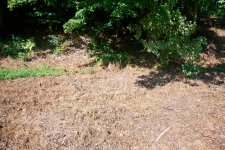
After seeing some kudzu vines in this area while bush hogging last summer, I cleared out the small trees and brush over the winter. Checking on my progress today, I was curious about how much of the kudzu had returned over the last 3-6 months.

This one vine is 20 feet plus long measured from where it comes out of the ground to the end as stretched across my tractor.

I cut this area with the rotary cutter about 4-6 weeks ago. The cutter didn't even touch the vine because the vine grows a couple inches off the ground beneath where the cutter reaches.

Kudzu can put down roots off the runners. The roots go several feet into the ground.

Other than using goats to graze kudzu to death, the only other practical method of control I've found is to spray it...over and over.

View attachment 752130View attachment 752131View attachment 752132
I do not know how much of this is (or isn't) accurate but it is interesting

Appaantly it is about as good as anyother feedstock for ruminants
Science direct is very reliable
 
   / The challenge of Kudzu #31  
I’ve dealt with Russian Olive, Honeysuckle and Multi Flora Rose at my place. They can be a real pain but Kudzu seems worse. Luckily I’ve only observed it and it hasn’t made its way here yet.
You guys do not have autumn olive out there ? Is that the same as Russian Olive?
 
   / The challenge of Kudzu #32  
You guys do not have autumn olive out there ? Is that the same as Russian Olive?
They’re different species but same genus. Autumn olive is Elaeagnus umbellata. Russian olive is Elaeagnus angustifolia. Russian olive has dusty silver leaves and the olives are green silver in color. The tree has thorns. I haven’t seen autumn olive in the west.
 
   / The challenge of Kudzu #33  
They’re different species but same genus. Autumn olive is Elaeagnus umbellata. Russian olive is Elaeagnus angustifolia. Russian olive has dusty silver leaves and the olives are green silver in color. The tree has thorns. I haven’t seen autumn olive in the west.
Great info. Thanks !
 
   / The challenge of Kudzu #34  
There is Kudzu in Tahiti also. It's a real problem because herbicides don't work because there is so much rainfall, the herbicide is washed off before it can be absorbed. They tried goats and the goats disappeared into the mountains. The mountains are steep enough that to eliminate it by hand requires mountain climbing gear. I have seen a palm tree that took 20 years to grow, covered by kudzu in one year. Good intentions without the study result in ecological disasters.
 
   / The challenge of Kudzu
  • Thread Starter
#35  
I used a rear mount boom to spray the areas where I saw kudzu leaves two weeks ago with a pretty strong mix of glyphosate and Crossbow at a 3:1 ratio using surfactant.

The area was browned out after two weeks.

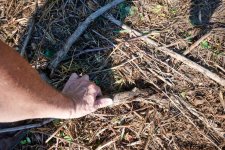
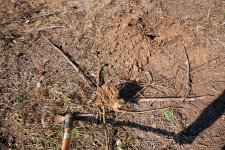
Since kudzu vine grows close to the ground to spread itself, I wanted to see what it really looked like under the dead vegetation. I set the scarifiers on my landscape box to just dig into the ground and pulled off as much vegetation as I could while also trying to rip up the kudzu vine.

I found several clusters of kudzu vine, all of which still appear capable of regrowing. Dug part of one cluster with a pickaxe.

Rotary cutters don't cut close enough to actually cut these vines that lay so close to the ground leaving them to spread. Some of this kudzu is strong enough that I suspect it could break the tines on a landscape rake. That's why I used the landscape box instead.

This may be why grazing with goats may actually be more effective because they can get at the vines.

Kudzuwk2001.JPGKudzuwk2002.JPGKudzuwk2003.JPGKudzuwk2004.JPGKudzuwk2005.JPG
 
   / The challenge of Kudzu #36  
The lady I bought the farm from, bought it in 1944. Over grazed, over cut eroding red clay steep hillside. With county conservation assistance planted thousand pine trees and multiflora rose and kudzu on the steeper parts. Could sorta controlled with cattle, hand clearing and bush hogging. Most of the pine trees are gone leaving a hardwood mix. Without cows a few years the the kudzu grew unchecked. Surrounded kudzu with a 15 acre fence for goats. Cut vines in trees some 8” thick. Sprayed 2-4D to kill trying to go across fences. Took 8 years to kill the kudzu out. Keep it clear for another 15 years. No stock now for 12 years. See a small patch of kudzu starting at tree line!?$!

Russian olives and privet explosion the latest struggle. Danuser Intimdator has helped immensely.

Around here housing and development are biggest threat to farming and will eventually be lost to progress.
 
   / The challenge of Kudzu #37  
After seeing some kudzu vines in this area while bush hogging last summer, I cleared out the small trees and brush over the winter. Checking on my progress today, I was curious about how much of the kudzu had returned over the last 3-6 months.

This one vine is 20 feet plus long measured from where it comes out of the ground to the end as stretched across my tractor.

I cut this area with the rotary cutter about 4-6 weeks ago. The cutter didn't even touch the vine because the vine grows a couple inches off the ground beneath where the cutter reaches.

Kudzu can put down roots off the runners. The roots go several feet into the ground.

Other than using goats to graze kudzu to death, the only other practical method of control I've found is to spray it...over and over.
 
   / The challenge of Kudzu
  • Thread Starter
#38  
No stock now for 12 years. See a small patch of kudzu starting at tree line!?$!

Around here housing and development are biggest threat to farming and will eventually be lost to progress.


I contacted the author of that study. He recommended aminopyralid (Milestone, Chaparral, and OpenSight).

Kudzu seems more entrenched and harder to get rid of when it gets to the tree line. My little experiment in post 35 above is still a bit of a shock to see the extent of the vine system in an open field once the other vegetation was removed.

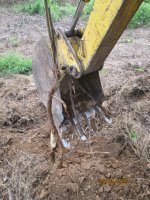
While I have the vines exposed, I'm thinking about the best method to dig out the tubers that appear to be in the top 6-10 inches of soil. I'm wondering if it would be more effective to kill these tubers than to continue spraying. So why not a little experiment to see?

I could cut and remove the vine and then dig with a PHD. My concern is the PHD getting bound up in the root system and/or shredding the tuber and it re-establishing itself. I could try a root ripper on the 3pt hitch, but I'd have to buy or fabricate one. Have even considered using a lawn edger, but I'm not sure it would dig deep enough.

I keep looking at my pile of scrap steel thinking something will come to me....
 
   / The challenge of Kudzu #39  
Around here we cut honeysuckle and other brush and immediately brush on glyphosate to the cut area. It seems like the glyphosate is sucked down to the roots and kills it. I don't have to fight Kudzu. But I worked on some honeysuckle climbing my pine trees last weekend.
 
   / The challenge of Kudzu
  • Thread Starter
#40  
The heat index has been over 100 here for a few weeks now, but with a slight break in temps I did some more digging today to better understand this kudzu.

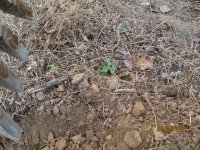
One of the biggest challenges is how well kudzu camouflages itself to blend in with what's around it. The brown vine blends in with bare dirt. The green vine blends in with grass and other green vegetation. I had literally finished digging out one tuber when I happened to notice another one hiding right beside it.

2 camo.JPG

Another challenge is that it is easy to dismiss a kudzu root crown as insignificant by looking at the surface, but the actual tuber may be nearly a foot long and/or well connected to an extensive root system in the soil.

1 tuber length.JPG


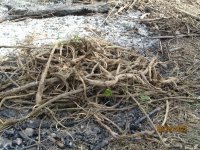
Todays' digging in a relatively small area turned up several tubers--all of which were still living despite having been sprayed a few weeks ago. My advice to anyone dealing with kudzu is not to assume it has been killed just because the vines on the surface are browned out after spraying them.

3 from small area.JPG

My current thoughts are to go back over the entire area with a landscape rake to see what other vines can be found and then continue digging them out with the backhoe. Our ground is pretty hard this time of year. The backhoe seems to be my best option to dig these things out of the field hoping that removing these tubers will actually kill the kudzu.
 

Tractor & Equipment Auctions

2019 BOBCAT T630 COMPACT SKID STEER TRACK LOADER (A56438)
2019 BOBCAT T630...
John Deere Gator (A53317)
John Deere Gator...
MARATHON 20KW GENERATOR (A55745)
MARATHON 20KW...
PALLET OF 15 4X8 GROUND PROTECTION MATS (A58214)
PALLET OF 15 4X8...
2022 CAT 289D3 (A60462)
2022 CAT 289D3...
2012 VOLVO VNL (A55745)
2012 VOLVO VNL...
 
Top