Cause of pump damage?

/ Cause of pump damage? #1  

hayden

Elite Member
Joined
Sep 23, 2000
Messages
2,650
Location
VT
Tractor
Kubota L5740 cab + FEL, KX121, KX080, Deere 6120M
I'm cross posting this in the Hydraulics forum since it's now clearly a hydraulic problem. I'd love to get a read from experienced hydraulic repair people about what might have caused this damage.

This is a 3PH PTO driven hydraulic pump that is part of a power pack for powering a hydraulic snow blower. It's used and new to me, so I have no history on the machine. But it wasn't developing power as expected so I started looking into the system pressure which turned out to be 1000 psi rather than 3000 psi. I rearranged my test gear to test the pump, and here's what I found.

I hooked up my flow meter, gauge, and variable restrictor immediately at the outlet of the pump. With engine at idle, no load but the blower rotating, I get 10 gpm and barely detectable pressure. That's normal. But when I apply load to the pump by restricting flow, it couldn't develop more than 500 psi, even when completely dead headed. This is down from 1000 psi just yesterday.

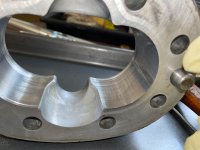
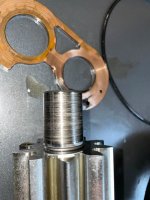
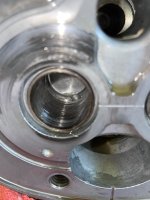
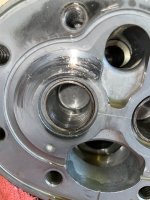
So I pulled the pump apart and indeed it's trashed. Take a look at the attached pictures. I think the housing it too damaged to even attempt a rebuild, so I'll be getting a new pump. Now I just need to figure out what it is. I did finally find some numbers on it and an embossed "Eaton", so with that I suspect I can figure it out.

If anyone has any pump rebuild experience, I'd be real interested in a read on what might have caused this damage. Because this power pack has no active cooling, and relies solely on ambient temp and operator attention to duty cycle to prevent overheating, I think previous overheating is a distinct possibility. So I'm particularly interested in whether this could have been caused by overheating. I guess the other possibilities are cavitation or contamination.

Thanks in advance.
 

Attachments

  • PCH_2022-01-23_10-59_2966.jpg
    PCH_2022-01-23_10-59_2966.jpg
    696 KB · Views: 177
  • PCH_2022-01-23_11-05_2970.jpg
    PCH_2022-01-23_11-05_2970.jpg
    426.9 KB · Views: 181
  • PCH_2022-01-23_11-07_2973.jpg
    PCH_2022-01-23_11-07_2973.jpg
    520.6 KB · Views: 171
  • PCH_2022-01-23_11-08_2980.jpg
    PCH_2022-01-23_11-08_2980.jpg
    417.2 KB · Views: 164
  • PCH_2022-01-23_11-08_2982.jpg
    PCH_2022-01-23_11-08_2982.jpg
    547.2 KB · Views: 174
/ Cause of pump damage? #2  
It'd be interesting to see what's in the filter and the bottom of the tank. Just debris from the pump, or more?
 
/ Cause of pump damage? #3  
Just thinking here....debris got into the bearing on one of the rotors and took out the bearing. Pieces from the bearing moved to the end of the rotor, then to the teeth of the rotor. Why didn't the filter get the debris in the first place? When cold, a filter may not handle the thick oil so it passes unfiltered oil through the bypass. Lots of equipment to clean out now because debris will be throughout the system.
 
/ Cause of pump damage? #4  
Is that a direct drive PTO pump or a gear box mounted pump?
Most of the direct PTO pumps are only rated to around 2000PSI.
That pump definitely had debris damage damage were the debris came from is an interesting
question was it contamination from and outside source?
Or did the pump cavitate and produce it's own debris?
It looks like an aluminum pump they will erode rapidly with cavitation.
Does the system have a suction filter and or a return filter?
 
/ Cause of pump damage?
  • Thread Starter
#5  
The filter is on the return, and I will pull it out and inspect. I'll also get a light in there somehow to get a look at the tank bottom.

The pump mounts to a 1:3.75 step-up gear box, and the whole assembly slides over the PTO shaft.

The pump is an Eaton 25506, 2.85 CID. 46.7 CC gear pump, 3200 psi operational pressure, and 3650 max intermittent, 2500 rpm. At 540 PTO rpm, the pump is tuning at 2025 rpm. The system has a 3000 psi fixed relief valve, so that's the max operating pressure in this application.

Interestingly, I can't see any damage to the gears or teeth. The damage all seems to be in the idler gear rear shaft bearing, the end surfaces that the idler gear rides against (one of which is the wear plate), and the chamber edge.

It seems odd to me that the idler gear bearing and shaft, plus the idler gear side the wear plate are all torn up, but the drive gear side is mostly OK. If debris had entered in the oil stream I would expect both gears to be more or less equally damaged. Same if there was cavitation. Wouldn't that equally affect both gears and chambers?

So it makes me think that perhaps the idler bearing was starved for oil, started shedding, and that jammed it against the wear plate and trashed the wear plate. The bearing that is torn up is opposite the bad wear in the wear plate. That's the only way I can see one side being so trashed and the other being mostly OK. It makes me wonder if it ran dry in it's initial startup and caused the damage.
 
/ Cause of pump damage? #6  
Hard to tell exactly but I larger brass side plate damage is not cavitation since I would expect that to be evident on Other areas of the pump as well.

My guess is something got between gear and bearings plate forcing it towards one side. This reduced the side clearance which limited the leakage flow to the shaft bearing. Once shaft bearing started to scour it just became self destructive.
On a gear pump highest leakage is between gear teeth tips and gear case. Gear case wear is usually a result of pressure pushing the gears sideways into the shaft bearings and gear teeth rubbing on inlet side of gear case.
 
/ Cause of pump damage? #7  
This is a question not a statement!
Could the control valve for the implement, in this case blower but previously who know, have been a spool valve for a cylinder and not a motor?
If this was indeed the case how would this "mistake" show itself in pump damage?

Dave M7040
 
/ Cause of pump damage? #8  
This is a question not a statement!
Could the control valve for the implement, in this case blower but previously who know, have been a spool valve for a cylinder and not a motor?
If this was indeed the case how would this "mistake" show itself in pump damage?

Dave M7040
As long as the pump is unloaded and not being dead headed it shouldn’t make a difference what spool type is used. Using cylinder style spool on motor could cause excessive pressure in the motor but valve should isolate the pump from seeing the pressure
 
/ Cause of pump damage?
  • Thread Starter
#9  
As long as the pump is unloaded and not being dead headed it shouldn’t make a difference what spool type is used. Using cylinder style spool on motor could cause excessive pressure in the motor but valve should isolate the pump from seeing the pressure

Agreed. And the relief valve which is immediately downstream of the pump would limit pressure to 3000 psi and prevent any damage.
 
/ Cause of pump damage? #10  
You said in your other thread that the PO had some odd additional connections to the system that you removed. Perhaps some other piece of equipment he was using is the source of the damage?
 
/ Cause of pump damage? #12  
The damage in the pump body and wear plate are what I would expect if the bearings began to get sloppy. Higher pressure at the outlet port always pushes on the gears and shafts and tries to causes them to interfere with the pump body and wear plate 180 degrees from the outlet. To resist that pressure is why pumps are built so rigid. With too much clearance between the shaft and bushing, the gears can touch the body of the pump exactly where the torn metal and wear pattern exists. It looks to me like that interference between the outer edges of the gear teeth and the pump body & wear plate tore metal loose and created what looks like an incoming suction side debris wear pattern in the pump body and end plate. It might have been outside debris - no way to know. If it is internal wear it would still technically be debris, but originating from interference within the pump rather than from without.

Summary:
My guess is that at some point this pump was run without oil and that is what wore the shaft-to-bushing clearance. The bushing wear allowed the high pressure to force the gears against the pump body 180 degrees away from the high pressure port. All the rest follows. Replace the pump. Be sure to pre-lube. Replace the oil and filter with new and do at least one additional filter change within the first hour of operation.

good luck,
rScotty
 
/ Cause of pump damage?
  • Thread Starter
#13  
You said in your other thread that the PO had some odd additional connections to the system that you removed. Perhaps some other piece of equipment he was using is the source of the damage?
Excellent point. I had forgotten about that and was similarly reminded looking back through some pictures last evening.

I believe the snow blower and power pack were originally purchased as a package because they have sequential serial numbers. But there was an extended filler neck on the tank, and a barbed hose fitting welded to it, presumably as a return for some other piece of equipment.

The snow blower itself clearly hadn't seen much use based on how little pant had been scraped off. Plus it came from Southern PA which isn't exactly snow country. But the power pack had a consistent layer of oil & dust all over it, suggesting more use. So this is piecing together to suggest it may have been used a bunch for other purposes, and perhaps abused. The package is 10 years old, after all. And use for other purposes, especially in weather above 40F, could have lead to overheating since there is no cooling system. If nothing else, this is wishful thinking that all the pump shreds contaminated some other piece of equipment and not the blower. Fingers crossed.
 
/ Cause of pump damage? #14  
The damage in the pump body and wear plate are what I would expect if the bearings began to get sloppy. Higher pressure at the outlet port always pushes on the gears and shafts and tries to causes them to interfere with the pump body and wear plate 180 degrees from the outlet. To resist that pressure is why pumps are built so rigid. With too much clearance between the shaft and bushing, the gears can touch the body of the pump exactly where the torn metal and wear pattern exists. It looks to me like that interference between the outer edges of the gear teeth and the pump body & wear plate tore metal loose and created what looks like an incoming suction side debris wear pattern in the pump body and end plate. It might have been outside debris - no way to know. If it is internal wear it would still technically be debris, but originating from interference within the pump rather than from without.

Summary:
My guess is that at some point this pump was run without oil and that is what wore the shaft-to-bushing clearance. The bushing wear allowed the high pressure to force the gears against the pump body 180 degrees away from the high pressure port. All the rest follows. Replace the pump. Be sure to pre-lube. Replace the oil and filter with new and do at least one additional filter change within the first hour of operation.

good luck,
rScotty
That’s what took out a $9,000 Rexroth aluminum pump in one of my tractors. Bushings began to move slightly in aluminum housing, releasing a glitter bomb in hydraulic system
 
/ Cause of pump damage?
  • Thread Starter
#15  
The damage in the pump body and wear plate are what I would expect if the bearings began to get sloppy. Higher pressure at the outlet port always pushes on the gears and shafts and tries to causes them to interfere with the pump body and wear plate 180 degrees from the outlet. To resist that pressure is why pumps are built so rigid. With too much clearance between the shaft and bushing, the gears can touch the body of the pump exactly where the torn metal and wear pattern exists. It looks to me like that interference between the outer edges of the gear teeth and the pump body & wear plate tore metal loose and created what looks like an incoming suction side debris wear pattern in the pump body and end plate. It might have been outside debris - no way to know. If it is internal wear it would still technically be debris, but originating from interference within the pump rather than from without.

Summary:
My guess is that at some point this pump was run without oil and that is what wore the shaft-to-bushing clearance. The bushing wear allowed the high pressure to force the gears against the pump body 180 degrees away from the high pressure port. All the rest follows. Replace the pump. Be sure to pre-lube. Replace the oil and filter with new and do at least one additional filter change within the first hour of operation.

good luck,
rScotty
Many thanks. That's exactly the sort of analysis I has hoping for. I think your summary makes perfect sense given the damage, i.e. the origin was bearing failure, and subsequent movement of the gear tore everything else up. That explains why only one gear and mating surfaces is trashed. If the pump had ingested crap from the intake, I would expect damage to be uniform across both gears and mating surfaces. Same if it was cavitation. This could have been run dry right at its initial startup, and damage has been accumulating over it's use. It might even be why the thing was for sale in the first place, either because the owner knew there was a problem, or because performance was poor.
 
/ Cause of pump damage?
  • Thread Starter
#16  
/ Cause of pump damage? #17  
Why are some pump housing built out of aluminum? Easy machining?
Cast would hold bushings longer. But I guess the bushings pressed in the housing could wear out and create same problem?
 
/ Cause of pump damage? #18  
Why are some pump housing built out of aluminum? Easy machining?
Cast would hold bushings longer. But I guess the bushings pressed in the housing could wear out and create same problem?

I think we are right on the reason for failure, but I also think it doesn't change things. The OP is going to have to replace the pump and clean out the system as best he can in any case. Changing filters makes sense over changing oil. The only thing better than filtering oil is to let it stand absolutely quietly for a month - like in glass containers - and then siphon the clean oil off the top without disturbing the sludge. That works, but who wants to do that?

Right. Cost of manufacture. It costs a LOT less to machine aluminum. The problem then becomes heat - just as you were wondering about.
Design can compensate for the way the different materials respond to stress, but not to heat. Aluminum expands twice what steel does. As things heat up, the pump wall ends up moving away from the gear teeth, and the bushing moves away from the shaft. This is compensated to some degree because the steel is surrounded by hot oil whereas the aluminum is surrounded by cool air.

For pumps made with both housing and the gears out of the same metal, radial expansion is the same, and the clearances stay constant. Much better for high temperatures.

Steel shafts in an aluminum case always get sloppy with heat unless you figure a way to cool the aluminum. Fins help a lot.
BTW, in case you were wondering..... To figure how much a hole expands, just pretend it is not a hole at all, but a solid metal plug the same diameter.
 
Last edited:
/ Cause of pump damage?
  • Thread Starter
#19  
New pump ordered. $830. It was $1300 through Erskine.
 
/ Cause of pump damage?
  • Thread Starter
#20  
Today I pulled the filter housing and removed and inspected the filter. There are flecks of crap caught in the filter, so it was doing it's job. That's good.

I also drained all the fluid out of the tank and it's a lot darker than I would expect, and I think thicker than the ISO 32 oil called for. I think it might even be motor oil, but am not sure. Regardless, I'm just going to replace it so I know it's the correct grade.

Once I got the tank drained, I can see flakes of copper on the tank bottom which would be from the thrust plate in the pump. Now I need to figure how to get it cleaned out. I have about a 4" access hole in teh tank top on one side where the filter fits in, so I have reasonable access there. But there is a baffle down the middle of the tank that blocks access the other side. But the other side also have a 1-1/2" fitting for the suction hose, and I can take that out to get some access, but not as good as the other side.

Anyone have any suggestions on how to best clean the tank out? I'm thinking that I need to get some solvent in there to clean out the oil, then I can probably get a vacuum hose in there at least on the side where the filter mounts, and maybe blast some compressed air in the other side with hopes of stirring things up enough so it ultimately gets sucked out by the vacuum.

Any other ideas?
 

Marketplace Items

2013 GMC SIERRA (INOPERABLE) (A60736)
2013 GMC SIERRA...
Woods BB72 72in Rotary Brush Cutter Tractor Attachment (A61567)
Woods BB72 72in...
2012 Ford F-250 4x4 Pickup Truck (A60352)
2012 Ford F-250...
New/Unused Quick Attach Skid Steer Brush Cutter (A61166)
New/Unused Quick...
2003 V.E. ENTERPRISES 500 BBL FRAC TANK (A60736)
2003 V.E...
2025 BrushFox XHD-78HF 78in Hydraulic Rotary Brush Cutter Skid Steer Attachment (A61567)
2025 BrushFox...
 
Top