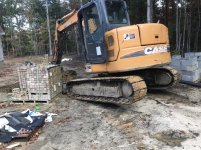
Completely homemade excavator

/ Completely homemade excavator #21  
VERY COOL! This is very ambitious and you seem to be chugging along, this gives me some guilt about letting my own larger projects grow stagnant. You inspire me. Thank you for sharing.
12.7GPM main pump, 6.3GPM auxiliary pump
The flow rate of the main pump is adjustable from 0 to 100% regardless of the engine speed. With the size of the cylinders, around 6GPM will be a good shoveling speed. The total (19GPM) will be used only for movement on a good surface. The 6.3GPM can also be used to drive an independent accessory (eg auger, brush cutter) while the 12.7GPM will remain fully available for the movement and activations of all cylinders.
2800lbs push (pull) force at approximately 2.5km / h. (3000PSI)

I am curious about your hydraulic system design. By my rough estimate, 19GPM @ 3,000PSI would require at least 40HP. Since you're using a 15hp engine I assume you are using 19GPM at lower pressure (for fast transit) OR 3,000PSI for digging/pushing, but not both at the same time. In my experience this kind of arrangement is addressed with load sensing valves that control the displacement (swashplate angle) of the pump. These systems get pretty complicated pretty quickly. I have pondered simpler ways to do it, and I'm curious if you've found one of these simpler ways, or if you're using load sensing. Actually I'm just curious in general, about all of it, mostly the hydraulics.
 
/ Completely homemade excavator #22  
I知 not sure how well the extra reach and hydraulic power is going to work out. You need the weight for counter balance. The commercial excavators already have more hydraulic muscle than they can use. Adding more wouldn稚 help.

THats what I was thinking.

Their is a reason commercial excavators get heavier as the reach increases. Its to offset the weight of lifting a bucket load at that reach.

If this thing is built with the reach of a 6000lb machine.....thats about 15'-16' reach.

But its built at 3500# where the commercial mini's limit reach to about 12'

That extra 4'.....when dumping a load off to the side....might make a 3500# machine very unstable.

I can understand all the other reasons.....lower door height, common parts, etc. But I'd try real hard to mimic the design of a time tested 3500# machine with respect to track width, dimensions, and boom length/reach, and cylinder sizing (power). Simply make it shorter, and customized just the way you want it.
 
/ Completely homemade excavator #24  
THats what I was thinking.

Their is a reason commercial excavators get heavier as the reach increases. Its to offset the weight of lifting a bucket load at that reach.

If this thing is built with the reach of a 6000lb machine.....thats about 15'-16' reach.

But its built at 3500# where the commercial mini's limit reach to about 12'

That extra 4'.....when dumping a load off to the side....might make a 3500# machine very unstable.

I can understand all the other reasons.....lower door height, common parts, etc. But I'd try real hard to mimic the design of a time tested 3500# machine with respect to track width, dimensions, and boom length/reach, and cylinder sizing (power). Simply make it shorter, and customized just the way you want it.

Yeah me 3 too. I was having the same thoughts that the weight is there for a reason...not just to make it more expensive.
 
/ Completely homemade excavator
  • Thread Starter
#25  
Yeah me 3 too. I was having the same thoughts that the weight is there for a reason...not just to make it more expensive.


Have you done extensive calculations to claim that the range and hydraulic power will not be usable?

I did the math, in addition to having experience on other excavators and bakhoe that were lighter than commercial excavators for their strength.
The hydraulic power when I go to work forwards or backwards is perfectly balanced to be able to use everything. Of course at 90 degrees on the side I could not use all the hydraulic power.
But I'll be aware enough to attack the mining of a big rock or a big stump from the front. And I still have plenty of room to shovel and deposit bucket loads on 360 degrees to 15 ft of distance. If I hold a huge rock pinched between the bucket and my thumb, I could still move it far to the side by tying it on the ground like I did with lighter excavators.

The force of the bucket which is about 4500lbs (close to that of a 3 ton excavator) Can be used without problem, it is the bucket which rolls up in the ground or which makes a lever between 2 rock. The excavator does not necessarily have to be more of the source to use the force of the breakout.
My 2 nd Mini Excavator was a towable FCM with a breakout force of 3000lbs and a total weight of 1600lbs. There is still the possibility of using all the hydraulic power by using the points of support (hydraulic stabilisator)

Commercial Excavators have less hydraulic power than their weight in many situations, I have estimated the capacity of a 6000lbs excavator in the table and commercial 6000lbs excavators have about the same cylinder size and pressure as my excavator. .
Usually this is not indicated, but I have found a table where it is clearly stated that the lifting capability allowed by the weight (stability) of the excavator is greater than the hydraulic force in these positions. In addition, it keeps a safety margin of 25% on the stability of the excavator ...

http://inrail.com.au/wp-content/uploads/2016/02/Excavator-Lift-Capacity.pdf


I know my excavator is going to be less stable than a 6000lb excavator and I cant use the full lift force on the side, but to claim that hydraulic power and / or the reach of about 15 feet will not be usable: is not according to the laws of physics.
I have places to work where the ground is still wet, the 3 ton tracks on a 1.75 ton excavator will surely help break less and get stuck less.


/ Completely homemade excavator #26  
You can lever with the bucket a little bit but you still need to be able to lift and pull to get anything done and weight is your friend to do that. IMG_9165.JPG
 
/ Completely homemade excavator #27  
That machine has a track foot print that’s probably twice as long and twice as wide and weighs 19,000 pounds and only has a 21’ boom. Putting a 15 foot boom on a 3500 pound machine is crazy.
 
/ Completely homemade excavator #28  
That's fantastic, I look forward to seeing the finished project. Inspiration to do something of the sort myself.
 
/ Completely homemade excavator #29  
You can lever with the bucket a little bit but you still need to be able to lift and pull to get anything done and weight is your friend to do that. View attachment 673324
Machines with blades need to have the blade down, like a stabilizer, to dig effectively. That photo has the blade up. Also, the operator is not too well versed in what is considered abuse to a machine. All the machines weight is on the front rollers and fighting against the track tensioners.
As to the OP's machine, counter weight is a huge part of lifting. But so is experience. When your butt goes up, get closer to your work, or less material in your bucket. Also, you don't suppose to lift a heavy load with the boom and stick fully extended. Doing so just wears out the turntable bearings faster. Especially trying to swing with a load extended. You curl, lift and crowd the stick in and lift the bucket near the tracks, when you have a heavy load in the bucket, then you swing and then extend where you want to dump. Also, lots of machines have different lengths of sticks. The OP, after some trial and error, might want to make a shorter stick. It all boils down to experience and just what all the OP wants out of the machine.
hugs, Brandi
 
/ Completely homemade excavator #30  
That machine has a track foot print that痴 probably twice as long and twice as wide and weighs 19,000 pounds and only has a 21 boom. Putting a 15 foot boom on a 3500 pound machine is crazy.

Going by this statement alone...........you are stating ALL long reach excavators are crazy.
hugs, Brandi
 
/ Completely homemade excavator #31  
Snowb,
Awesome project. Are the trailer wheels and tires gonna be your idler wheel at the tensioner? Also, can you show more photos and information on your Kubota crawler lift? That little thing looks awesome.
hugs, Brandi
 
/ Completely homemade excavator #32  
Machines with blades need to have the blade down, like a stabilizer, to dig effectively. That photo has the blade up. Also, the operator is not too well versed in what is considered abuse to a machine. All the machines weight is on the front rollers and fighting against the track tensioners.
As to the OP's machine, counter weight is a huge part of lifting. But so is experience. When your butt goes up, get closer to your work, or less material in your bucket. Also, you don't suppose to lift a heavy load with the boom and stick fully extended. Doing so just wears out the turntable bearings faster. Especially trying to swing with a load extended. You curl, lift and crowd the stick in and lift the bucket near the tracks, when you have a heavy load in the bucket, then you swing and then extend where you want to dump. Also, lots of machines have different lengths of sticks. The OP, after some trial and error, might want to make a shorter stick. It all boils down to experience and just what all the OP wants out of the machine.
hugs, Brandi

The blade was down. The stump wasn’t more than 5 feet off the blade and that’s about as close as that machine likes to work to itself. Usually when I feel the back end start to lift I stop but I pulled it up higher for the picture. Digging stumps is abusing the machine any way you go about it. Lifting the back end doesn’t hurt anything as long as you let it back down and don’t drop it.
 
/ Completely homemade excavator #33  
Going by this statement alone...........you are stating ALL long reach excavators are crazy.
hugs, Brandi

Those are for cleaning out ponds and they’re only on big machines.
 
/ Completely homemade excavator #34  
Those are for cleaning out ponds and they’re only on big machines.

They have the same physics, no matter what size. The bucket has to be scaled to the stick and boom lengths. The machine will work, just more unstable in various attitudes. He is building a complex piece of machinery, which you call crazy. Anyone that can do all that at home, I tip my hat off to. I am sure the OP is experienced enough to not try to push the machine's envelope or do stunts to press a point.


Brandi
 
/ Completely homemade excavator #35  
The blade was down. The stump wasn’t more than 5 feet off the blade and that’s about as close as that machine likes to work to itself. Usually when I feel the back end start to lift I stop but I pulled it up higher for the picture. Digging stumps is abusing the machine any way you go about it. Lifting the back end doesn’t hurt anything as long as you let it back down and don’t drop it.
The blade was down, and you raised your rear off of the ground, intentionally? Looks like abuse to me. How is digging stumps abusing the machine? They are made to dig and as long as you move outward on the roots, to a smaller section of the root if the bucket snags, where is the abuse? Experience (and paying $$$$ for your actions) negates any abuse and doing crazy stuff.
Brandi
 
/ Completely homemade excavator #36  
Digging stumps is about as hard as it can get for equipment. Maybe a D11 with a ripper would make easy work of it but it’s hard on small stuff. How does raising the rear off the ground hurt anything?
 
/ Completely homemade excavator #37  
Digging stumps is about as hard as it can get for equipment. Maybe a D11 with a ripper would make easy work of it but it’s hard on small stuff. How does raising the rear off the ground hurt anything?
With the blade on the ground, Your boom, stick, and bucket hydraulics was fighting against your blade hydraulics. Blade linkages are stressed trying to keep your level while the boom, stick, and bucket was picking your butt up. Simple physcis. Do it enough and something will brake or blow.
Brandi
 
/ Completely homemade excavator #38  
Which is pretty much what it’s supposed to do. Is lifting the rear 1/4 inch vs 2 feet any different?
 
/ Completely homemade excavator
  • Thread Starter
#39  
You can lever with the bucket a little bit but you still need to be able to lift and pull to get anything done and weight is your friend to do that. View attachment 673324


Referring to the approximate dimensions of a 9 ton excavator like this one, depending on the angle of the arms shown in the photo, the bucket is about 10 feet from the excavator.
By calculating the maximum possible force limited by the weight of the excavator, if we pull on the stump at the same time as we try to lift it, the force will be 6900lbs before the rear of the excavator lifts ( this is clearly the case here, it does not represent the limit of the excavator) In addition to exerting less force on the stump a good part of this force is wasted by pushing the stump into the ground towards the excavator.
By performing a straight upward movement only upward (approach the big boom and move the betit boom back slightly so that the bucket remains in the same horizontal position, the maximum force before the rear rises would be 11900lbs !!! in the latter case the action will be much more efficient and the excavator will give its full potential in hydraulic power without the rear lifting. This is simple math.


/ Completely homemade excavator
  • Thread Starter
#40  
This excavator is only 2400lbs and has a reach of approximately 12 feet from the front axles. There is still a way to work without overturning, even if it is not the heaviest in relation to its reach, in addition the ground is super soft there, it only holds by the grass.


Marketplace Items

2015 Hyundai Genesis 3.8 Coupe (A61574)
2015 Hyundai...
2016 Ford F-350 Pickup Truck (A61568)
2016 Ford F-350...
2014 Hagie DTS10 Sprayer (A63111)
2014 Hagie DTS10...
KMC 3pt 6 Row Vine Lifter (A64119)
KMC 3pt 6 Row Vine...
2005 Fontaine FTW5-8048SLW 48ft. 38 Ton T/A Piggyback Flatbed Trailer (A61573)
2005 Fontaine...
2007 John Deere 1790 Planter (A63111)
2007 John Deere...
 
Top