AC question

   / AC question #1  

Cougsfan

Veteran Member
Joined
Sep 10, 2008
Messages
1,647
Location
Eastern Washington State
Tractor
Ferguson TO35, Branson 4720CH
The air conditioner on my 4720ch stopped working. I found the hose out of my compressor to the condenser had been leaking and replaced it. On charging the system we found it would not take nearly enough refrigerant and both the low end and high and pressures were way too high. (350 psi on the high end, which is probably why the hose started leaking.). All this seems to indicate a blocked flow somewhere, probably a faulty expansion valve (The shop service manual is really good at covering all this). So I have ordered an expansion valve and receiver/dryer (a good chance it may be the problem too). My first question is: where in the heck is my receiver/dryer? The manual shows it in the line out of the condenser mounted in front of the condenser. It definitively ain't there.

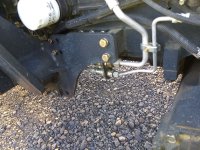
Also, as you follow the line out of the condenser along the chassis right below the engine there is what they call a block valve. What the heck is that? It isn't discussed at all in the service manual. The reason I ask is because when attempting to fill the system, the line before the block valve felt appreciably warmer than the line out of it. I am just wondering its function and might it be plugged.
 
   / AC question #2  
I'm not familiar with your tractor nor do I have access to a manual for it so I can only offer general AC advise.

IF it has an expansion valve it will be connected to the evaporator, not the condenser. Is the condenser clean and free of debris? Did you put the system on a vacuum before attempting to charge it?

If I were working on it I would flush the lines with nitrogen, install the new expansion valve, drier, and put it on a vacuum for at least and hour before charging. You also need to make sure the condenser and evaporator are not clogged with dirt or debris.
 
   / AC question #3  
High pressure on both high and low is also an indication of air in the system or over charged.

Although it is illegal in this country to vent ac refrigerant,
it used to be common after replacing components to run a purge thru the system before making the last connection.
The approved way now days is to use N2 and then pull a vacuum and hold it ideally over night.
A light charge and then a vacuum could also help.
 
   / AC question
  • Thread Starter
#4  
I am aware that the expansion valve is on the evaporator, however the manual shows the dryer receiver mounted next to the discharge of the condenser. I am assuming the dryer receiver must be under the roof near the expansion valve, but I don't want to tear it apart yet until the (hopefully correct) parts arrive.

Lou, The system had some freon in it when we started. It all leaked out when I changed the hose. and the system was open for less than 10 minutes. The little bit of oil that came out with the Freon was clean. We then pulled a vacuum and let it hold for a few hours to check for leaks. (it held just fine with the pump off.) We purged the gauge hoses with Freon prior to filling. So I am pretty sure there isn't any air in the system. The book calls for 2.89 lbs of Freon for a full charge (I am somewhat un-trusting of the accuracy of the book as it doesn't even know where the dryer/receiver is). We tried charging the system slowly with the engine and AC running. We got roughly 14 oz in it and it wouldn't take anymore (definately starting at zero with supposedly around 2 lb left to go). I was measuring cooling the air coming out of the evaporator all the while when charging and it never dropped below 94 degrees (it was about 94 outside) The pressures were extremely high on both sides at this point. The compressor was definitely running, running hard enough at the end to make the belt start chirping a bit (the belt is tight) before we shut it down.

My guess is that before we worked on it, the hose started leaking when the pressure got too high by whatever is causing it to be high. The AC didn't put out any cold air at all. I could tell the hose had been leaking by the dirt accumulated at the crimps where tiny amounts of had oil leaked out. My original thought was I just had a leaky hose and was out of Freon. I did have a leaky hose, but I was not yet out of Freon.

The guy helping me is an experienced in charging combines and such, Not an professional, but far more experienced than I.

He was wondering what those "block valves" are. He has never seen them before. He noticed the line hot on the infeed end to the one on the evaporator feed line and cooler on the discharge side. I did a search on the internet on "Block valves in auto AC systems" and came up with nothing. I can tear them apart when we take the system down again, but I hate tearing apart things that may not need torn apart. There is also an identical one on the suction line to the compressor. Could they be check valves that prevented all the Freon from leaking out when I changed the hose?
 
   / AC question #5  
Sorry I misread your question on the drier location and my brain thought you were looking for the expansion valve.

Some photos may help but I have never heard of a block valve in a AC system.

I have seen undercharged systems read high then stabilize with a full charge but it is rare and I haven't seen that in a long time.

If you are charging with 12oz cans it needs to be fed as a gas. About the only way I know to get it to go in is by warming the can. I use a 4 cup pyrex measuring vessel filled with hot water and just swish the bottom of the can around while it charges.

I guess you will learn more about it when your parts arrive and you take it back apart. You will want to disconnect at the compressor, drier, and expansion valve and blow through the hoses, evaporator, and condenser.

Does your engine have a fan clutch? Are you getting good air flow through the condenser and radiator?
 
   / AC question
  • Thread Starter
#6  
That is kind of where we are at, Tractor guy, we will wait until we get the parts and take the whole system down and start blowing air through each section like you advise and see what we get. My friend has a freon recovery system. Before we take the system all the way down we will try bleeding some freon back out of the system to see what that does. My guess is that won't help, but it is easy to try.

When we charged it, the first 12 oz can of freon went in on it's own. Took a while. Then it only took a little bit out of the second can. I did go up to the house and get a bucket of hot water to dip the can in, but it didn't seem to help, and the pressures were already too high.

Those "block valves" look like ball checks that I have seen in hydraulic systems. They are strictly mechanical and are in the line from the condenser to the evaporator and the line from the evaporator to the compressor. View attachment 664920 If they were check valves though, one would seemingly have to be installed backwards to work as a check to prevent freon from leaking out when opening the compressor end of the system. They are overly complex to serve just as a manner to join line sections. They really have me curious. (??)

I don't have a clutch on my fan, and the condenser is clean and air is flowing through unrestricted. I wish they wouldn't sandwich the tranny cooler, condenser and radiator so darn close together though. Makes cleaning them rather hard.
 
   / AC question #7  
Those block valves sound like they might allow for opening part of the system and keep the other side charged.
 
   / AC question #8  
I admire folks that learn to repair their stuff but I don't believe wading in without first educating yourself then asking questions after you are in trouble make's sense. In this case one should study principles of air conditioning before turning wrenches. Sound's like your friend only know's enough to be dangerous. There is never a need to "purge hoses" following proper evacuation proceedure and doing so would almost certainly introduce air back into system (possibly more air than was in system before evacuation). High pressures on high and low side sound's like air in system and ice created by moisture from the air. Schematic diagrams are not a "picture",they simply tell you what is connected to what and in what order. The Korean that wrote those instructions called isolation valve a block valve which is likly the correct translation. I'm suprised to hear Branson is equipped with isolation valves because aside from high end multi-ton commercial few systems,manufactures stopped installing them years ago. They alow replacing parts without opening intire system. Hire a pro to take it from here then go to trade school or apprentice if you want to learn how to repair air conditioning.
 
   / AC question #9  
Looking through the parts listing I don't see any valves in the lines. For that matter I can't find an expansion valve OR an orifice tube. It has to have one or the other. Can't find a drier in the parts diagrams either. This parts catalog is obviously missing some detail.

https://threeriversequipment.com/pdf/branson/parts/4720Ch(US)_.pdf
 
   / AC question #10  
This great nation was founded by people who didn't know what they were doing, and it grew mighty with the help of many more such people. We're scolded for it, but it's our indomitable, independent spirit coming through.

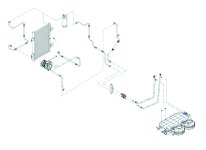
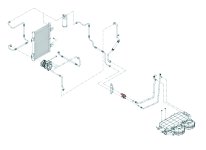
In looking at page K25W-201504 of the 20 series service manual which applies to the 4720, the "block valves" look like they're just bulkhead fittings, not valves. Here's a picture of the diagram to help envision the schematic of the pattern, and I've colored the "valves" red. The expansion valve is on the evaporator, and I've colored it blue:

AC diagram.jpg
 

Attachments

  • AC diagram.jpg
    AC diagram.jpg
    241.3 KB · Views: 306
   / AC question
  • Thread Starter
#11  
Those "block valves" are shown on page 194 and 195 as keys 5&6. they are called "Q/C 7/8" and Q/C 5/8" and do have a Branson part number. They could indeed be just bulkhead fittings and they have a bad translator. It is funny that the parts diagram doesn't show the expansion valve or the dryer receiver, yet I can buy them if I call the dealer. And my tractor definitely isn't exactly the same as all the things they show.

Hire a pro to take it from here then go to trade school or apprentice if you want to learn how to repair air conditioning.
Jax, I guess you and I come from totally different worlds. That's fine, it would be boring if we were all the same and some diversity is good.

I would learn exactly nothing if I hired a pro. Not only that, pro's aren't cheap, nor are there an abundance of "pros" just setting around willing to come out to my place and mess with this. My dealer, to his credit, has admitted that neither he or his mechanic are ac "pros" by any means. They would likely replace parts until they stumbled on to the solution, which is a more common way of doing things than most dealers would like to admit. And besides, what fun would hiring a pro be? I would get little done if I took time to go to a trade school to learn the intricate details of the diverse things that I like to do. I don't think doing this myself is going to cause anything to blow up and kill anyone. By the way, I am a retired Mechanical Engineer with a professional engineering licence and worked around various types of industrial refrigeration systems all my life. I probably have a better grasp of the Carnot cycle and thermodynamics in general than most "pro's". I don't have any experience with small automotive type DX systems though. I have never worked on one. My friend also has pretty good set of credentials along with years of back yard experience in working on various farmer's combine ac units. I think he knows enough not to be too dangerous. So we will soldier on despite our obvious ignorance and amateur status.
 
   / AC question #12  
Cougsfan I took the Q/C to mean quick coupler. Most likely like the couplers that are on some vehicles requiring a plastic tool to release a spring band to pull them apart.

Fuel Line and A/C Quick Disconnect Tool, 6 Pc.

If you get a chance post a photo and that could be confirmed or dispelled.
 
   / AC question #13  
Those "block valves" are shown on page 194 and 195 as keys 5&6. they are called "Q/C 7/8" and Q/C 5/8" and do have a Branson part number. They could indeed be just bulkhead fittings and they have a bad translator. It is funny that the parts diagram doesn't show the expansion valve or the dryer receiver, yet I can buy them if I call the dealer. And my tractor definitely isn't exactly the same as all the things they show.


Jax, I guess you and I come from totally different worlds. That's fine, it would be boring if we were all the same and some diversity is good.

I would learn exactly nothing if I hired a pro. Not only that, pro's aren't cheap, nor are there an abundance of "pros" just setting around willing to come out to my place and mess with this. My dealer, to his credit, has admitted that neither he or his mechanic are ac "pros" by any means. They would likely replace parts until they stumbled on to the solution, which is a more common way of doing things than most dealers would like to admit. And besides, what fun would hiring a pro be? I would get little done if I took time to go to a trade school to learn the intricate details of the diverse things that I like to do. I don't think doing this myself is going to cause anything to blow up and kill anyone. By the way, I am a retired Mechanical Engineer with a professional engineering licence and worked around various types of industrial refrigeration systems all my life. I probably have a better grasp of the Carnot cycle and thermodynamics in general than most "pro's". I don't have any experience with small automotive type DX systems though. I have never worked on one. My friend also has pretty good set of credentials along with years of back yard experience in working on various farmer's combine ac units. I think he knows enough not to be too dangerous. So we will soldier on despite our obvious ignorance and amateur status.

That is the attitude that helped make this country so great, the can do will do.
If you really want to get the "leave it to the professional" going talk about the many benefits of R290 and how easy it is as a drop in change out for R12 systems and will also work quite well in R134 systems also. It will be interesting to hear how how it works in these new R1234yf systems.
Also most HVAC training or education ignores the ammonia based systems which to my recollection is still the most energy efficient system available, especially with the technologies available today(collecting solar?) to generate the heat needed to cool.
Good luck getting your AC back in good working condition.
 
   / AC question
  • Thread Starter
#14  
Thanks Lou.
All of my experience is on the design end of large multi stage ammonia and CO2 systems in both flooded and liquid overfeed layouts. As a note, a particular refrigerant's efficiency is primarily based on the evaporating and condensing temperatures that you have available. Most will work in a somewhat significant range but each have their sweet spots in temperatures for efficiency. If you need to get something really cold, you may end up with a 2 stage package where an ammonia refrigeration system is used to cool the condenser of a separate CO2 refrigeration system.

I will be the first to admit that understanding theory behind a refrigeration system and understanding the nuts and bolts of how things work in practice are two very different and only partially related arts. I am quite short in knowledge on the nuts and bolts end of things, but am enjoying learning how that end works. I am looking forward to taking the system down to nothing and will report back when I am done.

I did post a photo of these block valves in an earlier reply, TractorGuy, but it came out as an attachment. I will try again.
 

Attachments

  • valves.jpg
    valves.jpg
    2.1 MB · Views: 179
   / AC question #15  
That is the attitude that helped make this country so great, the can do will do.
If you really want to get the "leave it to the professional" going talk about the many benefits of R290 and how easy it is as a drop in change out for R12 systems and will also work quite well in R134 systems also. It will be interesting to hear how how it works in these new R1234yf systems.
Also most HVAC training or education ignores the ammonia based systems which to my recollection is still the most energy efficient system available, especially with the technologies available today(collecting solar?) to generate the heat needed to cool.
Good luck getting your AC back in good working condition.
the problem with R290 is it's propane, and highly explosive. the problem with Ammonia is it's highly poisonous when inhaled.. other than that, they are both very good refrigerants, but both can leak, and cause death, which some people like to avoid!.:eek:
 
   / AC question #16  
the problem with R290 is it's propane, and highly explosive. the problem with Ammonia is it's highly poisonous when inhaled.. other than that, they are both very good refrigerants, but both can leak, and cause death, which some people like to avoid!.:eek:

The good thing about Ammonia is that it will let you know it's there long before it does any damage, most people start smelling it between 5PPM and 50PPM, it doesn't start getting to where it will do permanent damage until above 300PPM (300PPM is where OSHA, et,al require supplied air and a a hazmat suit)
By contrast, Freon based refrigerants are odorless and can asphyxiate you without warning under the right circumstances.

Aaron Z
 
   / AC question #17  
The good thing about Ammonia is that it will let you know it's there long before it does any damage, most people start smelling it between 5PPM and 50PPM, it doesn't start getting to where it will do permanent damage until above 300PPM (300PPM is where OSHA, et,al require supplied air and a a hazmat suit)
By contrast, Freon based refrigerants are odorless and can asphyxiate you without warning under the right circumstances.

Aaron Z
I don't think ammonia or propane is allowed as a refrigerant in homes or autos. you take a sleeping pill, or get drunk enough, in a house, you might not wake up in enough time to escape. also, in a car accident you may be trapped in there for too long.. except for ammonia refrigerators in mobile homes, those have VERY thick piping, and usually don't get compromised in an accident..
 
   / AC question
  • Thread Starter
#18  
No doubt finding leaks with ammonia is a piece of cake compared to other refrigerants. You'd have to do something incredibly stupid to get poisoned by it. Ammonia can be a significant skin irritant, and under ideal conditions it can be explosive too. Under normal circumstances you'd be hard pressed to make it burn. But there was an instance several years ago where a processing plant blew up and several people killed due to an ammonia leak teamed with stupidity which had lasting repercussions throughout industry . But all things considered, it is a very desirable refrigerant in many applications for a lot of good reasons. Imagine having an ammonia leak in a automobile though! Call the lawyers!
Nearly all refrigerants have some sort of drawback. Water is probably the only really safe one I know of. But the condensing and evaporating temperatures and pressures of water make it impractical for cooling systems (exception: swamp coolers). Water actually does work, using the very similar thermodynamic principles as a refrigeration system, but at a much higher temperature range. i.e. boilers & heat exchanger heating systems.
 
   / AC question #19  
Here's a good clue from Wikipedia:
A type of externally equalized thermal expansion valve, known as the block type valve, which features an internal sensing bulb (often the valve's metal body, particularly when a stable and hunting-free refrigerant flow control is required), located inside the suction line connection and in constant contact with the refrigerant that flows out of the evaporator's outlet, is nowadays often used on automotive evaporators.
 
   / AC question #20  
the problem with R290 is it's propane, and highly explosive. the problem with Ammonia is it's highly poisonous when inhaled.. other than that, they are both very good refrigerants, but both can leak, and cause death, which some people like to avoid!.:eek:

Propane in highly flammable, the LEL is 2.1%, the HEL is 9.5%.
So if it's richer then 9.5% it's not flammable or leaner the 2.1% it's also not flammable.
With the little bit that would be used in an AC system and the dissipation rate from a moving vehicle.
Also it is allowed even in this country in small systems and small chiller units, it is quite popular in many places.
I know of a few systems around that are using it.
 

Tractor & Equipment Auctions

1996 John Deere 770 Tractor w/ backhoe
1996 John Deere...
DEUTZ MARATHON 60KW GENERATOR (A58214)
DEUTZ MARATHON...
2019 INTERNATIONAL 4300 26FT NON CDL BOX TRUCK (A59905)
2019 INTERNATIONAL...
2019 KENWORTH T680 TANDEM AXLE SLEEPER (A59905)
2019 KENWORTH T680...
Ford F450 Bucket Truck with Altec AT200A Boom (A56435)
Ford F450 Bucket...
2019 Peterbilt 520 Heil Side Loader Garbage Truck (A55973)
2019 Peterbilt 520...
 
Top