Newer 3/4 ton advice?

/ Newer 3/4 ton advice? #21  
I知 not sure where all this CDL crap started because the OP doesn稚 need one. While he doesn稚 need a dually to pull a 14,000 pound trailer if he had a flatbed he could haul much bigger loads on the truck. And I stick to my original statement as being correct. Load the dually to capacity which is around 13k. Load the trailer to capacity which is 14k. Take out the overlap for the hitch weight minimum 1500 pounds and youæ±*e under 26k. But all of the above is irrelevant. The dually with no load and the trailer is well under 26k. And the dually with no trailer even a 450/550 can稚 be loaded to 26k so no CDL. The only way he needs a CDL is if he had a bigger trailer in which case the 250 can稚 pull it so again itç—´ irrelevant.

How is 13k plus 14k under 26k? If both are loaded to capacity that comes to 27k. 27k is 1,000 lbs over the 26k limit.

I doubt it痴 so much you can稚 do basic math and instead just like to use what suites you.
 
/ Newer 3/4 ton advice? #22  
Stability is why. I haul a cabover camper on my truck a lot. Used to have it on a SRW but since I take it off-highway I went to a DRW. World of difference having those two extra tires out there in an off-camber situation with a camper nearly 13' tall.
View attachment 623650

I get that. A DRW is much nicer to pull with, in most situations. Due to legal and insurance implications, I don’t recommend mend the DRW unless it’s needed. Such as the OP’s case, where he’s getting dangerously close to CDL territory.
 
/ Newer 3/4 ton advice? #23  
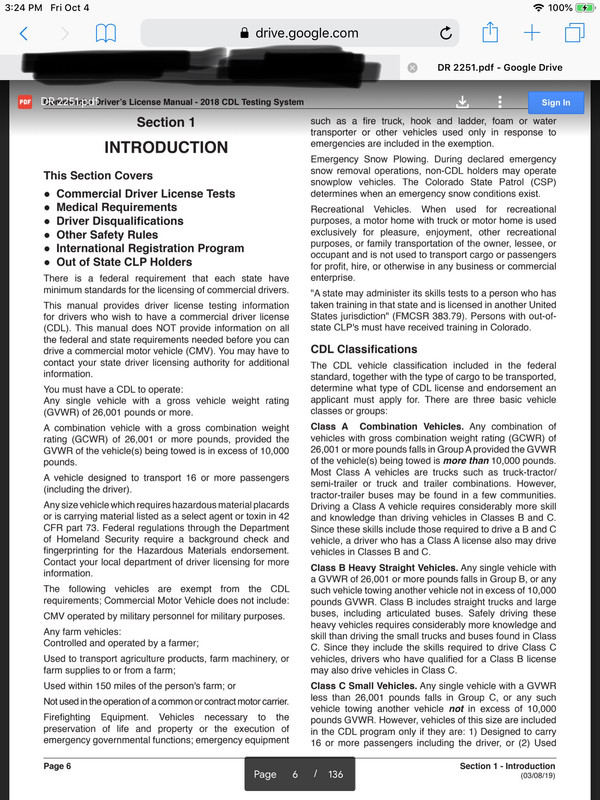
Here’s a page from the Colorado CDL Manual. I copied the part about when a CDL is required:


Notice, the combined GVWR’s being over 26k (with the towed vehicle over 10k), CDL is required. Now, go back and reread my posts and tell me what is inaccurate. Not what is inconvenient, for you, but what is inaccurate.

Here’s a link, if you think I typed it up, myself.

DR 2251.pdf - Google Drive
 
/ Newer 3/4 ton advice? #24  
How is 13k plus 14k under 26k? If both are loaded to capacity that comes to 27k. 27k is 1,000 lbs over the 26k limit.

I doubt it痴 so much you can稚 do basic math and instead just like to use what suites you.

You can’t load the truck to the 13000 or so maximum GVW and then hook a trailer to it. Well you can and I would but it’s over weight that way. To be legal you’re going to have to pull 1500 pounds or so off the truck for hitch weight which brings the truck to less than 26k.
 
/ Newer 3/4 ton advice? #25  
I get that. A DRW is much nicer to pull with, in most situations. Due to legal and insurance implications, I don’t recommend mend the DRW unless it’s needed. Such as the OP’s case, where he’s getting dangerously close to CDL territory.

A dually might weigh 500 pounds more than a SRW. It probably weighs around 8k empty. 8 k plus the 14k trailer is a good bit less than than 26000. How is he getting dangerously close? Even if there’s a ton of difference between the trucks which there’s not 7,000vs 9,000 makes no difference. Please explain why the OP is going to need a CDL if he buys a dually.
 
/ Newer 3/4 ton advice? #26  
Here’s a page from the Colorado CDL Manual. I copied the part about when a CDL is required:


Notice, the combined GVWR’s being over 26k (with the towed vehicle over 10k), CDL is required. Now, go back and reread my posts and tell me what is inaccurate. Not what is inconvenient, for you, but what is inaccurate.

Here’s a link, if you think I typed it up, myself.

DR 2251.pdf - Google Drive

Where does it say you need a CDL to tow a trailer that weighs 10,001 pounds or more while keeping the total weight under 26,000? Nobody not once has disputed needing a CDL for 26,000 pounds or more. ( although there are exceptions ) I didn’t see the part about 6 wheel pickups needed a CDL either.
 
/ Newer 3/4 ton advice? #27  
You keep skipping the pertinent part: GVWR. It’s not just actual weight. I know your type. The kind of guy who cherry picks the parts that suit them while denying the inconvenient parts. They are the ones who are going to sue me, have my job, blah blah blah, on the way to jail. Then, when the Judge finds them Guilty, the Judge doesn’t know anything. Not far different from the guy who is going to kick my ***, while the handcuffs are on, but are “yes, sir” when they come off.

My posts come from my experience in applying written and case law then professionally defending those actions, in court, and in running a side business (tractor jobs) where all of this is applicable. I am not an attorney, but I do have a very thorough working knowledge of how to avoid needing one. In the end, I can back up my statements with legally relevant documentation. I have posted the relevant page from the OP’s State DL manual. I can’t make you read it or understand it, but I can comment on it’s applicability, in certain situations.

A lot of people travel and operate outside the confines of law, it’s not uncommon.
 
/ Newer 3/4 ton advice? #28  
CDL requirements do not care about actual weight - the are based on weight ratings (GVWR and GCWR). Barring an exemption (RV, farm use, etc.) the license requirements are pretty straight forward. Fallon mentions tractor work/business so he clearly qualifies as commercial.

Class A CDL is required if 1) the trailer GVWR is >10,000 lbs. AND 2) the GCWR is >26,000 lbs.
Class B CDL is required for vehicles with a GVWR > 26,000 lbs (can tow a trailer ≤ 10,000 lbs GVWR without bumping up to Class A).

Definitions:
GVWR = Gross Vehicle Weight Rating (The maximum amount the truck or trailer can legally weight - this number is found on the door tag or trailer tongue)
GCWR = Gross Combined Weight Rating (The maximum amount the truck plus trailer can legally weight. This is a calculated number determined by adding the GVWRs listed on the truck and the trailer.)

Examples:
1. An F250 with GVWR = 10,000 tows a trailer with GVWR 16,000 lbs resulting in a GCWR of 26,000 lbs. No CDL is required. (Practical note: The truck would likely need to be a regular cab to have enough payload to fully load the trailer without overloading the truck)
2. A SRW F350 with GVWR = 11,400 tows a trailer with GVWR 14,000 lbs resulting in a GCWR of 25,400 lbs. No CDL is required.
3. A DRW F350 with GVWR = 12,000 (mid 2000s model) tows a trailer with GVWR 14,000 lbs resulting in a GCWR of 26,000 lbs. No CDL is required.
4. A DRW F350 with GVWR = 13,400 (newer model) tows a trailer with GVWR 14,000 lbs resulting in a GCWR of 27,400 lbs.
5. An F550 with GVWR = 19,500 tows a trailer with GVWR 10,000 lbs resulting in a GCWR of 29,500 lbs. No CDL is required.
6. An F550 with GVWR = 19,500 tows a trailer with GVWR 14,000 lbs resulting in a GCWR of 33,500 lbs. A Class A CDL is required.
6. An F750 with GVWR = 33,000 tows a trailer with GVWR 10,000 lbs resulting in a GCWR of 43,000 lbs. A Class B CDL is required.
6. An F750 with GVWR = 33,000 tows a trailer with GVWR 14,000 lbs resulting in a GCWR of 47,000 lbs. A Class A CDL is required.
I used Fords in the above example because they have models accross this entire range and it was easy.

As mentioned above, the CDL requirements are based on the RATINGS. An unloaded DRW F350 with GVWR = 13,400 lbs weighing only 8,000 lbs towing an empty 4,000 lbs flat bed trailer with GVWR 14,000 lbs requires a Class A CDL because the GCWR = 27,400 lbs even though the actual weight of the setup is only 12,000 lbs.
The exceptions for RVs, Farm Use, "Personal Use" etc. can get pretty muddy, especially state to state, but the CDL requirements for clearly commercial use are Federally defined and pretty straight forward.


Fallon,
I agree that a crew cab diesel 3/4 ton truck will limit your payload. I recommend stepping up to a SRW 1-ton pickup to ensure you have enough payload to fully utilize your trailer and just make sure the it's GVWR is ≤ 12,000 lbs.
 
/ Newer 3/4 ton advice? #29  
CDL requirements do not care about actual weight - the are based on weight ratings (GVWR and GCWR). Barring an exemption (RV, farm use, etc.) the license requirements are pretty straight forward. Fallon mentions tractor work/business so he clearly qualifies as commercial.

Class A CDL is required if 1) the trailer GVWR is >10,000 lbs. AND 2) the GCWR is >26,000 lbs.
Class B CDL is required for vehicles with a GVWR > 26,000 lbs (can tow a trailer ≤ 10,000 lbs GVWR without bumping up to Class A).

Definitions:
GVWR = Gross Vehicle Weight Rating (The maximum amount the truck or trailer can legally weight - this number is found on the door tag or trailer tongue)
GCWR = Gross Combined Weight Rating (The maximum amount the truck plus trailer can legally weight. This is a calculated number determined by adding the GVWRs listed on the truck and the trailer.)

Examples:
1. An F250 with GVWR = 10,000 tows a trailer with GVWR 16,000 lbs resulting in a GCWR of 26,000 lbs. No CDL is required. (Practical note: The truck would likely need to be a regular cab to have enough payload to fully load the trailer without overloading the truck)
2. A SRW F350 with GVWR = 11,400 tows a trailer with GVWR 14,000 lbs resulting in a GCWR of 25,400 lbs. No CDL is required.
3. A DRW F350 with GVWR = 12,000 (mid 2000s model) tows a trailer with GVWR 14,000 lbs resulting in a GCWR of 26,000 lbs. No CDL is required.
4. A DRW F350 with GVWR = 13,400 (newer model) tows a trailer with GVWR 14,000 lbs resulting in a GCWR of 27,400 lbs.
5. An F550 with GVWR = 19,500 tows a trailer with GVWR 10,000 lbs resulting in a GCWR of 29,500 lbs. No CDL is required.
6. An F550 with GVWR = 19,500 tows a trailer with GVWR 14,000 lbs resulting in a GCWR of 33,500 lbs. A Class A CDL is required.
6. An F750 with GVWR = 33,000 tows a trailer with GVWR 10,000 lbs resulting in a GCWR of 43,000 lbs. A Class B CDL is required.
6. An F750 with GVWR = 33,000 tows a trailer with GVWR 14,000 lbs resulting in a GCWR of 47,000 lbs. A Class A CDL is required.
I used Fords in the above example because they have models accross this entire range and it was easy.

As mentioned above, the CDL requirements are based on the RATINGS. An unloaded DRW F350 with GVWR = 13,400 lbs weighing only 8,000 lbs towing an empty 4,000 lbs flat bed trailer with GVWR 14,000 lbs requires a Class A CDL because the GCWR = 27,400 lbs even though the actual weight of the setup is only 12,000 lbs.
The exceptions for RVs, Farm Use, "Personal Use" etc. can get pretty muddy, especially state to state, but the CDL requirements for clearly commercial use are Federally defined and pretty straight forward.


Fallon,
I agree that a crew cab diesel 3/4 ton truck will limit your payload. I recommend stepping up to a SRW 1-ton pickup to ensure you have enough payload to fully utilize your trailer and just make sure the it's GVWR is ≤ 12,000 lbs.


Echo echo echo.

Good post and excellent recommendations.
 
/ Newer 3/4 ton advice? #30  
Notice the Colorado exemptions, the CDL requirements don't apply if the vehicle is not being used as a common carrier or in a commercial situation.
 
/ Newer 3/4 ton advice? #31  
Notice the Colorado exemptions, the CDL requirements don't apply if the vehicle is not being used as a common carrier or in a commercial situation.

True, but the OP is doing this commercially.
 
/ Newer 3/4 ton advice? #32  
You keep skipping the pertinent part: GVWR. It’s not just actual weight. I know your type. The kind of guy who cherry picks the parts that suit them while denying the inconvenient parts. They are the ones who are going to sue me, have my job, blah blah blah, on the way to jail. Then, when the Judge finds them Guilty, the Judge doesn’t know anything. Not far different from the guy who is going to kick my ***, while the handcuffs are on, but are “yes, sir” when they come off.

My posts come from my experience in applying written and case law then professionally defending those actions, in court, and in running a side business (tractor jobs) where all of this is applicable. I am not an attorney, but I do have a very thorough working knowledge of how to avoid needing one. In the end, I can back up my statements with legally relevant documentation. I have posted the relevant page from the OP’s State DL manual. I can’t make you read it or understand it, but I can comment on it’s applicability, in certain situations.

A lot of people travel and operate outside the confines of law, it’s not uncommon.

I’ve heard that rumor a lot too. Can you find a single instance where a person was ticked for having a rated payload of more than 26k while actually weighing less? I doubt it. Even more extreme I’ve heard plenty of people claim you need a CDL to tow a trailer that’s rated over 10k regardless of actual weight. Can you find a single instance of someone being ticketed for that? I doubt it. I’ve never been stopped much less weighed and fined for pulling my 10 ton trailer. There’s thousands of people pulling 10 ton GNs without a CDL. If what you say is true why aren’t any of them being fined?
 
/ Newer 3/4 ton advice? #33  
In regard to 2500 or 3500 SRW trucks, if you go gas engine, get the shortest rear gears you can find. For the Ford, the 6.2L gas engine comes with 3.73 or 4.30. The 4.30 do a great job bridging that gap between the 3.73 and a diesel.
The 6.2L came out in MY2011. It was largely the same until MY2017. The 2017 and laters have 25 more torques at 700 less RPM than the ‘11-‘16’s.

Same would go for the Ram 6.4L gas or the GM 6.0L gas. Get the shortest gears offered. The GM 6.0L drives like its git a lot less power than the Ford or Ram counterparts, which it does have some less. The Ford and Ram numbers favor the Ram, but I don’t notice as much, from the driver’s seat (comparing a SRW to my DRW, so not worth a lot). The GM motif may not be as pretty, on paper, but they are durable workhorses. The 6.2L Ford engine hasn’t been out as long as the 6.0L GM, but it, too, has an incredible history in regard to repairs and durability. In my opinion, the 6.4L Ram engine brings in the rear of the three, for durability. This is not a jab, just what I’ve read and heard. Still an awesome engine choice. Kind of like it is the weakest Navy SEAL or the ugliest Dallas Cowboys’ Cheerleader.

I can’t speak to the diesels beyond generalities. My only real experience is in a 2014 Ford 6.4L, and I have only put a few miles in it.

Warning, they can be hard to find. I looked for over six months and drove over five hours, one way, to get my 6.2L with 4.30’s. Even harder when you’re looking for a DRW, which I was.
 
/ Newer 3/4 ton advice? #34  
I’ve heard that rumor a lot too. Can you find a single instance where a person was ticked for having a rated payload of more than 26k while actually weighing less? I doubt it. Even more extreme I’ve heard plenty of people claim you need a CDL to tow a trailer that’s rated over 10k regardless of actual weight. Can you find a single instance of someone being ticketed for that? I doubt it. I’ve never been stopped much less weighed and fined for pulling my 10 ton trailer. There’s thousands of people pulling 10 ton GNs without a CDL. If what you say is true why aren’t any of them being fined?


It would be unprofessional for me to post their names on the internet. Yes, it happens. Some get to call for a properly licensed driver, others get towed, a few go to jail, and some get verbal warnings-like every other misdemeanor traffic crime. It’s been said that for every DUI caught there are 8,000 that get by with it. The good thing for those running illegal in trucking is there are fewer cops looking for them than are looking for DUI’s. Then, you have the shear number of cops to people (in any jurisdiction), which favors the criminal, by far.

Running overweight (or without proper licensing or registration, etc) is just like DUI, in another way. If a collision occurs, even if your actions did not contribute to the collision, you can be found at fault, since you weren’t running legally.
 
/ Newer 3/4 ton advice? #35  
So it’s better to pull a 14,000 pound trailer with lower rated 3/4 ton vs a dually?
 
/ Newer 3/4 ton advice? #36  
CDL requirements do not care about actual weight - the are based on weight ratings (GVWR and GCWR). Barring an exemption (RV, farm use, etc.) the license requirements are pretty straight forward. Fallon mentions tractor work/business so he clearly qualifies as commercial.

Class A CDL is required if 1) the trailer GVWR is >10,000 lbs. AND 2) the GCWR is >26,000 lbs.
Class B CDL is required for vehicles with a GVWR > 26,000 lbs (can tow a trailer ≤ 10,000 lbs GVWR without bumping up to Class A).

Definitions:
GVWR = Gross Vehicle Weight Rating (The maximum amount the truck or trailer can legally weight - this number is found on the door tag or trailer tongue)
GCWR = Gross Combined Weight Rating (The maximum amount the truck plus trailer can legally weight. This is a calculated number determined by adding the GVWRs listed on the truck and the trailer.)

Examples:
1. An F250 with GVWR = 10,000 tows a trailer with GVWR 16,000 lbs resulting in a GCWR of 26,000 lbs. No CDL is required. (Practical note: The truck would likely need to be a regular cab to have enough payload to fully load the trailer without overloading the truck)
2. A SRW F350 with GVWR = 11,400 tows a trailer with GVWR 14,000 lbs resulting in a GCWR of 25,400 lbs. No CDL is required.
3. A DRW F350 with GVWR = 12,000 (mid 2000s model) tows a trailer with GVWR 14,000 lbs resulting in a GCWR of 26,000 lbs. No CDL is required.
4. A DRW F350 with GVWR = 13,400 (newer model) tows a trailer with GVWR 14,000 lbs resulting in a GCWR of 27,400 lbs.
5. An F550 with GVWR = 19,500 tows a trailer with GVWR 10,000 lbs resulting in a GCWR of 29,500 lbs. No CDL is required.
6. An F550 with GVWR = 19,500 tows a trailer with GVWR 14,000 lbs resulting in a GCWR of 33,500 lbs. A Class A CDL is required.
6. An F750 with GVWR = 33,000 tows a trailer with GVWR 10,000 lbs resulting in a GCWR of 43,000 lbs. A Class B CDL is required.
6. An F750 with GVWR = 33,000 tows a trailer with GVWR 14,000 lbs resulting in a GCWR of 47,000 lbs. A Class A CDL is required.
I used Fords in the above example because they have models accross this entire range and it was easy.

As mentioned above, the CDL requirements are based on the RATINGS. An unloaded DRW F350 with GVWR = 13,400 lbs weighing only 8,000 lbs towing an empty 4,000 lbs flat bed trailer with GVWR 14,000 lbs requires a Class A CDL because the GCWR = 27,400 lbs even though the actual weight of the setup is only 12,000 lbs.
The exceptions for RVs, Farm Use, "Personal Use" etc. can get pretty muddy, especially state to state, but the CDL requirements for clearly commercial use are Federally defined and pretty straight forward.


Fallon,
I agree that a crew cab diesel 3/4 ton truck will limit your payload. I recommend stepping up to a SRW 1-ton pickup to ensure you have enough payload to fully utilize your trailer and just make sure the it's GVWR is ≤ 12,000 lbs.
Thank you for this very informative post! I guess the only example I'm not understanding is number five. No CDL is required because the trailer is only 10k? Even though total rating exceeds 26k?
 
/ Newer 3/4 ton advice?
  • Thread Starter
#37  
I had been under the assumption as long as truck & trailer combined ratings (GVWR) were under 26k was good. However it looks as if that is only partially the case. No CDL until 26k, but I need to deal with other DOT crap due to the trailer being over 10k I getting labeled as a CMV (Commercial Motor Vehicle). That's going to make life suck a bit more than I was expecting.

From the Colorado State Patrol
https://colorado.gov/pacific/sites/default/files/Small%20truck%20and%20Combination%20Web.pdf

"Example: Steve operates a landscaping business and has a 1 ton truck GVWR 12,000 pounds, and purchases a gooseneck trailer with a GVW of 14,500 pounds. The GCWR of the combination would be 26,500 pounds and the trailer towed is over 10,000 pounds, so Steve would need a class A CDL to operate this combination. Class “A”
Heavy Combination Vehicle: any combination of vehicles with a GCWR of 26,001 pounds or more if the GVWR or GVW of the trailer/trailers being towed are more than 10,000 pounds."

The only time I expect the truck will be leaving the state with a trailer is with our 4k camper trailer behind it, or on the way to a funeral & clearing out a parents house with the 14k trailer. So in that respect I'm not clear how the federal regulations will apply as I won't be doing anything interstate, only intrastate. In which case I think I only have to worry about the Colorado state laws, although it looks like the CO & federal stuff is in sync.

No need for DOT numbers on the truck if it's under 10k, but you would need them on the trailer.

Lots to think about on that front I guess.
 
/ Newer 3/4 ton advice? #38  
Just came back from a 700 mile trip with a friend, he just bought a new F350 diesel. OMG, that thing rides so hard I can't believe it, he actually said he made a mistake, I feel bad for him really, you really need to drive one on no so nice payment before you buy one.. The roads are perfect around the dealership he bought it from.. IFS would be what I would be looking for..
 
/ Newer 3/4 ton advice? #39  
Thank you for this very informative post! I guess the only example I'm not understanding is number five. No CDL is required because the trailer is only 10k? Even though total rating exceeds 26k?

Correct.

I had been under the assumption as long as truck & trailer combined ratings (GVWR) were under 26k was good. However it looks as if that is only partially the case. No CDL until 26k, but I need to deal with other DOT crap due to the trailer being over 10k I getting labeled as a CMV (Commercial Motor Vehicle). That's going to make life suck a bit more than I was expecting.

From the Colorado State Patrol
https://colorado.gov/pacific/sites/default/files/Small%20truck%20and%20Combination%20Web.pdf


The only time I expect the truck will be leaving the state with a trailer is with our 4k camper trailer behind it, or on the way to a funeral & clearing out a parents house with the 14k trailer. So in that respect I'm not clear how the federal regulations will apply as I won't be doing anything interstate, only intrastate. In which case I think I only have to worry about the Colorado state laws, although it looks like the CO & federal stuff is in sync.

No need for DOT numbers on the truck if it's under 10k, but you would need them on the trailer.

Lots to think about on that front I guess.

Any time your commercial rig (truck and empty trailer would qualify or bed loaded on truck, for examples) weighs more than 10k, DOT applies.

DOT number has to be on the truck. Trailers aren’t labeled, just tow vehicles. Magnets are popular for removal when not working. Mine are bolted on steel signs with wingnuts, for quick, easy removal, but better durability than magnets.

As long as you’re not leaving the State, for work, no worries. Take your DOT placard off and drive wherever, when you do leave.

You don’t need Federal Authority (MC number), if you’re intrastate. Kansas requires intrastate authority, but I don’t know about Colorado.

I can help walk you through what is required Federally and help you look up the Colorado specific requirements, if you want my help. I’d even give you my number to chat, if you’re interested.
 
/ Newer 3/4 ton advice? #40  
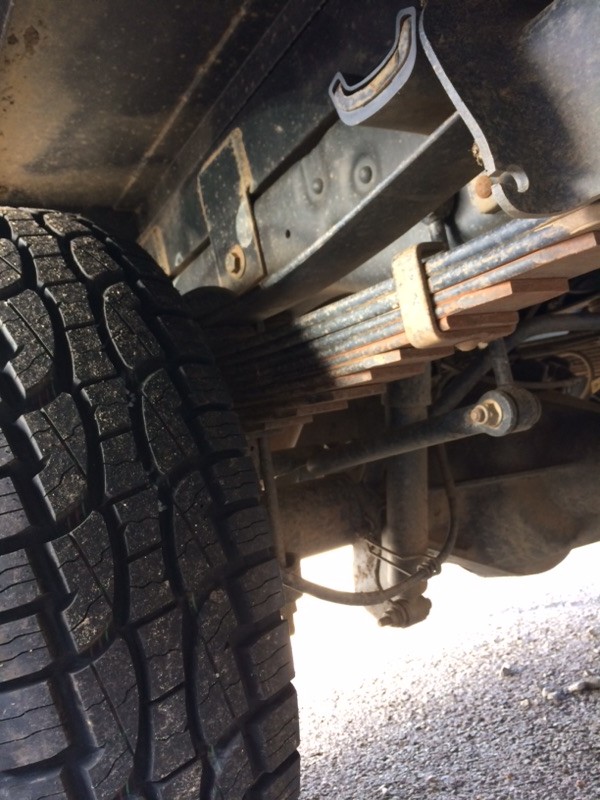
My truck rides very rough, when unladen. It was a chassis cab, not a pickup. The chassis cabs have a lot more leaf springs, in the back, than the four that come on the pickup. With 3-4K on the bed, it settles in nicely, or 7-14k on a bumper pull. My dump trailer is around 5k, empty, and my truck still rides rough, with it following.

Here’s my leaf springs:


Great for heavy loads, terrible for unladen ride quality.
 

Marketplace Items

10' Container w/ Side Door (A60463)
10' Container w/...
2010 International 4300 2,000 Gallon Water Truck (A55973)
2010 International...
Woods BW10.60 (A60463)
2018 Ford F-150 4x4 Crew Cab Pickup Truck (A59230)
2018 Ford F-150...
STEPP SEALCOATING MACHINE (A59906)
STEPP SEALCOATING...
PALLETS OF HEAVYEQUIPMENT (A58214)
PALLETS OF...
 
Top