Hopefully There are no Dumb Questions

   / Hopefully There are no Dumb Questions #1  

Gordon Gould

Super Member
Joined
Apr 1, 2007
Messages
6,719
Location
NorthEastern, VT
Tractor
Kubota L3010DT, Kubota M5640SUD, Dresser TD7G Dozer
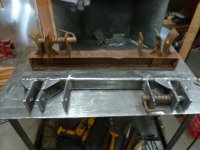
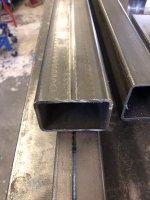
Question on when you are working with square tubing and most of the welds are on one surface. In trying to keep things straight/flat and limit the amount of deformation in general can you help yourself by putting the tubing surface with the seam in any particular orientation relative to the welds or should you just not worry about where the seam is ??? Say a piece like this - Thank you

P1180782.JPG

gg
 
   / Hopefully There are no Dumb Questions #3  
No, it doesn't matter as to the seam's orientation. You can marginalize the warping by clamping both ends of the tubing down to the welding table while making your welds and keeping it clamped until the metal assembly has completely cooled down.

If any warping does occur, you can reduce it or even eliminate it by heating the back side of the arch with a torch and cooling that side down with a very wet rag in the area of the highest arch point. Sometimes it takes repeated efforts.
 
   / Hopefully There are no Dumb Questions #4  
I've never worried about the seam.
Me either. I have turned the seam toward the inside to hide from view just in case after paint it doesn't show. Never worried about it from a warping standpoint but I'm no expert.
 
   / Hopefully There are no Dumb Questions
  • Thread Starter
#5  
OK thanks. I was just wondering if it possibly made a difference.

gg
 
   / Hopefully There are no Dumb Questions #6  
I don't worry about seams either, unless there's some aesthetic thing (looks) - generally I follow everything Oldoak mentioned.

I've built some hitch stuff similar to your project, what I do is precut every piece, then HARD clamp the tubing down to the 1" thick weld table at both ends and the middle, then I use a piece of 3/4" allthread and several nuts to string all the drilled pieces on - adjust the nuts for desired spacing and snug them up while the individual pieces are resting on a flat surface.

Then I check spacing at the holes, and at the welds, get everything lined up, then light tacks (2 per piece, 3 per gusset), then clamp the allthread nuts down HARD (by now everything's sitting where it SHOULD be)

Most of my clamps are rated 1200 pounds, and I'm pretty sure I'm there (unless the tube's too thin-walled to take it) -

Then I "hop-scotch" around til everything's full welded, and find something else to do til my IR gun says it's all at room temp. After I take off all the allthread stuff and unclamp from the table I run a straight edge across everything (and an aluminum rafter square), looking for daylight.

If THAT test passes, great; otherwise, Oldoak covered that too...

(Some say I'm too OCD; others are SURE I am) :laughing: ...Steve
 
   / Hopefully There are no Dumb Questions #7  
I was asked to come to a friends place of employment to fix something recently. They have a tubing laser. I think it goes up to 8" or so , thirty feet long. My friend was showing me stuff he plays around with. Notching two inch square tubing that then fits together like a cardboard puzzle, at a ninty, almost not requiring weld. Amazing! Who knew?
 
   / Hopefully There are no Dumb Questions #8  
Someone needs to design a laser weld-grinder that leaves a stack-o-dimes pattern.

Then I "hop-scotch" around til everything's full welded, and find something else to do

:cool2:

....one of the benefits of teaching your dog to weld.

:laughing::laughing::laughing:
 
   / Hopefully There are no Dumb Questions
  • Thread Starter
#9  
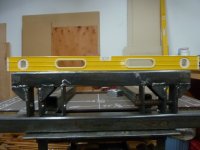
Thanks for all the tips. I did manage to keep it pretty flat and lined up.

P1180866.JPG

gg
 
   / Hopefully There are no Dumb Questions #10  
Won't make different,good buffing paint you'll never know.
 
   / Hopefully There are no Dumb Questions #11  
No, it doesn't matter as to the seam's orientation. You can marginalize the warping by clamping both ends of the tubing down to the welding table while making your welds and keeping it clamped until the metal assembly has completely cooled down.

If any warping does occur, you can reduce it or even eliminate it by heating the back side of the arch with a torch and cooling that side down with a very wet rag in the area of the highest arch point. Sometimes it takes repeated efforts.

Another dumb question..... which side is the back side of the arch? Concave or convex.
 
   / Hopefully There are no Dumb Questions
  • Thread Starter
#13  
The way I think of it is that you heat the side that makes the problem worse when that side expands from the heat. It seems backwards but, the heated metal compresses or crushes together when it gets hot enough to deform because it is restrained by the cool surrounding metal then when it is cooled quickly it freezes in the compressed position and ends up smaller than it was at room temperature which pulls the piece the other way.

gg
 
   / Hopefully There are no Dumb Questions #14  
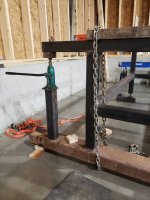
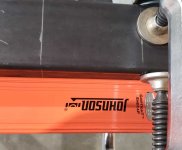
And there always good old persuasion. I had to straighten this 3x3 .120 wall tubing. It had pulled almost 1/8" and needed to be 1/32nd or less, a little creativity and it was back to spot on.

I asked a very talented fabricator friend, that I've seen use the heat and cool method to straighten large stainless pipe, about the best way to straighten this and he suggested trying to bend it back cold first.20181223_160357.jpeg20181224_152926.jpeg20181223_153959.jpeg
 
   / Hopefully There are no Dumb Questions #15  
Nothing to do with deformation, but I always try to put the seam side down or facing inwards if possible.

IMG_3314.jpg

If a glossy paint finish is used a slight indentation is always visible.

IMG_1054.jpg
 
   / Hopefully There are no Dumb Questions #16  
Nothing to do with deformation, but I always try to put the seam side down or facing inwards if possible.

View attachment 586522

If a glossy paint finish is used a slight indentation is always visible.

View attachment 586525
Same here, except when you assemble something and realize you put the seam up instead of down but theres no way you're getting it back appart to fix before welding. Not that I didn't just do this a couple days ago..................
 

Tractor & Equipment Auctions

2016 UTILITY 53X102 REEFER TRAILER (A59905)
2016 UTILITY...
2012 TEX MEX TRAILER LOW BOY GOOSENECK (A58214)
2012 TEX MEX...
2003 McCormick XTX 185 XtraSpeed Tractor (A56438)
2003 McCormick XTX...
2013 Ford Focus Hatchback (A59231)
2013 Ford Focus...
2020 CATERPILLAR 302.7D CR EXCAVATOR (A60429)
2020 CATERPILLAR...
2020 CATERPILLAR 289D3 SKID STEER (A60429)
2020 CATERPILLAR...
 
Top