Diesel vs gas

/ Diesel vs gas #121  
id say that is probably about right as I put in more on the diesel price of what mine cost me when I bought it new - but yes if I had to put down 10K for the cost of the diesel option on most trucks I could buy a LOT of fuel before I paid for the gasser - I really don't care I was just doing it for kicks to see since someone brought it up lol - others seem to be more concerned I enjoy the banter and debate, and you can accuse me of taking both sides and playing devils advocate - there are always 2 sides and no one is necessarily wrong unless they are not being truthful

I completely agree. I'm not going to go trade trucks tomorrow based on someone's "assessment".

If I added $5K to the diesel option I'd still be ahead.

Funny how these discussions morph. And the morhers always get butt hurt. :)
 
/ Diesel vs gas #122  
Another person that can not tell the difference between light, medium and HD service . No details on the era of the lawn equipment either. Try a port injected or direct injected gasser vs the tier IV diesel .

I’ve got a F series Kubota and a Grasshopper mid mount. The grasshopper is a 2007 and the Kubota is a few years older. If you take what I have in both units and multiple it by 4 you’d be getting close to the cost of either one new so I don’t really care what the direct injection gas has to offer. And the Kubota is 25 hp and the 28 hp grasshopper would almost certainly be de rated so they’d be in the less strict emission category.
 
/ Diesel vs gas #124  
Similar results. I used 15 and 10. .30 diff on fuel price. No def.

I just looked at my overhead which hasn't been reset for the past 140K miles. It says 18mpg. So I'm pretty safe at using 15mpg.

In my case regarding my truck, it's a no brainer.

Yep, those numbers add up to 60k. I guess the better mileage that pickups get VS the RVs that the calculator was for makes the difference.
 
/ Diesel vs gas #126  
all of my statistics are accurate and truthful...........my engine is HEUI with a Fuel Injection Control Module the notorious 6.0 Navistar so its not old technology - once you fix the poorly engineered problem they are amazing engines. To break even at 60K im guessing a cummins in an older dodge OR the person didn't buy it new and didn't add on the extra cost of the engine package = if I took that out of mine it would drop significantly

2003 to 2016 in various versions . Voted by Wards in 2003 as the worst diesel. Show us the numbers of what 2018 diesel breaks even over a direct injection gas in 2018.
 
/ Diesel vs gas #127  
I don't understand this response? My question was why the small/medium duty diesel market has grown? And I'm not talking about foreign countries. I'm talking about your neighborhood. :)

Manufactures keep costs down by building one piece of equipment to be sold world wide in all markets . Most of the market is in countries where diesel fuel is much cheaper than gasoline . Many of these countries have little to no emissions regulations . To be competitive in the world market the corporate choice is to build just diesels for the market and stick the US and Western Europe for the bolt on tier IV equipment . Plus in the US and Western Europe there are some consumers who still think they are in the 1950痴 to 1990痴 where diesels were the undisputed superior product . Some of these customers will purchase diesel no matter what , before they will accept change and make a different fuel choice .
 
/ Diesel vs gas #128  
I’ve got a F series Kubota and a Grasshopper mid mount. The grasshopper is a 2007 and the Kubota is a few years older. If you take what I have in both units and multiple it by 4 you’d be getting close to the cost of either one new so I don’t really care what the direct injection gas has to offer. And the Kubota is 25 hp and the 28 hp grasshopper would almost certainly be de rated so they’d be in the less strict emission category.
Rather than comparing apples and oranges , we are comparing 2018 to 2018.
 
/ Diesel vs gas #129  
Some of us still have good diesels and don’t plan on replacing them.
 
/ Diesel vs gas #130  
sorry B&D I didn't get the memo that we were only including 2018 units..............did I miss anything else noteworthy, I thot we were talking about tractors and not trucks? oh shoot did I get that wrong too?

lets see, how many gas tractors with 100hp do I have to compare with 100hp diesels. Wait............how about 150hp? or hmmm 80 , or 75 or 50?

im thinking there must be something to this diesel thing.......
 
/ Diesel vs gas #131  
sorry B&D I didn't get the memo that we were only including 2018 units..............did I miss anything else noteworthy, I thot we were talking about tractors and not trucks? oh shoot did I get that wrong too?

lets see, how many gas tractors with 100hp do I have to compare with 100hp diesels. Wait............how about 150hp? or hmmm 80 , or 75 or 50?

im thinking there must be something to this diesel thing.......


Explain light, medium and HD service .
Now that Trump is in the EPA will be forcing Tier V and VI emissions on US equipment . Europe is currently banning light duty diesels .
 
/ Diesel vs gas #132  
I have no idea who is saying anything about light/medium/HD service out of any diesel equipment - I think trump or anyone in the US will be hard pressed to force farmers (and the rest of us ) out of their current equipment and force them to buy something else w/out some real problems - there will guys puffing smoke from their exhaust till I am good and gone.......

Autos are one thing, getting food out of the ground/around the country and on the table is an entirely different venue..........hmmm what about the locomotives puffing smoke along the highway..... shall we add those ? im sure they have some sort of exemption since they are leased by the gov
 
/ Diesel vs gas #133  
Some of those locomotive are old or severely worn. It is a minority of small business and private individuals that will keep old equipment operational . The bulk of the equipment and vehicles out there were built after their operator’s were born.
California won’t let older “noncompliant “ trucks haul freight to destination .
 
/ Diesel vs gas #134  
well leave it to California to be so narrow minded, once they stop trucks from crossing the border entirely that dont have good enough emissions they will either starve to death or people will leave in droves to a state where they can buy food because they wont be able to afford to have only trucking companies with a niche truck that is PERFECT emissions to suit them bring them what they need not just food either, I find that hilarious.

Im waiting for the Big One Elizabeth ( earthquake ) - and see what they allow to go in/out
 
/ Diesel vs gas #135  
and hail to the small folks that keep the country going, w/out the small folks the world would be in a pickle
 
/ Diesel vs gas #136  
I know you can't compare with different transmissions, different size tires, engines......just curious of the comparison between my fathers farmall M, 43 hp , 1953 I believe and the little 2816hst I bought for my mother. As a kid, I was always amazed at what that old farmall would pull. And then discovering it only had 40 hp or there about. Now I see this little engine about 14 or 16 inches long in that Mahindra, diesel powered with 28 hp and wondered how far in pulling power it would have compared to the farmall. Since my father passed away I haven't had the chance to get the farmall out of storage to compare. Or haul any big wagons with the little compact tractor. The shear weight of the farmall, its just a bigger tractor and that's that. The big wheels and probably not far off of over 1.8 times the weight of the little compact. When my father said they got that after using horses it was thought of as a massive powerful tractor. Its a 40 hp gas and the compact is a 28 hp diesel.

Also, the J5 we use sometimes. they have a 115 hp gas engine, flathead 6. Years later they made some of them with a 4 cylinder diesel perkins with 90 or 100 hp. I wondered what the comparison would have been.

OK I now better understand your objective in your OP.

Gas options are typically older stuff like you mentioned.

Our 1976 MF 265 diesel was bought new by the wife's father and is a nice low hour (1400) 60 HP tractor.

I grew up on gas 801 Fords so late last summer I looked at some 3000 Fords. I was fine with gas. I looked at one gas and one diesel both would start and run but nothing to get excited about taking home. The next week a 1966 3000 Ford diesel popped up nearby on CL that ran and looked very nice and apples to apples was the better value so we got it and now it has the 711 Ford one arm loader on it. Very early this spring I looked at a 3600 diesel and a couple weeks later a 2600 gas tractor that I pulled a trailer 300 miles to buy. The guy finally got it started but the old carb issues came flooding back into my old head from years ago plus it looked much better in the photos. The 3600 diesel was just 15 miles away from this 2600 and I had the trailer so I drove over to the place with the 3600 diesel because it would start and run very nicely plus it had a strong lift that could hold up a 5 foot bush hog for a few hours after you shut it off. The guy still had it so he loaded it and I headed back to KY. I notice Friday the 3600 is at 2400 actual hours (I was told and appears to be factual) so I have put 100 hours on it this summer somehow I guess pulling the 7' twin spindle Bush Hog brand bush hog. In heavy stuff it will show some dark smoke when the governor opens up but has not used any oil. The owner of the last 32 years knew the owner who bought it new and he claims the engine has not been touched other than to change the oil and filter every 100 hours and mainly it cut and raked hay he said.

I was very open to an old gas Ford but in the real world of old tractors my brain had to go with diesels for the reasons noted. I have not seen any new gas tractors in years.

In a practical sense there are mainly only diesel tractor options today. I am sure a 3000 Ford gas or diesel will do about the same amount of work but the life of a gas engine just does not compare with the diesel version 50 years down the road from what I can tell. :)

While the 3600 has set outside all of its life and needs painting and some other stuff to make it look sharp it is turning out to be a real work horse as is and the price was $3500 picked up at its home of 32 years.

If I had a family gas tractor I would restore it I am sure.
 
/ Diesel vs gas #137  
Didn't read the whole thread but a 3 cylinder Perkins 152 whether gas or diesel puts out almost identical HP and torque numbers. The diesel is more fuel efficient but the gas isn't bad either. Both are excellent engines.
 
/ Diesel vs gas #138  
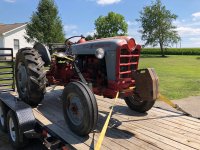
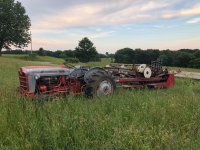
I got a Ford 1958 861 Diesel tractor. I believe this was Ford's first year for diesel tractors. The gasoline counterpart uses virtually the same engine block.
According to Tractor Data online, that diesel engine has the same bore & stroke 3.90x3.60 inches and the same 172 cubic inches as the gas engine. However the diesel has 16.8:1 compression compared to 7.5:1 for the gasser. The diesel has 56.3 hp and 140.4 lb-ft of torque at 1400 RPM; rated RPM is 2200. The gasoline engine is 62.6 hp, rated RPM is 2000, torque is 166 lb-ft at 1600 RPM. So it seems to me the gasoline engine is a little stronger when the cubic inches and bore/stroke are identical.

IMG_1283.JPGIMG_0934.JPG

Gas version
 
/ Diesel vs gas #139  
Gas powered tractors will get the work done,

standard.jpg


BUT, there's NO WAY I'd go back to gas powered tractors!

SR
 
/ Diesel vs gas #140  
Gas powered tractors will get the work done,

standard.jpg


BUT, there's NO WAY I'd go back to gas powered tractors!

SR

Yes they will, but I'd hate to try and stop that load on a hill with that old girl :cool:
That being said, we still use several gas tractors for farm work, Farmall 400, 560 and 656's for light work.
All the newer units are diesel.
This discussion (piss ant argument ) about gas vs diesel has had so much bull slung around it's ridiculous.
Diesel has more BTU per gallon, other aspects of engines being equal it will take less fuel then gas.
I've heard so many ridiculous claims in the discussion,
the cam(s) or valve timing (electronic) is what affects the engines power curve, it does not matter if it's gas or diesel.
With forced induction and new electronic controls both engines can make unbelievable hp and torque.
As an example a little 3.0 liter (183 cu.in.) diesel with 240 hp and 420 #'s of torque at 2000 rpm.

For lighter work I would like to see a modern 50-60 hp @ 2000 rpm gas tractor with a good flat torque curve and a base weight of 5000-6000 lbs,
and a diesel with the same Hp and torque and weight, it would be an interesting (at least to me) comparison.

And for those that want or claim that higher rpm is as good or better then low, no.
 

Marketplace Items

JLG 20MVL MANLIFT (A58214)
JLG 20MVL MANLIFT...
KUBOTA MX5800 TRACTOR (A62130)
KUBOTA MX5800...
Pace American MW8516TA2 T/A Enclosed Concession Trailer (A56857)
Pace American...
17101 (A55851)
17101 (A55851)
4ft Mini Skid Quick Attach Rotary Cutter (A63118)
4ft Mini Skid...
NEW HOLLAND 706 30 INCH 3PT DIRT SCOOP (A55315)
NEW HOLLAND 706 30...
 
Top