Break in procedure - Many questions

/ Break in procedure - Many questions #1  

GirlWhoWantsTractor

Platinum Member
Joined
Apr 25, 2015
Messages
948
Location
The Mountains of Virginia
Tractor
2018 Mahindra 26XL HST, Husqv GT48XLsi & YTH48LS
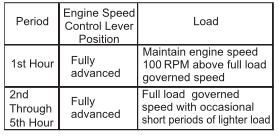
Read a bunch of threads on this and still a little confused. This is what the manual says:
Screen Shot 2016-03-18 at 9.05.34 PM.png

What is "full load governed speed"?

If you're aiming for a particular engine speed ("100 RPM above full load governed speed") why do you want the speed control lever "Fully Advanced."

Is "speed control lever fully advanced" the same as WOT?

"Lugging" is working under load at low RPM, right? (always bad)

All of this break in would be in low range, right? Should one also do some traveling around in high range?

Everyone talks about PTO but I actually don't have any PTO-driven implements yet. Should I go ahead and run the PTO with no implement (and can you leave the protector on while it's running)?

Start up is in idle. Then slowly move the SCL until 1500 RPM, then allow to warm up for a few minutes, then slowly up to 2500 RPM and go, right? Is this the same after break in?

First hour is already history. Basically I warmed it up, etc., as above, then spent an hour box blading, not continuously, as this part required periodically lifting the blade and scooting over to another section. Does that sound okay?

Thanks, guys.
 
/ Break in procedure - Many questions #2  
Their are a bazzilion theories about engine break in. The idea is to seat the rings and valves so you get good seal/compression. Some say idle is too low as it doesn’t provide good oil pressure and other say slowly increase engine speed over the first few hours. Varying engine speed is seen as a way to ensure things don’t wear in/seat in one way that may not seal with different speed and load.
IMO- modern machining and metals make this less critical. I don’t idle my machines when cold-1000-1200rpm instead. I’d be easy any varying for the first 5-10 hours. I wouldn’t just set one RPM and say run a PTO water pump. I also would go out with a 12’ disk and have to run the machine a full load. Easy and varying for the first few hours. After that use normal mechanical sympathy. Again, just MHO!!
 
/ Break in procedure - Many questions #3  
I've never used my PTO either. Probably should just to see if it works... but don't think I will ever have any PTO implements, so... :(
 
/ Break in procedure - Many questions #4  
Just run it the way you normally would.

"Full load governed speed" means the throttle is on full so the governor is limiting how fast the engine will turn. There will be about 100 rpm difference between full load rpm's and no load rpm's.

"Is "speed control lever fully advanced" the same as WOT?" I don't know what "WOT" means but if the lever is fully advanced you will have maximum rpms.


""Lugging" is working under load at low RPM, right?" Yes and never lug an engine, especially a diesel engine.


"All of this break in would be in low range, right? Should one also do some traveling around in high range?" It doesn't matter what range your transmission is in, just vary the rpms and don't lug it.

You can run your PTO with no load if you like. If you do then any transmission debris loosened by running it will be drained out in your 50 hour oil change.


Your start up procedure is fine. It partly depends on outside temps. The colder it is the longer I give it to warm up. If it is warm outside I give it a minute or two to get the oil circulating good then put it to work.
 
/ Break in procedure - Many questions #5  
My 2009 Kubota M6040 owners manual says about break in - -

For the first 50 hours

- do not operate the tractor at full speed

- do not lug the engine(during or after break in)

- do not put the engine under max load

- do not start quickly nor apply the brakes suddenly

- do not run the engine at speeds faster than necessary

- on rough roads or fields - - slow down

"Full load governed speed" - I would only be guessing - that's not an answer you need - call the dealer

Lugging is when the load placed on the tractor exceeds its ability to continue at the set rpm. The rpm will continue to decrease unless - the load is decreased, the speed control lever is increased, the clutch pedal is pushed. It is an undesirable condition under any situation.

There is no reason you can't operate the tractor in any gear or any range during break in as long as the engine is not lugged.

I run my PTO in the winter, with the rubber cover on, nothing connected - I think it helps warm up the massive gallons of hydraulic fluid.

I warm my tractor up at around 1300 to 1500 rpm and move on out at that rpm also. I see no need to run the rpm up to 2500 either during or after breakin to get the tractor moving.

I've always been told that during break in its best to vary the speed/rpm and not operate for long periods at the same speed or rpm.

I'm sure your first hour of operation was just fine.
 
/ Break in procedure - Many questions #6  
Just run it the way you normally would.

"Full load governed speed" means the throttle is on full so the governor is limiting how fast the engine will turn. There will be about 100 rpm difference between full load rpm's and no load rpm's.

"Is "speed control lever fully advanced" the same as WOT?" I don't know what "WOT" means but if the lever is fully advanced you will have maximum rpms.


""Lugging" is working under load at low RPM, right?" Yes and never lug an engine, especially a diesel engine.


"All of this break in would be in low range, right? Should one also do some traveling around in high range?" It doesn't matter what range your transmission is in, just vary the rpms and don't lug it.

You can run your PTO with no load if you like. If you do then any transmission debris loosened by running it will be drained out in your 50 hour oil change.


Your start up procedure is fine. It partly depends on outside temps. The colder it is the longer I give it to warm up. If it is warm outside I give it a minute or two to get the oil circulating good then put it to work.

WOT=wide open throttle
 
/ Break in procedure - Many questions #7  
I've always been told that during break in its best to vary the speed/rpm and not operate for long periods at the same speed or rpm.

I'd go with this and not worry that much about the minutia.

btw: WOT = wide open throttle
 
/ Break in procedure - Many questions #8  
I learn something new everyday, probably won't remember it tomorrow though.:confused:
 
/ Break in procedure - Many questions #9  
I learn something new everyday, probably won't remember it tomorrow though.:confused:

With all the “fly by wire” stuff I don’t even know if WOT means anything anymore. It’s probably “maximum flux capacitor” or something like that now.
 
/ Break in procedure - Many questions #10  
use common sense - but use the tractor. that is why you bought.
 
/ Break in procedure - Many questions
  • Thread Starter
#11  
Thanks everyone. Just a couple more to make sure I understand:

"Idle" is for initial start, and a brief idle period before shutting off, but that's it. If during work you need to get off the tractor and adjust something that might take a few minutes, you should go down to 1500 RPM, not all the way down to "idle." Is that right? Any other times you'd use idle? What I'm hearing is that idle is the enemy of a diesel engine.

When you've just started the tractor and you're raising the FEL or rear attachment, is idle okay or is 1500 RPM better?

After break-in, it sounds like the manual is suggesting that you should give your tractor a break from full load once in a while.

Is it bad for the tractor to have a wheel slipping? Is it better to always be in 4WD under load?

I don't want to overthink this, but a diesel engine seems quite different from a gas engine and this is my first. I figure it's just as easy to do things the right way as the wrong way. Might as well develop the right habits from the beginning.
 
/ Break in procedure - Many questions #12  
You're overthinking this.

"Is it bad to have a wheel slipping?": - If it means you're stuck, and you don't want to be stuck: Yes, that's bad.

Not really sure what you mean by this question.
Normally, tractors will apply the same torque to both wheels. So if muddy conditions allow one tire to spin with very little torque required, the other tire not spinning (say it's on dry land) doesn't have enough torque to move the vehicle and you're stuck.
There's then 2 solutions:
1) Engage the differential lock so both tires turn at the same time. Only use this temporarily when necessary. It will make steering harder as tractor wants to got straight.
2) Apply individual wheel brake to spinning tire, this increases the amount of torque applied to both tires, most importantly the one on dry land that has traction (not spinning) will (hopefully) power you out.

"Is it better to always be in 4WD under load?" - Meh! Use 4wd when you need traction. This will be usually be obvious, but note, other unobvious conditions where you may need traction are if you have a lot of weight on front end loader (FEL) and back tire's traction become "light". Less weight on back tire = less traction = less braking ability (and you can go for a "ride" down a hill). Tractors only have rear brakes. In this case, if 4WD is engaged, the mechanical linkage of the back tires with the front tires makes it so (rear) brakes will stop front tires too.

NEVER have 4wd engaged if on pavement or concrete or a surface where tires can't slip.

I was going to say idling is okay, in reasonable proportions. If tractor gets worked normally and hard every once in a while, this counters any effects of "normal" idling. Not really a big deal. However, depending on how they do the Tier IV, faster (hotter) "idling" may be recommended for longer times between regens (if it does regens?)
 
/ Break in procedure - Many questions #13  
I don't think it makes any difference about idle RPM if you are only talking about a short period of time like 5-10 minutes. As long as the engine is at operating temps, a short idle time is not an issue. If I stop my tractor for a short period, I just reduce the throttle to its lowest setting which is about 900-1000 rpm. I see no reason to leave it running at 1500 rpm unless you are in an engine warmup period.
If you have just started the engine and need to raise the FEL, a bit of throttle will make the FEL raise faster but even at an idle, it will still work as designed and wont harm the engine.

When I crank my tractors, I usually crank them at idle (this is how the throttle is set before I turned off the engine last time), I allow a few seconds for the oil pressure to stabilize then increase the throttle to about 1500 RPM. At this point, if I need to back out of my shed, I go ahead and do it. It takes me at least 5 minutes to get from my shed to anywhere on my property that I will do any heavy work, so I use this time to warm up the engine while travelling to the work site. I will increase throttle up to 2000 rpm if needed for power or speed of travel at this time. I don't use the PTO on the B26 (PTO speed is 2600 rpm which is WOT)so I rarely go above 2200 RPMs. This seems to be the sweet spot for power, speed of hydraulics and least engine noise. The engine really starts to scream above 2200. My LS PTO speed is 1900 and only time I exceed that is if I am roading the tractor and I want to travel at max speed (2500 RPM is WOT). The engine has plenty of power to do anything I ask of it when set at 1500-1900 RPM. I can actually bush hog light cutting with it at 1250 RPM and the PTO gearbox set at 750 range (3 speed gear box on the PTO is 540,750 &1000) which is an economy setting. If I need the power for heavy stuff, I just shift it to 540 and increase throttle to 1900. As long as you are getting the desired results from any PTO attachment, there is no need to run the engine at PTO speed unless you need the most power from your engine.
 
/ Break in procedure - Many questions #14  
My LS PTO speed is 1900 (ENGINE RPM).... I can actually bush hog light cutting with it at 1250 RPM and the PTO gearbox set at 750 range (3 speed gear box on the PTO is 540,750 &1000) which is an economy setting. If I need the power for heavy stuff, I just shift it to 540 and increase throttle to 1900. As long as you are getting the desired results from any PTO attachment, there is no need to run the engine at PTO speed unless you need the most power from your engine.

"....but, but, but, there's a indicating line on my tach!" :eek:
"...but, but, but, that's what the manual says!"

(^ said sarcastically) What you said is so true. But (some of us) are so programmed to "follow the rules" or perceive authority as all knowing we can't help it.
IMHO, exceptions to this, where you may want to be closer to 540 rpm would be if attachment has a hydraulic pump (where its output/rpm ratio is non-linear). Example: a baler with a kicker, etc..
 

Marketplace Items

2014 Subaru Legacy AWD (A62613)
2014 Subaru Legacy...
2023 Unverferth 3PT 10 FT Perfecta Field Cultivator (A63688)
2023 Unverferth...
2013 Ford Taurus Sedan (A61574)
2013 Ford Taurus...
More info coming soon (A61569)
More info coming...
John Deere 2155 Tractor W/ Loader (A62613)
John Deere 2155...
2005 CASE 580 SUPER M SERIES 2 BACKHOE (A62129)
2005 CASE 580...
 
Top