Removing Rust

/ Removing Rust #1  

tmajor

Platinum Member
Joined
Oct 9, 2007
Messages
686
Location
NE PA
Tractor
2010 MF 1529, Woods ZTR MZ1952, National Mower sickle bar circa 1963
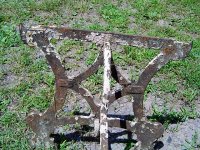
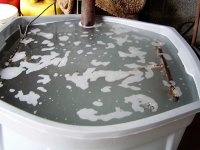
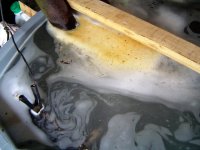
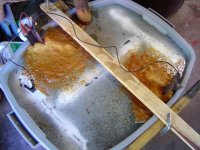
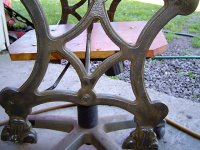
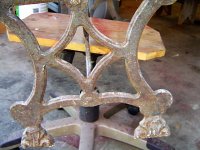
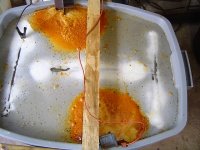
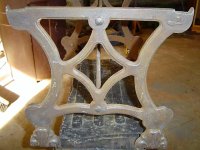
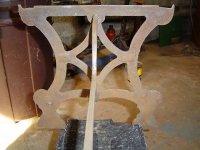
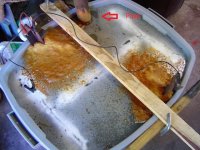
Everybody I know, who has a tractor or machinery has encountered RUST. But what I'm thinking about, are those pieces, which are frozen together or pretty nasty for refinishing. This weekend, I decided to try "electrolysis" for removing rust. You can find YouTube videos on the process. It's cheap, not much labor and effective. For my experiment, I selected a small cast iron table base, which was pretty nasty, but cleaned up good. The process, involves water, washing soda, an anode rod (or 2) and a battery charger. This particular item and condition took about 24 hours of "cooking". I pulled the piece after about 18 hours, but put it back in the bath for about another 4 hours. I cleaned off the anode rods for the 2nd bath.
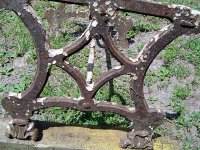
DSC00002.JPG DSC00003.JPG DSC00005.JPG DSC00006.JPG DSC00007.JPG DSC00009.JPG DSC00010.JPG DSC00012.JPG DSC00013.JPG DSC00014.JPG
 
Last edited:
/ Removing Rust
  • Thread Starter
#2  
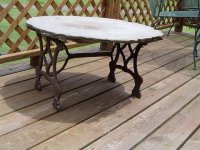
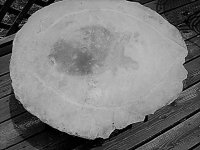
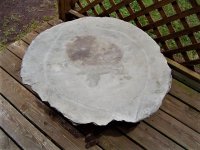
I'm not really sure, what to do with the table base. I thought, maybe, I'd place my "lye stone" on it. But, I certainly don't want to have to move it very often ... it's not like slinging an aluminum lawn chair around!

table1.JPG table2.JPG table3.JPG
 
/ Removing Rust #3  
I've watched some of those videos and it's interesting. Your cast iron table base would be a great use for this process. I guess if you wanted to restore other metal objects such as weather vanes or old collectible toys it would be practical but I doubt I could find a vat large enough for my truck. :laughing: maybe put it in a swimming pool. Good job on the table base.

Don't see a lot of Lye Stones anymore. In the pictures the drain groove is visible are there any smaller grooves in the center or have they gone away. Is yours granite.
 
/ Removing Rust
  • Thread Starter
#4  
Don't see a lot of Lye Stones anymore. In the pictures the drain groove is visible are there any smaller grooves in the center or have they gone away. Is yours granite.

Thanks, yeah, it turned out good. No "small grooves". It's not granite, ... I'm guessing, just a piece of grey stone found locally.
 
/ Removing Rust #5  
Definitely a piece of history. I just read the link you posted and enjoyed my history lesson for the day. I know your post was about "electrolysis" but the Lye Stone stole the show. Thanks for posting it.
 
/ Removing Rust #6  
I use electrolysis a lot. I've cleaned anything from metal tubing, to garden tractor attachments. For me, it's the best way to do it.

And as for a large enough vat for your pickup, I've seen pictures, and videos of guys who have done complete care frames. They build a frame out of wood, then line with black plastic, and fill with water. I've got a large 100 gallon water trough I use for most of my projects. And one of those video's may have been mine, while cleaning some of the tubing.
 
/ Removing Rust #7  
You all have convinced me that this really does work so I'm going to give it a try. I appreciate the ideas for larger parts as a working hobby I repair farm equipment or junk. If I wanted to paint a plow that might be a better way to remove the rust. Most of junk I repair is to be put back in the ground so not a lot of painting is ever done that's the reason I've never been serious about this process.
 
/ Removing Rust
  • Thread Starter
#8  
You all have convinced me that this really does work so I'm going to give it a try.

I'd say, it's "a fun, interesting and useful process". I've had and seen a number of frozen shafts and gears, etc., which would have benefited from the process. ... And, I can't think of hardly, anything, I like less than sandblasting. Also, with a frozen gear on a shaft, the sandblasting wouldn't do much good, where the electrolysis might work.
 
/ Removing Rust #9  
I've read along the way, that water temp should be 50コ, or warmer for best results. And, DO NOT do this inside, as the process emits Hydrogen gas. Think Hindenburg... And, do not use stainless steel as the anode, as it also produces a nasty gas.

The last couple of times, I've used my old cheapie Century AC/DC welder on the lowest setting. Only because I didn't want to take a chance on ruining my good battery charger, as the old one I used, finally bit the dust. Being the lowest setting is 20 amps, it does some serious bubbling. Also read anything above 3-5 amps, is a waste of heat & energy. So be it, it works great...

Here is a short video of me doing some tubing in my old water trough. Tough to see the bubbles, until I zoom in. Rust removal 001 - YouTube

And, a picture of before, after treatment, and after polishing off with a cup brush, some light steel tubing I did. The great thing, unlike chemicals (vinegar, etc.) that will eat metal, this only affects the rust.
 

Attachments

  • Rust removal.jpg
    Rust removal.jpg
    1 MB · Views: 164
/ Removing Rust #10  
As soon as some of the other projects are finished I'll play around with this. Looks like an interesting project because I have lots of junk pieces I need turned into jewels. :) The anode (sacrificial) metal, does it eventually become unusable? I'll have to read up and watch more video's before I start because my tinkering has led to stuff blowing up more than once. :eek:
 
/ Removing Rust
  • Thread Starter
#11  
There is one aspect of my project, which i don't understand. I started with a 2" black pipe for the anode. While it worked, it didn't seem to be as effective as anodes of angle iron. At one point, I had the pipe and 2 angle irons in the bath and the pipe drew very little rust, as compared to the angle iron anodes. ??

DSC00007.JPG

The anodes can be cleaned off and reused.
 
/ Removing Rust #12  
Pipe, possibly because it was galvanized, or black pipe, because seems they have some sort of coating. I don't know if that makes a difference. Angle iron is bare surface, and maybe more sq. inches of area to attract..??
 
/ Removing Rust #13  
Does this process leave a black coating when it's finished? Seems like I tried it a long time ago and it did that. Thanks.
 
/ Removing Rust
  • Thread Starter
#14  
Does this process leave a black coating when it's finished? Seems like I tried it a long time ago and it did that. Thanks.

I wouldn't say "black coating" (but, maybe), but possibly black dust, which seems to brush off with wire brush.
 
/ Removing Rust #15  
There is one aspect of my project, which i don't understand. I started with a 2" black pipe for the anode. While it worked, it didn't seem to be as effective as anodes of angle iron. At one point, I had the pipe and 2 angle irons in the bath and the pipe drew very little rust, as compared to the angle iron anodes. ??

View attachment 515166

The anodes can be cleaned off and reused.

I don't see it, so I gotta ask... is there a wire going to the pipe? :laughing:

Anyhow, from what I've read and the several times I've done it, the electrolysis is kind of line of sight and distance sensitive. The closest anode to the work piece gets the most current and the most "action". Also, as others have mentioned, the composition of the metals in the angle might not be the same as the pipe and that can also have an effect.

From what I've read, rebar is a good sacrificial anode. I'm going to use that the next time I do it.

To date, the largest items I have done are the iron handrails for our front and back porch steps. They are about 5 steps high by about 6' long. I made a shallow pool out of 2X12's slightly larger than the railings, then lined it with thick plastic sheet. I set the rails on risers and used several pieces of angle iron for the anodes. Hooked it all up to the arc welder and it was done overnight. Repeated for the other railing. Worked great! :thumbsup:
 
/ Removing Rust #16  
MossRoad what amperage did you set the welder. Never mind I just realized my old buzz box is AC only. I'm assuming it would need to be DC. So IF I were using a DC welder do you set it for the lowest amperage?
 
/ Removing Rust #17  
I think the lowest setting on my old Century AC/DC is 20 amps.
 
/ Removing Rust #18  
If you only have an AC welder you can put a rectifier diode in one lead to get DC. This also works great for welding thin metal with an AC welder that doesn't go low enough amps. It cuts the amps in half. I've welded 20 gauge with my 180A AC welder on 60A and a diode.
 
/ Removing Rust #19  
Bigdeano, you got specs and a source for a suitable rectumfinder?
 
/ Removing Rust #20  
Bigdeano, you got specs and a source for a suitable rectumfinder?

I just used one I had laying around. It was probably rated around 200A at 200V. It isn't critical. Try Digikey or Ebay maybe. You don't want a bridge rectifier, just a single diode.
 

Marketplace Items

New/Unused Receiver Hitch Ripper (A65583)
New/Unused...
2018 CATERPILLAR TL1255D TELESCOPIC FORKLIFT (A62129)
2018 CATERPILLAR...
2021 CATERPILLAR 326 LONG REACH EXCAVATOR (A65053)
2021 CATERPILLAR...
Wolverine Brush Cutter BC-13-72W Skid Steer Mount  (A62679)
Wolverine Brush...
Heavy Duty Steel Baskets (A65579)
Heavy Duty Steel...
NEW ATS Mini Ride on Skid Steer (A62679)
NEW ATS Mini Ride...
 
Top