Will this be tomorrow's transportation?

Status
Not open for further replies.
/ Will this be tomorrow's transportation? #41  
There is no way to solve the range problem. Too many people are clueless about physics and chemistry and they believe the engineers will solve it soon. There will be no solution or manor improvement unless the Almighty adds some new elements to the periodic table.
Upgrading batteries is like horse breeders attempting large gains in endurance and strength but it is just is not there . The next technological step will have to be as different as the horse is from a JD 4020.

Maybe they'll bring back "the amazing air car". Run on compressed air. No matter how much explanation was given as to whey it was not a viable thing, the idiosts sucked it up.
 
/ Will this be tomorrow's transportation? #42  
I think developments in lighter than air heavy lift has potential for long distance shipping in the future. Instead of venting helium in order to reduce bouyancy the helium is compressed, so issues with the ship being hard to manage on the ground are alleviated. Imagine shipping a container of your household goods cross country in a container while you relax in a stateroom. The ship could make stops, dropping off a tractor to a farmer and picking a container of produce. Emergency supplies, even portable MASH units could be delivered to disaster areas while serious cases could be medivaced out by the same ship. NY to LA could theoretically be done in 56 hours carrying 150 tons.

Freight traines could beat or equal that speed while caryying 10x as much. Okay, the 10x may be a bit much but...
 
/ Will this be tomorrow's transportation? #43  
Tesla doesn't have a prototype semi yet. Pictured (two links) is Nikola Motor's. I share B&D and DF's skepticism. Nuclear will remain set back on its heels until we explore other fuels that have a much lower radiation o'all and no tendency to 'run away' Chernobyl-style.

Thorium has been studied for such, requires excitation, and when that is turned off the reactor cools. I suppose there's more Uranium on the planet than Thorium, but if not it must be scarcity of it, the usual 'inertia', or profit margins that deter further study or application. Nuclear isn't a problem in concept, just the fuel source.

Yeah, a Tesla is fast. Is that what matters most? Remember GM's leased '96 - '99 EV-1 electric? Fast was what it did well, not much else. To say that Tesla is more economical than a factory 'hot rod' we should remember one aspect of powerplant specialization. All too often that $$ saved on fuel goes into the carmaker's pocket. :rolleyes: (Chevy Volt, report!)

btw, my brother bought his '12 Jetta wagon with the TDI option (yeah, that). Now the company is offering peanuts for a buyback ... just as he's about to break even on option cost vs economy ... at >80k mi.
 
/ Will this be tomorrow's transportation? #44  
Maybe they'll bring back "the amazing air car". Run on compressed air. No matter how much explanation was given as to whey it was not a viable thing, the idiosts sucked it up.


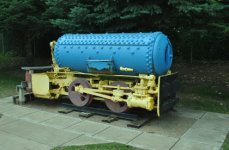
When we were out in Rapid City, SD, we stopped by this little park called Story Book Park. While walking around in there, we came across this...

bhills41.JPG

Its a compressed air locomotive. They used them in coal mines. They could run for several hours. Only problem was it took hours to charge it up.
 
/ Will this be tomorrow's transportation? #45  
We already produce enough oil in the US to not need foreign sources anymore and have a lot more available that isn't currently cost effective to produce. The primary reason we import oil isn't that we don't have enough, it's that our refineries are setup to refine their heavier crude. EPA and other government regulations make it cheaper to continue to import and refine that oil than it would be to refit the refineries for US produced oil. Eliminate the government involvement, or at least make it more reasonable, and that would probably change.

Fuel cells are the future, this battery powered electric vehicle thing is just a middle step. Limited range with a long recharge period isn't going to be acceptable.

You're not talking just Oil though, Solar and Hydro are great power sources and they don't require extra energy to refine the base product into something usable.

With respect to fuel cells a couple people have already touched on the issues around them. It's *really* hard to store hydrogen. Most commercial installations have hydrogen sensors because just about every tank leaks and if you don't have proper venting it collects and then explodes under the smallest spark.

Second as they age they get less efficient with the same amount of fuel. You'll pay the same for less range where as with batteries capacity lowers so you pay less. It's also not clear how the aging process works over the lifetime of the cell. We've got 43k miles so far on our EV and I've got less than 1% degradation in rage.

Lastly, the energy required to create and use hydrogen is really poor compared to battery EVs. This( Why a hydrogen economy doesn't make sense ) breaks it down. I think fuel cells have a place in high energy density applications like planes but probably not in a car.

In 2 years of ownership charge times have never been an issue, we leave the house will a full charge and use DCFC for a 30 min charge to 75%(300A @ 400VDC straight to the battery pack!).
 
/ Will this be tomorrow's transportation? #46  
Freight traines could beat or equal that speed while caryying 10x as much. Okay, the 10x may be a bit much but...

Your guess was too conservative....

150 tons for the airship.....

A Duluth, Missabe & Iron Range ore train pulled by a single 2-8-8-4 "Yellowstone" steam locomotive which totaled over 19,000 tons.... One steam engine pulled a train with 19,000 tons! That's 126X the amount of the airship.

Many main routes in the western US allow cars with gross weights up to 157.5 tons PER CAR! Many of those trains are 100 cars long or longer. That's 100 times as much.

:)


/ Will this be tomorrow's transportation? #47  
/ Will this be tomorrow's transportation? #48  
Tesla doesn't have a prototype semi yet. Pictured (two links) is Nikola Motor's. I share B&D and DF's skepticism. Nuclear will remain set back on its heels until we explore other fuels that have a much lower radiation o'all and no tendency to 'run away' Chernobyl-style.

Thorium has been studied for such, requires excitation, and when that is turned off the reactor cools. I suppose there's more Uranium on the planet than Thorium, but if not it must be scarcity of it, the usual 'inertia', or profit margins that deter further study or application. Nuclear isn't a problem in concept, just the fuel source.

Yeah, a Tesla is fast. Is that what matters most? Remember GM's leased '96 - '99 EV-1 electric? Fast was what it did well, not much else. To say that Tesla is more economical than a factory 'hot rod' we should remember one aspect of powerplant specialization. All too often that $$ saved on fuel goes into the carmaker's pocket. :rolleyes: (Chevy Volt, report!)

btw, my brother bought his '12 Jetta wagon with the TDI option (yeah, that). Now the company is offering peanuts for a buyback ... just as he's about to break even on option cost vs economy ... at >80k mi.

Actually thorium is more abundant than uranium and we happen to have heaps of the stuff right here in the good ole USA. In fact we have a lot of it stockpiled already. We've actually built LFTR type reactors and they worked great. That was back in the late 60s. As you pointed out it's a throttled reaction so is not like trying to herd wild cats the way light water uranium reactors are. Oh BTW unlike uranium reactors, a thorium fueled LFTR reactor is so inherently safe it needs no containment vessel. There is no viable reason we aren't doing it now. There are no physics problems to overcome, no knotty engineering to develop or conquer, it's real, it's viable, it's proliferation resistant, it can be used to replace the heat source in every existing fossil fuel plant today, it's easily scaled to meet large and small energy demands, it can even be used to consume some of the stockpiles of radioactive wastes from uranium reactors that were currently stuck with. The only things really standing in the way are politics and the existing economic powers. If we don't stop piddling around with this idiotic solar and wind stuff and get busy on something that has real promise, China or some other country is going to get to it first and leave us in the dust. And if they do, that is where we will stay, following not leading.
 
/ Will this be tomorrow's transportation? #49  
/ Will this be tomorrow's transportation? #50  
I wish I could link to the ultra-con anti-green bunch who insisted that if enough wind turbines were erected they would stall the Earth's rotation. :eek:

Of course we know (most of us, anyway ;)) that there will always be more trees than turbines, and that their moving and waving will maintain our existing wind patterns and our planet's 24 hr rotation. :D After I'm dead, who cares? :laughing::laughing:
(... Are we done with wood-gassification internal combustion so soon?? Aww....)

Seriously:

Vvanders, thanks for sharing real experience for those of us who often just listen to each other. There's always two
sides. :)
 
/ Will this be tomorrow's transportation? #51  
Had a chance to ride in the Goodyear blimp a few years back.......went all over LA and flew over the Rose Bowl two days before the game......beautiful on a calm day. You are right......takes a big landing area and a big crew.

Actually these new designs are not unwieldy on the ground like the airships of old where ground lines had to be manhandled or tractored to position the airship. The design allows the ship to move around on a pad of air like a hovercraft.

Here's a vid that explains the COSH (Control of Static Heaviness) technology, in this case the Aeroscraft: AEROSCRAFT World's Most Advanced AIRSHIP First Flight Commercial CARJAM TV 214 - YouTube. The Aeroscraft has internal cargo loading via cables that can winch containers into the hold, even while hovering. They have versions planned that will achieve over 100 MPH, 12,000 ft ceiling and a 500 ton capacity.
 
/ Will this be tomorrow's transportation? #52  
Shoot, why didn't anyone tell me, I want my free liberal arts degree now!

I think one thing important thing that hasn't been considered is reducing our dependency on foreign energy sources. The electric car is perfectly suited for this since you can drive generation from solar, natural gas(which is much cleaner than coal and currently transforming the energy generation industry), etc. Heck, I know more than a few people who run their electric cars 100% from the solar panels on their roof.

In my mind Tesla could be the modern American muscle car. You have a car designed in America, built in the US and growing the number of manufacturing jobs domestically. It's a company that has entered in incredibly difficult market and yet now builds one of the fastest production cars in the world. How can you not love a car that can put down over 1,000hp and is also a great family car(seriously they're incredibly roomy). Yes they had help from the government, but what industry hasn't? All of the things they used were available to other companies and today the ZEV credits/etc make a pretty small portion of Tesla's overall profits.

Sure, battery prices are high now but what many people don't consider is that batteries are a technology, not a resource. When economies of scale kick in they get orders of magnitude cheaper rather than more expensive due to scarcity. Just look at the price of HDTVs over the last 5 years. All of the physical components are readily available, it's the precise manufacturing process that's expensive. Just like the chip in your modern computer starts out as sand just(silicon) same with Li-Ion batteries.

To me they're a marvel of American thinking and engineering. I think that's something we could use more of these days, I'd much rather take that then companies that are moving production out of the US.
Another great point is how Tesla (aka Elon Musk) has driven down the price of batteries. Tesla motors has all but forced the other OEMs to start producing electric vehicles... QUADRUPLING the economic investment in high capacity batteries, and driving down the price per kWh hr by nearly 80% of what it was ten years ago. This has also driven technology to develop smaller/lighter packs as well.

In the next 20yrs, we are likely to see electric energy storage density increase by a whopping 1,000%. Just to give you an idea... that would be the equivalent of advancement we accomplished from the period of the Baghdad battery (around the time the Great Pyramids of Giza were built) to the mid-90s (NiCad rechargeable batteries). That's THOUSANDS of years in advancement in only two decades.

Another valid point is lifespan and renewability. Thanks to all this development, we're looking at carbon/air batteries being a realistic achievement within the next 12yrs. Carbon/air batteries are 100% recyclable... but that won't matter, as they also have lossless charging cycles.... meaning they lose no perceivable capacity over the course of 10,000 charge cycles (a battery that will NEVER need to be replaced in your lifetime). All this, plus they're lighter, AND can be carbon negative... meaning the various oxides of carbon can be removed from our polluted atmosphere and condensed into the material for their construction.

All these people who look at just the gross emissions per mile of electrics don't understand exactly how far reaching the effeciveness really is of all this investment and subsidy.

For decades, we have invested TRILLIONS of dollars into developing the internal combustion engine. The absolute best efficiency to be had from a gasoline engine of today is 50%... and that particular technology isn't viable for passenger cars (yet). The best diesel efficiency is 76%... and that will NEVER be viable for passenger vehicles OR road truck, simply due to the scale required to obtain such efficiency. Basically, we've all but hit a terminal plateau.

Even if you could devise a way to directly catalyze diesel into free electron energy... the gross yield would only be 80%. Even at that, we've already reached a point where any amount of progress would be miniscule at best, in terms of return over investment.

Electricity has made HUGE gains in capacity, efficiency, technology, density, and clean collection. One such promising technology is nano-carbon conversion. A team at Arizona State University has already developed a carbon nanostructure, that when exposed to light and water yields a LOSSLESS conversion of the solar energy DIRECTLY to hydrogen gas. This technology alone would make the solar capacity of an average home equal to a 250,000 square foot factory covered in our best current solar panels.

Want to know what funded nearly 10% of that development? Elon Musk (aka Tesla Motors, aka US tax dollars, aka PEOPLE BIYING ELECTRIC CARS).
 
/ Will this be tomorrow's transportation? #53  
Actually these new designs are not unwieldy on the ground like the airships of old where ground lines had to be manhandled or tractored to position the airship. The design allows the ship to move around on a pad of air like a hovercraft.

Here's a vid that explains the COSH (Control of Static Heaviness) technology, in this case the Aeroscraft: AEROSCRAFT World's Most Advanced AIRSHIP First Flight Commercial CARJAM TV 214 - YouTube. The Aeroscraft has internal cargo loading via cables that can winch containers into the hold, even while hovering. They have versions planned that will achieve over 100 MPH, 12,000 ft ceiling and a 500 ton capacity.

Very interesting......you're right......much different then the Goodyear Blimp I rode in back in the 80's. Back then.....my first scheduled ride was cancelled due to wind.....that blimp was spinning around like a teatherball. The hovercraft idea would be a big plus.
 
/ Will this be tomorrow's transportation? #54  
I wish I could link to the ultra-con anti-green bunch who insisted that if enough wind turbines were erected they would stall the Earth's rotation. :eek:

Of course we know (most of us, anyway ;)) that there will always be more trees than turbines, and that their moving and waving will maintain our existing wind patterns and our planet's 24 hr rotation. :D After I'm dead, who cares? :laughing::laughing:
(... Are we done with wood-gassification internal combustion so soon?? Aww....)

Seriously:

Vvanders, thanks for sharing real experience for those of us who often just listen to each other. There's always two
sides. :)

I'm just glad some people have an open mind. A lot of the issues around EVs devolves into politics rapidly. I think there's advantages on both sides that most people don't consider. There's no reason that is has to be exclusive and I fully understand there are some applications where EVs don't make sense.

Besides the engineer in me can't help but geek over some aspects of them. The efficiency gains alone are incredible and the thought of dumping 1200 amps into your powertrain in a fraction of a second, uf da!
 
/ Will this be tomorrow's transportation?
  • Thread Starter
#55  
I'm just glad some people have an open mind. A lot of the issues around EVs devolves into politics rapidly. I think there's advantages on both sides that most people don't consider. There's no reason that is has to be exclusive and I fully understand there are some applications where EVs don't make sense.

Besides the engineer in me can't help but geek over some aspects of them. The efficiency gains alone are incredible and the thought of dumping 1200 amps into your powertrain in a fraction of a second, uf da!

Perhaps change and alternates are just a fixture of today's world. Technology seems to be increasing at an almost exponential rate these days making so much possible.
 
/ Will this be tomorrow's transportation? #56  
'Technology' is like 'enlightenment', an intangible, so like many things it has its followers, and like fine art there are those who would have more of it if they could afford it. There are also those of us with diesel tractors, manual metalworking machines, and various hand-powered tools who are getting along fine with 20th Century stuff and saving today's bucks vs counting on 'saving' the checks we don't yet have in hand to cash. Just as with so many things we buy these days, the way to 'save' money begins with spending it. :rolleyes:

My favorite pitch is how consumers will automatically 'save money' with 'technology' ... after they wait for the price to come down, and after subsidies and profits are accounted for. Just like enlightenment it's something to look forward to getting someday.

"You have to believe", and it'd help if you're still young enough to have several decades to 'support the economy' and turn your labors over to gadgetry. When it's about 'technology' we're just potential customers who will reward someone else's work, while dreaming of having our chores done by remote control.

Personally, I'd like to see an automatic set-preparer and trap-setter. I don't have a heated cab on my basket, and it's darn cold to run my line .. just when I need more furs to keep warm. :D
 
/ Will this be tomorrow's transportation? #57  
"one thing important thing that hasn't been considered is reducing our dependency on foreign energy sources" this would be a blatantly uniformed statement. How much do you think we depend on "foreign" sources and what's your definition of "foreign?" If its Canada, then your close to correct. Our electricity production in 2015 broke out like: Coal: 33% Natural gas = 33% Nuclear = 20% Hydropower = 6% Other renewables = 7% Biomass = 1.6% Geothermal = 0.4% Solar = 0.6% Wind = 4.7% Petroleum = 1% Other gases = <1%. Coal natural gas, nuclear and hydro aren't foreign, unless again Canada is foreign. That makes over 75% of our electrical production domestic. For transportation, oil specifically, less than 20% comes form Persian gulf countries, Africa and tiny countries we've never heard of. The rest comes from the US (~40%) South America (~20%) and again Canada (~15%). ll give you that the south American countries are foreign so why do we buy it from them instead of getting it here? Cause its cheaper that way. Its the make or buy decision. If its cheaper to buy it than do it yourself, you buy it. It has strategic advantage to leaving our natural resource in the ground and buying the foreign stuff at rock bottom prices. wouldn't u rather have a potential future enemy without an oil reserve? Could we cut off foreign inbound oil today? Yep. Would that benefit us economically or strategically? Nope. The foreign energy fear is a scare tactic used by the media, in the words of Chuck D: don't believe the hype.
 
/ Will this be tomorrow's transportation? #58  
Another great point is how Tesla (aka Elon Musk) has driven down the price of batteries. Tesla motors has all but forced the other OEMs to start producing electric vehicles... QUADRUPLING the economic investment in high capacity batteries, and driving down the price per kWh hr by nearly 80% of what it was ten years ago. This has also driven technology to develop smaller/lighter packs as well.

In the next 20yrs, we are likely to see electric energy storage density increase by a whopping 1,000%. Just to give you an idea... that would be the equivalent of advancement we accomplished from the period of the Baghdad battery (around the time the Great Pyramids of Giza were built) to the mid-90s (NiCad rechargeable batteries). That's THOUSANDS of years in advancement in only two decades.

Another valid point is lifespan and renewability. Thanks to all this development, we're looking at carbon/air batteries being a realistic achievement within the next 12yrs. Carbon/air batteries are 100% recyclable... but that won't matter, as they also have lossless charging cycles.... meaning they lose no perceivable capacity over the course of 10,000 charge cycles (a battery that will NEVER need to be replaced in your lifetime). All this, plus they're lighter, AND can be carbon negative... meaning the various oxides of carbon can be removed from our polluted atmosphere and condensed into the material for their construction.

All these people who look at just the gross emissions per mile of electrics don't understand exactly how far reaching the effeciveness really is of all this investment and subsidy.

For decades, we have invested TRILLIONS of dollars into developing the internal combustion engine. The absolute best efficiency to be had from a gasoline engine of today is 50%... and that particular technology isn't viable for passenger cars (yet). The best diesel efficiency is 76%... and that will NEVER be viable for passenger vehicles OR road truck, simply due to the scale required to obtain such efficiency. Basically, we've all but hit a terminal plateau.

Even if you could devise a way to directly catalyze diesel into free electron energy... the gross yield would only be 80%. Even at that, we've already reached a point where any amount of progress would be miniscule at best, in terms of return over investment.

Electricity has made HUGE gains in capacity, efficiency, technology, density, and clean collection. One such promising technology is nano-carbon conversion. A team at Arizona State University has already developed a carbon nanostructure, that when exposed to light and water yields a LOSSLESS conversion of the solar energy DIRECTLY to hydrogen gas. This technology alone would make the solar capacity of an average home equal to a 250,000 square foot factory covered in our best current solar panels.

Want to know what funded nearly 10% of that development? Elon Musk (aka Tesla Motors, aka US tax dollars, aka PEOPLE BIYING ELECTRIC CARS).

The problem with electrics isn't the electrics but where the power to run them comes from. Today that is mostly fossil fueled plants that aren't any more efficient than the internal combustion engines that the electric motors are supposed to replace. Then you have to add in all the losses from transmission and energy conversion. Every time you change energy from one form to another you loose something to conversion loss. In the end electric cars are actually environmental disasters and it's dictated by physics which can't be overcome. Before electrics can make any sense at all you have to begin with something that makes sense. You have to begin at the beginning, not at the end of the chain. Once you have a real source of cheap, clean energy many more things are made possible but not until then.
 
/ Will this be tomorrow's transportation? #59  
The problem with electrics isn't the electrics but where the power to run them comes from. Today that is mostly fossil fueled plants that aren't any more efficient than the internal combustion engines that the electric motors are supposed to replace. Then you have to add in all the losses from transmission and energy conversion. Every time you change energy from one form to another you loose something to conversion loss. In the end electric cars are actually environmental disasters and it's dictated by physics which can't be overcome. Before electrics can make any sense at all you have to begin with something that makes sense. You have to begin at the beginning, not at the end of the chain. Once you have a real source of cheap, clean energy many more things are made possible but not until then.
Carbon sequestered plants are now emitting 90% less airborne pollutants... although their carbon emissions are hiegher in ratio to the net yield per kW, the pollutants are contained, managed, and have shown promise in alternative uses.

The carbon "cake" byproduct of sequestration has shown a great deal of promise in the form of alternative building material, AND synthesized soil.

Things WILL get better for electricity and electric vehicles... but not if we continue to depend on privatized/corporate research without the benefit of retail product funding.

Unless you can somehow devise a way to crack the hydrocarbon molecules of gas/diesel immediately before combustion, isolate/store/repurpose the carbon byproduct, and convince people to buy three to four times the gallons of fuel to net the same power... gas/diesel is not going to see any significant progress without expensive, exotic, and EXPENSIVE materials.

We have to push electric to further development, as there is MUCH more headway to be made in both production and application efficiency.

I agree with your point. Even hybrids are not the environmentally friendly alternatives they are made out to be...

...but continued advancement where it can be made is FAR more viable that throwing TRILLIONS of dollars toward R&D for gas/diesel technology... where progress is sparce, negligible, and and decreasingly available.

Sure, advanced efficiency in gas/diesel technologies are available... but they all have tradeoffs that simply aren't viable. Most engines that show any reasonable improvement suffer from one of four problems: 1- EXPENSIVE MATERIALS (requiring materials such as ceramics to combat wear/heat/etc.) 2- POOR RESPONSE (many new gas diesel technologies can be more powerful, compact, and efficient... but their throttle response is too slow for transport applications) 3- WEIGHT (the most advanced diesel engine on the market today, does so by being HUGE... as in, nearly three football fields huge... and it's only 76-78% efficient at full load) 4- ANCILLARY DEPENDENCY (more efficient power in the same packaging requires more cooling... which translates DIRECTLY to compromised aerodynamics)

Say what you will... but with our population growth rate and addiction to power (to the point that a country's potential is baselined by their power consumption per capita).... we MUST start developing other means of technology. Without public retail market funding, it'll NEVER happen in time.

If you don't want to see a systematic, world encompassing reduction in population, that is.
 
/ Will this be tomorrow's transportation? #60  
Oh, just heard on the news that the American avg life expectancy went down, the population reduction is starting...
If you add in the Baby Boomer end of life reduction, we wont need to do a thing here soon.
 
Status
Not open for further replies.

Marketplace Items

2007 Freightliner FLD120 (A62679)
2007 Freightliner...
COPPER RIVER 10 TON PINTLE HITCH TRAILER (A63291)
COPPER RIVER 10...
2022 EZ-GO ELITE ELECTRIC GOLF CART (A63276)
2022 EZ-GO ELITE...
2012 Peterbilt 337 G and H 8000 Container Handler Truck (A64194)
2012 Peterbilt 337...
HOOPER 95" X 30' TRI-AXLE GOOSENECK TRAILER (A63291)
HOOPER 95" X 30'...
2017 Forest River Rockwood Freedom Camping S/A Trailer (A61574)
2017 Forest River...
 
Top