Calculating FEL Lift Capacity

   / Calculating FEL Lift Capacity #1  

npalen

Elite Member
Joined
Nov 17, 2009
Messages
3,601
Location
Beloit, KS
Tractor
Kubota B9200 HSTD and Mahindra 3015
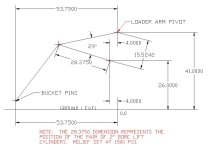
I was curious what the relief valve setting should be on my Kubota BF350 front end loader (FEL). So I did the attached layout based on measurements taken.

I come up with a theoretical lift force at the bucket pins (excluding friction and weight of loader itself) of 2,720 lbs.

The owners manual for the Kubota B9200 shows a loader lift capacity of 838 pounds at 1636 psi relief setting. (Discovered this data after using estimated 1500 psi)

So I'm needing help understanding where the discrepancy is occurring between the 2,720 pounds and 838 pounds.

Here are my calculations: 2" cylinder bore equals 3.14 sq. in. piston area times two cylinders = 6.28
1500 psi times 6.28 =9420 pounds force
9420 lbs. times 15.524" lever arm = 146,236 in. lbs torque about loader arm pivot point.
146,236 divided by 53.750 lever arm from bucket pins to loader arm pivot pins = 2720 lift force at bucket pins

Anyone care to check the math for me?
 

Attachments

  • BF-350-1.JPG
    BF-350-1.JPG
    56.8 KB · Views: 1,712
   / Calculating FEL Lift Capacity #2  
Not sure I'm following exactly what you did....

What is 15.514"? Is that the distance from the loader arm pin to the loader cylinder attachment? If so, I don't see where you accounted for the direction of the force. The cylinder isn't at the tangent to the loader arm arc. To calculate torque on the loader arm, you need to know what portion of the cylinder force is acting at the tangent to the loader arm arc. This will change for every loader position. So check it at full height to match with your spec. But then you will only have torque and not lift so it will only be right when the loader arc tangent is perpendicular to the ground.

An easier way to get a rough estimate of the average loader force is take the loader cylinder stroke divided by the loader lift height (adding in any loader travel below ground level). For example, if you're cylinder has a 1 foot stroke and bucket pins can travel six vertical feet you have 1/6. Multiply 1/6 by the 9420 pounds of force, subtract out estimated loader / bucket weight at the pins and it will give you an estimated average lift. The estimated average will be less than your lift at the bottom of the range and more than your full height lift. It might approximate what you can load from a trailer / truck but not really because remember it is at the bucket pins and the load will be out further. But you can do the math for that too.

If you want to know lift fairly accurately at a given position without doing all the geometry, Just measure loader vertical movement over a short distance and measure cylinder movement over same distance and multiply cylinder force by that ratio.

coincidentally, last night I just discovered that the curl spec in the Kioti literature for my KL402 loader isn't even close to being right. Then I noticed other specs in other places, some that seemed closer to reality. I haven't taken all the measurements and done all the math yet but will post if I ever get around to finishing it.
 
   / Calculating FEL Lift Capacity
  • Thread Starter
#3  
Thanks for the feedback! Some interesting bits of information to ponder. Using the formula of cylinder travel divided by lift height times cylinder force gives 2,088 lbs in my case. ((1.33/6)*9420)

The 15.514" that you ask about is the distance from the loader arm pivot point perpendicular to the cylinder(s) line of force. I used that distance to calculate the torque about the loader arm pivot which is the 146,236 in. lb.

The 53.750" dimension is the distance from the loader arm pivot to the vertical line above the bucket pins. This 53.750" divided into 146,236 in. lbs. gives the theoretical vertical lift force at ground level of 2,720 lbs. at the bucket pins. This is obviously not taking into account friction and the weight of the loader etc but it's much more than Kubota's spec of roughly 800 lbs. Incidentally the loader model of BF350 would suggest a lift capacity of 350 KG which is 770 LBS.

Incidentally, the main relief valve for this tractor is set at approximately 2500 PSI but with the loader relief set at about 1600 PSI, the rear remote valve has much less PSI output than if the remote valve was "in line" ahead of the loader valve. (Using power beyond to feed the 3PH position control) Not sure I need more PSI at the remote (three spools) but might consider changing the plumbing.
 
   / Calculating FEL Lift Capacity #4  
Or just stack sacks of concrete in the bucket to get a real world number.
 
   / Calculating FEL Lift Capacity #5  
I come up with about 800 psi on the cylinder at 832 pound load, giving the actual FEL a weight of zero.

But you are assuming that the limitation is purely hydraulic. It is likely due to lifting the rear end off the ground
 
   / Calculating FEL Lift Capacity #6  
Effective force of a cylinder working at an angle to direction of the load travel :
F = T x sine A
T = total cylinder force in pounds
F = Force acting to move the load
A = angle between the cylinder axis and load direction.

Like Gladehound stated with FEL's the angle is constantly changing but try and pick worst case for a FEL.

Example: 2" bore with 25 degree angle @2500 PSI = 3319 lbs force trying to move the load or approximate 42% of the total cylinder force.

Also have to figure in the lever ratio of distance from FEL arm pivot to cylinder connection Vs bucket pivot to cylinder mount on FEL arm.
 
   / Calculating FEL Lift Capacity
  • Thread Starter
#7  
I come up with about 800 psi on the cylinder at 832 pound load, giving the actual FEL a weight of zero.

But you are assuming that the limitation is purely hydraulic. It is likely due to lifting the rear end off the ground

How did you come up with the psi and load? Just curious.
 
   / Calculating FEL Lift Capacity #8  
Forgot to account for the angle of the cylinder. If the cylinder were mounted 90 degrees to the loader arm, then 100% of the cylinders force would be used for lift. But it is not. its mounted on a 29 degree angle. You have to take the Sine of the angle, and multiply that by the cylinders force. Whats left is the vertical component.

Then you have to account for the changing angle. The largest angle is with the loader at its lowest. Thus a loader has the most lift force at ground level usually called breakout force when reading specs. ITs usually twice as high as when fully raised. +

So, Raise the FEL to max height.

Re-measure the angle of the hydraulic cylinder. Re-calculate the math. The new number would be the lift to max height.
 
   / Calculating FEL Lift Capacity #10  
I was curious what the relief valve setting should be on my Kubota BF350 front end loader (FEL). So I did the attached layout based on measurements taken.

I come up with a theoretical lift force at the bucket pins (excluding friction and weight of loader itself) of 2,720 lbs.

The owners manual for the Kubota B9200 shows a loader lift capacity of 838 pounds at 1636 psi relief setting. (Discovered this data after using estimated 1500 psi)

So I'm needing help understanding where the discrepancy is occurring between the 2,720 pounds and 838 pounds.

Here are my calculations: 2" cylinder bore equals 3.14 sq. in. piston area times two cylinders = 6.28
1500 psi times 6.28 =9420 pounds force
9420 lbs. times 15.524" lever arm = 146,236 in. lbs torque about loader arm pivot point.
146,236 divided by 53.750 lever arm from bucket pins to loader arm pivot pins = 2720 lift force at bucket pins

Anyone care to check the math for me?

This is probably a dumb question - but do you actually have the spec on the I.D. of the lift cylinder? Or does it just look like ~2" from the outside?
 
   / Calculating FEL Lift Capacity
  • Thread Starter
#11  
This is probably a dumb question - but do you actually have the spec on the I.D. of the lift cylinder? Or does it just look like ~2" from the outside?

The outside diameter of the cylinder is 2.25" and the wall thickness is 0.125" leaving and inside diameter or bore of 2.00"
Was able to actually caliper the wall thickness at the rod end of the cylinder as the gland is recessed a bit.
 
   / Calculating FEL Lift Capacity
  • Thread Starter
#12  
Forgot to account for the angle of the cylinder. If the cylinder were mounted 90 degrees to the loader arm, then 100% of the cylinders force would be used for lift. But it is not. its mounted on a 29 degree angle. You have to take the Sine of the angle, and multiply that by the cylinders force. Whats left is the vertical component.

Then you have to account for the changing angle. The largest angle is with the loader at its lowest. Thus a loader has the most lift force at ground level usually called breakout force when reading specs. ITs usually twice as high as when fully raised. +

So, Raise the FEL to max height.

Re-measure the angle of the hydraulic cylinder. Re-calculate the math. The new number would be the lift to max height.

The "angle of the cylinder" is irrelevant when using "moments about a point" method of calculating forces. It's a simple matter of determining the torque that the cylinder force applies about the loader arm pivot point. (146,286 in. lb. based on 9420 lbs applied at 15.524" from the pivot in post #1 above) .

This torque can then be applied to any point about the pivot which, in this case, is applied vertically to the bucket pins which are 53.750" from the loader arm pivot. It is applied vertically due to gravity being applied against the weight being lifted in this case.

The decimal point is overkill in the numbers above. It's simply the measurement output from CAD. It can be set to show any number of decimal points including zero.

With that said, I do realize that some people use trigonometry (sine, cosine and tangent) to calculate forces based on angles.
 
   / Calculating FEL Lift Capacity #13  
A couple of things:

- Your math is correct, you are correct about breaking it into moments vice doing the trig.
- You are neglecting a lot. Those cylinders will take 50lbs or more to overcome the friction if they are fresh I'd guess. The weight of the loader and bucket/forks is also directly off the number you got. Not to mention any friction in the pins/pivots.
- Finally, lift capacity is often stated at a much more usable height then what you've measured/drawn. You are closer to the spec of breakout force, which is often much higher. Raise your bucket to 3/4 of it's working height and re-measure. Your cylinder angle (or the moment arm that is currently ~15") will be greatly reduced, changing your equation and lowering your result.
 
   / Calculating FEL Lift Capacity #14  
The loader lift is a lot higher at ground level. The 8xx pound rating is to full height. Subtract the weight of the loader and add in some margin of error and I'd say you could lift the number you came up with. Id be a bigger fan of just adding a measurable weight to the bucket until you can't lift it.
 
   / Calculating FEL Lift Capacity #15  
All this time I was looking at your diagram as if the loader was in the full height position because that is the rating you were comparing against.

I agree with all those above that say your numbers look correct and I see absolutely no discrepancy between your numbers and the rating that you have because they are not at the same loader position.

I previously had a similar size loader and the full height rating at the pin was 850 pounds and the ground level rating at the pin was 1650 pounds. So big difference depending on loader position.
 
   / Calculating FEL Lift Capacity #16  
The "angle of the cylinder" is irrelevant when using "moments about a point" method of calculating forces. It's a simple matter of determining the torque that the cylinder force applies about the loader arm pivot point. (146,286 in. lb. based on 9420 lbs applied at 15.524" from the pivot in post #1 above) .


Technically, it doesn't matter if you take the angle of the forces into account *or* you compute the effective perpendicular lever arm to the angled force -- either way you are working some trig in there if the linkage dimensions are based off the actual loader mechanism.

When computing a moment, in the end you are always doing the equivalent of a vector cross product, and r x f = |r|*|f|*sin(angle). Doesn't matter how you think about lumping in that angle, it's going to be there just the same.
 
   / Calculating FEL Lift Capacity #17  
Sorry, I am a bit rusty at calculating moments about a point. Not the way I normally calculate these kinds of things, but as they say, "there is more than one way to skin a cat".

But something still don't seem right.

Your 15.4xxx measurement doesn't appear to account for the angle of the cylinder. As those two points are fixed, and no matter how high the loader is raised....those two points don't change.

But the angle of the cylinder, and the force it can apply to the loader arm absolutely do change.

And I really doubt the cylinder only has a 1/8" wall. That part you measured is likely turned down smaller than the bore and threaded for the gland cap. I would be willing to bet the cylinders are a standard 45 mm cylinder. Pretty common for Kubota. That's 1.77", and gives you closer to a 1/4" wall thickness. Which is alot more realistic
 
   / Calculating FEL Lift Capacity
  • Thread Starter
#18  
Here is the drawing showing the geometry at lift height of 72" which is about maximum lift height for this particular FEL:

The 1618 pounds of theoretical lift force at this height compares to the 2,720 pounds at ground level.

I agree that 3/16" to 1/4" would be considered normal wall thickness for a cylinder tube. Using 3/16" wall in lieu of 1/8" wall would reduce the cylinder force by about 12-15% going from 2" bore to 1 7/8" bore.

The 15.4 (15.5 actually) measurement is a bit misleading as it is the distance from arm pivot perpendicular to the cylinder center line not the distance between the two pivot points.

The posts above make good points regarding friction etc. Taking all these factors into account including the smaller cylinder bore diameter probably makes the BF350 a reasonable model number.
 

Attachments

  • BF-350-2.JPG
    BF-350-2.JPG
    41.1 KB · Views: 212
   / Calculating FEL Lift Capacity #19  
That second drawing cleared things up for me as to how you were factoring in that cylinder angle. That initial 15.xxx inch measurement was perpendicular to the cylinder. At ground level, it looked as if you just took the actual measurement. So you are I deed compensating for the cylinder angle as the loader lifts.

I still believe you have 45mm cylinders. 50mm wouldn't allow enough wall thickness, and 45mm is the next smaller nominal size in metric, which is what Kubota uses.

For that matter, even sae, it wouldnt be something odd like 1-7/8. It's gonna be a nominal size, like 1-3/4".

Second.....both Kubota loaders that I have owned, and had gauges on, it takes about 600psi JUST to lift the loader frame and empty bucket. So that only gives you about 1000psi to lift your load.

So figure it with 1.77" cylinders and 1000psi and I'd bet you would be right on the mark.

I think you have just come to the realization that many on here overlook....and that is that a loader is alot stronger down low. Too many people only look at lift spec to max height, and overlook the breakout force rating. Which is what it can lift down low like digging out of a pile of dirt. Many people often mis-understand this and claim there loader is "underrated". When in fact people are just looking at the wrong ratings for what they are doing.
 
   / Calculating FEL Lift Capacity
  • Thread Starter
#20  
I believe you are correct on the metric size cylinders with 45mm probably spot on.
Here's one of many FEL spec charts showing the various nomenclature:
Farm King - Front-End Loaders
The "breakout force" seams to be misunderstood in some cases.
 

Tractor & Equipment Auctions

2015 Doosan 750 CFM Mobile Air Compressor (A59228)
2015 Doosan 750...
2016 KOMATSU D65PX-18 CRAWLER DOZER (A60429)
2016 KOMATSU...
UNUSED FUTURE 16" HYD AUGER (A52706)
UNUSED FUTURE 16"...
11" QUICK ATTACH EXCAVATOR BUCKET (A60429)
11" QUICK ATTACH...
2019 KOMATSU D61PXI-24 CRAWLER DOZER (A60429)
2019 KOMATSU...
Freightliner Fuel Truck (A56438)
Freightliner Fuel...
 
Top