Energy storage, cheap and low tech.

/ Energy storage, cheap and low tech. #41  
I'm sorry, my 30kW quote was from an earlier version of the Prius. Here's the latest version.


I found the article that you pulled that screen shot from...

FD Prius Power

If you read it, and look at the diagram, the owner is only running a 1000W inverter from the 12v battery of the Prius to power a small load, not 50,000W.
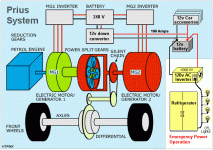
Prius-Backup-Power.GIF
466918d1462071047-energy-storage-cheap-low-tech-prius-backup-power-gif
 
/ Energy storage, cheap and low tech. #42  
/ Energy storage, cheap and low tech. #44  
I found the article that you pulled that screen shot from...

FD Prius Power

If you read it, and look at the diagram, the owner is only running a 1000W inverter from the 12v battery of the Prius to power a small load, not 50,000W.
That does not change the fact that there is net 50KW available from the engine / generator system. Conditioning it for home power is all that remains.
 
/ Energy storage, cheap and low tech. #45  
You don't think it's that efficient or you're concerned with a 14% loss?
I doubt the end to end efficiency claim. Im thinking that the losses are actually 14% for both the up conversion and the down conversion. ie, 86% of energy put in is stored at hilltop - and 86% of that can be gotten back. ... ~74% overall
 
/ Energy storage, cheap and low tech. #46  
Interesting discussion. I don't think I'm going to jump into it, but when discussing this, keep in mind that kW or mW (kilowatts/megawatts) is a measure of power and to compare energy you need to talk about kW-hrs or mW-hrs. If you find something that says 1000 mW of storage, that doesn't mean anything. If it's really 1000 mW-hrs, that means it can provide 100 mW for 10 hours. Articles promoting storage ideas like to give the impression it can back up a plant of a certain capacity when it's really only a fraction of that for an extended period of time.

I thought I had been instructed that a Watt was a unit of power. Just like a gallon is a unit of volume.

And regardless how you slice it, be it a quart a minute for four minutes, or a gallon all at once, the same amount of whatever was being transferred.

So if you have a 1000 milliwatts of energy available, you can take the entire amount in a moment (like discharging a capacitor across low resistance), OR dribble it out at 100mW/hr over 10 hours. It's the same total amount of energy.

So saying you have 1000 mW available describes capacity perfectly, just like a gallon.
Your description is close. 100mW delivered for 10 hours is exactly the same as 1000mW storage available.
I've got a 125 mW memory saving Li-ion battery down on the bench merrily lighting a green LED that draws about 15mW at 3 Volts
The set up is good for a few days, then the battery is drained and needs charging. The numbers work out so long as I apply a fudge factor for the age and condition of the battery. ;-)


Watts are Watts! ;-)

Now energy generation capacity needs to be stated as continuous or peak output, but that's
 
/ Energy storage, cheap and low tech. #47  
I thought I had been instructed that a Watt was a unit of power. Just like a gallon is a unit of volume.

And regardless how you slice it, be it a quart a minute for four minutes, or a gallon all at once, the same amount of whatever was being transferred.

So if you have a 1000 milliwatts of energy available, you can take the entire amount in a moment (like discharging a capacitor across low resistance), OR dribble it out at 100mW/hr over 10 hours. It's the same total amount of energy.

So saying you have 1000 mW available describes capacity perfectly, just like a gallon.
Your description is close. 100mW delivered for 10 hours is exactly the same as 1000mW storage available.
I've got a 125 mW memory saving Li-ion battery down on the bench merrily lighting a green LED that draws about 15mW at 3 Volts
The set up is good for a few days, then the battery is drained and needs charging. The numbers work out so long as I apply a fudge factor for the age and condition of the battery. ;-)


Watts are Watts! ;-)

Now energy generation capacity needs to be stated as continuous or peak output, but that's
Power is Energy per unit Time. Watts are Power. Energy is work ... Power multiplied by Time. If you want to do any work it takes time.

,,,,,,,,,Pumping a gallon instantly would require infinite power.
 
/ Energy storage, cheap and low tech. #48  
rate X time = volume/distance/etc. simple math. It's fun to consider what happens when the denominator is ZERO! ;-)
 
/ Energy storage, cheap and low tech.
  • Thread Starter
#49  
So nobody sees anything wrong with the 86% efficiency claim?

Beats ICE in typical car hands down. Typical ICE in car is not even 20% efficient. Typical refinery requires about 4 to 7.5 kWh of energy to produce 1 gal of fuel. Translated to efficiency, refinery is about 86% efficient. If you consider energy required to produce gasoline or diesel during refining typical car uses about 15% of energy contained in crude oil. In fact it is even lower if you take in into account the energy required to get it out of ground and transport it.
Electric car uses estimated 20-24% of energy contained in the fuel used to generate electric energy. That is almost double of ICE powered car.

Considering the number above, 14% storage loss looks very good especially if the energy is generated from wind or sun. 86% is typical efficiency of small run of the mill electric motor. As the size of the motor increases the efficiency also rises. Large electric motors (MW sizes) have efficiency over 90%.
 
/ Energy storage, cheap and low tech. #50  
That does not change the fact that there is net 50KW available from the engine / generator system. Conditioning it for home power is all that remains.

And no one has done that yet.

And if they do, from some quick web searches, to produce 50KW it has to run at 5000rpm. Typical Prius owners report their engines are running anywhere between 1000 and 2500 RPM at 70 MPH. So 5000 RPM is like running your Prius at 90+ MPH. Who would want their car sitting in their driveway running at 5000rpm for hours or days at a time? Its only got an 11 gallon tank. It would drain it 3-4 times a day and it would be the equivalent of running at 90+ MPH for 24 hours, or about 2000 miles! Who's going to want to put 2000 miles of hard wear and tear on their car each day and suck down 40+ gallons of fuel?
 
/ Energy storage, cheap and low tech. #51  
I doubt the end to end efficiency claim. Im thinking that the losses are actually 14% for both the up conversion and the down conversion. ie, 86% of energy put in is stored at hilltop - and 86% of that can be gotten back. ... ~74% overall

So you'd only be getting 74% interest on your free money instead of 100%. Sounds like a good deal. :laughing:
 
/ Energy storage, cheap and low tech. #52  
And no one has done that yet.

And if they do, from some quick web searches, to produce 50KW it has to run at 5000rpm. Typical Prius owners report their engines are running anywhere between 1000 and 2500 RPM at 70 MPH. So 5000 RPM is like running your Prius at 90+ MPH. Who would want their car sitting in their driveway running at 5000rpm for hours or days at a time? Its only got an 11 gallon tank. It would drain it 3-4 times a day and it would be the equivalent of running at 90+ MPH for 24 hours, or about 2000 miles! Who's going to want to put 2000 miles of hard wear and tear on their car each day and suck down 40+ gallons of fuel?

I respect your opinion and many informative posts, but several things need to be corrected.

First - I never mentioned a "kit" in my posts. You must be confusing me with other posts.

Second - I don't know where you got your information that the Prius needed to run at 5,000 RPM to produce it's maximum output. Here is a chart for the early version of the Prius (30kW) that clearly indicates that the maximum output occurs between 940 and 2,000 RPM, significantly lower RPM than a typical generator. In fact at 5,000 RPM the output drops off.

0sUO2Rtl.jpg
 
/ Energy storage, cheap and low tech. #53  
And no one has done that yet.

And if they do, from some quick web searches, to produce 50KW it has to run at 5000rpm. Typical Prius owners report their engines are running anywhere between 1000 and 2500 RPM at 70 MPH. So 5000 RPM is like running your Prius at 90+ MPH. Who would want their car sitting in their driveway running at 5000rpm for hours or days at a time? Its only got an 11 gallon tank. It would drain it 3-4 times a day and it would be the equivalent of running at 90+ MPH for 24 hours, or about 2000 miles! Who's going to want to put 2000 miles of hard wear and tear on their car each day and suck down 40+ gallons of fuel?
You only use as much engine HP as is needed to produce the power the house needs. The engine would automatically throttle up and down to meet the power demand. Like an inverter generator set does.
 
/ Energy storage, cheap and low tech. #54  
I respect your opinion and many informative posts, but several things need to be corrected.

First - I never mentioned a "kit" in my posts. You must be confusing me with other posts.

Second - I don't know where you got your information that the Prius needed to run at 5,000 RPM to produce it's maximum output. Here is a chart for the early version of the Prius (30kW) that clearly indicates that the maximum output occurs between 940 and 2,000 RPM, significantly lower RPM than a typical generator. In fact at 5,000 RPM the output drops off.

0sUO2Rtl.jpg
Those are motor/gen speeds. Not engine speeds
 
/ Energy storage, cheap and low tech. #55  
So you'd only be getting 74% interest on your free money instead of 100%. Sounds like a good deal. :laughing:
I think you need to include a few other things in your cost vs benefit thought process.
 
/ Energy storage, cheap and low tech. #56  
Those are motor/gen speeds. Not engine speeds

The Prius uses a power split device that automatically adjusts the speed of the motor/generator to match the load independent of engine speed. If you only needed 10kW to run your application, it may well accomplish that at high idle.
 
/ Energy storage, cheap and low tech. #57  
And no one has done that yet.

And if they do, from some quick web searches, to produce 50KW it has to run at 5000rpm. Typical Prius owners report their engines are running anywhere between 1000 and 2500 RPM at 70 MPH. So 5000 RPM is like running your Prius at 90+ MPH. Who would want their car sitting in their driveway running at 5000rpm for hours or days at a time? Its only got an 11 gallon tank. It would drain it 3-4 times a day and it would be the equivalent of running at 90+ MPH for 24 hours, or about 2000 miles! Who's going to want to put 2000 miles of hard wear and tear on their car each day and suck down 40+ gallons of fuel?
You only use as much engine HP as is needed to produce the power the house needs. The engine would automatically throttle up and down to meet the power demand. Like an inverter generator set does.

I respect your opinion and many informative posts, but several things need to be corrected.

First - I never mentioned a "kit" in my posts. You must be confusing me with other posts.

Second - I don't know where you got your information that the Prius needed to run at 5,000 RPM to produce it's maximum output. Here is a chart for the early version of the Prius (30kW) that clearly indicates that the maximum output occurs between 940 and 2,000 RPM, significantly lower RPM than a typical generator. In fact at 5,000 RPM the output drops off.

0sUO2Rtl.jpg


Those are motor/gen speeds. Not engine speeds

The Prius uses a power split device that automatically adjusts the speed of the motor/generator to match the load independent of engine speed. If you only needed 10kW to run your application, it may well accomplish that at high idle.
Pls integrate points already made; otherwise you essentially are going to shift the subject

,,,,,,,The point being made for 5000rpm was refuted as only applicable to 50kW demand. And the rpm of the engine is not the motor/gen rpm, but that of most efficient throttle and speed needed to get enuf power from the motor/gen.
 
/ Energy storage, cheap and low tech. #58  
I doubt the end to end efficiency claim. Im thinking that the losses are actually 14% for both the up conversion and the down conversion. ie, 86% of energy put in is stored at hilltop - and 86% of that can be gotten back. ... ~74% overall

74% is rather optimistic. Total Mw/hrs of stored energy is too low to be of any use.
 
/ Energy storage, cheap and low tech. #60  
So you'd only be getting 74% interest on your free money instead of 100%. Sounds like a good deal. :laughing:

I think the way to look at it is getting 74% OF your money back, not 74% Interest ON your money.
 

Marketplace Items

2018 22ft. Tycorp Vector Belt VB-16H (A60352)
2018 22ft. Tycorp...
2022 Ligchine Spiderscreed Concrete Screed (A59228)
2022 Ligchine...
2019 FREIGHTLINER CASCADIA CA113DC 6X4 T/A DAY CAB TRUCK TRACTOR (A59911)
2019 FREIGHTLINER...
iDrive TDS-2010H ProJack M2 Electric Trailer Dolly (A61567)
iDrive TDS-2010H...
2021 VOLVO VNL860  6X4 T/A SLEEPER TRUCK TRACTOR (A59909)
2021 VOLVO VNL860...
1988 KENWORTH T800 DUMP TRUCK (A58375)
1988 KENWORTH T800...
 
Top