dave1949
Super Star Member
That pretty cool Eric. Well done!
See any sign of Jimmy Hoffa? :laughing:
See any sign of Jimmy Hoffa? :laughing:

Interesting video but it doesn't prove that a siphon will work in a vacuum in my opinion. They are not using 'water'. They are using an ionic liquid, a type of 'liquid magnet' as they explain it. So its more akin to using a chain in a vacuum, and of course a chain will respond to gravity. They are not really creating a siphon at all.
My guess is that a true siphon really does use air pressure to push water up the tube. The air pressure at the lower end is not important. The low pressure is created by gravity INSIDE the tube as the water tries to separate from itself, hence creating a vacuum or suction inside the tube. So a true siphon requires atmospheric pressure AND gravity.

The long rise side is like an ideal inclined plane - frictionless. Gravity acts proportional to the sine of the angle. ... Less than 1 on the rise, but 1 on the vertical fall.
...Any fall greater than the rise will flow to the fall.
You're absolutely correct. However, the question is can the uphill side of the hose be longer than the downhill side of the hose from the top of the water level?In my experience, a siphon doesn't care about the slope on either end or the amount of hose under water. It just cares that the discharge end is below water level and the further below water level the discharge end is, the more flow comes out of the discharge.
Aaron Z
No you wouldnt because they would just support physics.Have you gotten out your clear hose two buckets and a camera yet? Would love to see your results.
As long as the total fall is greater than the total rise and the outlet is lower than the water level it should siphon water.You're absolutely correct. However, the question is can the uphill side of the hose be longer than the downhill side of the hose from the top of the water level?

As long as the total fall is greater than the total rise and the outlet is lower than the water level it should siphon water.
Aaron Z
No you wouldnt because they would just support physics.
,,, Prove it to yourself. If it doesnt work post good pictures and Ill tell you what you did wrong.





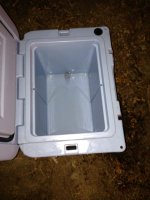
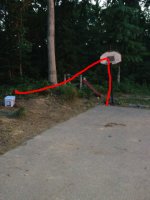
I went outside and tested this, and I was surprised with the result. The up side was 15-1/2 feet long, and the down was 7-1/4 long. I ended up with a wet driveway, and an empty Yeti.
As long as the total fall is greater than the total rise and the outlet is lower than the water level it should siphon water.
Aaron Z
I went outside and tested this, and I was surprised with the result. The up side was 15-1/2 feet long, and the down was 7-1/4 long. I ended up with a wet driveway, and an empty Yeti.
Curious how you started the siphon.
I tried to just suck on it, but I was unable to suck hard enough. I used a piece of vinyl tubing to help seal it, and held a water hose on the downhill side. When I heard water flowing into the tank I removed the water hose, and the water started flowing the other direction.

I went outside and tested this, and I was surprised with the result. The up side was 15-1/2 feet long, and the down was 7-1/4 long. I ended up with a wet driveway, and an empty Yeti.
The downhill side always has to be longer than the uphill side AND the discharge always has to be lower than the inlet. If its not, it will try to flow the wrong way.
The downhill side does not have to be longer ... only to discharge at a lower level.
,,,larry
So you're saying a 10' long downhill pipe with an outlet 1" below the inlet of a 100' long uphill pipe will work?
Until a bubble collects at the apex.
Long gradual rise on uphill, then steep drop to a lower level on down side. ... A geometry issue.
What is going to pull water up the hill? There is more weight on the uphill side than the down hill side. It absolutely will not work.
The long rise side is like an ideal inclined plane - frictionless. Gravity acts proportional to the sine of the angle. ... Less than 1 on the rise, but 1 on the vertical fall.
...Any fall greater than the rise will flow to the fall.
Have you gotten out your clear hose two buckets and a camera yet? Would love to see your results.
No you wouldnt because they would just support physics.
,,, Prove it to yourself. If it doesnt work post good pictures and Ill tell you what you did wrong.
Here ya go.I've given numerous examples to support my position. You've given none. :dance1:

Good. -- I like to keep the Joule = Watt-sec or W= J/s in my head. Helps clarify Energy vs PowerExcavating the gloop next, but before we say goodbye to siphons, I will try and clear up a few points that have been raised (RedNeckGeek, this could be real boring, you may want to skip and come back tomorrow).
I see a lot of fun debate going on about what people think would work and wouldn't work with a siphon. To me, nothing beats getting out a bit of plastic tubing and having a play. The beauty of siphons is that everything you try with a small bit of tubing will also scale up to larger diameter and longer pipes. The only limitation I know of is that the maximum vertical height is supposed to be 33 feet. I was near that limit when I put on the last extension piece and was half expecting trouble, but it ran well. At more than 33ft they say a vacuum is created at the top of the down flow pipe - hey anyone for a water powered vacuum pump project ?
I have watched many youtube siphon videos and although some of them are very good, some of the classroom style presentations leave a lot to be desired in my opinion. Siphons are not chains running over a pulley. You would miss out on a lot if that's how someone teaches you to think about siphons. Chains run over a pulley to the lowest point for the same simple reason that everything in the universe moves - they are lazy. Give any inanimate object the chance to get to a lower energy state and it will grab that opportunity in the easiest way it can. The physicists amongst you will correct me if I am wrong, but that is about the only thing chains and water siphons have in common.
Turbines
The outflow can be used to turn a turbine, but you may want to do a little calculation first to see how much power you can generate and decide if it is worthwhile.
Any liquid that is free to move will run downhill. In that respect water moving through a siphon is no different, it is simply getting rid of some of it's "Potential Energy". You can calculate how much potential energy it can loose by the classic
equation.
Potential Energy = m * g * h
m = Mass of water moved
g = acceleration due to gravity
h = Difference in height from the level in the pond to the bottom of the discharge pipe.
Most people calculate this using SI units, so m would be measured in kilograms and h in metres. Unless you have been abducted by aliens to another planet, g is near enough a constant figure of 9.8 metres per second per second.
So when 1 kg of water is siphoned over a height of 1 m, it looses it's potential energy of :-
1 kg * 9.8 * 1 m = 9.8 Joules
With a small diameter tube that takes 10s to drain the kilogram of water, the power is
9.8 Joules / 10s = 0.98 Watts
If a turbine and generator was 100% efficient (they are nowhere near that in reality, but let's ignore that for the moment), we could convert that head of water into an electrical output of 0.98 W for a whole 10s.
Alternatively, we could use a bigger tube and perhaps move it all in a single second.
The power is then 9.8 J / 1s = 9.8 W
That sounds 10 times more impressive, however it only lasts for a single second, then all the water is gone. The energy availabe is constant regardless of how fast we draw off the water.