Firewood Market

   / Firewood Market
  • Thread Starter
#21  
Hey jymbee, you're probably right. I think the rick measurement became so common locally is that a rick can easily be hauled in a full sized pickup. Thrown in it will come up a little above the bed. By the way what wood varieties are commonly used in your area? I had some friends from Vermont that burned a lot of Maple but down here that trash wood. But here its water maple maybe not the hard maple he used?
 
   / Firewood Market #22  
Sugar or 'Hard' maple is the best common wood around here. Red or Silver Maple is OK, and Manitoba Maple isn't worth my time.
Beech is nice too and White Oak is great, Red Oak is fine. I think we have White, Black and Green Ash here too, but I don't know them well enough to say which ones I've burned. Ash is the best for burning green though and splits very nicely. I have a few dead Tamaracks I'll cut this winter, its supposed to be among the best softwoods and has as much BTU's per cord as Red Maple.
 
   / Firewood Market #23  
Most of you, it seems, are further north. Here in Louisiana, on my place, there are 3 primary trees- pine, oak and gum. I have a couple black walnut and a few mockernut hickory trees. We also have a few of my favorite, cedar. I do not use the fireplace often being we now have central heat. We actually have a heatalator, get the box hot, cut on the blowers and heat the house. I never used pine due to sap and chimney buildup. Gum simply did not burn well, maybe too dense. Water (once cured) and red oak burned great- even, heated up quickly but did not burn too fast. Split very well using my splitting axe.
 
   / Firewood Market #24  
When somebody mentioned supper I heard you calling:) We still call it breakfast, dinner, and supper.

Around here you hear mostly cord or face cord but sometimes somebody will call it a rick.

Red oak is the first choice, followed by white oak, and then hickory. Of course hickory is used a lot for smoking food but a lot is burnt as firewood. There are some large thickets of hickory around and it burns about the same as red oak but stringy and a little harder to split.

A cord goes for around $180 - $225 delivered and stacked. Most folks in the business buy their wood from the loggers by the truck load and then process it though I'm not sure how much they pay for it but each will tell you they can't go cut it themselves any cheaper.

I know its not much but that's all I know about the firewood business.

On the farm we burn anything that has fallen or about to fall. If it's wood it'll burn.:thumbsup:
 
   / Firewood Market #25  
Fire wood is sold by the cord here because that is the law. You can sell a half or third cord, but you have to advertise it that way, not as a rick, face cord, etc.
 
   / Firewood Market #26  
Lots of folks down here in LA (Lower Alabama) use the term "rank" instead of rick. I asked one merchant what he charge for a rick of wood; he looked at kind funny and said, "whatcha talkin' 'bout".
 
   / Firewood Market #27  
Up here in Northern Kentucky the most commonly used term for selling firewood is a "truck load"! That almost always works out to a eight foot bed with the firewood thrown in until it's piled slightly higher than the bed rails. I'm sure there are a lot of guys out there that know how to throw it in just right to make it look like you're getting more than you think you are.
Around the smaller towns, a pickup load runs from $45-65, some take it into the bigger cities (Louisville, Cincinnati, Florence, etc) and get right around $125-150, but that involves 50 to 80 miles driving to deliver it.
The big city buyers are usually just people that want to burn in fireplaces, but locally a lot of people use it for primary or secondary heat and I've often wondered if they were really saving any money by spending that much for the wood.
I burn wood in the garage and wood shop, and it's usually locust, plenty of it around here and it does well since I'm there to tend to the fire and add more as needed. Growing up we used a lot of hackberry (good to stoke the stove at night with), a lot of hickory (I never liked that, but Dad did and he made the rules), cherry and white oak. We also burned quite a bit of honey locust, but it had so many thorns, it was a lot of work to take a hatchet and clean them up. You'd always miss some and always find them when you went out to the woodpile at night to get a load!
 
   / Firewood Market #28  
Up here in Northern Kentucky the most commonly used term for selling firewood is a "truck load"! That almost always works out to a eight foot bed with the firewood thrown in until it's piled slightly higher than the bed rails. I'm sure there are a lot of guys out there that know how to throw it in just right to make it look like you're getting more than you think you are.
Around the smaller towns, a pickup load runs from $45-65, some take it into the bigger cities (Louisville, Cincinnati, Florence, etc) and get right around $125-150, but that involves 50 to 80 miles driving to deliver it.
The big city buyers are usually just people that want to burn in fireplaces, but locally a lot of people use it for primary or secondary heat and I've often wondered if they were really saving any money by spending that much for the wood.
I burn wood in the garage and wood shop, and it's usually locust, plenty of it around here and it does well since I'm there to tend to the fire and add more as needed. Growing up we used a lot of hackberry (good to stoke the stove at night with), a lot of hickory (I never liked that, but Dad did and he made the rules), cherry and white oak. We also burned quite a bit of honey locust, but it had so many thorns, it was a lot of work to take a hatchet and clean them up. You'd always miss some and always find them when you went out to the woodpile at night to get a load!
yeah same thing around here you either buy a pickup load or the loggers will deliver you a dump truck load of logs you cut and split to suit yourself the dump truck load turns out a cord and half you pay $160 thats how get mine every year i keep a year ahead or more now i probably got a winter worth of wood down on my fences and in the moutain rd the pickup loads sell for $60to $85 depends on how cold it is when you call them i have sold a lot of loads on 8 ft bed as high as i could stck it for $40
 
   / Firewood Market #29  
In Ohio, the only legal way to sell firewood is by the cord, legally defined as 4x4x8, tightly stacked. From what I've seen, most of the reality is that it's sold by the "truckload" which may be undefined.

I remember years ago calling an ad in the paper and asking how much wood per load and the told me "It's a really big truck, it has lots of gears" !!!! I didn't explore further.
 
   / Firewood Market #30  
By the way what wood varieties are commonly used in your area? I had some friends from Vermont that burned a lot of Maple but down here that trash wood. But here its water maple maybe not the hard maple he used?

Most plentiful would be maple, ash, and black cherry. Depending on location white/black/yellow birch, ironwood, and beechnut are also common. Hardly any oak in my immediate vicinity but not that far away there's plenty of it. Always interesting to see where the different species take hold. In the fall when the leaves change is as good time to spot the different concentrations of trees as each has it's own color characteristics.

Hard or "Sugar" Maple is among my favorites but the softer maples such as silver, red, swamp etc. are fine by me. I heat primarily with wood and like a variety of types and sizes. Smaller pieces of ash & black cherry for example to get a fire going and larger chunks of hard maple, or beech for those overnight burns. But like others here report, nothing goes to waste and from time to time I'll burn wood that some around here avoid such as poplar, willow, or elm.
 
   / Firewood Market #31  
Most plentiful would be maple, ash, and black cherry. Depending on location white/black/yellow birch, ironwood, and beechnut are also common. Hardly any oak in my immediate vicinity but not that far away there's plenty of it. Always interesting to see where the different species take hold. In the fall when the leaves change is as good time to spot the different concentrations of trees as each has it's own color characteristics.

Hard or "Sugar" Maple is among my favorites but the softer maples such as silver, red, swamp etc. are fine by me. I heat primarily with wood and like a variety of types and sizes. Smaller pieces of ash & black cherry for example to get a fire going and larger chunks of hard maple, or beech for those overnight burns. But like others here report, nothing goes to waste and from time to time I'll burn wood that some around here avoid such as poplar, willow, or elm.

I am a 50 miles from the NY border, mostly red maple on my land, it is really good burning wood when it grows in dry spots. Most will tap it like sugar maple.
 
   / Firewood Market #32  
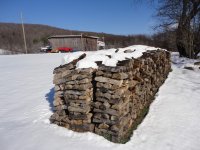
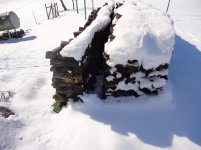
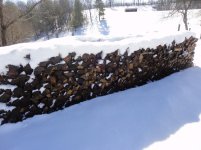
well here what i get for $160 remember i got to cut up and split and stack what your looking at is 1 and 1/2 cords of wood DSC00386.jpgDSC00387.jpgDSC00388.jpg
 
   / Firewood Market #33  
I just came for dinner (the noon meal in Kentucky). I had been out delivering 3 ricks of wood to Aunt Peggy.

<snip>

Trash wood are popular, beech, gum, sycamore, maple, locust, sassafras, persimmon, pine, cedar and cottonwood. .

Locust as a "trash wood"!! It ranks in the charts above oak IIANM, if not above right in the same vicinity . Trash species in many places yes, but not a trash firewood.

Harry K
 
   / Firewood Market #34  
Out West here it is almost all softwood, typically various types of pine. Occasionally you can get hardwood in the form of apple or cherry from orchards being developed, driven out of business by Chinese competition, etc. In either case this time of year it runs around $200 per cord but varies +-$25 based on the type of wood. In the summer it is closer to $150. In this area you can also get Juniper which is fairly hard for a softwood. The Boise area is essentially desert greened up by irrigation. Pine comes from the higher elevation mountains and Juniper comes from the desert mountains.


Here in E Washington I heated my house for over 30 years with nothing but willow. That ranks right at the bottom of most charts but it is the only species in this area that is both plentiful and many farmers eager to get rid of. I started burning in 1977 by harvesting buckskin Tamarack fromthe mountains in Idaho. Didn't take me but one season to realize that a 120 mile round trip for 1/2 to 3/4 cord was not a paying proposition when I could get willow almost next door and the only dreawback was having to feed the fire more often.

Harry K
 
   / Firewood Market #35  
the old type mountain locust is the best firewood money can by the old field locust is good but not as good holds fire longer puts out more heat and burns up to real fine ashes acording to the profesinals the wood that puts out the most heat or btu's they call it is apple wood
 
   / Firewood Market #36  
Never heard of a "rick" before. Maybe it's because I'm from NY. Here I've only heard it called a "face cord". Guess I learned something new..

That's the problem with all the regional volumne measurements. None are universal, all are illegal wherefirewood sales are regulated under the "Weights and Measures" codes.

I have never understood why people use them as there is a very good measure, understood throughout the US and Canada, legal, etc. Is a "cord" or "fraction of a cord" - nothing else is needed.

Harry K
 
   / Firewood Market #37  
the old type mountain locust is the best firewood money can by the old field locust is good but not as good holds fire longer puts out more heat and burns up to real fine ashes acording to the profesinals the wood that puts out the most heat or btu's they call it is apple wood

Apple is hot wood for sure. I have old apple trees that the woods has grown up around, making them reach for the light. The apple branches that eventually die off will just hang on the tree forever and get hard as iron. Take the edge off the saw chain and just shatter in the chipper. It takes a solid, probably high lignin content wood, to be like that. Red oak is another solid wood that dead limbs hang on the tree for years.
 
   / Firewood Market #38  
I would rather split would with a maul than be bent over a splitter. When I bought a hydraulic splitter for the tractor I picked one that was tall enough so I did not have to be bent over to split. I then build a PT bench to hold the splitter so I had room to stack and move the wood around on. No bending over all day! :thumbsup: Funny thing is, if the wood is straight I can split faster by hand. It is the forked pieces that need the splitter. For the last two years I have split with a maul! :confused3::laughing::laughing::laughing: I like the quiet of the maul. No engine noise. :D I found a Fisker maul on Amazon with the right handle length. That splitter is NICE! :thumbsup:

I do have a stack of wood I cannot split without using wedges or the wood splitter. What is funny, is that I found a piece of wood that is straight and should split real easy. The Fisker, which came with a decent edge on it, COULD NOT even dent that piece of wood. :confused3::shocked:

Later,
Dan

Same here. I have a splitter but split everything I can by hand. It is pleasant work and I use it as my "Physical Training" regime. Beats paying a gymn membership all hollow. The stuff that Ican't splitt with my Fiskars, maul, wedge/sledge (about 5% of all) goes to the splitter pile and rejects from there get "noodled" (workedup with the chainsaw).

I have a 50 plus cord stock of black locust I harvested over the past 7-8 years, 8 still in the rounds that I work on about an hour every day on these cold wintry conditions.

The Locust borer moved in here 10-15 years ago and has or still is killing off the black locust. I am harvesting every stick I can beg as it will keep forever.

Harry K
 
   / Firewood Market #39  
So, what was on the other end of that Fisker handle? :laughing: Sounds like the elm I try to split, and they aren't ever more than ten or twelve inches across. I give elm one chance to split, just in case I might get lucky :p, then I toss it off to the side.

Any elm I harvest is only under protest - I have to take that to get the better stuff. As for splitting it? I don't even try manually, it goes staight to the splitter. Even then I wish the splitter had a high knife projection on the wedge to cut all those strings.

Harry K
 
   / Firewood Market #40  
Besides the Dummy, I think it was red oak which usually splits really nice and easy. :laughing::laughing::laughing: That one round I hit, if they could built tanks out of it, would be unstoppable. :D:D:D

Later,
Dan

That one round sounds somewhat like the occasional black locust that will not take a wedge and axes just bounce. I resort to use the chainsaw to cut a shallow kert to start the wedge. Even so, the splitter will take it easily.

Harry K
 

Tractor & Equipment Auctions

Toro z turn (A56859)
ALLMAND NIGHT-LIGHT PRO 4 BULB LIGHT PLANT (A52706)
ALLMAND...
2024 CATERPILLAR 255 SKID STEER (A52709)
2024 CATERPILLAR...
Lone Star dump trailer (A55973)
Lone Star dump...
MURRAY PUSH MOWER (A58214)
MURRAY PUSH MOWER...
2025 MMS MS36C (A53317)
2025 MMS MS36C...
 
Top