Painting things.

/ Painting things. #1  

clemsonfor

Super Member
Joined
Sep 11, 2009
Messages
9,785
Location
Greenwood Co., SC
Tractor
Yanmar YM2000
I bought a cheap HF spray gun. I want to start painting things. eventually my old trucks. So here is my question. I know prep prep prep. I can get how to prep something for paint and how to sand it to create a "tooth" for it to stick to. But how do i go about painting. I am confused with the hardeners acetone diluters and paint itself.

Say i want to repaint my bushhog. I know i can use good old liquid rustoleum, but what do i cut or mix it with and rates?

When i paint my old trucks where do i find the paint, if i want it to match factory color, or just repaint color (i know i seen paint at carquest)? What do i mix it with to dilute, how much hardener if any and the rates?


And finially tips on how to paint once its ready for it?
 
/ Painting things. #2  
I've done a little bit of paint with a air gun. Its tough if all you've ever used is a spray bomb. I get paint at an automotive parts store. With the paint I used, it was just mixing reducer with the paint, and they told me what ratio to use, or it might have been on the can also, I can't remember. Don't forget to use a good primer also. Once you actually start to paint, just come up with a pattern that works for you. Don't forget to use a good filter near your air gun to catch any water. They make some fairly cheap ones you just throw out after one use.
 
/ Painting things.
  • Thread Starter
#3  
Thanks i knew to run a cheap filter infront of the gun. I have no experience, but want to paint at least one of my trucks. I dont have high expectations. One of those 35ft paint jobs is fine for me. Anything is better than faded paint and chipping clear.
 
/ Painting things. #4  
first, it depends on the type of paint your using, whether enamel, acrylic or lacquer. some require activators, some require thinning.
Sherwin-Williams makes some pretty good automotive paints (planet color), I'll be shooting my bike with some of the barrett-jackson next month.
For an inexpensive DIY paint, Duplicolor has a product called paint shop. (I currently doing a 65 chevy with it).
Start with a primer and sealer, then move to the base coat. I shoot 32 oz of base with 8 oz of hardener & 8 oz of lacquer thinner and do about 4 - 5 coats. (be sure to use a medium drying thinner). then you can move to the mid-coat or clear coat.
There's a ton of videos and help on the web. Are you using a gravity feed gun or the one with the pressurized can?
 
/ Painting things.
  • Thread Starter
#6  
it will be a gravity feed gun. How much time between coats should it dry?
 
/ Painting things. #7  
Check the manufacturers datas sheet for each product (primer (epoxy or urethane), basecoat, clearcoat. Most available on the web, they give drying/recoat times and compatibility info. buy some graduated mixing cups, try TCP global or Eastwood for supplies.
 
/ Painting things. #9  
I have painted a few vehicles but I am not an expert. The main thing is 1. the preperation 2. the finish of the undercoat. Get these two right and the topcoat is easy (so to speak) I run 20 psi - 30 psi max depending on the paint. Any more than that and you go through paint like a dulux supply store.
 
/ Painting things. #10  
Lots of good advice given here. I will throw a bit more on top of the pile. The harbor freight guns are good enough for the undercoats and prep, but spend a bit of money on a Binks or Sata for your top coats. I have had hit or miss results using the HF guns with base/top coats, plus having multiple guns for the different steps saves time and effort and cross contamination. It all depends on your desired results, for painting equiptment or when "show quality" cosmetic results are not needed by all means the HF guns are the ticket.

As far as paints the Paint Shopt stuff is your basic "old school" laquer in a rts (ready to spray) form. Other (better) options are acrylic enamels (the once industry standard was Dupont's Centari) Urethan single stage paints have sort of taken the place of the acrylic enamels. The two latter options require reducers and hardeners. The can will tell your the ratios based on air temp and humidity, typically there is about a 20 minute flash time between coats to maintane a "wet edge" when spraying.

Primers: there are a whole host of different types for different applications such as high build for filling minor sanding scratches, self etching for bare metal, tinted for light color base/top coats ect...

Best advice I can give is choose a brand/system and stick with their products as mixing brands throughout the process can cause incompatibilty problems such as one product may "eat" another product when it flashes. I have always prefered Dupont products, but PPG, House of Kolor are other good quality paints for quality looking results (asuming your technique is good :D) But if your just looking for something quick and dirty use any old brand of laquer (like Duplicolor's Paint shop) it will be the cheapest usually.

Here is the first car I painted when I was 15
valiantpaint001.jpg


valiant001.jpg


Here is another vehicle I painted in the past
30willys001.jpg


Finished (I did everything, mechanicals and interior/upholstry)
wk_101a.jpg


Another project I did
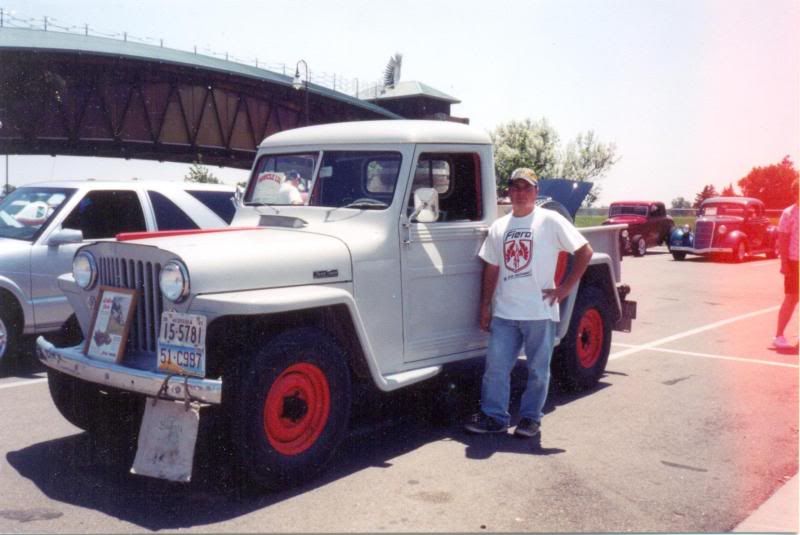
49jeeppickup001.jpg
 
Last edited:
/ Painting things. #11  
For paint, try this guy: 1 Gallon Silver Metallic Acrylic Enamel AutomotivePaint items in Auto Paint store on eBay!

I bought a few gallons from him, as well as reducer, hardener, etc and his prices are great, and the paint is easy to deal with. I painted my boat hull and the roof of my tractor with this paint. Also, clear coat is your friend. It can turn easy to scratch paint (which is nearly all paint) into hard as nails paint in a single wet coat. I sprayed this guys' clear coat on my tractor after using Valspar red to paint it. I recently rotary cut a mess of small trees and not a scratch, even using my tractor as a battering ram. Granted, I really need to add a bumper at some point :D

I tend to repaint almost everything I buy for outdoor use, nowadays. Paint from the above guy is so cheap, it only costs a few dollars in paint and I enjoy painting anyhow, so it is win-win. My stuff looks nicer, lasts longer and everything color matches, which I'm chuckling just admitting, but I really like my equipment to look like it belongs at the same house.

Don't forget plenty of sand paper. Both cotton backed and wet/dry. They both have their uses and not having any makes for a huge time/gas waster just to run to town for a sheet of paper.

And be **** about cleaning your spray gun. One lazy move and you are buying a new one. Paint doesn't forgive when it comes to cleaning your equipment. I can't stress that enough. You will waste acetone cleaning your stuff, but it is much cheaper than the cost of a new gun or a crappy paint job as a result of being lazy.

EDIT: Oh, and also, if you bought the non-HVLP gun.. take it back. The HVLP version is only about $7-10 more and it puts out far higher quality paint jobs and uses less paint. Overspray is your enemy in painting and an HVLP gun helps combat it. It is also quieter, which you wouldn't think is an issue, but listening to the loud hiss of a high pressure gun gets irritating quickly. I'd recommend against ear plugs, as it is handy to hear what your gun is 'telling' you by the sound differences it makes. Some cheap safety glasses (the disposable kind) are recommended, as overspray tends to float around a while. I wear prescription glasses, so I just wear a pair I don't mind scraping paint off. Adding wax to the lenses prior to painting helps a bunch for cleaning them later.
 
/ Painting things.
  • Thread Starter
#12  
Thanks junkman. Thats the kind of advice i wanted. What im looking for sounds like the "paint shop" from dupli color. Someone else brought them up as well. RTS sounds like the easiest thing for me, and thats what i want. After all im just painting my old trucks to make them look better not restoring them or trying to get show quality color jobs on them.

With this paint would i still clear them?
 
/ Painting things. #13  
Great advice from Junkman & Domush.
I started out with the same questions you have. Still learning, mostly by trial & error. First project is still underway.
My son & I have been restoring his 65 chevy truck. It's a poor mans project for sure. Using the Duplicolor "paint shop"
Here's the hood.
2012-05-24_15-46-49_694.jpg
 
/ Painting things.
  • Thread Starter
#15  
Thanks Domush. You were the one who reminded me to start this thread which i been meaning to for a while. Seeing you repaint of the finish mower prompted it.

Does not sound all that hard. I can do so much other stuff i know i can learn this. And again i dont want show quality, just all the same color and no rust!!


The parts of my truck that are currently painted and in good shape color and clear. Do i need to just scuff them with those scotch pads. What about the spots withno clear left, chipping clear, and rusty spots? Well i know the rust needs to be taken all the way down and or neutralized then primed. Do i need to prime all parts of the truck before i start or can i just scuff paint take care of the few rust spots and then paint it?
 
/ Painting things.
  • Thread Starter
#16  
Also i am looking at the link Domush gave to the paint on Ebay and also Duplicolor paint on amazon. How much paint should i expect to use on a ranger? And clear?
 
/ Painting things. #17  
Also i am looking at the link Domush gave to the paint on Ebay and also Duplicolor paint on amazon. How much paint should i expect to use on a ranger? And clear?

You will likely use about two quarts, which means a gallon is both the cheaper and safer bet. Being new to painting, the gallon will also allow you to do a few practice panels.

When practicing on a panel, the most important part to practice is getting the air pressure and fan spray correct, then training yourself to move at a constant pace and stay perpendicular (as much as possible) to the panel. A few youtube videos will get you educated in that area a heck of a lot better than a bunch of text will.

A gallon of clear will go a long way, and is always handy. In fact, next order I make will have two gallons of clear, as it works really well over rustoleum, too. In short, if something looks dull or is easy to scratch, clear coat makes it look new again in addition to protecting it from scratches/rust.

Clear coat is also great for playing around with additives. Say, you want to make something visible at night, you can add glow-in-the-dark powder to the clear and poof! You just make it glow-in-the-dark! The same works for pearl paint jobs, the pearl (or metallic flake, or..) is just a powdered additive.

If you are simply painting some yard items, I'd recommend starting with some rustoleum or valspar, then finish it with clear. It is very cheap ($9/qt) and will get you practiced up for the 'real' stuff. I painted my entire tractor with those paints. They also thin really well with acetone (which flashes quickly, making it easy for beginners to prevent runs).

As for repainting, a full degreaser wash and a quick scotch-bright pad over the paint, followed by a light brushing with a shop cloth (tack cloth if you have one) is all it needs. For rust, sand it out or use a rattle can of rust converter, lightly sand, then prime.

Primer varies in thickness depending on whether you want to fill in scratches or simply prepare bare metal for paint. Buy what you want. I like high fill types of primer for equipment because it adds an extra layer of protection from deep scratches. Heavy primer will require more clear coat if you don't sand it, in order to smooth over the grit it leaves behind from the filler additives in it. For auto and important stuff I will use thin primer and hand sand using sand paper wrapped around a carpenter's pencil. The finish you get out is proportional to the time you put in for prep.

That should get you started. Be sure to watch 10-15 painting videos on youtube, as they will walk you through it nicely, especially getting your paint gun spraying correctly. And, of course, have fun doing it! It's quite enjoyable seeing before and after photos, as you noted with the finish mower. Painting is very gratifying if you aren't trying to be perfect.
 
Last edited:
/ Painting things. #18  
The parts of my truck that are currently painted and in good shape color and clear. Do i need to just scuff them with those scotch pads. What about the spots withno clear left, chipping clear, and rusty spots? Well i know the rust needs to be taken all the way down and or neutralized then primed. Do i need to prime all parts of the truck before i start or can i just scuff paint take care of the few rust spots and then paint it?

Best results and longevity of the paint job you need to take down the existing paint. For the chipping clear spots you will need to at least blend it back to where the clear is '"adheared" to the original base coat using something like a 120 grit (film or paper backed disc) then refine the scratch a bit with say a 180. This is not the ideal way to do it, just a quick fix. On the rust spots if they are not so pitted that the metal is thin (requiring patching) I would get your hands on a bristle disc in green or yellow (50,80 grit) A flap wheel would work here as well, this will be much faster an cleaner than sanding. Prepping the rust/bare metal use a self etching primer as a standard primer will not stick to bare metal. I would then use a high build sandable primer over the whole thing, being sure to build on the areas where you blended the clear coat chips. If the paint fails this is where it will fail most likely. After sufficient coats of primer sand the high spots getting it as smooth an uniform as possible. If you wish to use filler this is the time to use it, however you will need to prime and sand it to seal it. After you are satisfied with the results of priming and sanding use a sealing primer. Now your ready for the base and top coats. You may want to sand in between color coats if you get some fish eyes or orange peel. Dust will be your enemy given most people don't have any sort of booth to do it in, just be as clean as possible. Good lighting is also a must.

This is NOT an expert tutorial and I am no painting expert. I am self taught. My information given is based around a cheap (money wise) paint job with quality results. The more time you take in the surface prep and priming/filling stages the easier the top coats go on and the better the overall look.
 
/ Painting things.
  • Thread Starter
#19  
OK the more i think about it. I really dont want to just change the color on my ranger. I really dont want to get involved in painting the door jambs and in the hood and totally forgot about inside the bed, which i dont want to paint. So where would i go about getting factory matched paint? Any ideas on what this stuff costs? What brand should i use thats good yet cost efficient. Keep in mind im going to paint my 1990 ranger with 290K miles on it. Im not restoring it just want to get the faded paint and gone clear taken care of. The truck has dents down the passenger side which were there when i got it 8 yrs ago. Looks like someone slid into a gard rail on an icy road. Im not planning on fixing them, i'm just gonna clean the rust on the few where the paint chipped and a rust spot on the roof and the hood and a spot of rot on the fender but i got that taken care of i have done this with success on my old chevy and covered it with spray paint to match the truck, which needs a paint job too. I just want fresh paint onthe truck. So knowing my goals id like suggestions on paint brands for it.


My old K10 i think i will change the color and go with the Ebay link Domush sent me. On that one, heck i dont care about the jambs as much. Its sat on the farm in one spot for the last year!!
 
/ Painting things. #20  
For painting practice, such as on your bushhog check your local farm supply type store for tractor paint. Cheap, maybe 1/4 the price of real car paint. Here in Oregon we have Wilco. TSC, which we don't have, may carry some.
 
 
Top