How much repair do the old timers require?

   / How much repair do the old timers require? #1  

keegs

Veteran Member
Joined
Sep 8, 2009
Messages
1,725
Location
The County, ME
Tractor
Kubota M5640SUD
Hi all,

My wife and I bought the farm four years ago. :D It's
80 acres ... about three fourths pasture land and one fourth woodland. The pasture is mostly timothy and clover with a generous mix of weeds of all manner and other grasses as well. The woodland is very think/dense and consists mostly of conifer with a mix of birch alder and aspen. The terrain is mostly flat with the back border/boundary steeply sloping off to a stream. We'll very likely retire there in about 10 years.

A neighbor has been cutting the fields and harvesting the hay for his beef operation but there're areas he doesn't get to and I can't say with any certainty how long this arrangement will last. I've been doing some of the cutting around the house and pond for instance with a walk behind machine which is great for the exercise but takes way too much time. I'm considering getting a used tractor and bush hog. I've been lurking the forum and have some idea the size machine I should be considering and there seems to be many used tractors available for sale.

My question is about the age of the machine. As I mentioned there are many out there for sale and affordable but they are in many cases older than me. :D So I have to wonder how often a fifty plus year old piece of farm equipment will break down?

TIA ..for your insights.
 
   / How much repair do the old timers require? #2  
Hi all,

My wife and I bought the farm four years ago. :D It's
80 acres ... about three fourths pasture land and one fourth woodland. The pasture is mostly timothy and clover with a generous mix of weeds of all manner and other grasses as well. The woodland is very think/dense and consists mostly of conifer with a mix of birch alder and aspen. The terrain is mostly flat with the back border/boundary steeply sloping off to a stream. We'll very likely retire there in about 10 years.

A neighbor has been cutting the fields and harvesting the hay for his beef operation but there're areas he doesn't get to and I can't say with any certainty how long this arrangement will last. I've been doing some of the cutting around the house and pond for instance with a walk behind machine which is great for the exercise but takes way too much time. I'm considering getting a used tractor and bush hog. I've been lurking the forum and have some idea the size machine I should be considering and there seems to be many used tractors available for sale.

My question is about the age of the machine. As I mentioned there are many out there for sale and affordable but they are in many cases older than me. :D So I have to wonder how often a fifty plus year old piece of farm equipment will break down?

TIA ..for your insights.

I've got a total of 17 tractors. Most are used in my business, some stay on the farm. My "go to" tractors on the farm are 40+ years old and 30 years old. The 40 year old (MF150) has had LESS time spent making repairs IN IT'S ENTIRE LIFETIME than some of my newest tractors (3 years old or less) Older USUALLY = simple....Simple USUALLY = stone reliable. The trick is to get the RIGHT model and get one in good condition.

The MF150 sees around 140/150 hours per year now days, so it isn't sitting around idle....It works for a living. Other than oil changes, a couple flat tires, and a loose fender bolt last week, it hasn't had a wrench touched to it in 6 years. (painted it 6 years ago...) Oh wait....I did change a fan belt 4 years ago....It was an original 1971 belt.

I keep one "new tractor" here at the farm too...It's 3 years old. I've spent right around 4 times on the newer one as what the original purchase price was on the MF150 just on major repairs.

Based on actual results;

With older tractors, get them in top mechanical condition and sell your tools....You won't need 'em any longer.

With newer tractors, sell your tools so you can afford to pay the "technician" at the dealer...
 
   / How much repair do the old timers require? #3  
The family down the road from me still uses their late 40's Farmall H nearly every day-pulling wagons, raking, manure spreader etc. Their grandfather bought it brand new.
 
   / How much repair do the old timers require? #4  
In most cases a good older tractor will last a long time and require very little in repairs. I have had several older tractors and for the most part have found them to be lower in cost to operate and maintain than auto's for example.

Picking the right used tractor is key imo.
 
   / How much repair do the old timers require?
  • Thread Starter
#5  
Thanks for the tips gents. It stands to reason that if so many are still kicking they must have made them well back then.

A local old timer has been helping me with projects around the place ..septic, drainage, well trench to the house.. etc. I'm going to ask him for some help with this.
 
   / How much repair do the old timers require? #6  
Like FWJ says, older does not mean more work needed and more often than not, older tractors will require a lot less work to keep going. The reason is: before computer-aided design and such, machines tended to be way overbuilt and as a result, they last a lot longer than the new stuff. Also, the lemons of that era have mostly found thier way to the scrapyard by now. New tractors are basically designed to last until the warranty runs out, then every part should fail simultaneously, if the designer did his job right. Just enough material is used to carry the loads, with no extra allowance for wear and corrosion. For the last 25 years, I have ran a 1951 Ford 8n that needed a valve job when I got it (they were not designed for unleaded gas), but I have not touched it in the last 24 years, other than oil changes. All of the tractors I have bought since that one, including one that is reatively modern, have required more work in that time period. The downside of the old ones is they dont have all the modern conveniences, and tend to use significantly more fuel, especially if gas powered. Also, it is tough to do loader work without 4wd, which is tough to find on old tractors. I would be a lot more scared of buying a new tractor than an old one.
 
   / How much repair do the old timers require? #7  
The hours on the machine may be a more reliable gauge than the age in years. :thumbsup:
 
   / How much repair do the old timers require? #8  
I have to agree about the old FORD's. After 60 years they have just about proven themselves. Parts are available and they are reasonably simple to work on. Buy one cheap that someone has already gone thru and rebuilt.
 
   / How much repair do the old timers require? #9  
Thanks for the tips gents. It stands to reason that if so many are still kicking they must have made them well back then.

A local old timer has been helping me with projects around the place ..septic, drainage, well trench to the house.. etc. I'm going to ask him for some help with this.

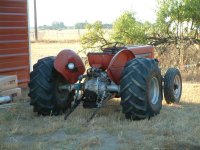
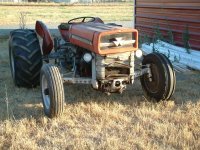
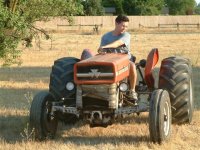
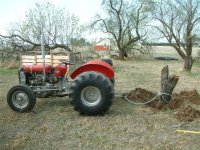
My 1964 MF135 diesel (45 hp engine, 37 hp pto, 2WD, power-assist steering) is running OK, but there's an oil leak (probably the oil pan) and a seal on the pto shaft is dripping oil. Bought it in Jul06 for $3600. It's a field tractor that has been lowered for use in olive orchards around here. Spent a few bucks to rewire it and repaint. It's a good tractor for mowing, discing, plowing, etc.

DSCF0008-small.JPGDSCF0011-small.JPGDSCF0024 (Small).JPG

DSCF0016 (Small).JPGDSCF0017 (Small).JPG

You can find 135s on eBay and craigslist quite often.

Good luck
 
   / How much repair do the old timers require? #10  
Depending on how old you go also gets into what do you need the tractor to do.

Although you may not have a big list independent PTO sure is nice as well as power steering!

A rear remote might also be needed as well as three point hitch!

For some time is critical, so a break down from the age and the time that it might take to get it fixed might also be of consideration. It is one thing if there are more then one tractor that can do the work!
 
   / How much repair do the old timers require? #11  
I run some old tractors on my small farm. Hay is about as time sensitive as you can get, and I trust them as much as my new (2005) tractor. I do a few minor things to them from time to time, but no more than the newer equipment, and the cost is much lower. I will say this, I am a tinkerer at heart and do not get intimidated by working on equipment, if you are not handy find a good dealer weather you buy old or new. I have a local dealer who still treats my 53' Ford like I bought it last week, actually they deal in most of the equipment I have. I do most of my own work but they get parts unbelievablly quick for the old equipment.

I agree the two biggest cons are fuel, the old tractors are thirsty, and comfort, they were built for work and you came home tired and dirty to prove it. I have a theory that just because a tractor has survived 50+ years may not mean it was a good model but it does means it must be a good tractor, otherwise it would have been parted out or scrapped long ago. The theory has proven true with my equipment anyway.

Good luck in your endevor.
 
   / How much repair do the old timers require? #12  
I run some old tractors on my small farm. Hay is about as time sensitive as you can get, and I trust them as much as my new (2005) tractor. I do a few minor things to them from time to time, but no more than the newer equipment, and the cost is much lower. I will say this, I am a tinkerer at heart and do not get intimidated by working on equipment, if you are not handy find a good dealer weather you buy old or new. I have a local dealer who still treats my 53' Ford like I bought it last week, actually they deal in most of the equipment I have. I do most of my own work but they get parts unbelievablly quick for the old equipment.

I agree the two biggest cons are fuel, the old tractors are thirsty, and comfort, they were built for work and you came home tired and dirty to prove it. I have a theory that just because a tractor has survived 50+ years may not mean it was a good model but it does means it must be a good tractor, otherwise it would have been parted out or scrapped long ago. The theory has proven true with my equipment anyway.

Good luck in your endevor.

I'd say SOME older tractors are thirsty.....SOME aren't. My MF150 is as easy on fuel as ANY tractor I've ever been around. Pound for pound, HP for hp, the Perkins AD3-152 3-cylinder diesel is still amongst the most thrifty engines EVER built, even against the best of todays tractors.
 
   / How much repair do the old timers require? #13  
My 1964 MF135 diesel (45 hp engine, 37 hp pto, 2WD, power-assist steering) is running OK, but there's an oil leak (probably the oil pan) and a seal on the pto shaft is dripping oil. Bought it in Jul06 for $3600. It's a field tractor that has been lowered for use in olive orchards around here. Spent a few bucks to rewire it and repaint. It's a good tractor for mowing, discing, plowing, etc.

View attachment 227387View attachment 227388View attachment 227389

View attachment 227390View attachment 227391

You can find 135s on eBay and craigslist quite often.

Good luck
>>>>>>>>>>>>>>>>>>>>>>>>>>>>>>>>>>>>

Apologies to the OP--not trying to hijack.

Cool looking tractor, Dude!

It looks more like a sand rail than a tractor, being low, and especially with those big meats out back--LOL

To lower it, were the roundish-looking gear boxes that drive most tractors (I can't recall what they're called right now--arrgghh) REMOVED, and the rear axle modified, or is that entire rear axle specifically made for orchard work (i.e., built as it appears, like an automotive "straight" rear axle?) The (missing?) gear boxes I'm referring to are there to RAISE a traditional tractor's ground clearance, I believe.

Nice machine, and nice price, IMO (though I am no expert).

Gear drive or ?

Great thread, OP--I'm interested in seeing more responses, as this is a question I've had for some time.

Perhaps someone could point out a downside of older machines that I've read about, like Ford 8N's, IIRC? The problem is, some tractor's hydraulic system only functions when the tractor is MOVING, if I've got it right? IOW, you can't move the FEL unless the tractor is moving forward, IIRC? Is that true?

If so, is it to do with not having a "live PTO," or some other reason?

Obviously, I don't really know what I'm talking about, but I've had a few people tell me that most of the front end loaders on the old stuff don't work while the machine is not moving.

Also, is it true that many of those old FEL's do NOT have "down pressure?"

And I've heard that BRAKE REPLACEMENT can be a hassle on some models, something HST owners probably wouldn't think about, not having to use them much (or at all?)?

I hope my questions are helpful to the OP--and I hope I was clear enough that someone can answer them! LOL

My Hoe
 
   / How much repair do the old timers require?
  • Thread Starter
#14  
>>>>>>>>>>>>>>>>>>>>>>>>>>>>>>>>>>>>

Apologies to the OP--not trying to hijack.

Cool looking tractor, Dude!

It looks more like a sand rail than a tractor, being low, and especially with those big meats out back--LOL

To lower it, were the roundish-looking gear boxes that drive most tractors (I can't recall what they're called right now--arrgghh) REMOVED, and the rear axle modified, or is that entire rear axle specifically made for orchard work (i.e., built as it appears, like an automotive "straight" rear axle?) The (missing?) gear boxes I'm referring to are there to RAISE a traditional tractor's ground clearance, I believe.

Nice machine, and nice price, IMO (though I am no expert).

Gear drive or ?

Great thread, OP--I'm interested in seeing more responses, as this is a question I've had for some time.

Perhaps someone could point out a downside of older machines that I've read about, like Ford 8N's, IIRC? The problem is, some tractor's hydraulic system only functions when the tractor is MOVING, if I've got it right? IOW, you can't move the FEL unless the tractor is moving forward, IIRC? Is that true?

If so, is it to do with not having a "live PTO," or some other reason?

Obviously, I don't really know what I'm talking about, but I've had a few people tell me that most of the front end loaders on the old stuff don't work while the machine is not moving.

Also, is it true that many of those old FEL's do NOT have "down pressure?"

And I've heard that BRAKE REPLACEMENT can be a hassle on some models, something HST owners probably wouldn't think about, not having to use them much (or at all?)?

I hope my questions are helpful to the OP--and I hope I was clear enough that someone can answer them! LOL

My Hoe

Hi Hoe...it's all good. A while back I was picking up a load of manure for the garden at a nearby horse stable and the owner offered to load it up for me with her antique FEL. I don't know what kind of tractor it was but there was allot of lurching and jerking involved with getting the load into the bed of the truck. I was relieved that I got away from there without any dents in my pickup. :laughing: It may have been what you describe.

The main purpose for this machine will be for mowing and I want something that's affordable and can efficiently handle 60 acres or so. At some point I'm sure there will be other projects and task that will involve more than that though...maybe there's a 4wd compact in my future too?? :thumbsup:
 
   / How much repair do the old timers require? #15  
I am pretty much in agreement with everyone else, we own tractors from 1953 to 2011 though I am not quite as skeptical of the newer tractors as some others.

My brothers use the older tractors with the newest being an 87 MF. We bought a very used 60's Case 995 close to thirty years ago for bush hogging and all we have ever done is regular maintenance and tire replacement.

Don't be concerned about age, but focus on mechanical condition. My brother checks out the used tractors we buy and have even come out ahead buying with problems and fixing them. Have a knowledgeable person help you evaluate one prior to purchase and good luck.
 
   / How much repair do the old timers require? #16  
>>>>>>>>>>>>>>>>>>>>>>>>>>>>>>>>>>>>

Apologies to the OP--not trying to hijack.

Cool looking tractor, Dude!

It looks more like a sand rail than a tractor, being low, and especially with those big meats out back--LOL

To lower it, were the roundish-looking gear boxes that drive most tractors (I can't recall what they're called right now--arrgghh) REMOVED, and the rear axle modified, or is that entire rear axle specifically made for orchard work (i.e., built as it appears, like an automotive "straight" rear axle?) The (missing?) gear boxes I'm referring to are there to RAISE a traditional tractor's ground clearance, I believe.

Nice machine, and nice price, IMO (though I am no expert).

Gear drive or ?

My Hoe

That MF135 diesel has a basic gear drive tranny 6F/2R with multipower-a hydraulic setup that gives you two more ranges for a total of 12F/4R.

Roundish gear boxes? Are you referring to the bull gears that are used on the rear axles of some high crop tractors--like the 1951 Minneapolis Moline BF tractor that I'm restoring now?

DSCF0088 (Small).JPGDSCF0091 (Small).JPGDSCF0012 (Small).JPG

If so, the answer is no--my 135 is a standard field tractor without bull gears like a high crop. No modifications were made to the rear axle. The original owner replaced the 28" dia rims that you generally find on the rears of field tractors with 16" dia rims carrying Goodrich 6-ply 18.4-16A rubber. He used shortened spindles on the front axle to keep the tractor level. He used it mainly for mowing and discing his olive orchard, essentially converting a field tractor into a low-squat, high-floatation orchard tractor. BTW--this is a simple way to modify a field tractor for mowing steep slopes. The 18" wide rears are used on a variety of big ag equipment (swathers, combines, etc) and are readily available at places that sell ag tires, like Les Schwab out here on the West Coast.
 
   / How much repair do the old timers require? #17  
The JD770 that I own has 2670 hours on it and everything works as it should.

I have had no break downs in the 100+ hours that I have operated it. It's a 1992.

I wouldn't be nervous buying an "older" tractor. But, before buying a certain brand, check parts availability. That would be important to me.
 
   / How much repair do the old timers require? #18  
Hi all,...My question is about the age of the machine. As I mentioned there are many out there for sale and affordable but they are in many cases older than me. :D So I have to wonder how often a fifty plus year old piece of farm equipment will break down?

TIA ..for your insights.

find a good one, or find one and make it good and it should last a long time.

Like FWJ, I have a barn full of tractors. only 1 of them is new-ish.. and it's 11ys old.. past that my next newest in in the 70's, with some in the 60's, 50's and 40's.

the oldies get the most use..

for large acerage you need large machines.. i'd look at 35-75 ish hp as you want a 6-10' mower.... heck.. look to 110 and that gets you into the 15 and 20' batwings, which, if you look around can be had cheap and then repaired. I paid 2500$ for a jd 1517 15' batwing mower. it needed 1 hr of repair to weld up a couple cracks, and seperate a seized pto shaft.

if going bigger thansay.. 48 hp.. go diesel.. gas will get too $hard$ to feed a large tractor.

I think I'd really look for a diesel in the say.. ford 4XXX, 5XXX, 66XX, 7XXX, 8XXX, 9XXX tw15 range.

those old large beasts will go for pennies on the hp/dollar from when they were new.

not uncommon to get a 50-70hp used classic tractor inthe 4-6000$ range

you could go smaller.. like inthe 35-45 hp range with say a ford 3XXX or a 8XX series ford.. but you will get alot of seat time doing that much mowing .. even at 6' width.. that's alot of mowing.

if you plan to mow it htat often..

post back

lots of options.

ps.. I'ma ford guy so I reccomended fords.. there are plenty of flavors out there that will work...


soundguy
 
   / How much repair do the old timers require? #19  
Really a good thread and I agree, the old machines without all the computers , bells and whistles are the best. I would just add to be careful and try before you buy, take someone with you that knows tractors , if you don't and try it out at the sellers location before you buy...Again, a great thread.
 
   / How much repair do the old timers require?
  • Thread Starter
#20  
Really a good thread and I agree, the old machines without all the computers , bells and whistles are the best. I would just add to be careful and try before you buy, take someone with you that knows tractors , if you don't and try it out at the sellers location before you buy...Again, a great thread.

That's in the plan. I've been working with a retired farmer/logger on projects around the place who I think doesn't own anything built prior to the mid-sixties. From what I've gathered from conversations, he knows his way around farm equipment.
 

Tractor & Equipment Auctions

2025 HT360W Mini Stand-On Track Loader Skid Steer (A59228)
2025 HT360W Mini...
2010 Turfco Mete-R-Matic III Pull-Behind Top Dresser (A59228)
2010 Turfco...
2019 JCB 457 (A60462)
Informational Lot - Financing (A61306)
Informational Lot...
1999 TRANSCRAFT FLAT BED 48FT TRAILER (A59905)
1999 TRANSCRAFT...
2019 INTERNATIONAL 4300 26FT NON CDL BOX TRUCK (A59905)
2019 INTERNATIONAL...
 
Top