Transmission cover removal

/ Transmission cover removal #1  

284 International

Veteran Member
Joined
Jun 28, 2010
Messages
1,464
Tractor
International Harvester 284
Are there any tricks to removing the transmission cover on a YM2000? (Part 16)

I've pulled this part on my YM240 before, and it came off with 4 bolts. This time, it seems to be immovable. It has been immune to a dead blow hammer, blocks of wood walloped with a regular hammer, a putty knife hammered between the transmission case and the cover, hooks slid inside and levered upward with a 2x4, and probably some other methods I'm forgetting.

The tractor has lost neutral and reverse. That is, in those positions, the tractor moves forward when the clutch is let out. None of the other shifter positions correspond to anything other than forward, or locked. I'm suspicious of the shifter forks, but can't pull the cover off. I'm ready to build some hooks to connect onto my engine hoist, but I really don't want to break this cover.

The shifter cover (Part 8 (I guess) here) comes off easily; everything appears intact, movable, with functioning detents and so forth.

I haven't tried the old heat wrench yet; maybe tomorrow will bring me to that.

It's weird. There's going to be some write-ups about this coming, I suspect.
 
/ Transmission cover removal #2  
it's not dowelled on as well is it? i dunno as i have never pulled one off. i might go and have a looky see at some of hoyes pics.
 
/ Transmission cover removal #3  
had a look but doesnt appear to be dowelled. it hasnt been tack welded or something silly like that has it?
 
/ Transmission cover removal
  • Thread Starter
#4  
No dowels, pins, welds, silicone sealant, or anything else I can see that's visible. The shafts for the shifter forks are contained within the cover so aren't the issue. I don't know how the forks themselves could be bound up so tightly on gears that they don't come off.

When I did it on my YM240, I pulled the 4 bolts, wiggled the shifter, and it came right off.
 
/ Transmission cover removal #5  
We used a silicone sealant on big gear reducers where I used to work. That stuff can stick unbelieveable. We had to use jack bolts to break it loose. :thumbsup:
 
/ Transmission cover removal #6  
I wonder if you could drill and bottom tap a couple 3/8 16 holes in between existing mounting holes just down to the case and use a couple bolts screwed in to push it off which is what I believe Winston is referring to also.
 
/ Transmission cover removal
  • Thread Starter
#7  
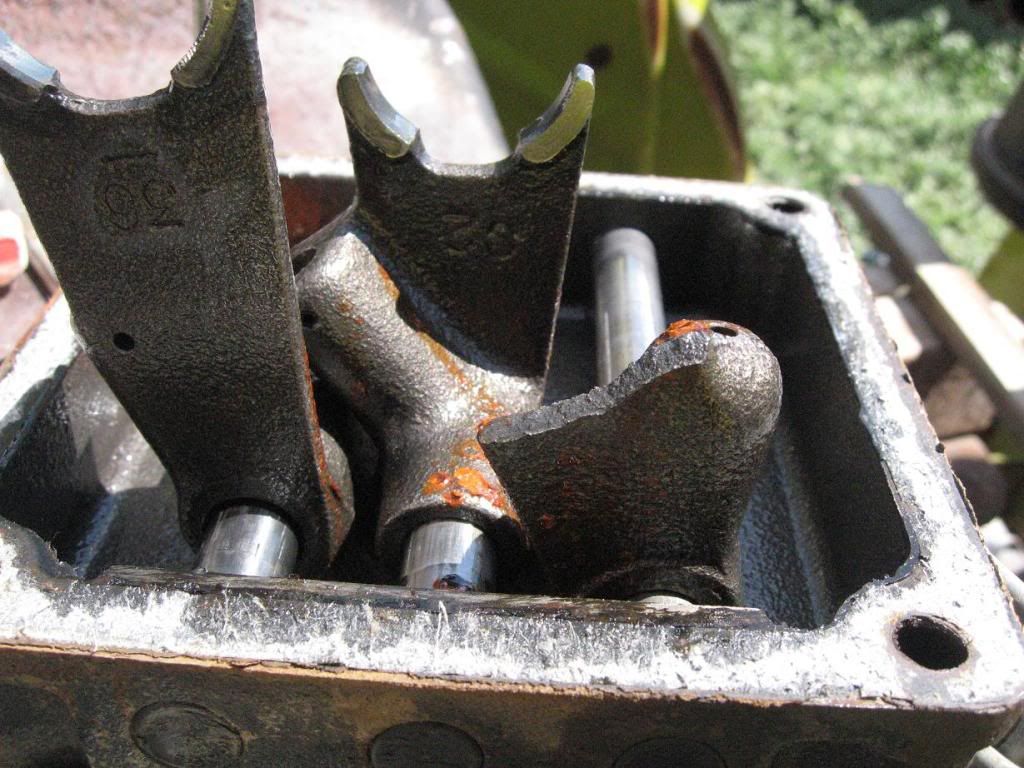
I got it off, with a combination of a hoist and a mallet. I'm not sure why it was so tight, but it was! The internals were kind of disappointing, and also a relief. There was a broken shifter fork, sure enough:
Brokenshifterfork.jpg


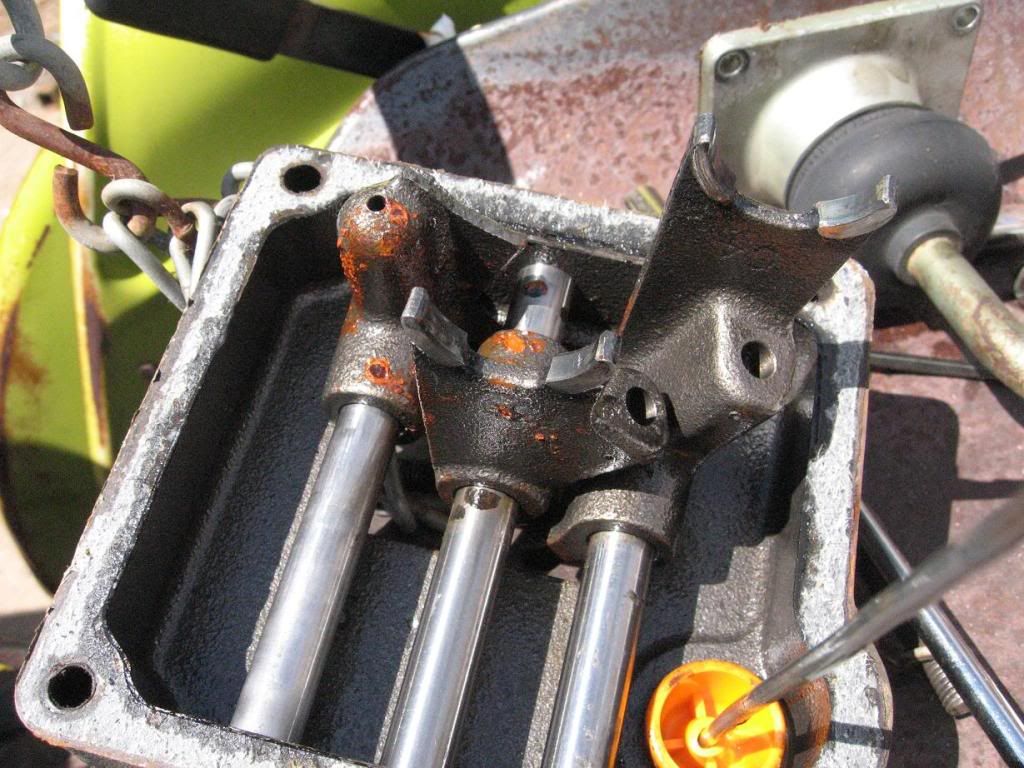
There was also very clear signs of water contamination and the ensuing rust:

Shifterplate.jpg


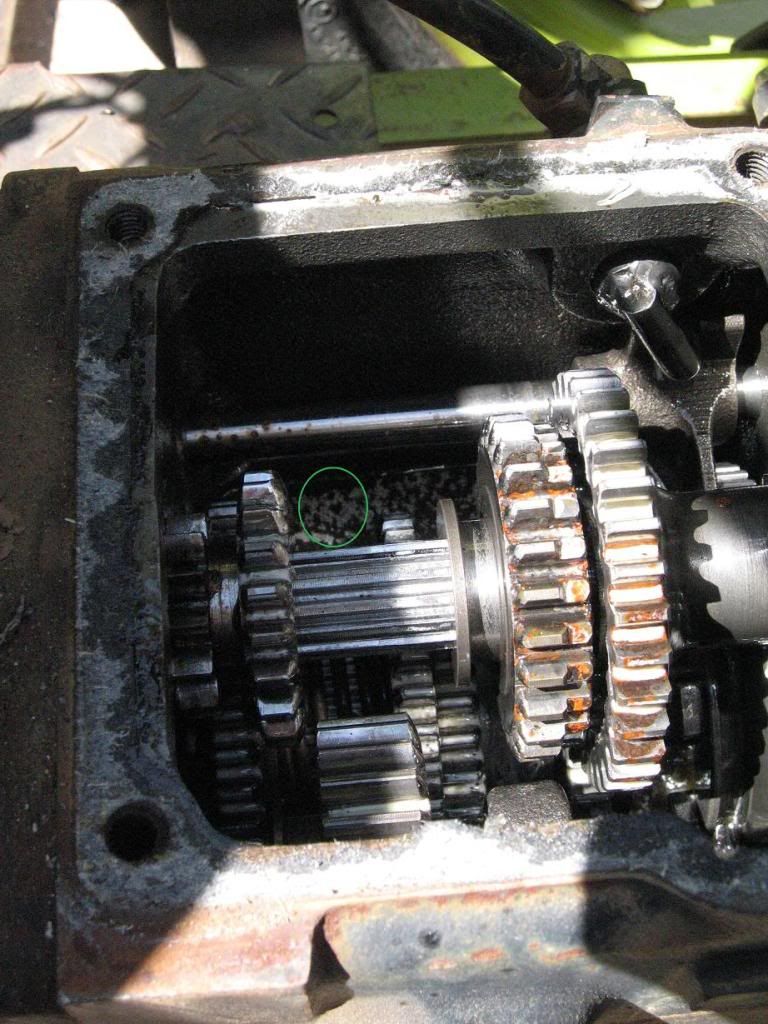
There is a film of something, whether it's an algae growth or what I'm not completely sure, floating on fresh hydraulic fluid over a milkshake of contaminated fluid. You can see the grayish-white flakes in the green circle. There is also ugly rust on some gears, but it appears to be fairly shallow, and shouldn't be a problem once cleaned.

Gearboxinternal.jpg


The broken piece of the shifter fork is presumably down in the bottom of the transmission case. I haven't been able to find it with a magnetic probe. I'll pull the hydraulic screen and attempt to reach it through there. The hydraulic fluid badly needs to be changed anyway. I'm hoping to be able to fish it out from there.


The more observant may have noticed the horrible lime green fenders, and realized this is actually a YM240D, but that's neither here nor there, the cover is the same.
 
/ Transmission cover removal #8  
Never had a doubt you would overcome!:D
 
/ Transmission cover removal #9  
If the piece broke from there, it may be sitting at the bottom of the 4WD housing underneath the tractor. That seemed to be a popular spot for broken gear teeth to fall in mine.

BTW- You're not gunna use those gears, are ya?... :p
 
/ Transmission cover removal #10  
If the piece broke from there, it may be sitting at the bottom of the 4WD housing underneath the tractor. That seemed to be a popular spot for broken gear teeth to fall in mine.

BTW- You're not gunna use those gears, are ya?... :p

nah you dont want those ones, they have rust and mould on them........:laughing:
 
/ Transmission cover removal
  • Thread Starter
#11  
I finally managed to fish out the pieces of the broken shifter fork. I drained the hydraulic fluid, and it was absolutely disgusting. Literally: it was a rancid mixture that smelled like formaldehyde, looked like puss, and generally reminded me of my time in the cadaver lab. Ugh.


I feel sorry for the guys who at the parts store who are going to drain this stuff into their tank. I'm going to find out when their pickup dates are so it doesn't make their store reek. It had coated the filter screen with a layer of nastiness that reeked worse than the fluid:

Filterscreen.jpg


The biggest piece was at the far back of the transmission case, somewhere under the PTO shaft. It looks like a broken off piece of shifter fork:

Brokenshifterfork-1.jpg


After some more fishing, I found remnants of the spring, washer and circlip that fit onto the bottom of the shift lever and knob and, happily, the broken off tip of the fork, which sits nicely onto the larger piece:

[
Missingpieceofshifterfork.jpg


Work is, as usual, getting in the way of my tractor tinkering, so it will be a bit yet before I can weld the pieces together and get everything ground down smooth again. It looks like the shifter forks are cast iron, does anybody know for sure? I was planning to use Ferroweld rod on it, but would appreciate others' experiences in welding on these types of parts, good or bad.
 
/ Transmission cover removal
  • Thread Starter
#13  
It's the reverse shift fork, so not as steep, but still worth buying the rod and spending some time to make these pieces work!
 
/ Transmission cover removal #14  
If it is cast iron, I think nickel rods are best to join them, if I'm not mistaken. My neighbor owns a welding shop and that is what he says he uses on cast iron. I can ask him tomorrow to make sure.

Definitely worth attempting the repair. It is metal.. it always goes back together :)
 
/ Transmission cover removal #15  
I am going on the record by saying dont weld it.

If it breaks (it will) and you aren't so lucky then and end putting the bottom end in that tranny it will be a heck of a lot more money and effort than just putting in a new fork and forget about it, every shift you will be wondering is this the last one. my ,02

Anything can be repaired and I know you will do as good a job as can be done its just is it really worth doing especially cast and in a critical area with a lot of lateral forces against it I dont think so in any stretch of the imagination.

If it was outside and if it broke again it just inconvenienced me so be it but lighting a fuse by welding it and its inside a trans is insane. my .02

It isn't the last fork in existence so imho it isn't a candidate for repair. ymmv as always
 
/ Transmission cover removal #16  
It looks like the shifter forks are cast iron, does anybody know for sure?

Easiest way to tell if it is cast steel or cast iron is to grind it (which you need to do before welding it, anyhow). Cast iron will have orange sparks, and not many of them at that. Steel will have yellow-white sparks which fly everywhere.

If it is cast steel, a standard MIG or TIG will do just dandy. An arc welder will be needed (special rod used) for cast iron.

Be sure to grind a small angle (1/3 material) on each side (so 1/3 material remains in the center) of where the pieces connect, so the weld joins the two pieces natively and semi-flush (a little above flush is what you want here, to be safe), rather than making a "weld band-aid" on both sides with little to no attachment in the center of the joint. If the piece is 1/4" or less thick, you are fine just making a tiny groove (1/16" on each side) instead of digging into the material, as most welders, including cheapy home ones, will weld 1/8" steel completely through, so long as you don't rush the weld. Practice on a piece of scrap before you do it, just to be sure you are dialed in, if you are nervous.

You may already know most of this, but thought I'd play it safe.

I'd also recommend quenching the part right after welding it, so it will stiffen it. I'm guessing here, but I'd think a shift fork needs to be more stiff and less flexible than your average steel part. Worked out well on my 4WD shift dog I recently repaired.

Don't be afraid to cut it off if you don't weld it perfect. Perfect and re-re-re-welded is better than close enough and pretty in this case. Time is free (mostly), so take you time and do it right. I always want to rush through a weld, but then wish I didn't when I'm disassembling the entire assembly to re-weld a rush job.

As always, don't forget to take before and after photos (more is better!), as no DIY job is complete without photos. :thumbsup:
 
/ Transmission cover removal #18  
I am right in the middle. I would probably try the welding route and judge it once completed. Sometimes after doing something like this you can gain or loose confidence in the results. :thumbsup:
 

Marketplace Items

2016 Ford E-450 Passenger Bus (A61568)
2016 Ford E-450...
2006 JAYCO JAYFLIGHT 30' TYPE CAMPER (A58375)
2006 JAYCO...
2019 KUBOTA SVL75-2 SKID STEER (A62129)
2019 KUBOTA...
Sdlanch SDLD25 (A60463)
Sdlanch SDLD25...
FORD F SERIES DUMP TRUCK (A52707)
FORD F SERIES DUMP...
2022 Harley-Davidson FLHTP Police Electra Glide Motorcycle (A60352)
2022...
 
Top