Sprayer Question

/ Sprayer Question #21  
Yes people do seperate fields of each, or some are mixed. Either way works depending on the orchard variety and the timothy variety. If the Ograss is a late maturity and the timothy is an early timothy, they get closer anyway.

As to the field blowing in the wind. Welcome to hay making where some one else does your stuff. This situation is common and it stinks for you and your horses. The hay is still edible if made dry and not rained on, but you can hopefully do better next year. Couple options here. First, just go ahead and make it. It will not be pretty, the nutrition will be low, but the field will get a great over seed (Silver lining). If it is made soon, and you are getting some rain, you still have plenty of time to get a good second cutting. Second, let it stand a little longer if you are getting rain, and second cutting will grow in with first. You will still have the straw seed shafts, but more green vegetative leaf on the bottom. Third is bush hog the field down. This is not a great option as much of the clippings will be in the second cutting, and the heavy thatch will hurt the field, and likely kill a few spots. Basically there is no good solution to what is standing. Next year if you can mow the field when it gets to be about 6" tall, and cut it back to 4". Do this two or three times depending on how the spring is going, and you will delay the maturity of the ograss, and it will have less seed shafts. Your yield will be about 70% of what you will get out of what is standing now.

Very good advice. However, there are some additional "caveats" to what Barry has already offered.

Yes, the "2nd cutting" of Timothy or Orchard grass will begin to grow into the standing first crop. It will be very thick and very hard to get dried out (as well as just getting it cut). And as the season progresses; daytime cooling in the AM and PM increases and the drying periods decrease.

If you can - cut it now and bale it! Good dry forage in the barn is worth alot in the winter - even if you have to supplement it with some added (read store bought) feed.

The added "reseeding" of the mature seed heads that shatter and spread with the haying process is truly a "silver lining"! The thin areas in most fields - along the fence lines or low spots - will have a great chance of filling in and next year's hay will have improved odds of better production and competing with any weeds that are prone to take over those thin areas.

If you're gonna have to brush hog the field - bale it too! Get it off the field. And give it to someone with goats or llama's! IMO - leaving that much material in the field after cutting it up to a mulch consistency is a recipe for significant winter kill.

I'd rather leave the hay uncut and improve the likelihood that the full stalks will not completly freeze into a hard mat on top of the root zones. Even bent over with snow, rain, and ice much of the grass will not "glacier" onto the lower stalks and root tops - leaving a space.

AKfish
 
/ Sprayer Question
  • Thread Starter
#22  
Great advice (and education) guys. Thanks. Looks like my next reading/research mission will be to find what early maturing timothy and late maturing clover varieties work best in my area.

A postscript on my fields... weather permitting, it looks like the remaining 35 ac will get cut and baled next week.
 
/ Sprayer Question #23  
Just cut 2 of my fields tonight. The 3rd field is a little on the "puny" side this season... need to do a soil test this next year on that field, I guess.

Gonna give it a couple of weeks and cut it - it'll be too mature and seeded out, etc. but it'll give the horses something to do! Entertainment if not nutrious. :D

AKfish
 
/ Sprayer Question
  • Thread Starter
#24  
I'm doing a soil test this month. For hay, what are the specific elements I need to pay attention to so I can be sure and order the right test? They (UMass Amherst Ag School) have a standard soil test ($10) then a standard with organic matter ($15), then a soil texture ($70) and a soluble salts test ($5). I also have five separate fields separated by (at most) a quarter mile to the farthest ends. Do I need to test each field? TIA.
 
/ Sprayer Question #25  
I'm doing a soil test this month. For hay, what are the specific elements I need to pay attention to so I can be sure and order the right test? They (UMass Amherst Ag School) have a standard soil test ($10) then a standard with organic matter ($15), then a soil texture ($70) and a soluble salts test ($5). I also have five separate fields separated by (at most) a quarter mile to the farthest ends. Do I need to test each field? TIA.

Either the standard test or the standard with OM is all you need. pH is not as important as the amount of available calcium is. Your base saturation on the CA should be AT LEAST 85%. If you are not at this level, you need lots of good high calcium lime before you do anything else. You will not get the bang for the buck out of any fertilizer you use unless your CA is high enough. (Have I repeated myself enough times yet to get the message across?) There is no test for N in the soil. The test will give you numbers for P and K, and several other elements. Get the CA right in your soil and you will not need to ad very much P or K.

Did you go and check out the Growers site yet for your research?????"
 
/ Sprayer Question #26  
standard soil test is what you need. it should give you a lime ,n,p and k recommendation. at first you need a test for each separate field. apply lime according to test ,most important.nitrogen recommendation is based on yield expectations .phosphorus is very necessary for stalk growth.potash for yield.potash and lime should both be considered organic because they are both dug up with nothing else added.high rates of n uses the lime up faster.you highest yields will come from commercial fertilizer or commercial fertilizer and manure.organic fertilizers made from various products have draw backs too. lime is added to counter various bad organisms .when they are used the ph will stay up. a 100%manure program will not work due to phosphorus build up.if alfalfa can be used it would be the best as it makes its own nitrogen and has good hay quality
 
/ Sprayer Question
  • Thread Starter
#27  
Thanks guys! This is the info I need. Yes, Barry, sometimes you have to repeat yourself a few times for things to sink in with people of my density, yet not too dense to appreciate your kind replies and attempts. Although I am on the Grower's site, internet research can never replace the useful, direct information from guys like yourself, cowski and AKfish. With basic farming and growing hay, I will never catch up to the years already behind you. I, no doubt, speak for many others on this site.
 
/ Sprayer Question #28  
One other thing about soil tests, they are not truely accurate. The labs dry the sample and grind it very fine. This can release elements in the lab that are not available in the soil. Tests over the years can show trends in the amount of nutrients in the soil, but your plant growth is a better indicator than the numbers. The number of worms is a great indicator as to how your calcium is doing in the soil.

I can show you fields that have had 10 ton of lime in one shot. Common ag science says I killed my field doing this, but come see it. These 10 ton test strips on the lime are the highest producing parts of the fields to this day, three years after the application. I was where you are now just 13 years ago. If I can learn it, you can too.
 
/ Sprayer Question
  • Thread Starter
#29  
How long is a soil sample good once it's out of the ground? Is it time sensitive or can you go weeks or even months between dug-up and tested? I understand common sense (and a sense of urgency) would suggest sending it in as soon as its dug.
 
/ Sprayer Question #30  
I neber fertilize (hay) myself, I contract with the local co-op, they do the soil analysis and apply the correct amounts of whatever it needs. Much cheaper, no investement, other than a phone call.

profitable farming is all about knowing when to contract out and fertilizing/herbicide/pesticide application is better contracted unless you are running a thousand acres.
 
/ Sprayer Question #31  
Around here contracting out will put you at the end of the list for getting anything done. Local out fitts will not even look at spraying hay until the beans are done with the round up in July. If you want your stuff done around here in a timely fashion you have to be able to do it your self. It may well be different where you are.

Also the coop is selling you potash, this is potsiumchloride! Chlorine is used to kill all kinds of bacteria and different organism. K also bonds much more water to itself in the plant as compared to calcium which is what your plants really need. This is why you crops look great in the field, but take for ever to dry down and shrivel up to nothing once they are dry. Keep buying that potash, the salesman is counting on you to make his retirement golden, no mater what is does to your land and crops.

Sorry for the little rant, but I got *****ed by those folks for the last time in 2008, and finally payed that bill off in May of 2011. There are plenty of alternatives that work very well out there if you want to find them and use them.
 
/ Sprayer Question #32  
Around here contracting out will put you at the end of the list for getting anything done. Local out fitts will not even look at spraying hay until the beans are done with the round up in July. If you want your stuff done around here in a timely fashion you have to be able to do it your self.

Absoluteley and even having more acres does'nt help as most outfits have a "Prefferred list" that will jump ahead of you . And Sometimes employing the contractor with the $200'000 sprayer does'nt ensure a good job , often you are still at the mercy of a college kid at the wheel in his summer job . I have seen a lot of crops damaged from poor aggitation,wrong mixes,poor washing out . Obviously not all of them but experienced many!
Regardless of size most guys keep their own sprayer even if only for emergencies.
 
/ Sprayer Question #33  
Around here contracting out will put you at the end of the list for getting anything done. Local out fitts will not even look at spraying hay until the beans are done with the round up in July. If you want your stuff done around here in a timely fashion you have to be able to do it your self. It may well be different where you are.

I don't think it matters where you live.... if you CAN do it yourself - DO it!

Or you'll be waiting... and gettting p!ssed.... and then it might not be done right anyways!

AKfish
 
/ Sprayer Question #34  
One other thing about soil tests, they are not truely accurate. The labs dry the sample and grind it very fine. This can release elements in the lab that are not available in the soil. Tests over the years can show trends in the amount of nutrients in the soil, but your plant growth is a better indicator than the numbers. The number of worms is a great indicator as to how your calcium is doing in the soil.

I can show you fields that have had 10 ton of lime in one shot. Common ag science says I killed my field doing this, but come see it. These 10 ton test strips on the lime are the highest producing parts of the fields to this day, three years after the application. I was where you are now just 13 years ago. If I can learn it, you can too.

Ten tons.... on how many acres? There are fields on Kodiak Island that research indicates would need up to 14 tons per acre of lime (very, very acid) in order that the N, P, K would be available for uptake by Timothy hay. Nonetheless, it was also determined that it was not "cost effective" to apply that much lime, etc. as the grower could not recoup the expense... - in his lifetime!

I need to add lime to my hay ground, too. Maybe just a ton/acre or so. But, at $424/ton it's gonna have to be on the 5-year plan at the very least!!!! :eek:

AKfish
 
/ Sprayer Question #35  
AKfish,

Location is everything. There is a paper mill in Spring Grove, PA, just about 10 miles away. As part of the paper making process they have to make their own caustic soda, and the byproduct is a beautiful wet lime, calcium carbonate, passes 98% through a 325 mesh screen. Price picked up, $2 per ton, and then usually about 6-7 per ton to have it trucked down. $2 per ton to rent the spreader for wet lime, and my tractor time and fuel to spread. I figure it costs me about $14 a ton on the field. This is why I can do test strips like this, and over the last 3 years I have done at least 6 ton to the acre on all the grasses, and 10 ton on the alfalfa. The alfalfa gets 1 ton per year from here on out as alfalfa is a calcium pig if it is available. Available calcium is finally getting up into the 5000 pounds per acre range. I figure in a few more years I will have to start on the calcium maintenace rates of about a ton per acre per year, or two tons every other year doing half the ground each year. High calcium also makes a huge difference in how the hay dries and keeps, but that is a whole other subject.
 
/ Sprayer Question #36  
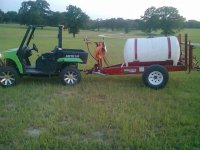
Heres a pic of my new sprayer just been spraying weeds this year and it will have paid for itself next year.I can spray different pastures when I feel like it now. prowler00.JPG 300gal.21ft boom
 
Last edited:
/ Sprayer Question #37  
I like it! Good lookin' sprayer. 'Cept that Artic Cat ain't gonna run it... unless there's a "hidden" pto somewhere!

Might burn a belt or two pulling 300 gallons up any kind of hill, too! :eek:

AKfish
 
/ Sprayer Question #38  
I like it! Good lookin' sprayer. 'Cept that Artic Cat ain't gonna run it... unless there's a "hidden" pto somewhere!

Might burn a belt or two pulling 300 gallons up any kind of hill, too! :eek:

AKfish

:laughing:was for picture only!
 
/ Sprayer Question #39  
I know... just HAD to say somethin'! :p

AKfish
 

Marketplace Items

2017 Ford F-150 Ext. Cab Pickup Truck (A60352)
2017 Ford F-150...
2011 FORD F-450 4X2 PICKUP TRUCK (A59908)
2011 FORD F-450...
John Deere 50 (A60462)
500 BBL FRAC TANK (A58214)
500 BBL FRAC TANK...
Cummins 6-Cylinder Diesel Engine with Transmission (A61568)
Cummins 6-Cylinder...
Pallet of Fork and Frame Mini Skid Steer Attachment (A61567)
Pallet of Fork and...
 
Top