B26 Stabilizer question

/ B26 Stabilizer question #1  

Carl Bert

Platinum Member
Joined
Jul 13, 2010
Messages
852
Location
Rockland county, New York
Tractor
Kubota B26, John deere X595
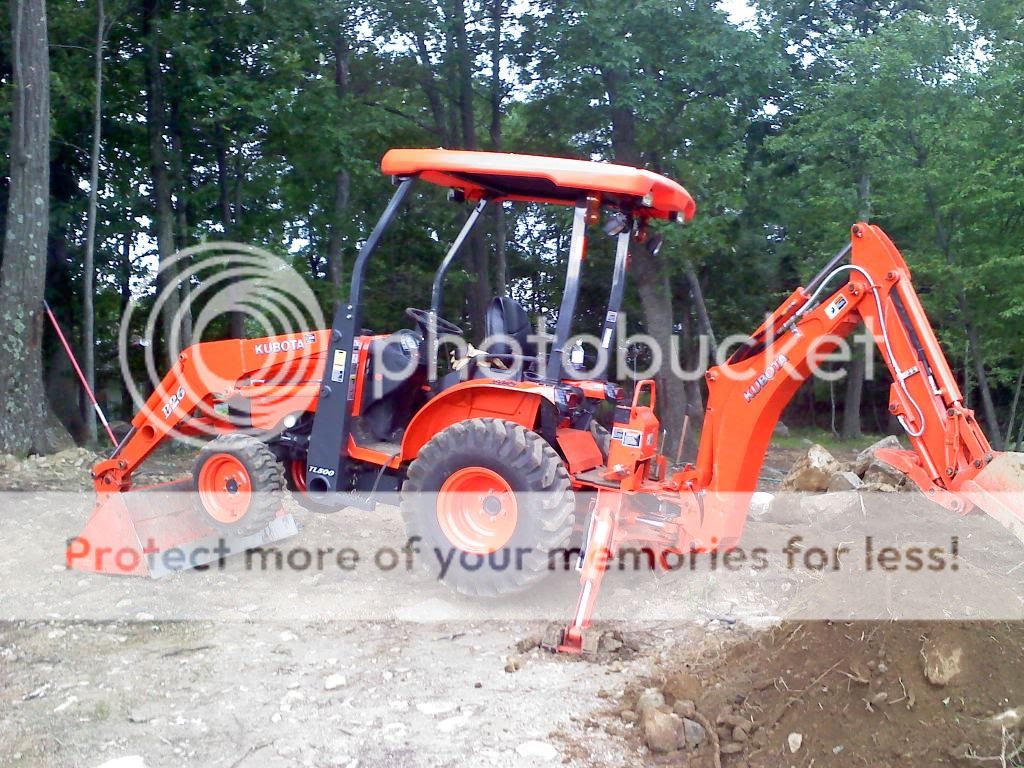
Can someone with a B26 tell me how high off the ground the stabilizers lift your machine. I feel as if they used to lift my machine a lot higher then they do now, but I have nothing to compare to. Would there be any way of looking this sort of information up? Heres a pic of it in fully raised position.
0604111818a.jpg
 
/ B26 Stabilizer question #2  
Can someone with a B26 tell me how high off the ground the stabilizers lift your machine. I feel as if they used to lift my machine a lot higher then they do now, but I have nothing to compare to. Would there be any way of looking this sort of information up? Heres a pic of it in fully raised position.

0604111818a.jpg


Hello Carl,


About your stabilisers;


You are limited in stroke only by the ground conditons below the stabiliser pads-meaning wet stinky muck will aid in sinking them where in you should or could have a pair of plywood pads made with 4 by 4's and pressure treated plywood to cover the 4 by 4's.

Your machines wieght in the placement of your machine in the picture is all pushing towards the rear as the loader bucket is fully extended downward
and the bucket can no longer travel which forces the machine wieght to the rear affecting the symetry of the stabilisers.

My question is why you have done this as the rule of thumb/norm- is simply place the bucket on the ground flat and lower the stabilisers to the point where the back hoe is level from side to side following the ground contour and then start digging to depth and then repeat after the maximum reachable distance is reached/desired with the dipper arm and bucket.

Does the back hoe frame have a centering or line level bubble on it at the operators platform?


Not to rain on your parade, but the loader bucket cylinders are being stressed by thier position and can become jammed (been there, done that).
 
/ B26 Stabilizer question
  • Thread Starter
#3  
Hello Carl,


About your stabilisers;


You are limited in stroke only by the ground conditons below the stabiliser pads-meaning wet stinky muck will aid in sinking them where in you should or could have a pair of plywood pads made with 4 by 4's and pressure treated plywood to cover the 4 by 4's.

Your machines wieght in the placement of your machine in the picture is all pushing towards the rear as the loader bucket is fully extended downward
and the bucket can no longer travel which forces the machine wieght to the rear affecting the symetry of the stabilisers.

My question is why you have done this as the rule of thumb/norm- is simply place the bucket on the ground flat and lower the stabilisers to the point where the back hoe is level from side to side following the ground contour and then start digging to depth and then repeat after the maximum reachable distance is reached/desired with the dipper arm and bucket.

Does the back hoe frame have a centering or line level bubble on it at the operators platform?


Not to rain on your parade, but the loader bucket cylinders are being stressed by thier position and can become jammed (been there, done that).

I am new to the TLBs and prior to purchasing this one in July have had absolutely no experience operating one. I guess the only reason I thought that was the correct position for the machine, when operating the backhoe, was because thats how its shown in the advertisements. Also thats how the guy from the dealership did it when he delivered and demonstrated it for me.

I'm not saying your wrong, and I am all for not abusing the machine, but it does seem odd that its pictured this way on the Kubota site. Take a look. Go the the Kubota site, then go to the B26 and go into the photo gallery. You will see a pic of the machine sitting just as mine was, as the operator is using the backhoe.

I do appreciate the advice, and will keep it in mind for next time. Thanks
 
/ B26 Stabilizer question #4  
I have an 07 B26 and from the looks of it,that is about normal.
If your stabilizer cylinders are fully extended,thats as far as its gonna lift.

digger2
 
/ B26 Stabilizer question #5  
Carl,
Since we both have B26's i have a question for you.First,did you buy it new?If so,did you get an extra pin in your toolbox?I mean a sizable pin like one for a bucket.An extra pin came with mine(in the tool box) and the dealer was at a loss for its use.Do you know what its for?I've had my machine for over 3 yrs. now and i still dont know.:laughing:

digger2
 
/ B26 Stabilizer question #6  
I am new to the TLBs and prior to purchasing this one in July have had absolutely no experience operating one. I guess the only reason I thought that was the correct position for the machine, when operating the backhoe, was because thats how its shown in the advertisements. Also thats how the guy from the dealership did it when he delivered and demonstrated it for me.

I'm not saying your wrong, and I am all for not abusing the machine, but it does seem odd that its pictured this way on the Kubota site. Take a look. Go the the Kubota site, then go to the B26 and go into the photo gallery. You will see a pic of the machine sitting just as mine was, as the operator is using the backhoe.

I do appreciate the advice, and will keep it in mind for next time. Thanks

Hello Carl no worries there,

I just dont want you to have problems as these sales people love to show off the machines and most do not pay attention to the simple laws of physics and stress machines simply to make them look good; If they deny this I wil gladly look them in the eye for you!!!

The other thing is this Carl the photos are staged and under good lighting to sell iron good or bad; You wont catch John Deere doing this with one of their back hoes-besides that you lose reach and depth so they are not doing you or anyone else any favors.


I had to listen to a line of crap from a lot of mining equipment "sales engineers", and the floating manure certainly made "If you cant dazzle them with brilliance baffle them with B.,S.," true to its basic fact.


its no differnent than a
crawler excavator pulling itself out of a hole with the dipper arm pushing the excavator in reverse up the incline that it went down in.
 
/ B26 Stabilizer question #7  
Carl,
Since we both have B26's i have a question for you.First,did you buy it new?If so,did you get an extra pin in your toolbox?I mean a sizable pin like one for a bucket.An extra pin came with mine(in the tool box) and the dealer was at a loss for its use.Do you know what its for?I've had my machine for over 3 yrs. now and i still dont know.:laughing:

digger2

Hello Digger,

Please check your boom for a pin hole to which allows you to lock the boom in the elevated position to check fluids and the radiator chaff screen.
 
/ B26 Stabilizer question
  • Thread Starter
#8  
Carl,
Since we both have B26's i have a question for you.First,did you buy it new?If so,did you get an extra pin in your toolbox?I mean a sizable pin like one for a bucket.An extra pin came with mine(in the tool box) and the dealer was at a loss for its use.Do you know what its for?I've had my machine for over 3 yrs. now and i still dont know.:laughing:

digger2

I did buy it new, but all it came with was a 40amp fuse and an oil filter wrench. Not sure what a pin that size would be for, other then a QA bucket. I'm looking for an 18" QA bucket. I purchased mine with a 12", thinking the BH wouldn't have enough power to handle the 18". Boy was I wrong. Was the tool box worth the money?
 
/ B26 Stabilizer question #9  
The stablizers will only go so far. if you put them down 1st it dont get bound up as you have it. I have many times used the buck as you have it to keep from draging the machine while digin. Yes it has its risk but so does sliding down a pond dam.

Carl I have 18 and a homemade 30 inch it has power to spare.

The extra pin is if you dont use the qa system or thumb.
 
/ B26 Stabilizer question #10  
They look perfect, as said before ground conditions will dictate the level, same on my B3200TLB that I once owned. I'm with Leonz on bucket position, would not do that if me either but you decide.
DevilDog
 
/ B26 Stabilizer question #11  
When I use my back hoe I was told by the dealer to roll the bucket all the way down and set it into the ground, barely raising the front end, but leaving the front tires on the ground also. As for the outriggers, basically the same thing, lower them to just take some but not all the weight off of the rear of the tractor. I have Rim Guard in my rear tires for ballast also. Not saying you re wrong, but everyone probably has their own way of setting it up to use the back hoe.
 
/ B26 Stabilizer question #12  
When I use my back hoe I was told by the dealer to roll the bucket all the way down and set it into the ground, barely raising the front end, but leaving the front tires on the ground also. As for the outriggers, basically the same thing, lower them to just take some but not all the weight off of the rear of the tractor.
Same here :thumbsup: - but it's actually what my backhoe manual said to do ....
 
/ B26 Stabilizer question #13  
It looks to me Carl like your stabilizers have the rubber pad on them but they are flipped over so you are loosing a couple of inches of lift right there. I know it appears that having them flipped this way puts the pointed metal of the stabilizer into the ground which theoretically should keep the hoe from pulling you back towards the hole you are digging but in practice I find it doesn't make that much difference. I always deploy the stabilizers with the rubber pads down.

Although I normally only put the flat of the bucket on the ground and lift the front tires off the ground prior to setting the rear stabilizers I have found use the technique in your picture (and the Kubota brochure) does seem to help in keeping the hoe from pulling me back into the hole. I have read before that this is hard on the FEL cylinders but I have used it a few times and so far not experienced any problems. I personally prefer to get the rear end of the machine (I have loaded rears) off the ground as I find the added weight on the stabilizers keeps the B26 more firmly planted.

If you are not sure if the stabilizers are fully deployed, place your hoe bucket close to the back of the B26 and then lift the back end up with the hoe and press the stabilizer levers to see if there is any travel left in the cylinders.
 
/ B26 Stabilizer question #14  
It looks to me Carl like your stabilizers have the rubber pad on them but they are flipped over so you are loosing a couple of inches of lift right there. I know it appears that having them flipped this way puts the pointed metal of the stabilizer into the ground which theoretically should keep the hoe from pulling you back towards the hole you are digging but in practice I find it doesn't make that much difference. I always deploy the stabilizers with the rubber pads down.

In hard dirt, I find the stabilizers hold much better with the rubber pads flipped up. The rubber is really intended for concrete or asphalt.

Carl - As others have said, no need to raise the machine as high as you have in the picture. I have not read it, but a lot of others here highly recommend the book "Operating Techniques for the Tractor-Loader-Backhoe" by Gary Ober for those without experience using a TLB.
 
/ B26 Stabilizer question #15  
Was the tool box worth the money?Well,i guess it does its job but I think it was like about $80 and for that kind of money it should have been made out of 3/16 thick steel.Its a very thin metal gauge for $80........digger2
 
/ B26 Stabilizer question
  • Thread Starter
#16  
digger2 said:
Was the tool box worth the money?Well,i guess it does its job but I think it was like about $80 and for that kind of money it should have been made out of 3/16 thick steel.Its a very thin metal gauge for $80........digger2

That's what I thought after looking at it online. It's kind of hard to tell though without actually seeing it. If I remember right, my dealer wanted $120 for It. I thought that was a bit steep for a metal box. Can you tell me where it mounts to the B26?
 
/ B26 Stabilizer question
  • Thread Starter
#17  
Stonehaller said:
In hard dirt, I find the stabilizers hold much better with the rubber pads flipped up. The rubber is really intended for concrete or asphalt.

Carl - As others have said, no need to raise the machine as high as you have in the picture. I have not read it, but a lot of others here highly recommend the book "Operating Techniques for the Tractor-Loader-Backhoe" by Gary Ober for those without experience using a TLB.

Thanks, I will definitely looking into it. I am so glad I posted that picture or I would have been misusing the machine for some time before ever finding out. Thanks again everyone.
 
/ B26 Stabilizer question #18  
Do you guys with the loaded tires have the B26? I have a B2630 and they say not to load the tires if you have the backhoe. There's been a few posts about this - various opinions regarding overstressing rear axles, etc...

I've done a tremendous amount of backhoe work with my machine that people honestly cannot believe such a small machine is capable of. I have to work smart because the tractor is so light, but I am used to it. It is frustrating, however and I would really like to load up the rears. Would love to hear from people with B26's and B3030/2630's that have both loaded rears and backhoes. I'm interested in long term results, and also curious if they really make that much difference when using the backhoe.
 
/ B26 Stabilizer question
  • Thread Starter
#19  
Do you guys with the loaded tires have the B26? I have a B2630 and they say not to load the tires if you have the backhoe. There's been a few posts about this - various opinions regarding overstressing rear axles, etc...

I've done a tremendous amount of backhoe work with my machine that people honestly cannot believe such a small machine is capable of. I have to work smart because the tractor is so light, but I am used to it. It is frustrating, however and I would really like to load up the rears. Would love to hear from people with B26's and B3030/2630's that have both loaded rears and backhoes. I'm interested in long term results, and also curious if they really make that much difference when using the backhoe.

I asked that question when I bought my B26 and was told by 2 different dealers, not to load the tires. At the time I was undecided between the B26 and the B3200, and one dealer had said to me, "if you decide on the B3200 I would load the tires, but not the B26". I don't remember the specifics, but I think it had to do with the fact that the B26 sits at over 4000 lbs with the BH. I think its a great tractor, but I always felt that they should have designed the B26 around the B3030 instead of the B2630, then it would have been the perfect machine, the B30. Just my opinion.
 
/ B26 Stabilizer question #20  
Do you guys with the loaded tires have the B26?

I have the rears loaded on my L39, big brother to the B26. The stabilizers don't seem to know the difference and lift the tractor just fine. I think the extra weight does help with digging and loaded rears really help with the backhoe off. I suppose that if you did a lot of trench crossing or repositioning where you are lifting the back of the tractor with the hoe you may notice the extra weight.
 

Marketplace Items

23105 (A56859)
23105 (A56859)
2006 Freightliner Auger Truck (A61307)
2006 Freightliner...
2013 Hyundai Volster Coupe (A59231)
2013 Hyundai...
429983 (A61165)
429983 (A61165)
Kubota LA525 Front Loader Tractor Arm Attachment (A59228)
Kubota LA525 Front...
2021 CAT 289D3 (A60462)
2021 CAT 289D3...
 
Top